Used MINI Countryman (Mk2, 2017-2024) review and buyer's guide
A full used buyer’s guide on the MINI Countryman covering the Countryman Mk2 (2017-2024)

Verdict
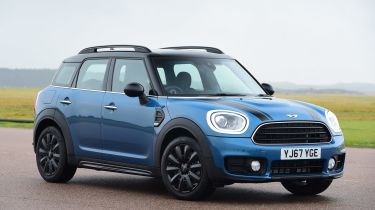
While the word ‘mini’ is not the most inappropriate one when talking about the Countryman, this relatively compact SUV actually fits in with the MINI brand very well. That’s partly why it’s been a great success since the introduction of the Mk1 model. Just like its smaller MINI siblings the Countryman looks smart, and is well made, user-friendly and good to drive.
We ran a Countryman Plug-In Hybrid on our test fleet in 2017/18 and loved its blend of usability, comfort, thoughtful design touches and refinement. We averaged around 65mpg in normal use, although this dipped to 56mpg in the winter. The only problem in our time with the car was an erratic hands-free electric tailgate. However, we loved everything else about the Countryman, because the not-so-mini MINI really was that good.
The Austin and Morris Mini of 1959 rewrote the rulebook when it came to brilliant packaging, affordability and a great driving experience.
But the motoring world had moved on by the time BMW launched its all-new MINI in 2001, with buyers expecting much more in terms of comfort and safety. As a result the new MINI hatch was much bigger, not so efficiently packaged and less affordable thanks to BMW’s aspirations to take the MINI brand upmarket. But BMW had only just got started, because a raft of bigger cars followed, the largest of which was the Countryman SUV of 2010. The Mk2 covered here came six years later, and was larger, plusher and more sophisticated than ever.
Used - available now

2022 Mini
Countryman
49,242 milesAutomaticPetrol1.5L
Cash £20,499
2022 Mini
Countryman
39,172 milesAutomaticPetrol2.0L
Cash £18,999
2020 Mini
Countryman
37,108 milesManualPetrol1.5L
Cash £13,649
2018 Mini
Countryman
51,879 milesAutomaticPetrol1.5L
Cash £14,197Model covered
- MINI Countryman Mk2 (2017-2024) - Countryman is a great choice for those wanting MINI style with more practicality.
History
MINI’s second-generation Countryman landed in showrooms in April 2017, priced from £22,465. Buyers could choose from 134bhp Cooper and 189bhp Cooper S petrol models, or 148bhp Cooper D and 187bhp Cooper SD diesels. All were available with front or four-wheel drive (badged All4) and with an automatic or manual gearbox, apart from the auto-only Cooper SD.
The performance-orientated 228bhp John Cooper Works (JCW) arrived in spring 2017 with standard four-wheel drive; the plug-in hybrid Cooper S E All4 joined the range in June 2017 with an emphasis on economy.
A facelifted Countryman arrived in May 2020 and featured a new grille, standard LED head and rear lights, updated engines and a new digital dashboard with a five-inch colour screen. There were also fresh colours and finishes inside and out. The Mk3 MINI Countryman went on sale early in 2024 to replace this car.
Which one should I buy?
Whichever powertrain you choose, you’ll probably love your Countryman; the plug-in hybrid offers an impressive balance between performance and economy, but this model is expensive, and a diesel offers comparable economy for less initial outlay.
From the outset all Countrymans came with alloys, air-con, DAB radio and sat-nav; most buyers chose a Chili Pack that brought part-leather trim, climate control and bigger 18 or 19-inch rims. From October 2018 there was a new trim structure, with buyers still able to pick between Cooper, Cooper S and Cooper D models, but now there were Classic, Sport and Exclusive trims, plus the extensive options list. The Classic comes with 16 or 17-inch wheels; the Sport features 18-inch alloys, sports seats and a bodykit, while the Exclusive has leather-trimmed seats.
Alternatives to the MINI Countryman
The Countryman sits between the B and C-segment SUV sectors in terms of size, but its premium pricing means that you can buy bigger cars for your money. These include compact SUVs such as the Nissan Qashqai, Ford Kuga, Mazda CX-5, Kia Sportage and Hyundai Tucson. If these are too big, the SEAT Arona, Volkswagen T-Cross and Skoda Kamiq might suit; they’re essentially all the same car but with different badges.
Other small SUVs worth considering are the Ford Puma, Nissan Juke, Peugeot 2008, Renault Captur and Mazda CX-3. If you fancy something a little bigger that still has a premium feel, you should look at the Audi Q3, Volkswagen T-Roc and BMW X1.
What to look for
Codes
The original MINI Countryman was codenamed R60 by BMW; the Mk2 was dubbed the F60.
Plug-in hybrid
The PHEV can officially cover 25 miles in electric mode and return 134mpg; real-world figures are closer to 18 miles and 60mpg.
Towing
Most Countrymans are capable of towing up to 1,500kg, but the four-wheel-drive All4 Cooper S can haul as much as 1,800kg.
Rattles
Dashboard rattles aren’t unusual in the Mk2, but fixing them is long-winded because it means significant dismantling of the Countryman’s dash.
Interior
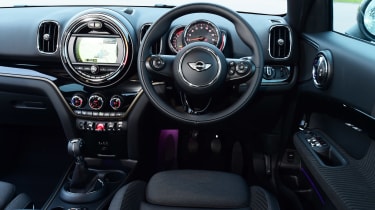
MINI has always put an emphasis on design as well as quality, and both are evident in abundance here. Fit and finish are excellent and there are neat design touches everywhere you look, but there’s no hint of style over substance because everything is also pretty user-friendly.
Passenger space is fairly decent too, with lots of headroom and a sliding rear seat that allows anywhere between 450 and 1,390 litres of boot capacity depending on whether the seats are slid forwards or back, or folded up or down. The Countryman gets an 8.8-inch colour infotainment display as standard, with nav and Apple CarPlay included. An extra £1,300 bought the Navigation Plus Pack, with a digital cockpit display, wireless charging and Amazon Alexa.
Prices
Check used deal prices with our Find a Car service or get the price for a specific model with our free car valuation tool.
Running costs
MINI Countryman owners can choose fixed or condition-based servicing. The former allows up to 12 months or 10,000 miles between visits to the garage, while the latter normally flags up that maintenance is due after 18,000 miles or two years, although it can be less than this depending on how the car is driven.
Many recent MINIs come with the balance of a TLC pre-paid servicing package, which lasts five years or 50,000 miles; you can see if a Countryman has the balance of a TLC package remaining at tinyurl.com/suy4dk3k. All Mk2 Countryman engines are chain-driven, so there are no timing belts to replace.
Recalls
The MINI Countryman Mk2 has been recalled eight times so far, the first coming in July 2018 because of faulty front suspension, which could collapse while the car was being driven. Some models left the factory without a crash protection plate for the fuel pump; these were recalled in September 2018 to have the plate fitted.
Since then there have been further campaigns due to incorrect crankshaft sensor software (October 2018), short circuits in an electronic circuit board (March 2019), faulty steering components (April 2020) and curtain airbag glitches (May 2020). The two most recent recalls came in August and October 2020; the first was launched because of leaking exhaust gas recirculation module coolers, while the second one was down to faulty batteries being fitted in plug-in hybrid models.
Driver Power owner satisfaction
The Countryman hasn’t appeared in our Driver Power new or used-car surveys, but the Mk3 MINI hatch was 55th out of 100 in our 2019 used-car poll. In that same year MINI came 18th in the brands section, but in 2020 the firm tumbled to 26th out of 30, let down by high servicing costs and poor front-seat comfort. Owners like the performance, build quality, interior design and driving experience, though.
MINI Countryman (2017-2024) review: What we said...
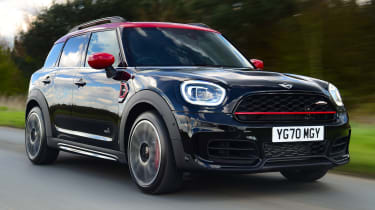
The MINI Countryman is the biggest car for sale in the MINI lineup. That makes it something of a contradiction to the original Mini ethos, but it has used the retro appeal of the classic car to attract SUV buyers wanting an upmarket family car with some clever packaging.
Like the MINI Hatch and Clubman estate, the Countryman is bigger and more expensive than before. It’s also more spacious inside, now proving to be a truly practical family car, while interior quality has taken a significant step up. It drives well, too – sacrificing some of the enjoyment of smaller MINIs for a more grown-up and refined experience on the road.
About the MINI Countryman
Thanks to its somewhat inflated dimensions, the MINI Countryman is a car that enthusiasts of the original Mini love to hate, but buyers can’t get enough of them. It may be a little at odds with the spirit of the company, but the first generation sold well all its life, and this Mk2 version continues to be popular as the crossover boom intensifies.
Launched in 2017 and refreshed again in 2020, the Countryman line-up includes a plug-in hybrid (PHEV) variant as well as petrol options, but the diesel has been axed in the light of fading consumer interest. However, as well as offering an alternative powertrain choice and the additional space of a larger body, the MINI Countryman price tags have also risen inexorably over the years. They now start from around £29,000 for the basic Cooper, rising to around £39,000 for the high performance John Cooper Works (JCW).
This price range means the MINI Countryman goes up against a variety of rivals in the premium small SUV class. There's the Audi Q2 or slightly larger Q3, the Mercedes GLA and Volvo XC40, while cars like the VW T-Roc and Mazda CX-30 offer something different for a little less outlay.
As with the rest of the MINI range, the Countryman comes in Cooper and Cooper S versions, with two- and four-wheel-drive variants available. These are joined by the Cooper S E PHEV plug-in hybrid, and the range-topping JCW which packs a seriously powerful punch with its 302bhp engine.
The Cooper, Cooper S and PHEV come in Classic, Exclusive and Sport packages that bundle desirable kit together. Classic spec is effectively the standard trim level; Sport and Exclusive packs are the same price but the former gives you sports seats and racy detailing, while the later includes leather upholstery and a more refined ambience. Special edition models come and go from the price list, with the top-of-the-range JCW offering a spec all of its own. The price list currently includes a Untamed Edition which features unique 18-inch alloys, Momentum Grey paint, black exterior trim and Untamed badging.
The Cooper features a 134bhp 1.5 three-cylinder turbo petrol that's found across the BMW and MINI line-ups, while the Cooper S now has a 176bhp turbo four-cylinder unit. Cooper and Cooper S models come with a seven-speed dual-clutch automatic transmission, the PHEV has a six-speed automatic 'box, and the JCW an eight-speed auto.
For the ultimate in efficiency, the PHEV offers a zero-emissions driving range of around 31 miles on electric power, although of course you're only going to reap the benefits by plugging the battery in to recharge as often as possible.
Engines, performance and drive
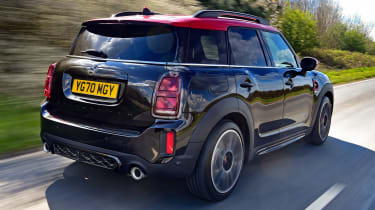
MINI has built a reputation for building fun to drive small cars, but as larger and more practical models arrive they threaten to erode the agile feel delivered by the core cars. Thankfully, the Countryman still has plenty of MINI DNA left in the driving experience.
This fun is evident when you get the Countryman on a twisty road. The steering is quick and there’s lots of grip on offer. Even though it has a longer wheelbase and a higher kerbweight than rivals like the Audi Q2 or Volvo XC40, the car feels more nimble and sharper to drive.
The steering is quick, especially just off centre, so the MINI darts into turns with a keenness that might take you by surprise at first. But you soon get used to this agility, and the car handles well and corners with little roll. There are different driving modes to choose from as part of the Sport Pack, and in the Sport setting the Countryman’s steering and throttle response are sharpened up. However, Mid mode is more natural, with a nicer linearity to the accelerator.
The wider track means the handling is very surefooted and composed. There’s plenty of grip, even on lesser models, and the MINI is keen to turn-in to corners with its sharp, direct steering. Even the gearshift operates with the well-oiled precision typical of a BMW Group model. It’s not as fun or engaging to drive as smaller MINIs, but by the standards of the crossover class it’s very good.
Happily, MINI has also managed to match composed handling with mature cruising ability. The ride is a bit firm at times – particularly on models with larger wheels – as potholes and torn surfaces unsettle the car. Vertical movements are evident at higher speeds, but the Countryman is never too uncomfortable thanks to good damping. Optional Dynamic Damper Control allows this to be adjusted according to the road surface and the driver’s preference.
MPG, CO2 and running costs
Modern MINIs are about paying a little bit extra for the increased desirability and quality. As such, the Countryman isn’t exactly the cheapest small crossover to buy, but at least it shouldn’t prove costly to run.
Under the latest WLTP fuel economy tests, you shouldn’t be too disappointed with the base Cooper’s combined economy figure of up to 44.8mpg – although that may be tricky to achieve in the real world. The Cooper S claims up to 43.5mpg, while the top-spec JCW version returns 37.2mpg on the combined cycle.
To really cut your costs, the Countryman PHEV plug-in hybrid is the one to go for. It has emissions of 44g/km, and the ability to travel around 31 miles on electric power alone. MINI claims an overall economy figure of up to 156.9mpg, but as with any plug-in hybrid model, you'll have to regularly charge the battery to get anywhere near this figure.
Interior, design and technology
Given that MINIs are designed to appeal to more fashion-conscious buyers, the Countryman has to look good. While this is subjective, the bulkier Countryman Mk2 appears to push the brand’s design language to its limit.
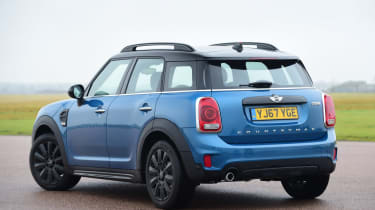
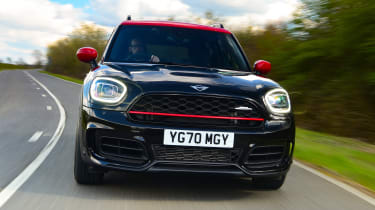
The front-end design, with its gaping front grille and bulbous headlamps, has always looked a bit awkward, while the squared-off rear isn’t much better. The 2020 facelift addressed some of these issues with a new radiator grille, new front and rear bumpers and Union Flag-branded tail lights.
Customers also benefit from adaptive LED headlights with auto-dimming as standard, while MINI’s Piano Black exterior styling package can now be optionally specced in place of the standard car’s exterior brightwork.
There’s plenty of scope for personalisation, with contrasting roof and mirror colours available. You can team this with bonnet stripes and themes, but these hike the price.
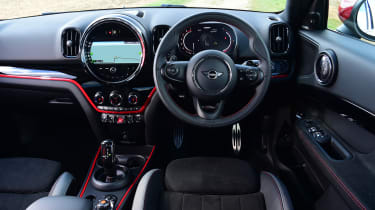
Inside, things are less controversial. The design is typical MINI, with overstyled yet neat touches like the huge circular display and chrome toggle switches, while the facelift introduced a new five-inch digital instrument binnacle (as seen in the MINI Electric) as standard across the entire model range. There’s also some new Piano Black trim for the dashboard and doors cards, along with two new leather upholstery colours.
Quality is largely excellent – the materials for the seats feel classy, while a mixture of soft touch plastics on the dash and fabric trim on the door pulls lifts the ambience. The black trim on the dashboard feels solid and looks upmarket, too.
Delve into the huge options list and you’ll find ambient lighting packs, which light up the cupholders, door handles and even shimmer through the black dash inlays in whichever colour you desire.
You can spend thousands speccing up a MINI with all sorts of customisation choices, but standard equipment is good – all cars include LED headlights and taillights, rear parking sensors, cruise control, air-con, a DAB radio and Bluetooth.
Sat-nav, stereo and infotainment
The standard infotainment system is now a 8.8-inch colour display with sat-nav and Apple CarPlay functions. Ranging from £1,200 to £1,800 (depending on which model you've chosen), the Premium Plus Pack adds items such as a rear view camera, a Harman Kardon audio system, a head-up display and a wireless smartphone charging function.
Practicality, comfort and boot space
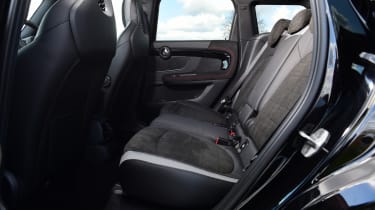
The second-generation Countryman is larger in almost every dimension than the old car, so it’s unsurprising that space increases inside. Leg and headroom for rear seat occupants is on a par with rivals like the Audi Q2, meaning four adults can travel long distances in decent comfort. There are Isofix points for child seat mounting, too.
The 450-litre boot is genuinely practical. There’s some clever kit on the options list, with the Activity Pack (costing about £500) adding sliding and reclining rear seats to either maximise boot space or seat room. You can also spec a 10-litre larger fuel tank to increase the car's driving range, while an electric tailgate can be added for around £450.
Size
The MINI Countryman is 4.3m long, 2.0m wide and 1.56m tall. That’s a little longer and wider than the previous-generation car, although the height hasn’t increased. That has the effect of making the Countryman look more squat and purposeful while also benefiting passenger room.
Legroom, headroom and passenger space
MINI has extended the wheelbase of the Countryman by 75mm, which benefits rear legroom and means two adults will be comfortable in the back for longer journeys. Five is a bit of a squeeze, though, thanks to the large transmission tunnel and sculpted seats, despite the increased cabin width.
The S E hybrid has to accommodate its battery pack below the rear seats, so the bench is raised up by about 25mm. It's not too noticeable, however, and there's still a good amount of headroom.
Boot
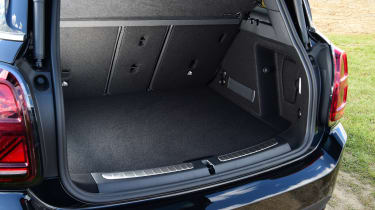
The Countryman’s boot is an impressive 450 litres – that’s 20 litres more than a Nissan Qashqai. It also extends to 1,390 litres with the seats folded, while the chairs can split 40/20/40 for increased versatility. That means this is a genuinely practical MINI, rivalling the Clubman for outright space.
The hybrid powertrain in the S E robs the boot of 45 litres of space, although in reality you're unlikely to notice the reduction.
Towing
The MINI Countryman has a modest range of towing capabilities. Starting at 1,500kg for two-wheel drive manual and automatic versions, you will need to move up to the ALL4 Cooper to gain another 200kg of towing capacity. However, if you still need more, ALL4 versions of the Cooper S and Cooper D allow you to tow 1,800kg.
Want the latest car news in your inbox? Sign up to the free Auto Express email newsletter...
More reviews
In-depth reviews
Long-term tests