MINI Aceman review
The MINI Aceman is a stylish and fun electric car, but it’s a little cramped and the ride is firm

Our opinion on the MINI Aceman
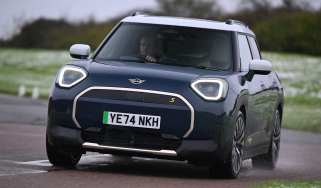
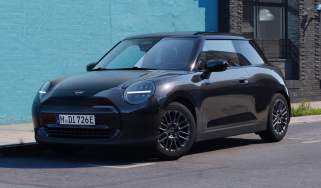
The MINI Aceman is a talented small SUV and has plenty of personality to set it apart from the competition. It looks funky, drives brilliantly, and in SE guise, offers a usable 200-plus miles of range. The classy, uniquely styled and beautifully built cabin sets a high-class benchmark, too. But it’s far from perfect, because the interior packaging is poor, and the ride is too firm – just as it is in all modern MINIs – and we think it could charge slightly faster.
About the MINI Aceman
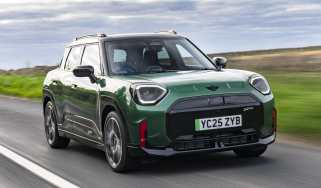
MINI’s ever-expanding product line-up is almost complete. The Aceman slots into the range between the entry-level three-door MINI Cooper and the larger MINI Countryman SUV. Only available as an electric car, you can think of it as a zero-emissions alternative to the five-door hatch with a price premium of around £2,000 versus the equivalent three-door.
For your money, you get an extra pair of doors, a more accessible cabin and a slightly bigger boot. The Aceman still isn’t a large car; space is at a premium anywhere but up front, so it would probably suit those looking for occasional rear seats or the ability to put small kids in the back. People may complain that the Countryman has grown beyond recognition, but the Aceman remains a MINI through and through.
There are two battery sizes to choose from: the basic Aceman E uses a 42.5kWh battery, while the Aceman SE ups this to 54.2kWh. Trim levels consist of Classic, Monochrome, Exclusive, Sport, with the quickest John Cooper Works sitting at the top of the range.
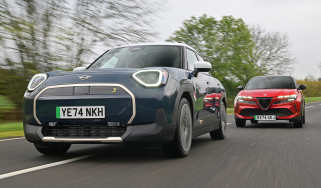
We've tested various versions of the Aceman, including an SE Exclusive MINI Aceman against the Alfa Romeo Junior in a twin test, and our Consumer Reporter, Tom Jervis, has run a MINI Aceman as part of our long-term test fleet.
Engines, performance & drive
Pros |
|
Cons |
|
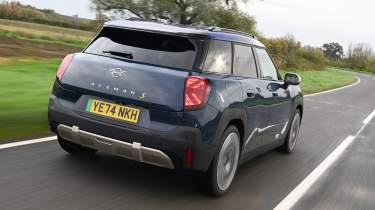
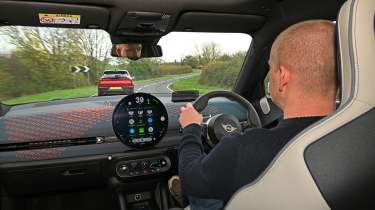
Everything that the Aceman does well on the road comes with the big caveat ‘for its weight’. The MINI’s handling is fairly sharp by the standards of this class, but it comes at the expense of a ride that’s far too firm for a five-door hatchback.
We also find that the Aceman has almost too many drive modes to mention, but you’ll rarely need to delve deeper than the usual Core, Green and Go Kart settings – the latter replicating a traditional ‘sport’ mode. Whichever mode you choose has an effect on a number of parameters – from motor response to steering weight, as well as the sound the car makes. The raciest of these isn’t what you’d call conventional; the almost sci-fi-like sound crescendos in a pleasing enough way, and changes tone if you push the accelerator pedal past a certain point. It doesn’t attempt to replicate an old-school petrol engine as the Abarth 500e does, but it still offers a level of engagement missing in many rivals.
Performance, 0-60mph acceleration and top speed
Kicking things off is the Aceman E, and it's certainly no slouch with 181bhp and 290Nm. In our experience, it picks up instantly, with a strong surge of power all the way up to our national speed limit; 0-62mph takes only 7.9 seconds.
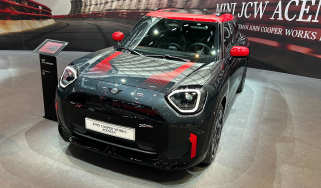
The Aceman SE offers plenty of power through the ‘rev’ range. It’ll do 0-62mph in just 7.1 seconds, and we can’t see many needing to step up to the full-fat JCW. If you do, it'll trim this time even further to 6.4 seconds if you utilise the 'Boost' paddle behind the steering wheel, unlocking the full 254bhp. Most of the time, the Aceman JCW produces 227bhp.
| Model | Power | 0-60mph | Top speed |
| Aceman E 42.5kWh | 181bhp | 7.9 seconds | 99mph |
| Aceman SE 54.2kWh | 215bhp | 7.1 seconds | 105mph |
| Aceman JCW 54.2kWh | 227bhp (254bhp in Boost mode) | 6.4 seconds | 124mph |
Town driving, visibility and parking
Lively performance, great brake pedal feel and quick steering all make the Aceman an ideal companion for driving around town. Unfortunately, this is all undone by the unnecessarily stiff ride comfort. It’s no firmer than the smaller Cooper Electric, but it seems slightly more forgivable in that car, because practicality is not such a consideration – family cars don’t need to ride like this. Our consumer reporter, Tom Jervis, described the ride as being uncompromising when he ran a MINI Aceman SE Exclusive as part of our long-term test fleet, and often resorted to using the seat massaging function on his Level 3 equipped test car to relieve the strain on his back.
B-road driving and handling
For a long time, MINI has promoted its ‘go kart handling’ characteristics with firm suspension set-ups that minimise body roll. While that almost works on a 10-year-old MINI Cooper S that weighs not much more than a tonne, on the 1,800kg-plus Aceman, it only really gives a thin veneer of fun, which is promptly undone, thanks to the car’s hard ride. The weight is masked by overly sensitive steering, which points the Aceman’s nose at a corner with plenty of enthusiasm, but with little in the way of feel or feedback. There are few cars in this class that could cover ground so effectively, but the MINI still isn’t particularly thrilling.
Motorway driving and long-distance comfort
Even at high speeds, the suspension never fully settles down, but otherwise the Aceman’s impressive stability and performance make it a solid long-distance cruiser. There’s a little wind noise at motorway speeds due to the rather upright windscreen.
"While the Ford Puma Gen-E manages to deliver genuine driving enjoyment alongside a comfortable ride, I only needed to drive down my own street to discover that this certainly isn’t the case with the MINI Aceman." – Tom Jervis, consumer reporter
Range, charging & running costs
Pros |
|
Cons |
|
All Acemans use a single electric motor mounted to the front axle, with the base ‘E’ model featuring a 42.5Wh battery for up to 192 miles of range, while the punchier ‘SE’ and John Cooper Works models feature a more powerful motor and a larger capacity 54.2kWh battery, and do 251 and 221 miles to a charge, respectively.
During our testing of an Aceman SE, we managed around 3.8mi/kWh on our mixed test route in cool autumn temperatures of around 10-12 degrees, and we achieved a similar efficiency rating when we ran an Aceman SE Exclusive running on larger 19-inch wheels as part of our long-term test fleet. That translates to 187 miles per charge based on the usable capacity of 49.2kWh. That's okay for mostly urban driving, but if you want to go further, either the 355-mile Skoda Elroq with a 77kWh battery or the Kia EV3 with an 81.4kWh battery and 375 miles of range would be better bets.
Whichever Aceman you go for, you get a mediocre peak charging speed. Entry-level 'E' models peak at just 70kWs, while 'SE' and John Cooper Works models have a peak charging speed of 95kW. While that might have been a stand-out feature five years ago, it’s nothing to write home about today; the Jeep, Peugeot, etc, all manage 100kW, while a Volkswagen ID.3 can do 145kW or more.
Those speeds should allow the MINI to recharge from 10-80 per cent in around half an hour, with the bigger-battery car taking slightly longer. Utilise a typical 7.4kW home wallbox charger, and it'll take around seven hours to fully recharge the 42.5kWh battery Aceman from empty, or nine hours to do the same with the 54.2kWh model.
| Model | Battery size | Range | Insurance group |
| Aceman E | 42.5kWh (38.5kWh usable) | 191 miles | 20 |
| Aceman SE | 54.2kWh (49.2kWh usable) | 251 miles | 23 |
| Aceman JCW | 54.2kWh (49.2kWh usable) | 221 miles | 29 |
Insurance groups
Insurance costs should be reasonable, because the range starts in group 20 for the 'E' version, goes up to 23 for the quicker 'SE', while the quickest John Cooper Works is in group 29. All those are lower than the Volvo EX30, which starts in group 35.
Tax
Like every new electric car, you'll need to pay the standard annual rate of vehicle excise duty (VED), because EVs are no longer exempt from being charged road tax. The current luxury car tax limit for EVs is now £50,000, and the price of the Aceman is comfortably below this limit.
The Aceman should be a good company car choice, because all are in the low four per cent benefit in kind (BiK) tax band. This rate will rise to five per cent for the ‘27 to ’28 tax year, and seven per cent for the ‘28 to ‘29 tax year.
EVs would also be subject to an eVED pay-per-mile fee if that comes into force from April 2028 onwards.
Depreciation
Residual values for the Aceman are decent for the class. Our expert data suggests that the Aceman range is expected to maintain between 45 and 52 per cent of its original value after three years or 36,000 miles, which is higher than the Volvo EX30 (41 to 44 per cent), and similar to that of the Kia EV3 (47 to 51 per cent).
To get an accurate valuation for a specific MINI Aceman, check out our free car valuation tool...
Design, interior & technology
Pros |
|
Cons |
|
Base models are badged Classic and feature:
- LED lights front and rear
- Roof rails
- 17-inch wheels made from 30 per cent recycled aluminium
- A 24cm diameter circular touchscreen with sat-nav, Apple CarPlay and Android Auto smartphone connectivity
- Dual-zone climate control
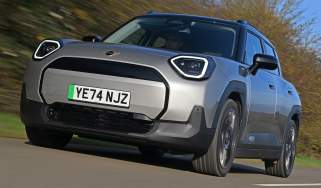
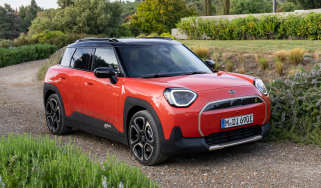
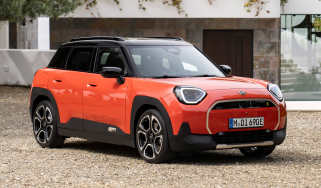
Upgrade to Exclusive and you get – as the name suggests – a slightly more exclusive look with bigger wheels and a ‘Vibrant Silver’ grille. There are also different roof options, plus a wider paint palette, and different interior trim.
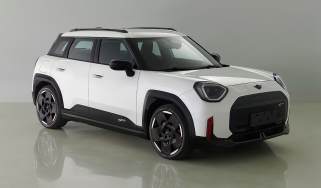
Above this sits the raciest-looking Sport trim, which doesn't look all that different from the JCW model. It boasts a subtle bodykit, some JCW badges, different wheels, body stripes, standard Chili Red paint with a contrast black roof, and a rear spoiler.
Then, on top of this, MINI offers different optional equipment packs. The ‘Level 1’ pack (£2,000 on all 'E' models, standard on all 'SE' and JCW models) adds a head-up display (useful when there's no conventional instrument cluster), wireless phone charging and heated front seats. Next up, ‘Level 2’ (£4,400 on all 'E' and 'SE' models, and £1,700 on JCW) brings a panoramic roof, tinted windows and a Harman Kardon stereo. Finally, ‘Level 3’ (£6,900 on 'SE' Exclusive and Sport models, £4,300 on JCW) throws in electrically operated massaging front seats with a memory function, as well as virtual-reality navigation and extra safety features.
On SE and JCW versions of the Aceman, you can add the Level 2 and 3 packs with a towbar option for an additional £700 over their respective prices, but considering the Aceman only has a braked towing capacity of 750kg, and the towbar doesn't have a trick folding mechanism a has to be removed manually, we don't thing you should bother with it.
Interior and dashboard design
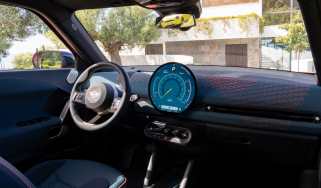
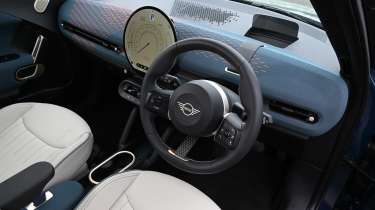
With an ever-increasing trend towards touchscreens, some manufacturers manage to introduce minimalism better than others, and the Aceman is one of the best examples out there. The cabin is almost identical to the smaller MINI Cooper Electric, but you won’t hear us complaining about this. The round, central touchscreen with a bare minimum of physical controls below it is a fantastic modern take on the original Alec Issigonis Mini, and the use of fabric across the dashboard is enhanced further by the ambient lighting, which plays with the textures at night.
Our one wish would be to reintroduce physical climate controls and take them away from the touchscreen. However, this is a common gripe that we have with almost every model that has such a set-up.
Materials and build quality
Buyers coming from the old car might miss the wonderfully tactile quality of the artificial chrome switchgear compared with the more pared-down finish of the current car, but otherwise the new model feels wonderfully plush and solid beside most rivals. The one exception inside is the driver’s central armrest, which looks very cheap.
Infotainment, sat-nav and stereo
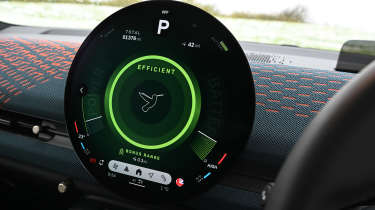
There’s no arguing that MINI’s latest infotainment system is a bit of a party piece. The big, circular screen in the centre of the dashboard looks great, and it’s responsive enough not to require multiple prods like you might find in some rivals’. Yet we really didn’t find it all that intuitive to operate; sure, you might get used to the layouts, but setting a destination, changing the radio station, and making small adjustments to the climate control temperature should be simpler.
That said, it’s full of functionality, and as always, the fitment of Apple CarPlay and Android Auto means you can bypass many of the tricky submenus if you’re happy to use your phone’s apps instead. It’s a shame it doesn’t fill the entire screen, but this isn’t an issue exclusive to MINI – and a challenge only made harder by the shape of the Aceman’s circular screen.
Wireless phone charging comes as part of the Level 1 pack, which is £2,000 on 'E' models, and standard with the 'SE'. The standard audio system is good enough for the class and is helped by less background noise than a typical small SUV with a traditional petrol or diesel engine, but we found that the upgraded 315-watt, 10-speaker Harman Kardon surround sound system that was fitted to our long-term MINI Aceman test car is probably the best sound system fitted to a car in this class.
Boot space, comfort & practicality
Pros |
|
Cons |
|
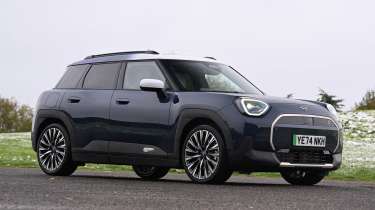
You might look at the MINI Aceman and be attracted by its elevated ride height and superior size – at least versus the three-door Cooper – but in reality, this is still a small car.
Ultimately, think of the Aceman as an electric alternative to the five-door MINI Cooper, and you’ll not be disappointed. However, rivals like the Jeep Avenger, Ford Puma Gen-E, and Skoda Elroq are bigger and much more practical cars.
Dimensions and size
Measuring a fraction over four metres long, the benefit of the Aceman's diminutive size is that it’s perfectly at home in the city, where it can squeeze into tight gaps and parking spots that the larger Countryman cannot. The Aceman is 50mm taller than the regular MINI Cooper, but that doesn't translate into a commanding SUV driving position. Anyone looking for that would be better off with the 1,552mm tall Renault 4 or 1,625mm tall Skoda Elroq.
| Dimensions comparison | |||
| Model | MINI Aceman | Alfa Romeo Junior | Volvo EX30 |
| Length | 4,079mm | 4,173mm | 4,233mm |
| Width | 1,754mm (1,991mm inc mirrors) | 1,781mm (1,981mm inc mirrors) | 1,940mm (2,032mm inc mirrors) |
| Height | 1,514mm | 1,532mm | 1,555mm |
| Wheelbase | 2,606mm | 2,562mm | 2,650mm |
| Boot space | 300-1,005 litres | 400-1,265 litres | 318-1,000 litres |
Seats & passenger space
A six-foot-tall adult can just about squeeze into the back, but it remarkably has less leg room compared with the shorter Renault 5, according to our measurements, and you can forget about fitting three abreast for anything more than a short hop to the shops.
Space in the front is plentiful, although it is a shame that lumbar adjustment isn't standard, and only becomes available if you specify the expensive 'Level 3' pack with full electric front seat adjustment. We're also not fans of the awkward to get to central cubby, which is accessed by pulling on a red nylon strap and is hinged towards the passenger, which doesn't work all that well for a right-hand drive seating position.

Boot space
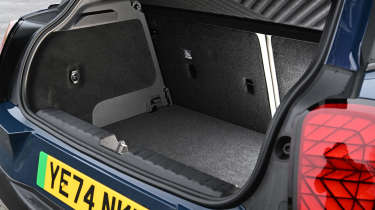
The trade-off for the compact exterior of the Aceman is a small 300-litre boot – we fitted two carry-on suitcases behind the rear seats, but a bulky buggy or child’s bike might be a stretch. The back seats fold in a typical 60/40 split to reveal a 1,005 litre space, but that's some way short of the 1,283 litres offered by the Puma Gen-E or the 1,580 litres of an Elroq. There's also no clever underfloor storage well like in the Puma, which has a plug at the bottom so you can easily wash it out after storing dirty charging cables or muddy boots.
"I noticed that if you use the rear screen wash to clean the window and then go to get something out of the boot shortly after, all the residual water is able to dribble down in an unsightly mess over the inside trim on the tailgate. I've not come across that on any other car, so it stood out for me when I tested the MINI Aceman." – Max Adams, online reviews editor
Safety & reliability
Pros |
|
Cons |
|
The MINI brand finished 22nd (out of 30 brands) in our most recent list of the best manufacturers in the 2026 Driver Power customer satisfaction survey. MINI owners like their cars' acceleration, powertrains, and handling, while exterior styling also scored highly. Unfortunately, practicality came in for heavy criticism, as did value for money.
In terms of safety, the Aceman gained the maximum five-star rating from safety experts Euro NCAP, along with its smaller MINI Cooper sibling. That's on par with the Smart #3 and BYD Dolphin, and one star ahead of the four-star Renault 4.
There are plenty of driver-assistance systems provided as standard, including speed limit recognition software, lane keep assistance, rear cross traffic alert to warn you of cars crossing your path when reversing out of a parking space, and a blind spot monitoring system to warn you of vehicles alongside you when you go to change lanes.
| Euro NCAP safety ratings |
|
Buying and owning
Best buy: MINI Aceman SE Classic
Pricing for the entry-level Aceman E Classic starts at around £29,000, although our money would go on the higher capacity battery of the Aceman SE Classic, which starts at around £32,000. If you were to go all out for the quickest Aceman John Cooper Works, you'd need just over £37,000.
Unfortunately, the Aceman doesn't qualify for the Government's Electric Car Grant (ECG), while its more practical and better riding MINI Countryman brethren presently does. The latter qualifies for the higher band 1 discount of £3,750, which dramatically reduces the jump up in terms of cost from an Aceman to a Countryman. That might make people consider whether spending just a little more for the bigger car is a better decision.
Still, if your heart is set on an Aceman, we think the larger battery of the 'SE' makes more sense because it goes further on a charge, and it has a higher peak charging speed. You also get more kit for your money with 'SE' because that gets our preferred Level 1 pack as standard, which would be an expensive option on an 'E' model, and makes the gap between the two only £1,000. Sticking with the Classic trim means you get smaller wheels compared with Exclusive and Sport trims, which can only help with the Aceman's very firm ride.
If you're interested in purchasing an Aceman, our Buy A Car service lets you spec your ideal MINI Aceman and choose the best offer from top dealers around the UK. Alternatively, you can lease an Aceman or buy a used Aceman. We can also help you sell your old car, too.
MINI Aceman alternatives
This part of the market is awash with talented alternatives to the MINI Aceman. It’s impossible to ignore the range of Stellantis small cars, which includes the Jeep Avenger, Alfa Romeo Junior and Peugeot E-2008, as well as the less premium-feeling Vauxhall Mokka and Citroen e-C4.
Then there’s the Volvo EX30, plus the larger BMW iX1 and Mercedes EQA. You’d be unwise to dismiss the Hyundai Kona Electric, Kia EV3, and Skoda Elroq, too, while the Ford Puma Gen-E is far more practical and charges faster than the Aceman, despite costing significantly less (no doubt helped because it qualifies for the highest electric car grant discount). Speaking of the ECG, the MINI Countryman also qualifies for the higher discount, and brings the price of that car within reach of those considering an Aceman.
MINI Aceman SE Exclusive long-term test
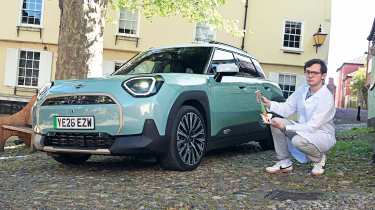
Our consumer reporter, Tom Jervis, is running a MINI Aceman SE Exclusive for a long-term test. He's been utilising some of the Level 3 pack options this car has, such as the driver's seat massage function, because the car's firm ride is affecting his back. He is enjoying this car's performance and excellent Harman Kardon sound system. Read more about our long-term MINI Aceman here...
Key updates of the MINI Aceman review
26 June 2026: General update to include observations from our long-term MINI Aceman test.
9 January 2026: Updated the tax section with the increased £50,000 expensive car surcharge limit and included a mention about the proposed pay-per-mile scheme for EVs.
Deals on the MINI Aceman and alternatives
MINI Aceman pictures
Frequently Asked Questions
The MINI Aceman gets a three-year, unlimited-mileage warranty, which is about average in this class.