Toyota Yaris review
The Honda Jazz is a practical, efficient and generously equipped hybrid supermini, though it’s pricier than rivals

Our opinion on the Toyota Yaris
The latest Toyota Yaris supermini is a fine choice in our view, if you’re looking for something with good fuel economy and plenty of kit as standard that’s very easy to drive around town.
The fourth-generation Yaris is a great performer in urban environments, and it can cope with a bit of B-road and motorway action, too. However, it isn’t the cheapest small hybrid around, there’s limited room for people in the back, and a small boot could limit its appeal for a family. Its dull interior could also prove to be a stumbling block for some.
About the Toyota Yaris
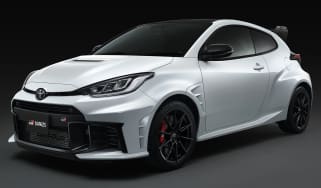
Even without considering the marvellous Toyota GR Yaris hot hatch that holds so much appeal for keen drivers, the regular version of Toyota’s Yaris supermini still deserves to be lauded as the best version to date. As a pioneer of hybrid technology, the Japanese brand Toyota offers a single petrol-hybrid powertrain while most car makers continue to offer petrol in their small car line-ups.
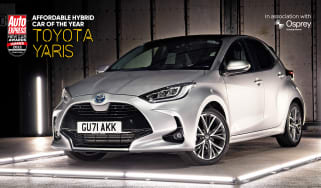
In an ultra-competitive supermini market, the five-door Yaris (the winner of our 2022 Affordable Hybrid Car of the Year award) keeps things simple with its one hybrid engine in two states of tune, and four levels of trim. All Yaris models are automatic.
Used - available now

2019 Toyota
Yaris
30,941 milesManualPetrol1.5L
Cash £10,000
2025 Toyota
Yaris
18,885 milesAutomaticPetrol1.5L
Cash £16,048
2022 Toyota
Yaris
33,105 milesAutomaticPetrol1.5L
Cash £16,113
2024 Toyota
Yaris
25,010 milesAutomaticPetrol1.5L
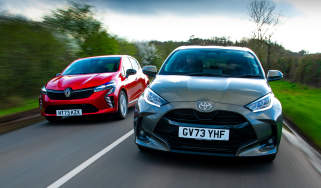
Cash £14,995We’ve tested the Toyota Yaris on numerous occasions since its launch, recently it featured in a real-world twin test against the hybrid-powered Renault Clio E-Tech. Unfortunately for Toyota, the French supermini took the win here thanks to its smoother powertrain, more stylish design and upmarket interior.
Toyota Yaris prices and latest deals
Pricing for the Yaris starts from just under £24,000 for the entry-level Icon, while our preferred Design trim comes in at around £26,000. The more premium Excel trim also comes with a slight cost premium, at around £28,600, while the sportier-looking GR Sport trim costs a little over £30,500.
In order to get the best deal on a Yaris, check out our latest new car deals on your ideal Toyota Yaris, or take a look at our latest Yaris leasing deals. Alternatively, we also have plenty of used Toyota Yaris examples on Auto Express. And don't forget we can help you sell your car, too.
Performance & driving experience
Pros |
|
Cons |
|
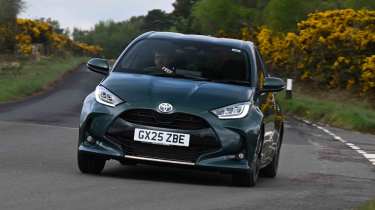
The Toyota Yaris is a competent all-rounder, offering a reasonable drive on a variety of roads. Its hybrid set-up is better suited to more measured inputs, and if you take that on board, you’ll be rewarded with a relaxing and smooth drive.
It’s quite a contrast to the far sportier Toyota GR Yaris, which may bear the same name but is a completely different beast underneath. The GR is basically a four-wheel-drive rally car that’s been tamed for the road, whereas the regular Yaris is an efficient front-wheel-drive runabout with a far simpler suspension arrangement of MacPherson struts at the front and a torsion beam at the rear.
A key advantage of the Toyota hybrid system is that you don’t have to stop to plug in and recharge, or trail an extension cord to your car to top it up overnight. Instead, the Yaris’s battery pack is ‘refilled’ by a regenerative braking function, which produces electricity when you brake or coast. Excess power from the engine is used to charge the battery.
Performance, 0-60mph acceleration and top speed
The entry-level 114bhp hybrid system combined with a relatively low kerbweight of 1,085kg allows for a reasonably swift 0-62mph sprint of 9.7 seconds. It’s not a fast car with a top speed of 108mph, but that’s not a figure many Yaris customers will be actively trying to match. It’s not that kind of car.
The more potent electric motor with the 128bhp Yaris version means that you’re getting a little extra performance without dramatically increasing your running costs. In bald terms, the 0-62mph time is reduced to 9.2 seconds, making it slightly swifter than its Honda Jazz rival.
Town driving, visibility and parking
Like its Honda Jazz and Renault Clio E-Tech rivals, the Yaris can drive on electric power alone for short periods of time during low-speed urban runs using its 0.7kWh capacity battery, although we’ve found you need to be really gentle with the accelerator to avoid petrol power kicking in.
Both the 114bhp and 128bhp versions feel similarly perky at low speeds, with plenty of initial shove provided by the electric motor. That all helps make the Yaris feel quicker getting away from the lights compared with most automatic petrol superminis Skoda Fabia or Volkswagen Polo, where there’s a noticeable lag between putting your foot down and actually moving forward.
The steering feels precise, and the Yaris is easily manoeuvred around the tightest of turns, so parking up in narrow spaces should prove to be straightforward. Coupled with the diminutive exterior dimensions, the Yaris feels right at home in the urban environment. It's easy to brake to a smooth stop, and there’s plenty of stopping force should you need to quickly come to a halt for pedestrians.
You can avoid potholes and deep drain covers thanks to its nimble handling, and when you do encounter a speed bump, you won’t have your teeth shattered, because the ride is pleasingly compliant.
B-road driving and handling
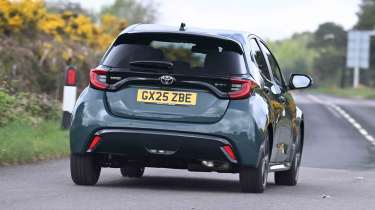
Venture out of the urban hustle and you’ll quickly realise that the standard CVT automatic transmission isn’t the most involving when pressing on through twisty B-roads. The Yaris is quite noisy under hard acceleration due to the gearbox letting the engine revs rise as you build speed.
The handling is pretty agreeable, and the Yaris manages to avoid leaning over too much in bends if you start to press on. The ride can seem a little on the firm side given that you can detect some fidget over rougher surfaces at speed (which isn’t something that bothers the more refined Renault Clio), but the suspension deals with bigger bumps well enough and avoids feeling crashy.
Motorway driving and long-distance comfort
While you can use the Yaris for motorway drives, we find that the Clio is a more comfortable place to tackle a long jaunt. The engine in the Yaris can sound strained when getting up to speed, and there’s too much road noise, which is a shame because the car feels very stable at 70mph, with well-controlled body movements over undulations that stop things getting bouncy.
The more potent 128bhp version is better if you plan on taking longer trips. It’s more comfortable at motorway speeds, although the high-revving hysteria that you typically get under acceleration with a continuously variable transmission (CVT) remains. At least the extra power means you get up to pace and into a comfortable cruise more quickly.
“The rear C-pillars are on the thick side, so over-the-shoulder vision is slightly impaired, but there’s a rear camera to help with reversing.” – Dean Gibson, senior road test editor.
| Model | Power | 0-62mph | Top speed |
| Yaris 1.5 Hybrid Icon | 114bhp | 9.7s | 108 mph |
| Yaris 1.5 Hybrid Excel | 128bhp | 9.2s | 108 mph |
MPG & running costs
Pros |
|
Cons |
|
A supermini with a starting price of around £23,500 doesn’t sound like particularly great value, especially when the Yaris’ entry price is just over £1,500 more than the base-level Renault Clio E-Tech. The Yaris undercuts the Honda Jazz hybrid, though.
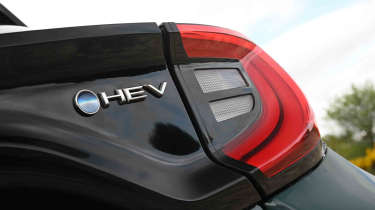
You will, however, save money at the petrol pump, because Toyota claims average fuel economy on the combined cycle of 68.9mpg. During our own testing, we saw an average of 65mpg, with the high economy figures unusually maintained through town centre driving. The 128bhp version uses a little more fuel at 67.3mpg, but we don’t think you’ll really notice such a small difference in the real world.
| Model | MPG | CO2 | Insurance group |
| Yaris 1.5 Hybrid Icon | 68.9mpg | 92g/km | 13 |
| Yaris 1.5 Hybrid Excel | 67.3mpg | 96g/km | 16 |
Insurance groups
No matter which trim level you opt for, the Yaris shouldn’t incur expensive insurance premiums. The entry-level 114bhp version in Icon trim sits in group 13, while the more powerful 128bhp model starts in group 15 in GR Sport trim. In comparison, the Honda Jazz starts from group 21.
Tax
No version of the Toyota Yaris (apart from the high-performance Toyota GR Yaris) costs more than £40,000, and so there’s no luxury car tax surcharge. You’ll only need to pay the standard rate of VED road tax from the second time the vehicle is taxed.
Low CO2 emissions ranging from 92g/km to 96g/km, depending on your chosen trim level, mean more affordable 24 and 25 per cent BiK (Benefit-in-Kind) company car tax rates, compared with the 26 per cent charge for the Honda Jazz, but an EV will be a lot cheaper.
Depreciation
According to our market data, a fourth-generation Yaris should retain 46 to 52 per cent of its original value over a typical ownership period of three years or 36,000 miles. That’s on par with the Renault Clio, which clings on to 47 to 53 per cent, but the Honda Jazz does a little better at 52 to 56 per cent over the same period.
To get an accurate valuation on a specific model check out our free car valuation tool...
Interior, design & technology
Pros |
|
Cons |
|
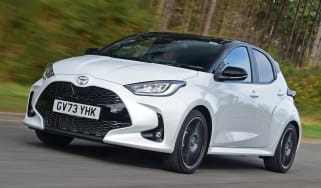
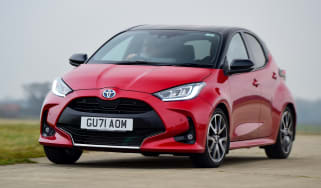
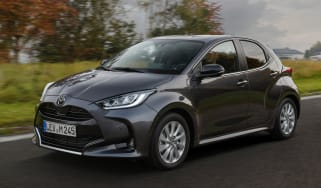
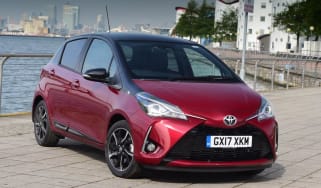
Toyota has bestowed the Yaris with a strong, distinctive look. The muscular wheelarches, large grille and sharp creases all contribute to a more purposeful appearance than on any other Yaris model. There’s a hint of the Toyota GR Yaris performance model about the standard cars.
There's a good level of standard equipment on offer. The entry-level Icon trim includes:
- 16-inch alloy wheels
- Automatic headlights and wipers
- Adaptive cruise control
- Air conditioning
- Reversing camera
- Multi-function leather-trimmed steering wheel.
It does have ‘keep fit’ manual rear windows in the back, so those with small children may want to go further up the range to get a model with electric rear windows that you can lock to prevent them from being opened.
Our preferred Design version adds:
- 17-inch wheels
- Rear privacy glass
- Electric rear windows
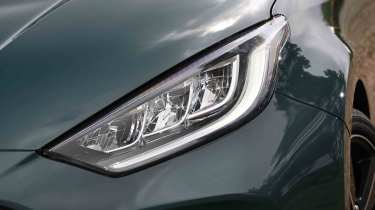
- LED headlights.
Stepping up to the Excel trim gets you:
- Wireless phone charging
- Parking sensors
- 12.3-inch digital instrument cluster
- Blindspot monitoring
- Satellite navigation\
- Wireless smartphone integration
The GR Sport, despite costing more than an Excel model, actually offers similar equipment to the Design trim, just with sportier styling both inside and out.
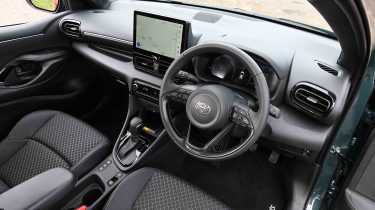
Interior and dashboard design
The dashboard looks solid and practical, but has very little sparkle or sense of style. However, we do approve of the simple-to-use climate controls that set it apart from touchscreen-based rivals like the Peugeot 208.
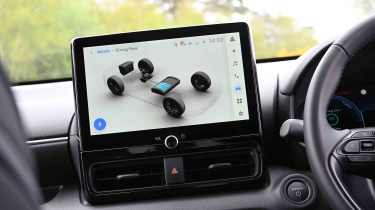
That doesn’t mean the Yaris is lacking in this digital age, because the base Icon and our preferred Design trim feature a nine-inch central touchscreen, while Excel and above use a larger 10.5-inch display. There are also three different instrument cluster designs: Icon gets analogue dials; Design uses a part-analogue, part-digital cluster; and Excel and GR Sport models gain a fully customisable 12.3-inch screen.
Materials and build quality
We can’t deny that the inside of the Yaris is all well screwed together in the typical Toyota fashion, but it is a bit on the gloomy side thanks to lots of materials painted in black or dark grey.
Some efforts have been made to cheer things up, with Icon and GR Sport trims using a few metal-effect accents, while Design and Excel employ glossy piano black trim in a bid to give the Yaris a more premium feel. Excel trim also introduces some leather strips and a diamond pattern design to the figure-hugging sports seats. The racier-looking GR Sport models feature aluminium pedals, a ‘GR Sport’ logo on the steering wheel and some red stitching on the seats.
Infotainment, sat-nav and stereo
A 9.0-inch Toyota Touch 3 infotainment system comes as standard on entry-level Icon and mid-range Design, while Excel and GR Sport feature a 10.5-inch display with sat-nav included.
Both touchscreens are positioned high on the dashboard. The smaller screen features some physical buttons on the passenger side, which is a little disappointing for a right-hand-drive car. The larger 10.5-inch screen has a volume dial in the middle below the screen, which is a much more sensible set-up.
Toyota’s standard 9.0-inch infotainment menu system isn’t quite as clear as we'd like, and there are a few too many sub-menus to navigate through if you want to change a setting – radio station selection is especially frustrating if you haven’t set up your favourites for instant access.
Despite being an upgraded system, the 10.5-inch set-up still isn’t as easy to navigate or as responsive to inputs as the one found in the Renault Clio, and it doesn’t have the French car’s Google-based sat-nav with live traffic information or its intuitive voice recognition software.
Apple CarPlay and Android Auto smartphone connectivity is fitted as standard, so you can bypass Toyota’s system completely if you want. Wireless phone charging is standard on the Excel trim.
“The Yaris touchscreen requires too many distracting button presses to access certain menus.” – Max Adams, online reviews editor.
Boot space & practicality
Pros |
|
Cons |
|
The Toyota Yaris comes as a five-door model only and offers solid practicality without being the roomiest option in the class. There are plenty of storage spaces and cubby holes for assorted items, along with cupholders, useful seatback pockets and two rear coat hooks. The door bins are shallow and a little awkward to access due to the shape of the armrest above them, though.
The driving position and overall visibility are good, with the driver benefiting from a height-adjustable seat. Passenger seat height adjustment is fitted to the Excel trim. The steering wheel moves for reach and rake, helping to improve comfort over longer drives.
Dimensions and size
The Yaris is slightly smaller than its predecessor, although Toyota cleverly managed to increase the wheelbase by 50mm. Overall length is 3,940mm, width 1,745mm and height 1,500mm. In comparison, the Honda Jazz is longer at 4,044mm, stands taller at 1,526mm, but its 1,694mm width makes it a little slimmer.
| Dimensions comparison | |||
| Model | Toyota Yaris | Renault Clio | Honda Jazz |
| Length | 3,940mm | 4,053mm | 4,089mm |
| Width | 1,745mm | 1,798mm (1,988mm inc width) | 1,694mm (1,966mm inc mirrors) |
| Height | 1,500mm | 1,440mm | 1,526mm |
| Wheelbase | 2,560mm | 2,583mm | 2,517mm |
| Boot space | 286-947 litres | 254-1,006 litres | 304-1,205 litres |
Seats & passenger space
There is enough space up front for a 5ft 10” driver, with sufficient headroom and legroom available. Taller people needing more kneeroom might want to consider rivals such as the Skoda Fabia, which is a bit more generous in that department.
The Icon and Design trims feature fairly flat front seats, whereas the Excel and GR Sport models have nicely bolstered sports seats that keep you in place during cornering. Both seat types are fine, but the seat base is a bit short for those with long legs, and there’s no ability to tilt the seat to improve the under-thigh support, so it might not be all that comfortable for longer trips. You do get electric lumbar adjustment in Excel trim, which is a rarity in this class.
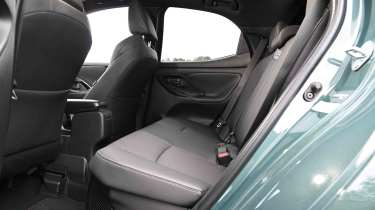
Space in the back of the Yaris is at a premium. We found that a 5ft 10” adult sitting behind their preferred driving position will have their knees pressed into the seat in front, and their hair brushing the ceiling. Anyone taller would struggle further, and you’ll find it difficult to squeeze three across the back seat because the Yaris isn’t particularly wide. Two Isofix child seat mounting points are provided on the outer positions of the rear seats.
Boot space
Boot space for the Yaris stands at 286 litres, which is just about acceptable. If you plan on carrying more luggage, you may want to take a closer look at some of the Yaris’ rivals: the Honda Jazz provides a decent 304 litres, or the more spacious Skoda Fabia has 380 litres of capacity.
The Icon and Design trims don’t get an adjustable height boot floor, meaning there’s a sizable lip you need to lift heavier items over when loading up at the back. Higher Excel trims do get an adjustable height boot floor to reduce that gap, but this robs more space from an already small boot.
Folding the rear seats flat in the Yaris increases overall capacity to a reasonable 947 litres, but the Jazz is much more useful in this regard because its seats fold flat into the floor, and leave a larger 1,205 litre space.
“The rear door openings aren’t particularly wide, making access tricky if you’re trying to install a child seat or put a child in their car seat.” – Max Adams, online reviews editor
Reliability & safety
Pros |
|
Cons |
|
In the 2025 Driver Power owner satisfaction survey, the Toyota Yaris finished in a rather average 35th place out of 50 on the best cars to own list, beating the Vauxhall Corsa in 43rd place and the Peugeot 208 in last place, but falling well short of the much more practical Honda Jazz in 14th. Toyota placed 14th out of 31 manufacturers.
Safety experts Euro NCAP retested the Yaris in 2025, and like a number of superminis these days, it has scored four stars out of five. That's one-star down on its 2020 result, and matches the new (although won't be appearing in the UK until 2027) Renault Clio and MG3, but falls behind other supermini choices like the BYD Dolphin and MINI Aceman.
The Yaris has lots of safety kit as standard. Emergency Steering Assist and lane-keeping assist systems help to nudge you back into your lane, and there’s Driver Attention Alert to warn if you need to stop and rest.
Like all modern cars, there’s a Road Sign Assist feature to ping up speed limit warnings, but that can be quite annoying. Unlike in the Clio where there’s an easy way to switch it off, you have to spend a lot of time diving into sub-menus in the driver instrument cluster to change the settings, which is highly distracting while driving.
| Euro NCAP safety ratings | |
| Euro NCAP safety rating | Four stars (2025) |
| Adult occupant protection | 72% |
| Child occupant protection | 84% |
| Vulnerable road user protection | 83% |
| Safety assist | 72% |
Buying and owning
Best buy: Toyota Yaris 1.5 Hybrid 116 Design
While the 128bhp version is a good car in isolation, the extra cost over our preferred 114bhp version means it wouldn’t be the one we’d recommend. Choosing the base engine also means you can stick with the well-specced and reasonably priced Design trim.
Toyota Yaris alternatives
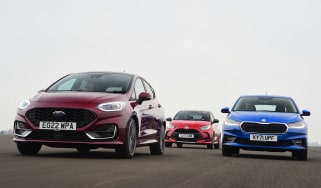
The Yaris is a fine small hybrid runabout, but it does cost an awful lot more than one of our favourite small cars, the Renault Clio. The Clio offers a hybrid system with similar performance and fuel economy figures to the Toyota, but has a more refined driving experience and far greater practicality.
In terms of practicality, no rival in this class does it better than the Honda Jazz. It may not be quite as efficient, and it is costlier to buy, but it is stacked with versatile features, chief among them its innovative ‘Magic Seats’ that allow you to have a flat load area when they are folded down. You may even consider the Mazda 2 Hybrid, which would be ironic, because it’s essentially a Yaris with Mazda badging.
Then there are a few all-electric alternatives that might take your fancy if you’re likely to spend more of your time in the urban jungle and you’ve got easy access to charging. For around the same money as a Yaris, the Renault 5 offers respectable practicality, zippy performance, and even greater refinement.There’s also the even more affordable Citroen e-C3, which has a smooth ride and more space inside for four adults.
Owner Reviews
Here’s what owners in the most recent Driver Power survey thought of the Toyota Yaris.
| What they like | What they don't like |
| “It’s reliable, has great fuel economy and there’s plenty of room inside. I also like the user-friendly media interface and Toyota app.” | “Lovely to drive and even though the Yaris isn’t a big car, it feels bigger than it is. It’s comfortable and comes with lots of hi-tech kit.” |
| “The engine is smooth and when you need a little bit of extra power, the car is more than willing." | "Refinement is pretty good, although the engine can get raucous when accelerating hard." |
| “It’s easy to get more than 60mpg on a run; I’ve beaten 70mpg on occasions." | “The Apple CarPlay doesn’t work correctly, but the dealership is no help whatsoever. If I stick with the built-in radio, the sound is pretty good for such a small car, but if I was buying another Yaris, I’d pay the extra for the JBL audio system.” |
Key updates of the Toyota Yaris review
20 January 2026: inclusion of buyer opinions from the latest Driver Power survey.
16 December 2025: update to include the 2025 Euro NCAP retest safety data.
Frequently Asked Questions
The Toyota Yaris is well-equipped and highly economical. However, there are better family-oriented superminis offering more passenger space, and the Yaris isn’t a barrel of laughs to drive. That honour is reserved for the (impossible to order) GR Yaris hot hatch.
Deals on the Yaris and alternatives