Mercedes GLA (2020-2026) review
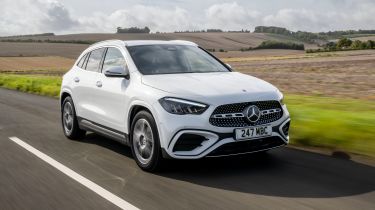
The Mercedes GLA is a premium compact SUV offering high levels of comfort and refinement, and good on-board tech

Our opinion on the Mercedes GLA
The Mercedes GLA is comfortable and practical, plus it’s offered with a wide variety of engine options. The modestly powered petrol and diesel versions are fairly frugal and priced competitively, while the plug-in hybrid GLA 250 e with its 45-mile EV range is ideal for those who wish to reduce their emissions without committing to an EV.
However, the current second-generation GLA is considerably older than its key rivals from BMW and Audi, and there’s an all-new model coming soon that’ll feature the brand’s latest, cutting-edge hybrid and EV powertrains. So if you want a small, premium SUV from Mercedes, we recommend either holding off for a while or keeping an eye out for clearance deals on the current model.
About the Mercedes GLA
The current Mercedes GLA is available in five trim levels: Sport Edition, Sport Executive, AMG Line Executive, AMG Line Premium, and AMG Line Premium Plus, with a choice of petrol, diesel, and plug-in hybrid engines. There are also three trim levels of the tuned AMG version with up to 416bhp on tap. There’s also an electric alternative to the GLA in the form of the Mercedes EQA, which we’ve covered in a separate in-depth review.
We’ve tested the GLA alongside the Alfa Romeo Tonale in a twin test. Our experts deemed the Italian SUV as the better buy due to its superior driving experience, styling and competitive finance offers.
Mercedes GLA prices and latest deals
Prices for the Mercedes GLA start from just under £37,500 - slightly less than the BMW X1, and around £1,500 less than the Audi Q3. However, the Merc’s price tag quickly rises past the £40k mark if you upgrade to a higher specification or a more powerful engine. You’ll have to pay more than £45k to get the plug-in hybrid GLA 250 e, for instance.
Used - available now


However, you can save on the list price by ordering your Mercedes GLA through the Auto Express Buy A Car service. You can also choose from our wide selection of used GLA models, as well as some very hot GLA leasing deals.
Performance & driving experience
Pros |
|
Cons |
|
Mercedes has ensured that the GLA delivers premium levels of comfort and refinement. The SUV’s extra ride height and additional suspension travel compared with the Mercedes A-Class hatchback, which uses the same platform, mean that it soaks up road imperfections easily and offers a comfortable drive.
The inevitable trade-off is that the GLA isn’t the most engaging steer, although if you fancy your compact SUV with a bit more shove, that’s exactly what the Mercedes-AMG models are for.
The GLA employs the second generation of Mercedes’ Modular Front-wheel-drive Architecture (MFA2 platform), which is also able to incorporate the manufacturer’s 4Matic four-wheel-drive system. This can send 50 per cent of the engine’s power to the rear wheels for extra grip, if needed.
The GLA 180 and 200 both feature a 1.3-litre four-cylinder petrol linked to a 48-volt mild-hybrid system, providing an extra 14bhp for brief moments and allowing for engine-off coasting. Every GLA uses an eight-speed automatic transmission that works well, and it doesn’t hold onto revs too long before changing gear.
| Model | Power | 0-62mph | Top speed |
| Mercedes GLA 180 | 134bhp | 10 seconds | 124mph |
| Mercedes GLA 200 d | 148bhp | 8.8 seconds | 129mph |
| Mercedes GLA 250 e | 215bhp | 7.9 seconds | 130mph |
Performance, 0-60mph acceleration and top speed
The entry-level 134bhp GLA 180 is a bit sluggish with a 10-second 0-62mph time, so we’d recommend the swifter GLA 200 with a much more respectable 8.9-second 0-62mph sprint time.
Diesel remains an option, with the 148bhp GLA 200 d posting a decent 8.8-second 0-62mph acceleration time, while the extra power and traction of the 188bhp, four-wheel drive GLA 220 d cuts this time down to 7.5 seconds. We found this version pulls strongly, with maximum torque achieved from just 1,600rpm.
If you want performance and superior economy, the plug-in hybrid GLA 250 e combines a 1.3-litre petrol engine and a powerful electric motor. Together, these deliver 215bhp and a 0-62mph time of 7.9 seconds. That’s more than enough punch to get up to motorway speeds, even when in fully electric mode.
Mercedes hasn’t forgotten those who desire plenty of pace, so at the top of the GLA range sits the Mercedes-AMG GLA 35 with 302bhp and the extreme 415bhp GLA 45 S, both of which use the same turbocharged 2.0-litre four-cylinder engine with power going to all four wheels through an eight-speed automatic transmission. The 35 gets from 0-62mph in 5.2 seconds and has a top speed of 155mph, while the extra power of the 45 S has a Volkswagen Golf R-beating 0-62mph time of 4.3 seconds and a 168mph top speed.
Town driving, visibility and parking
The plug-in GLA 250 e can tackle most journeys into and around town without ever waking the petrol engine, thanks to up to 45 miles of pure-electric range and its responsive e-motor. When the engine comes to life, it does so smoothly and without much noise. We found the ride in the PHEV to be on the firm side, but still comfortable.
However, the regenerative braking on mild-hybrid models can be unsettling when transitioning between energy recovery and the engagement of the physical discs and pads, making it difficult to slow down smoothly. We found this to be even more noticeable on the plug-in hybrid model.
Country road driving and handling
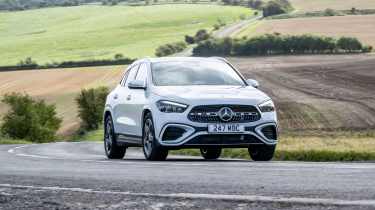
The regular GLA isn’t much fun to drive, due in part to a lack of steering feel and a relatively high centre of gravity, which aren’t surprising qualities for a compact SUV. Grip is good, though, so it’s stable and sure-footed around corners. If you want some thrills to spice up the school run, there’s the GLA 35 and 45 from AMG.
Motorway driving and long-distance comfort
The GLA’s ride isn’t as firm or harsh as rivals such as the Alfa Romeo Tonale or BMW X1, and its suspension absorbs bumps well. We felt during our testing that the plug-in GLA 250 e was more settled over larger bumps than the petrol or diesel versions, plus it can be driven in EV mode even at higher speeds, boosting refinement even further. However, there is perhaps a little more road noise inside the GLA than some rivals.
“For private buyers, the petrol GLA 200 will make plenty of sense. The mild-hybrid system is keen to cut out when coasting towards a junction, and the engine fires up smoothly when more power is needed." - Alex Ingram, Auto Express special contributor.
MPG & running costs
Pros |
|
Cons |
|
In 2023, Mercedes added mild-hybrid technology to the regular petrol and diesel versions of the GLA to help boost their efficiency. The petrol GLA 180 and 200 offer up to 43.5mpg on the WLTP combined cycle, and emit up to 155g/km of CO2. We achieved 43mpg when testing the updated Mercedes GLA 200 with mild-hybrid tech, which is almost exactly what Mercedes says it should be able to return.
The diesel GLA 200 d and 220 d perform better than their petrol counterparts in terms of fuel economy, returning up to 52.4mpg, while CO2 emissions reach up to 158g/km.
The BMW X1 is available with a similar selection of petrol and diesel engines, which are slightly more efficient on paper. The base petrol engine, for instance, can return closer to 50mpg, while the diesels can do almost 60mpg.
The hot AMG versions also utilise mild-hybrid tech. However, that doesn’t stop them from drinking through petrol. The GLA 35 returns 32.2mpg at best, while the GLA 45 does just 28mpg.
| Model | MPG | CO2 | Insurance group |
| Mercedes GLA 180 Sport Edition | 42.9mpg | 148g//km | 22E |
| Mercedes GLA 200 d Sport Executive | 52.4mpg | 142g/km | 26E |
| Mercedes GLA 200 AMG Line Premium Plus | 41.6mpg | 155g/km | 27E |
Electric range, battery life and charge time
For those looking to lower their running costs, the GLA 250 e plug-in hybrid model should be at the top of the list. That’s because it can (theoretically) return up to 282.5mpg and offers a pure-electric driving range of up to 45 miles, although that varies slightly depending on the trim level. In fact, we only saw a real-world average of 43mpg during our own test on a mixture of roads, which is pretty mediocre at best.
Like with all plug-in hybrid cars, in order to achieve the best figures from the 250 e you’ll need to ensure you top up the 16kWh battery as often as possible. This will take around four-and-a-half hours using a typical 7.4kW home wallbox charger.
| Model | Battery size | Range | Insurance group |
| Mercedes GLA 250 e AMG Line Executive | 16kWh | 45 miles | 25E |
Insurance groups
The entry-level GLA 180 Sport Edition falls into insurance group 22, so premiums are going to be on the high side. That said, the entry-level BMW X1 sDrive20i is in group 25. Equally, there’ll be no insurance bargains if you opt for a diesel version, with the base 200 d Sport Executive in group 26 and the GLA 250 e hybrid sitting in group 25.
Tax
While the plug-in hybrid model is technically the best Mercedes GLA for company car drivers, the all-electric Mercedes EQA attracts the very lowest Benefit-in-Kind (BiK) tax rates, so this is the better option if you want the biggest savings.
All buyers will need to be careful, though, because the vast majority of the GLA line-up crosses the £40,000 luxury car tax limit. This will add £440 to your annual VED road tax bill between the second and sixth year after the car is registered for the first time.
Depreciation
The Mercedes GLA’s brand credentials and premium status appear to be working in its favour on the used market. Our data shows that after a period of three years or 36,000 miles, this compact SUV should retain between 46 and 55 per cent of its original value.
This is a similar outcome to that faced by the BMW X1, which manages 47 to 53 per cent. The Audi Q3, meanwhile, is also in a similar bracket between 47 and 55 per cent.
To get an accurate valuation on a specific model check out our free car valuation tool...
Interior, design & technology
Pros |
|
Cons |
|
The original GLA didn’t really hit the mark for being the best-looking small SUV, and was missing the crucial sense of style that most Mercedes customers desire. The Mk2 offers much more kerb appeal, with the interior including quality materials and much greater focus on technology, with a dual-screen infotainment system featuring in every model.
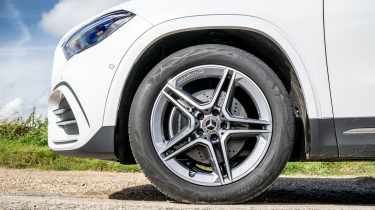
Outside of the Mercedes-AMG performance models, customers now have the choice of five core trim levels. Standard equipment on the most entry-level GLA Sport Edition includes 18-inch alloy wheels, LED headlights, heated front seats, keyless go, a reversing camera and a 10.25-inch touchscreen with Apple CarPlay and Android Auto connectivity.
Our pick of the range is AMG Line Executive, because it’s available with a choice of engines and adds:
- AMG styling kit
- 19-inch alloy wheels
- Privacy glass
- AMG sports seats with leather and suede upholstery
- Nappa leather steering wheel
- Wireless smartphone charging pad
- 64-colour ambient lighting
If you feel like opting for AMG-Line Premium or AMG-Line Premium Plus trim levels, these offer luxuries such as 20-inch rims, adaptive dampers, a panoramic sunroof, a head-up display, a 360-degree parking camera and more driver-assistance tech.
Interior and dashboard design
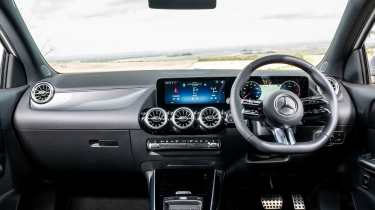
The GLA’s dashboard design is virtually identical to the Mercedes A-Class hatchback, including its pair of 10.25-inch displays, a bank of climate controls and a row of three circular air vents. That said, the top of the dashboard is taller in the GLA, and it offers a more upright driving position, as one would expect from an SUV.
Materials and build quality
The BMW X1 and Audi Q3 might feature fresher, more modern interiors, but the quality of the GLA’s is still very impressive. There are lots of soft-touch materials - the AMG Line Executive model we drove featured leather and suede on the doors and centre console - plus the metal switchgear is satisfying to use, especially when you hear and feel the click of the rotary controls on those metal air vents. However, it’s very fiddly trying to use the various controls on the steering wheel.
Sat-nav, stereo and infotainment
The GLA’s infotainment system is great. The built-in sat-nav can feature augmented reality if you tick the right box, which means it will overlay directional arrows onto a live picture of the view ahead displayed on the 10.25-inch touchscreen. It’s clever tech, but you have to take your eyes off the road to benefit from it, so it has its strengths and its flaws.
Of course, you can use the standard Android Auto and Apple CarPlay smartphone connection, if you prefer. You’ll have to plug in your phone, but a wireless charging pad is included on AMG Line Executive trim and above, if you don’t use either of these functions.
Otherwise, the graphics on the Mercedes set-up are super-sharp, and the touchscreen responds quickly; you can use the touch-sensitive pad on the transmission tunnel, but it’s a bit tricky at times. The menu layout removes a lot of the complexity because it’s so simple to navigate.
“The chunky steering wheel is good to hold, but the twin horizontal spokes that are packed with multifunction controls are a bit fiddlier to use than necessary.” - Dean Gibson, senior test editor.
Boot space & practicality
Pros |
|
Cons |
|
Mercedes increased the interior space for the second-generation GLA by making it a full 110mm taller than the original model, and extending the wheelbase by 30mm. Boot space also grew as a result, and it’s still on par with the newer BMW X1 and Audi Q3, plus the Range Rover Evoque.
Dimensions and size
At just over 4.4 metres long, the GLA is smaller than its BMW X1 and Audi Q3 rivals, plus the Volvo XC40, MINI Countryman and Alfa Romeo Tonale. However, that doesn’t stop the Mercedes from offering more boot space than almost all of them, except the BMW and certain versions of the Alfa.
| Model | Mercedes GLA | BMW X1 | Audi Q3 |
| Length | 4,412mm | 4,500mm | 4,531mm |
| Width | 1,834mm | 1,845mm | 1,859mm |
| Height | 1,616mm | 1,642mm | 1,608mm |
| Wheelbase | 2,729mm | 2,692 mm | 2,680mm |
| Boot space | 495 litres | 540 litres | 488-575 litres |
Seats & passenger space
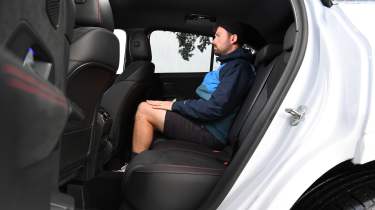
Space upfront in the GLA is more than adequate, although rear-seat passengers may find things a bit tighter. Rear legroom is just about okay, and headroom could be an issue for taller individuals, due to a sloping roofline. The rear seat backs recline, which may help in this regard.
When we tested the GLA against the Alfa Tonale, we found the Mercedes’ cabin wasn’t as wide as its rival’s (1,433mm for the GLA versus 1,456mm for the Tonale), which means trying to seat three adults across the back will be more of a squeeze. Plus, while the two outer seats are sculpted - and both feature a set of Isofix mounting points for child seats - the middle chair is more of a perch.
Boot space
Petrol-powered versions of the GLA offer up to 485 litres of boot space, while diesel models have 487 litres. However, you can only cram up to 445 litres worth of stuff into the plug-in hybrid 250 e. That’s less than the equivalent BMW X1 or Audi Q3, but we think it should just be enough to accommodate the luggage of a family of four.
The GLA also boasts a more flexible 40:20:40 split folding rear seat, revealing 1,422 litres of space to play with in the diesel version (1,420 litres in the petrol), or 1,385 litres in the plug-in hybrid.
Reliability & safety
Pros |
|
Cons |
|
Safety is an area where Mercedes customers can feel reassured. The latest GLA went through Euro NCAP’s battery of crash tests in 2021 and achieved the organisation’s maximum five-star safety rating. It was also awarded a very impressive 96 per cent adult occupant protection score, and a 90 per cent score for child occupant protection.
It only got a 75 per cent score in the safety-assist category, but that’s not to say the GLA doesn’t come with any driver-assistance tech. In fact, every model includes lane-keeping assist, Active Brake Assist, cruise control, auto headlights and rain-sensing wipers.
Top-of-the-line AMG Line Premium Plus versions also have adaptive cruise control, blind-spot monitoring, lane-change assist and other ADAS tech as standard, but you can add it to lower-spec models by adding the optional Driving Assistance package for £1,495. Although it is worth noting that less expensive cars and some of the GLA’s rivals, such as the Audi Q3, come with this technology as standard.
The Mercedes GLA didn’t make it onto our most recent list of the best cars to own, which is based on the results of our Driver Power owner satisfaction survey. However, the Mercedes A-Class hatchback (which the GLA is based on) finished in 11th place out of the 50 cars included in the survey, and Mercedes as a brand came second out of 31 brands in our best car manufacturer rankings. Subaru finished first this time around.
Buying and owning
- Best buy: Mercedes GLA 200 AMG Line Executive
For most buyers, the simple mild-hybrid petrol engine will meet their everyday needs, and the 161bhp GLA 200 delivers adequate performance and decent fuel efficiency. In AMG Line Executive trim, it’s priced at just over £42,000, so it will incur the luxury car tax supplement, but we think it’s worth paying the extra money for the features you get over lesser Sport Edition and Sport Executive models.
Alternatives
The Mercedes GLA’s biggest and closest rivals are the BMW X1, Audi Q3 and Volvo XC40, because all four are offered with a similar choice of powertrains, feature premium interiors and are similarly practical.
There are also plenty of small premium electric SUVs that are worth your consideration. These include the GLA’s sibling, the Mercedes EQA, as well as the BMW iX1 and Volvo EX40.
Key updates of the Mercedes GLA review
14 May 2026: Latest driving impressions and depreciation data.
Frequently Asked Questions
The Mercedes GLA comes with a three-year warranty, and there’s no mileage limit during that time. This is pretty par for the course when compared with BMW and Volvo, but a bit stingy compared to Kia and MG’s seven-year plans.
Deals on the GLA and alternatives