Best diesel cars 2026
Diesel power strikes a balance between performance and fuel economy, and these are the best diesel cars you can buy today

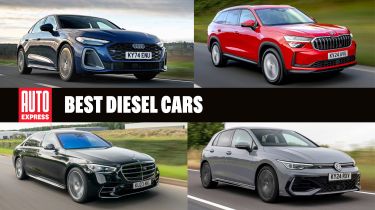
Sales of diesel-powered cars have been on a steady decline for the past few years, with some manufacturers dropping these engines from certain model line-ups all together. But even in 2026, there’s still a strong case for choosing a diesel car over a petrol, hybrid or electric one.
The best diesel cars on sale still offer advantages in fuel economy and CO2 emissions over petrol-engined cars, making them a sensible choice for some buyers. They are particularly suitable for people who need a larger car, cover higher mileages and don't have easy access to EV charging infrastructure.
The smooth, muscular power delivery of a diesel engine really comes into its own on longer journeys, as does the long driving range. Diesel-power can’t really be beaten when it comes to towing trailers or caravans, either, thanks to its strong torque.
With that in mind, we’ve pulled together the top 10 best diesel cars on sale now as chosen by our expert road testers. These cars offer a great combination of low running costs and superb performance...
Compare the best diesel cars
| Rank | Car | Price from | Overall rating | Max. WLTP combined efficiency | Buy |
| 1 | Skoda Octavia | £32,000 | 4.5 | 64.2mpg | Latest deals |
| 2 | Mercedes C-Class | £47,500 | 4 | 62.8mpg | Latest deals |
| 3 | Volkswagen Golf | £31,000 | 4 | 64.2mpg | Latest deals |
| 4 | Skoda Kodiaq | £41,000 | 4.5 | 53.3mpg | Latest deals |
| 5 | Mercedes E-Class | £58,300 | 4 | 58.9mpg | Latest deals |
| 6 | Mazda CX-80 | £53,500 | 4 | 49.6mpg | Latest deals |
| 7 | Audi A5 | £51,000 | 4 | 57.2mpg | Latest deals |
| 8 | Skoda Superb | £39,000 | 4.5 | 57.6mpg | Latest deals |
| 9 | Land Rover Defender | £60,000 | 4.5 | 33.8mpg | Latest deals |
| 10 | Mercedes S-Class | £110,000 | 4 | 45.6mpg | Latest deals |
You can find our ratings for the top 10 diesel cars using the table below, along with our scores and official ratings for each model's efficiency. Scroll down or use the links to jump to a particular make and model..
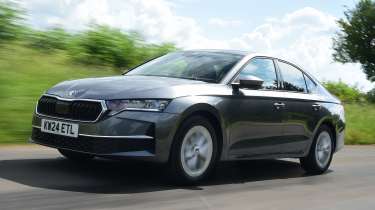
1. Skoda Octavia
Our favourite diesel car right now is a great all-rounder with very few downsides.
- Prices from £32,000
| Pros | Cons |
|
|
The Skoda Octavia is one of the best family cars currently on the market thanks to its efficient engines, practical cabin, great user-friendly technology and focus on value for money.
Having received a facelift in 2024, our Family Car of the Year at the 2024 New Car Awards retained all the crucial elements which make it an award winner. First and foremost, the 2.0-litre diesel engine available in the line-up comes in two states of tune: a lower-powered, 114bhp version that’s capable of up to 64.2mpg, or a 148bhp alternative with a DSG automatic gearbox that still achieves 63.2mpg.
Performance is more than adequate, with the 0-62mph sprint takes 10.4 and 8.5 seconds respectively, and while the turn of speed won’t blow you away, there’s more than enough performance for keeping up with traffic and merging on to faster roads.
Inside, passenger space is excellent, with plenty of legroom and headroom throughout. The boot is an impressive size too, measuring 600 litres even with the rear seats in place. Should you drop those down, capacity rises to 1,555 litres.
“If you need a hugely practical family car that’s comfortable, refined, good to drive and well-equipped, then the Octavia should be near the top of your shopping list.” – Alex Ingram, ex-chief reviewer.
- Who will like it? Family car buyers focused on practicality and value for money.
- Who won’t like it? There are still those who can’t quite look past the Skoda brand.
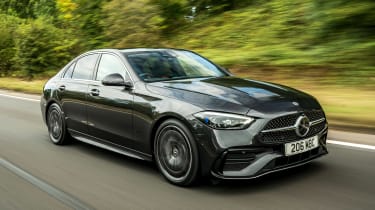
2. Mercedes C-Class
If a high-quality interior, strong efficiency figures and great on-board technology are near the top of your priorities, the Mercedes C-Class is a fine pick.
- Prices from £47,500
| Pros | Cons |
|
|
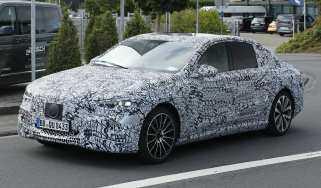
In most comparisons of compact executive cars, the BMW 3 Series tends to have a small edge over the Mercedes C-Class. But among current models, it’s Mercedes that has the edge with diesel. Fine though BMW’s four-pot diesel is, the 2.0-litre mild hybrid in the C220d offers truly remarkable real-world fuel economy, giving it the edge for us.
Official combined economy is 62.8mpg (the more powerful C300d is impressive too at 54.3mpg) but on a steady motorway run you can expect even more, with effortless torque, long gearing, and excellent aerodynamics making the C-Class a real fuel-sipper. It’s no slouch either, with 197bhp at its disposal and a 0-62mph time of 7.3 seconds.
And of course, the C-Class is a fine car in its own right too, with composed handling, a smooth ride, and a cabin that takes more than a little inspiration from the S-Class flagship, with plenty of tech and great seat comfort.
“We’ve tried the C 220 d mild-hybrid model and found it an incredibly smooth drive: with 440Nm of torque available from 1,800rpm, the C-Class was able to effortlessly shift up to higher motorway speeds and remained relatively quiet and composed under harder acceleration.” – Pete Baiden, web producer.
- Who will like it? Anyone looking for a compact executive saloon with a focus on refinement.
- Who won’t like it? Those who put driving thrills at the top of their agenda.
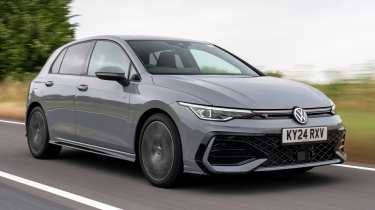
3. Volkswagen Golf
A stalwart of the family car class, the Mk8.5 is one of the best Golf generations yet.
- Prices from £31,000
| Pros | Cons |
|
|
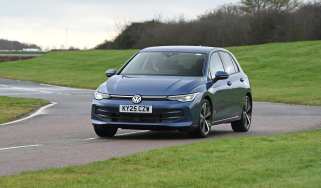
The eighth-generation Volkswagen Golf didn’t endear itself to us as much as its predecessor when it launched with its annoying touch-sensitive buttons. The facelift that arrived in 2024 aimed to write many of the wrongs, getting rid of the haptic controls on the steering wheel for some good old-fashioned physical buttons, and while the touch-sensitive slider remains under the central touchscreen it is at least backlit these days.
What we’ve always liked about the current Golf is the 2.0-litre TDI diesel engine. Available in 114bhp form in Match trim or in R-Line trim for the more powerful 148bhp version, they’ll return a very impressive 63.5mpg and 60.5mpg respectively.
While its CO2 emissions won’t make it very popular with company car users, as a private buy its miserly consumption will keep running costs about as low as anything this side of an electric car.
“I think the six-speed manual is fine, but not as slick as it could be. Also, the clutch pedal in the Golf lacks a bit of feel for the biting point, requiring a little acclimatisation before you get the knack for making smooth gear changes. Ultimately, the DSG automatic makes for a better driving experience” – Max Adams, online reviews editor
- Who will like it? Those who like understated style and quality
- Who won’t like it? Anyone wanting to stand out from the crowd.
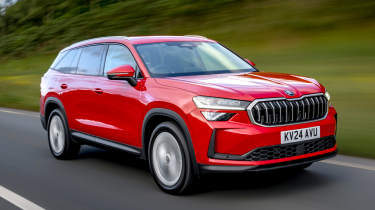
4. Skoda Kodiaq
Skoda’s value-for-money ethos and focus on practicality make the Kodiaq a tough large SUV to beat.
- Prices from £41,000
| Pros | Cons |
|
|
It’s no surprise to see the second of three Skodas in this list, given that all three come with the same 148bhp 2.0-litre TDI diesel engine. While it’s offered in a few Volkswagen Group cars, you get more for your money with the Skoda-badged offerings.
Indeed, the Skoda Kodiaq diesel is offered in five or seven-seat guises, so those with big families will be well catered for here. Thanks to the engine’s strong torque, the Skoda doesn’t feel particularly underpowered, either, despite its size and weight. The 53.2mpg economy figure (51.7mpg in the seven-seater) is impressive, too.
The cabin is filled with lots of storage cubbies and the boot is generous at 910 litres, or 310 litres in the seven-seat Kodiaq when the third row is in position. Most passengers should be well-catered for when it comes to head, knee and legroom, although those passengers in the rearmost row might feel a bit squeezed.
“The Kodiaq is spacious, efficient and features plenty of clever touches, while the cabin has taken a step upmarket when compared with the first model.” – Dean Gibson, senior test editor.
- Who will like it? People interested in getting the maximum bang for their buck
- Who won’t like it? Larger families who really need seven seats may find rivals more spacious.
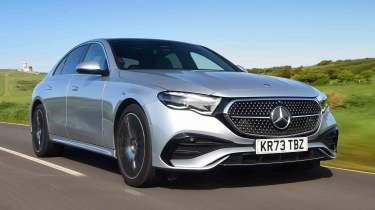
5. Mercedes E-Class
There are very few cars which can match the Mercedes E-Class when it comes to being a comfortable long-distance cruiser.
- Prices from £58,300
| Pros | Cons |
|
|
The Mercedes E-Class and diesel power go hand in hand — which is something you’d expect, given how popular it’s been with taxi drivers over the decades. Unlike the BMW 5 Series, which has abandoned diesel engines in its latest form, the E-Class continues to offer a diesel option in mild-hybrid or plug-in hybrid guises.
The mild-hybrid E 220 d is a great car, thanks to its frugal engine that will return 58.9mpg in the basic AMG Line trim. Around town, you can hear the diesel engine, but it settles down at speed – and, along with an 855-mile range, makes the E-Class a wonderful long-distance cruiser.
It doesn’t matter if you’re up front or being driven around in the back, the Mercedes E-Class is a very comfortable car thanks to some generous leg- and kneeroom, and the seats are really supportive, unlike those in its arch-rival, the BMW 5 Series.
“The Mercedes E-Class is something of a lifeline for buyers needing a car that can travel huge distances in comfort and without having to stop often for fuel. Diesel E-Classes make for great tow cars too with a 2,100kg braked trailer weight limit, even beating some SUVs” – Dean Gibson, senior test editor.
- Who will like it? Anyone looking for a comfortable and spacious saloon car
- Who won’t like it? Tech-laden interiors aren’t to everyone's taste, and the E-Class might be overwhelming for some.
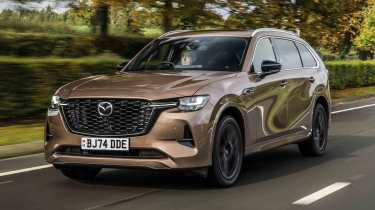
6. Mazda CX-80
The Mazda CX-80 is a great large SUV for those who don't want to follow the crowd.
- Prices from £58,300
| Pros | Cons |
|
|
The Mazda CX-80 manages to hit all the right notes for a large SUV when it comes to the space and versatility you’d expect from a seven-seater, and while the plug-in hybrid petrol engine is a great powertrain, the diesel unit suits the CX-80 down to the ground.
The 3.3-litre six-cylinder diesel unit produces 251bhp and a meaty 550Nm of torque. What this means is that the Mazda easily beats premium rivals like the more expensive entry-level BMW X5 xDrive30d in the towing department. The CX-80 can tow up to 2,500kg where the entry-level X5 can only tow 1,700kg. To match the Mazda in an X5 you’ll need to step up to the X5 xDrive40d which costs a whopping £26,000 more than the CX-80.
Fuel economy isn’t too bad either considering the CX-80’s size, with a claimed 49.6mpg which is pretty respectable.
The cabin feels incredibly sturdy and generally well put together. Unlike some of its German rivals, the CX-80 has made use of physical buttons and a rotary dial when it comes to navigating the infotainment system and using the climate controls. The cabin feels pretty airy and there’s plenty of usable space, including a 687-litre boot capacity.
“Unlike some seven-seat SUVs, there’s more than enough headroom and legroom in the rearmost seats for even six-feet tall adults to get comfortable. We noticed that the third-row seats are shallow, which meant our legs were slightly raised from the seat bases, but it’s only a minor gripe.” - Jordan Katsianis, news editor
- Who will like it? People looking for a left-field seven-seater car choice, or those who tow trailers and caravans
- Who won’t like it? The looks aren’t for everyone.
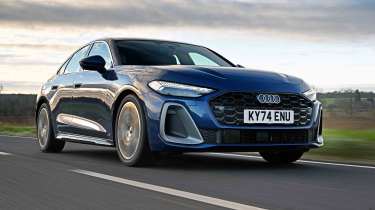
7. Audi A5
Solid, secure and dependable, the Audi A5 is an automotive jack-of-all-trades.
- Prices from £51,000
| Pros | Cons |
|
|
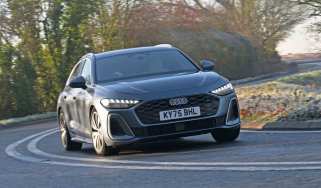
The latest Audi A5 replaces the old A4, as well as various incarnations of the old A5. Knowing that diesel remains popular in this class, the A5 retains a 2.0-litre, 201bhp turbocharged four-cylinder diesel, available in both front-wheel drive and with Audi’s quattro all-wheel drive system.
Economy is the obvious benefit of these models, with up to 57.2mpg in two-wheel drive form and 55.3mpg as the quattro. Not quite enough to match the C-Class mentioned above when it comes to overall economy, but this diesel engine will keep fuel costs low and with a 61-litre fuel tank, 700 miles without stopping for fuel should be well within reach.
The new A5 keeps traditional Audi traits like a well-built interior (though it’s a little heavy on the screens these days), and the hatchback layout makes it more practical than the old saloon. There’s still an Avant estate too if you need even more space.
“The experience behind the wheel won’t tempt keener drivers, but the A5 doubles down on being a high-quality, solid and sensible car with smart looks and better legroom (although not headroom) for rear passengers.” – Paul Barker, editor.
- Who will like it? Those looking for a solid and secure driving experience rather than loads of fun
- Who won’t like it? If you want efficiency, rivals like the Mercedes C-Class might be more appealing.
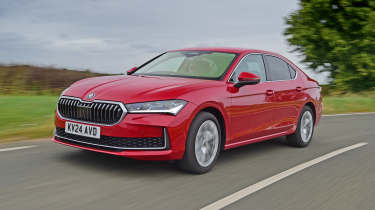
8. Skoda Superb
Few cars are as boldly named as the Skoda Superb, but it’s a firm favourite that lives up to its billing.
- Prices from £39,000
| Pros | Cons |
|
|
The latest Skoda Superb picks up where the third-generation model left off. Skoda set about improving the car’s boot space (now a whopping 645 litres for the hatch and 690 litres for the estate) and adding a flashier, tech-filled cabin.
Thankfully, there are still diesel options available, with a 2.0-litre four-cylinder TDI putting out either 148bhp or 190bhp. The lower-powered version is able to reach 57.6mpg, but the more powerful diesel engine doesn't fare as well, only returning 47.9mpg.
The estate version is only slightly more thirsty at 55.4mpg, and on long journeys you can expect a figure much closer to 60mpg. At this kind of economy, you can expect a real-world range of 800 miles or more – enough to get from London to Edinburgh and back on one tank.
“Both the king-size hatchback and massively practical estate car versions are comfortable, hugely spacious, and offer a well-finished interior at an affordable price.” – Ellis Hyde, news reporter.
- Who will like it? People who want a comfortable, classy long-distance cruiser who don’t want to break the bank
- Who won’t like it? The Skoda badge won’t appeal to everyone.
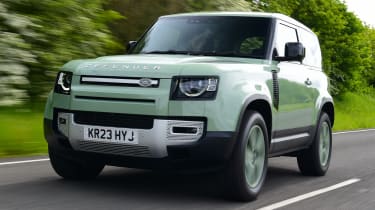
9. Land Rover Defender
If you’re after a great tow car and regularly head off-road, there’s nothing quite like the Land Rover Defender.
- Prices from £60,000
| Pros | Cons |
|
|
Land Rover silenced the doubters, producing a Defender worthy of its predecessor’s famous name. It’s clearly a more technologically advanced and luxurious car, but it hasn’t lost any of its character or core attributes, which means the Defender is equally at home on the steepest of muddy slopes or in the urban jungle.
While die-hard Landie fans have moaned about the price and luxuriousness of the new Defender, the current car is worlds apart from its agricultural predecessor. The diesel-powered mild-hybrid D250 edition is no slouch, with the three-door Defender 90 S managing the 0-62mph sprint in just 7.6 seconds, which is pretty good going when you consider it’s almost three tonnes. Even the huge 130 model takes only 7.9 seconds, and both versions will return around 33mpg on a WLTP combined cycle.
While the CO2 emissions are relatively high – the D250 emits 223g/km – those looking for a practical, incredibly competent off-roader are in the right place.
“Core to the Defender’s appeal is, of course, its off-road ability, which very few SUVs can match. Although a true 4x4, it also works well as a family car and looks the part in the most upmarket environments.” – Alastair Crooks, senior news reporter.
- Who will like it? Anyone seeking a 4x4 which really can go almost anywhere
- Who won’t like it? Die-hard original Land Rover Defender fans.
Latest Land Rover Defender deals
10. Mercedes S-Class
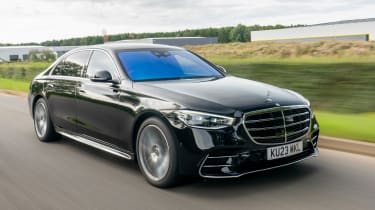
Mercedes has hit the bullseye with comfort levels and refinement in the S-Class.
- Prices from £110,000
| Pros | Cons |
|
|
Massive road presence and a cosseting interior mean the Mercedes S-Class is a top luxury car, and it's at its best in diesel guise: if you want the ultimate in luxury driving, then look no further.
Mercedes does offer a hybrid S-Class as its true economy champ, but the hybrid powertrain isn't as well suited to the car so we’d opt for the 3.0-litre twin-turbo six-cylinder. This powerplant is super-smooth yet seriously quick, with 0-62mph taking just 6.4 seconds – quite a feat in a car weighing nearly two tonnes. Yet driven carefully it will return 42.8mpg.
Whatever guise the S-Class is in, it irons out any imperfections in the road. Sophisticated technology 'reads' the road ahead and is able to prep the air suspension for upcoming bumps. This really is one of the most comfortable cars short of a Rolls-Royce Phantom.
The Mercedes S-Class has always been a showcase for the absolute latest technology and this one doesn't disappoint, with two 12-inch screens in the dash, mobile data, optional night vision, and reclining rear seats. Plus in an industry first, there isn't a single filament lightbulb on the car.
“The S-Class is a supremely luxurious, refined and technology-laden conveyance for affluent and successful individuals, and the current seventh-generation car has a bold face that enhances its opulent style.” – Max Adams, online reviews editor.
- Who will like it? Those looking for the ultimate luxury saloon to drive or be chauffeur driven in
- Who won’t like it? The screen-filled interior won’t be for everyone
Should you buy a diesel car?
Our top 10 diesel cars offer smooth driving, great efficiency and plenty of power for every day needs, although you should still consider whether a diesel model suits you.
If you do lots of short, urban low-speed journeys, then you won't be getting the best from a diesel, and a petrol, hybrid or electric car might be a better bet. That’s part of the reason why so few small cars are offered with diesel engines today.
Diesel is still the engine of choice if you cover longer distances, as it's more fuel efficient than an equivalent petrol, while the torque of a diesel engine means they're well suited to towing, but without harming fuel economy too severely.
Automatic diesel cars
Given the kind of long distance driving which diesel cars excel at, automatic gearboxes are a very popular choice.
The user-friendlyness of a self-shifting gearbox is great whether you’re cruising on the motorway or stuck in an urban traffic jam. Automatic gearboxes also take a lot of the strain out of driving when you’re towing a caravan or trailer, allowing you to concentrate on the job at hand.
Unlike automatic cars of old, modern auto gearboxes are just as efficient, if not more so than the manual equivalent, too.
Of course, many of the models available above can be chosen with a manual gearbox if that’s what you’d prefer. When it comes to servicing, it’s worth mentioning that manual cars are generally cheaper and require less maintenance as they have a less complex design.
The challenges facing diesel
Today's diesel cars are a far cry from the noisy, rattly, smoky diesels of old. They use clever particulate filters and additional measures that are designed to cut exhaust emissions, and one study has estimated that you would need to put 42 million new diesel cars on the road to match a coal-fired power station for harmful nitrogen oxide emissions.
That hasn’t stopped the UK government from introducing schemes like the Ultra Low Emissions Zone (ULEZ) in London as a deterrent for drivers of high-polluting vehicles. Unfortunately for drivers of most diesel cars registered before 2016, their cars don’t meet the standards set by Euro 6 and they’ll need to pay to enter the ULEZ zone. Every new diesel car on sale today is Euro 6 compliant and increasing numbers are also compliant with the tougher RDE2 real-world emissions standards.
The reputation of diesel wasn't helped by Volkswagen and the Dieselgate scandal. The manufacturer fitted devices to some of its TDI engines to achieve better emissions results in lab tests than were possible in everyday driving. The resulting scandal pushed through the introduction of the more representative WLTP and RDE emissions tests that give a closer indication of the fuel economy and emissions a car will produce in the real world. But even the VW story was concentrated on older diesel engines, and the current ones are just as clean and efficient as those made by rivals.
As part of the fallout of the diesel backlash, some manufacturers rolled back on the number of diesel models they offer. Small diesel engined cars in particular are now rare with hybrid and electric technology taking over. On the whole, however, a diesel car is still a sound choice for the new car buyer with the right usage patterns.
Key updates
- January 23 2026: The Mazda CX-80 is a new addition to the list in sixth place, while the Volkswagen Golf, Skoda Kodiaq, Audi A5, Skoda Kodiaq and Mercedes S-Class change positions. The Kia Sorento was removed from tenth place.
Diesel power not for you? Check out the best hybrid cars...