Peugeot E-3008 review
The Peugeot E-3008 looks the part, but is held back by disappointing performance and a harsh ride

Our opinion on the Peugeot E-3008
The Peugeot E-3008 is a spacious, efficient EV with a stunning cabin design. But that aside, this electric SUV does little to move the game on. Performance is sub-par, while ride comfort disappoints. It’s by no means a bad car, but given the significance of the E-3008 both for Peugeot and the entire Stellantis group, we were hoping for more. Strong finance deals rescue what would’ve otherwise been a lower score.
About the Peugeot E-3008
The Peugeot 3008 can trace its lineage back to 2008, when the French manufacturer first stepped into the family crossover arena to challenge the Nissan Qashqai. The early 3008 was an awkward-looking thing but offered the requisite raised driving position, which was raised even further with 2016’s second-generation 3008, which went down the path of becoming an SUV.
Now in its third generation, the latest version introduced fully electric power to the 3008 range, and that’s the car we’re focusing on here. We also have a dedicated Peugeot 3008 review if you’re interested in the regular petrol, hybrid, or plug-in hybrid versions.
We’ve tested various versions of the E-3008 since it arrived, and even tested a top-spec GT trim Peugeot E-3008 against a Skoda Enyaq Coupe. We have also run a Peugeot E-3008 as part of our long term test fleet.
Performance & driving experience
Pros |
|
Cons |
|
On paper the E-3008 is pitched just about where it should be, with performance and range figures that land it squarely in the middle of a competitive class. However, it’s the driving experience that lets the side down. It’s not bad, but the firm ride means it’s less comfortable than many rivals, without the usual trade-off of being entertaining to drive - it’s merely competent rather than sporty and engaging.
Electric motors, 0-60mph acceleration and top speed
The E-3008 single motor makes 211bhp and 343Nm. Not outstanding figures, and so it proves on the road. Performance is sprightly enough below 30mph, but the acceleration tails off significantly as you approach motorway speeds. There’s not a whole lot of extra performance from the Long Range model despite greater power (228bhp), though efficiency is clearly the focus there. We’re also big fans of the introduction of steering-wheel mounted paddles to access its three levels of brake regeneration on the fly.
Used - available now


It’s the dual-motor model that offers a real hit of power, with a hot-hatch challenging 321bhp at its disposal and the traction advantage of all-wheel drive. 0-62mph in six seconds flat is the result, achieved by little more than pressing the pedal into the carpet. However, at nearly 2.2 tonnes, the dual-motor E-3008 is several hundred kilograms heavier than the average 300-horse hot hatch, which does suck some urgency out of the way it deploys its power. It’s quick, but don’t expect the kind of kick in the kidneys you get from the fastest Tesla Model Y or the quicker Hyundai Ioniq 5 variants.
| Model | Power | 0-62mph | Top speed |
| E-3008 Allure standard range | 211bhp | 8.8sec | 106mph |
| E-3008 Long Range | 228bhp | 8.7sec | 106mph |
| E-3008 Dual Motor | 321bhp | 6.0sec | 112mph |
Town driving, visibility and parking
At a basic level, the E-3008’s not bad in town, with pretty good forward visibility, and a wieldy feel thanks to a fairly quick steering ratio and the small wheel. But the steering’s also a drawback, since even from low speeds, there’s an odd, sticky sensation just off centre. In sport mode, it gets heavier and even more gloopy, which takes away from what might otherwise feel like a relatively responsive car. Ride comfort also isn’t ideal, without the pliancy over speed bumps and potholes that some rivals seem to provide with ease.
B-road driving and handling
Out on the open road the quick steering gives the E-3008 an agile feel through corners. There isn’t much body roll either, and there’s enough grip to keep up a decent pace. The lack of roll is another sign of how firm Peugeot has set the ride though. On a country road it thumps strongly into every compression, and leaves you worrying for the state of the alloys on particularly potholed stretches.
Motorway driving and long-distance comfort
Refinement is strong, with road and wind noise well-suppressed from the inside. The ride quality still isn’t ideal, but it definitely settles down at speed compared to its behaviour in town and on B-roads, while the E-3008’s weight gives it a planted feel on the motorway too. The cabin’s not a bad place to spend long commutes in.
Range, charging & running costs
Pros |
|
Cons |
|
While you won’t quite match Peugeot’s figures in the real world, the battery range offered by most variants of the E-3008 is competitive, with up to 435 miles in the 97kWh Long Range model, and 326 miles in the 73kWh standard range version. The only variant not to distinguish itself in this respect is the high-performance dual-motor car, whose claimed 300 miles means you’ll see realistic figures in the mid-200s.
Electric range, battery life and charge time
With the largest 97kWh battery pack, dubbed the Long Range version, the E-3008 is claimed to cover up to 435 miles on a charge, one of the bigger numbers you’ll find for an SUV in this class. Even the smaller 73kWh battery model covers 326 miles on a charge – very close to the top-spec Skoda Enyaq’s 348-mile maximum. You can thank the Peugeot’s efficiency for that; WLTP numbers suggest the E-3008 can hit 4.6 miles per kWh.
Charging speeds are decent, too. At 160kW, the E-3008 is above average for the class, pipping the Scenic (150kW) if not quite matching the rapid rates of a Tesla Model Y or Hyundai Ioniq 5. An E-Routes feature can calculate the optimum route on a longer trip by considering the distance, available range, charge-station locations and traffic conditions to make the journey as easy and efficient as possible. E-Routes is accessible through a mobile device connected to the infotainment system.
We’ve never quite managed to match Peugeot’s efficiency claims on our own drives, but 4.2 miles per kWh away from motorways translates into a still-impressive 307-mile range. Overall, we managed to average 3.9 miles per kW in our long term GT trim 73kWh 3008 test car, or 285 miles of range to a charge. The fact that a heat pump is a £700 optional extra on most versions (bar the range-topping GT Premium where it’s standard) is disappointing.
| Model | Battery size | Range | Insurance group |
| 3008 Electric | 73kWh | 326 miles | 32E |
| 3008 Long Range Electric | 97kWh | 435 miles | 33E |
| 3008 Dual Motor Electric | 73kWh | 308 miles | 40E |
Insurance groups
Opt for a standard range E-3008 in entry-level Allure trim and insurance kicks off in group 32E, while the dual-motor GT and GT Premium at the top of the range sit in group 40E. You might end up spending more to insure an E-3008 than a Skoda Enyaq as a result, which starts in group 27E and tops out at group 39 even in vRS form, though ultimately insurance costs will come down to your personal circumstances.
Tax
This one’s straightforward: like all electric vehicles, any E-3008 costing under £50,000 (which means the entire range at the time of writing – even with options) is subject to a VED bill of £10 in the year of registration, and then a flat rate of £200 per annum thereafter.
Electric vehicles will be subject to an eVED pay-per-mile scheme, which will start from 3 pence per mile from April 2028, but will more than likely increase in cost from April 2029 onwards.
Depreciation
The E-3008 isn’t expected to retain its value as well as some of its rivals according to our expert valuation data. Over three years or 36,000 miles, it is only likely to retain 38 per cent of its original value, and while that is slightly more when compared with the Genesis GV60 (36 per cent), its someway behind the likes of the Ford Capri (43 to 51 pre cent), Nissan Ariya (42 to 51 per cent), or Renault Scenic (54 per cent).
Interior, design & technology
Pros |
|
Cons |
|
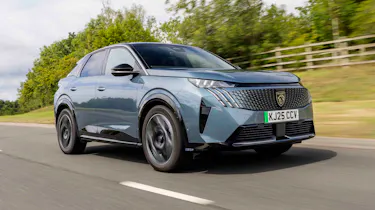
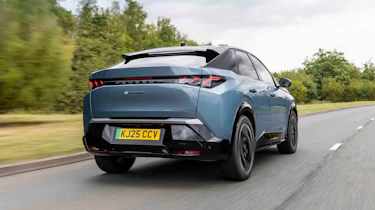
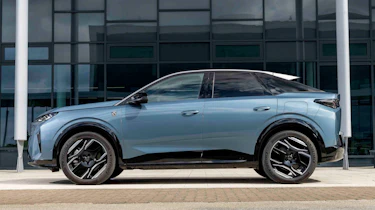
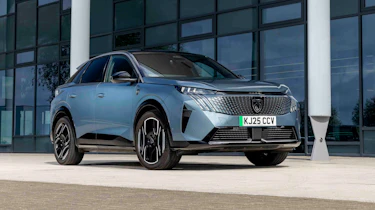
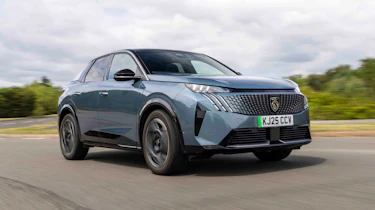
It’s a sharp looker, the E-3008. Peugeot has cultivated a certain style for its range that certainly stands out on the road, even in an otherwise all-too-familiar body style like that of a family SUV. The 3008’s sloped roofline helps, Peugeot presumably deeming the small practicality hit to be worth it for a more rakish shape. It’s augmented at either end by lights that incorporate Peugeot’s tiger-claw signature, while at the front there’s an intricate grille design and at the rear, a neat tailgate spoiler for aerodynamics, and a sharp kick to the trailing edge of the boot. Some of the alloy wheel designs are pretty striking too.
Interior and dashboard design
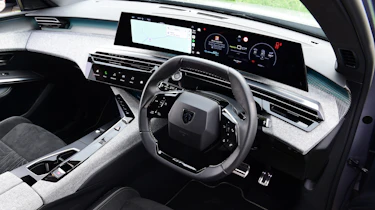
The E-3008’s cabin is undoubtedly one of its strongest suits, with a dashboard that swoops dramatically around the driver to form a sporty and luxurious feel. It’s unlike anything else in the segment, and the use of materials, ambient lighting and contemporary design make it class-leading - and makes some rivals feel somewhat uninspiring with their standard-issue flat dashboards and near-identical touchscreen positions.
Peugeot continues to use a small steering wheel mounted a little lower than is conventional, which adds to the futuristic feel and isn’t placed to block the instruments unless you have the seat in a particularly odd position.
Materials and build quality
It looks great, and it feels well-built too. Peugeot’s build quality has come on in leaps and bounds over the years and the E-3008’s interior bears scrutiny with pretty much anything else in the sector, at least on initial inspection - only time will tell if it’s equally solid in the long-term. The cabin’s ambience is lifted further by the choice of materials. Cheap-looking piano black plastic is kept to a minimum, there’s fabric trim on the dashboard rather than a huge expanse of plastic, and ambient lighting casts a soft glow onto the fabric too. The metal-trimmed floating bridge looks and feels the part too.
Infotainment, sat-nav and stereo
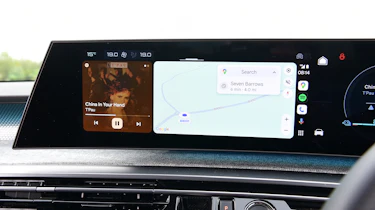
The in-car tech set-up is similar to the system used in the Peugeot 308 hatchback, with customisable shortcut widgets on a secondary touchscreen making it easy to work with. Unlike in its hatchback sibling, however, the 3008’s screen forms a single 21-inch display that flows into the main driver instrument cluster, which appears to float above the dash.
Boot space & practicality
Pros |
|
Cons |
|
Peugeot has judged the E-3008 about right for accommodation and space. Clearly a boxier design would’ve liberated more interior volume and allowed for a bigger boot, but the usual compromise in favour of style hasn’t actually harmed the 3008 that much - there’s decent room for adults both front and back (and kids will have no problem), while the boot, if not loaded to the roof at least, is larger than you’ll find in a Renault Scenic.
Dimensions and size
| Dimensions comparison | |||
| Model | Peugeot E-3008 | Renault Scenic E-Tech | Skoda Enyaq |
| Length | 4,542mm | 4,470mm | 4,658mm |
| Width | 1,934mm | 1,864mm | 1,879mm |
| Height | 1,641mm | 1,572mm | 1,622mm |
| Wheelbase | 2,739mm | 2,785mm | 2,766mm |
| Boot space | 588-1,663 litres | 445-1,670 litres | 585-1,710 litres |
Driving position, seats & space in the front
Peugeot has used its polarising i-Cockpit control layout for well over a decade now, and the high-set instruments and low-set wheels suit some drivers better than others. It’s tended to work better in SUVs and crossovers like the 3008 where a naturally higher seating position relative to the dashboard means the wheel isn’t as likely to obstruct your view of the dials, and that’s how things go here. The result is a fundamentally good driving position and the small-ish wheel doesn’t feel quite as odd in the hands as it used to in some older Peugeots - if still a little unconventional if you’ve just hopped out of a car with a regular wheel. The futuristic dash gives the front cabin an airy feeling (helped in cars with lighter fabric colours), despite the high console hemming you in more than an open plan layout might.
Seats & space in the back
For rear seat space, the 3008 isn’t class-leading but is far from inadequate. Shoulder room is on par with those in the front seats and headroom is only a little squeezed, something that younger and shorter passengers are unlikely to notice. Some rivals offer better visibility back there for children, but quality is at least up there with those in the front.
Boot space
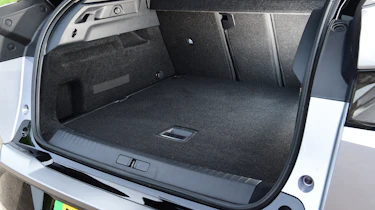
Despite the coupe-style sloping roofline, the E-3008’s boot is towards the larger end for cars in this class, pipping the 585-litre space of the Skoda Enyaq by a handful of litres, and the Renault Scenic by a significant margin. That said, the sloped roof means that, should you load the boot to the very limit, it’ll ultimately take smaller objects than a boxier shape would. Full seats-down volume in the 3008 is 1,663 litres, which is smaller than both the Renault and Skoda, illustrating this compromise, while the rear seats don’t fold completely flat.
Reliability & safety
Pros |
|
Cons |
|
The Peugeot 3008 finished in tenth place in the 2026 Driver Power customer satisfaction survey, with owners being very happy with their 3008s. They especially liked its styling, both inside and out, its child-friendly features, and its practical boot. They weren’t so fond of the powertrains, quality and reliability, and value for money. The Peugeot brand ranked 7th out of 30 manufacturers, scoring well for styling and low running costs. Work still needs to be done on the car’s infotainment system and poor mix of physical and touchsensitive controls, though.
Instead, what lets the E-3008 down slightly is a four-star Euro NCAP rating, rather than the full five achieved by so many rivals. Occupant protection was decent enough, but the E-3008 scored somewhat lower for safety assist systems, affecting its overall score.
| Euro NCAP safety ratings | |
| Euro NCAP safety rating | 4 stars (2025) |
| Adult occupant protection | 80% |
| Child occupant protection | 85% |
| Vulnerable road user protection | 79% |
| Safety assist | 62% |
Buying, prices and deals
Best buy: E-3008 GT Long Range
Thanks to a reduction in pricing across the Peugeot line-up, the E-3008 now starts at just under £37,000 for the 73kWh Allure, rising to just under £38,000 for the 73kWh Allure Premium. The longer range 97kWh version will set you back a touch over £39,500 in Allure trim, while the four-wheel drive Dual Motor costs just under £43,500 in GT trim.
Pricing for certain versions of the E-3008 has been made more affordable thanks to the £1,500 electric car grant (ECG) discount from the Government. It applies to the 207bhp 73kWh standard range models in Allure, Allure Premium, and GT trims.
While the performance of the dual-motor E-3008 can be entertaining, it’s ultimately a bit redundant in a car like this, especially when driving fun isn’t one of the car’s strong suits to begin with. For that reason, we’d concentrate on the long-range models, with the bigger battery being available in Allure, GT, and GT Premium trim.
Of those trim lines, GT is the one to go for. Its base price of around £40,500 is roughly £3,500 more than the Allure and around £2,000 less than the GT Premium, but it has the best balance of equipment of the trio. True, GT Premium does get a heat pump as standard, and paying £700 for one on the GT closes the price gap between the pair, but with the larger battery option you may not miss the range it would save in the winter anyway.
If you'd like an E-3008 and fancy getting a healthy discount, you can configure your ideal E-3008 now to get great offers from nearby dealerships, take a look at our top leasing deals or find top used models with our Buy A Car service. You can even sell your existing car for a great price with Auto Express Sell My Car.
Alternatives
The world’s your oyster in the E-3008’s class, which gets busier every year. We’ve already mentioned its French rival, the good-value Renault Scenic E-Tech, and the talented Skoda Enyaq Coupe too. But there’s also the Nissan Ariya (a former Auto Express Car of the Year), the big-selling Tesla Model Y, the Ford Explorer and Ford Capri (or, towards the top of the E-3008 range, the Ford Mustang Mach-E too), and a talented trio from Korea in the shape of the Hyundai Ioniq 5, Kia EV6, and Genesis GV60. Other options are the Volkswagen ID.4 and Toyota bZ4X.
Peugeot E-3008 pictures
Frequently Asked Questions
Peugeot’s warranty takes the lead set by other manufacturers in offering a standard warranty length (in this case a so-so three years) but then extending it through routine servicing at a Peugeot retailer. This means that a properly serviced E-3008 will have up to 8 years or 100,000 miles of cover, and it’s transferable to the next owner too.