Used Volkswagen Passat (Mk8, 2014-2021) review
A full used buyer’s guide on the Volkswagen Passat covering the Passat Mk8 (2015-2021)

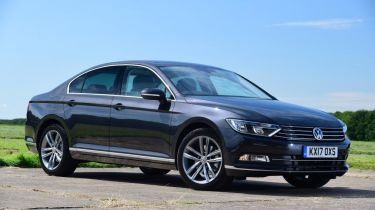
The Passat first joined Volkswagen’s model range way back in 1973, when it was offered only with petrol engines. It was available in Fastback, saloon and Estate forms, and the large family car sold alongside the Beetle, with the Golf and Polo arriving soon afterwards. Since then VW has launched seven generations of Passat, each safer and more efficient, spacious, comfortable and technologically advanced than the last.
It took a while for the Passat to take off in the UK but, by the time the fourth-generation model arrived in 1997, it had become a fleet favourite. Once the Mk8 (codenamed B8) was introduced in 2014, the Passat had become a staple product for private buyers and company car drivers nationwide.
Models covered
- Volkswagen Passat (Mk8, 2014-2021) - VW’s stalwart has stood the test of time and Mk8 version makes a great used buy.
Volkswagen Passat Mk8
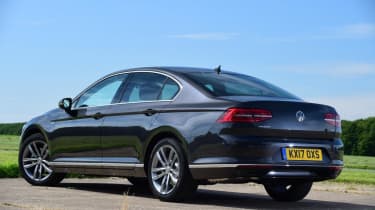
History
The Mk8 Passat hit UK roads in January 2015, priced from £22,215. Buyers could choose a saloon or Estate, but only diesel engines were offered initially, in 1.6 or 2.0-litre forms. The former was available in ultra-frugal BlueMotion guise from June 2015, rated at just 95g/km of CO2. A month later, the chunky four-wheel-drive Alltrack Estate reached showrooms.
Used - available now

2020 BMW
2 Series Gran Tourer
59,121 milesAutomaticPetrol1.5L
Cash £12,880
2022 MG
HS
42,916 milesManualPetrol1.5L
Cash £12,880
2020 Volkswagen
Golf
61,778 milesManualDiesel1.6L
Cash £12,490
2022 Mercedes
GLA
32,179 milesAutomaticPetrol1.3L
Cash £24,490In October 2015, a GTE arrived in saloon and Estate forms. This was powered by a petrol/electric plug-in hybrid powertrain with a 1.4 TSI petrol engine at its heart and a claimed 31-mile electric-only range.
SE Business trim was added in December 2015. Then, in July 2017, three petrol engines joined the range: 1.4 TSI, 1.8 TSI and 2.0 TSI, all with manual or auto boxes.
Volkswagen Passat Mk8 reviews
- Volkswagen Passat 1.4 TSI review
- Volkswagen Passat 1.6 TDI BlueMotion review
- Volkswagen Passat GTE review
Which one should I buy?
More than half (57%) of the Passats sold in the UK are Estates, so you’ll have plenty of choice if you’re looking for a load-lugging family car. Most are diesels and, while the 1.6 TDI is fine if you’re in no hurry, the 2.0 TDI is usefully more muscular.
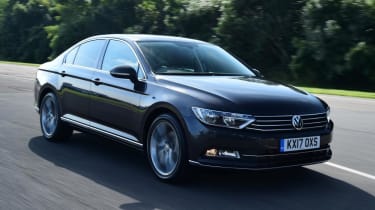
The days of the poverty-spec Passat are over, with even the entry-level S trim getting 16-inch alloy wheels, a cooled glovebox, DAB radio, a 6.5-inch touchscreen display, an eight-speaker stereo, air-con and electric windows. SE has 17-inch alloys, adaptive cruise control plus auto lights and wipers. SE Business features sat-nav, power-fold door mirrors and privacy glass, while the GT has 18-inch wheels, heated leather and Alcantara seats, and tri-zone climate control. R-Line adds sporty cosmetic enhancements.
Alternatives to the Volkswagen Passat
With its semi-premium status, the Passat is up against a wide array of talented rivals, perhaps the closest of which are the Volvo S60 and V60. Similarly priced, ultra-safe and well equipped, the Volvo is a slightly left-field choice but still worth a closer look. Other obvious rivals include the Audi A4, BMW 3 Series and Mercedes C-Class, all of which come in saloon and estate forms with excellent petrol and diesel engines.
The Mazda 6 is another tough adversary, thanks to its smart styling, excellent dynamics and appealing interior, along with decent equipment and superb build quality at reasonable prices. The Ford Mondeo, Hyundai i40, Skoda Octavia/Superb and Vauxhall Insignia are also hard to beat. All offer hatchback or estate practicality with lashings of equipment and at keen prices.
What to look for
Spare wheel
Most Passats come with a steel space-saver spare wheel, but the GT-specification car is fitted with a full-size alloy spare.
Filling up
You can’t put the wrong fuel in your Passat; a misfuel prevention device is fitted to every oneof the cars, regardless of trim level.
Equipment
Volkswagen upgraded the Passat in January 2018, with all cars in the range benefitting from an extra helping of standard equipment.
Rear rattles
Rattling sounds from the back of the car can be down to a loose undertray – that or the suspension needs to be lubricated.
Interior
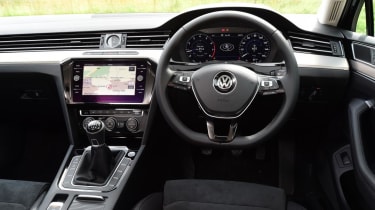
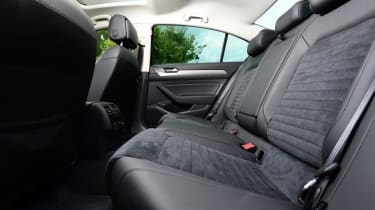
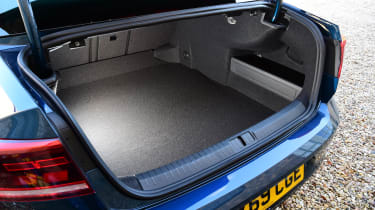
VW interiors are designed for ease of use rather than creative flair, and the Passat is no different. There are first-rate materials throughout, plenty of standard equipment and lots of head and legroom for rear-seat passengers. Boot space is good, too, at 586 litres for the saloon, and SE cars and above get a load-through facility. The Estate can stow 650 or 1,780 litres (seats up/down).
Running costs
Owners can choose fixed or variable servicing, at every 12 months/10,000 miles, or two years/18,000 miles. Fixed services alternate between minor and major. Brake fluid needs to be changed every two years. The cambelt should be replaced every 130,000 miles on TDI units or 75,000 miles on BiTDIs. Petrol engines have no set schedule.
Recalls
The Mk8 Passat has had 13 recalls. Early cars could be affected by braking problems because of wiring glitches, and airbags going off. Issues with panoramic sunroofs on Estates and faulty child locks led to actions in 2016. Recalls were also made for the ESP and lighting, airbags, seatbelt pretensioners, back seats, sunroof joints, wheel bearing housings and head restraints.
Driver Power owner satisfaction
The Passat Mk8 wasn’t in our last Driver Power used-car survey, but it notched up a 54th-place finish in the 2019 new car poll. That’s a respectable result rather than a spectacular one, with owners liking boot space, all-round visibility and ride quality. The infotainment system also gets a thumbs up, but owners aren’t so keen on refinement, the gearchange or running costs.
Verdict
For years the Passat has been a staple part of VW’s line-up, and in the UK it’s the brand’s third most popular model after the Golf and Polo hatchbacks.
The Passat isn’t a car that you buy with your heart, but it makes sense on so many levels that it’s hard to ignore. Spacious, practical, frugal, well equipped and easy to live with, it’s also good to drive and has reasonably strong resale values.
It won’t make your heart beat faster but, if you’re looking for safe and comfortable family transport, then look no further.
Read our full used buyer’s guide on the Volkswagen Passat Mk7 (2010-2015) here…
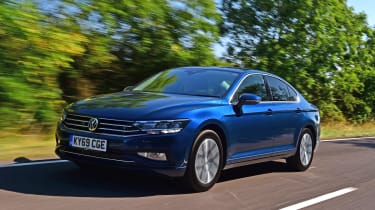
Volkswagen Passat (2014-2021) review: What we said
Extracts from our 2020 in-depth review of the Mk8 VW Passat...
Volkswagen knows that the only way is upmarket for conventional family cars. The class is dying out, so it needs to focus on rivals such as BMW and Mercedes, rather than Ford and Vauxhall. Luckily for VW, this Passat is a more convincing alternative to these executive cars than ever. It's got the quality, refinement and technology to compete with the best, even if it lacks the badge prestige.
The Passat has plenty of advanced tech, including the latest infotainment and active safety options, while the GTE uses Volkswagens’ clever hybrid tech to minimise emissions and appeal to fleet users. Although, most buyers will still be best-served by the smooth, economical diesel models.
About the Volkswagen Passat
The Volkswagen Passat saloon and Passat Estate are the longest lived models in the VW line-up. They've been for sale since 1972, so pre-date the Golf by a couple of years, while the current B8-generation version has been on sale since 2015, with recived a mid-life facelift in 2019.
The big change when the current Passat arrived was a move upmarket compared to what we're used to. It was a planned step, with VW moving away from the family car sector and fixing its sights on the compact executive saloon class instead. As it sits in this middle ground between the two sectors, it has a number of rivals that it needs to take on.
Other models in the family car class have taken a leaf from the Passat's book by moving upmarket, so cars like the Vauxhall Insignia, Ford Mondeo, Peugeot 508, Mazda 6 and Skoda Superb have all raised their game. All these rivals offer a mix of hatchback or saloon bodies, and are offered as estate cars too.
At the other end of the spectrum are the executive models that the Passat is designed to emulate. This includes the big three Germans in the shape of the Audi A4, BMW 3 Series and Mercedes C-Class, while the Jaguar XE, Alfa Romeo Giulia and Lexus IS are also in the running. In reality, the Passat gets close to these cars, but isn't quite at the same level.
The exterior looks aren't very inspirational, but the Passat has moved up a notch in terms of luxury, which is reflected even more strongly inside, where it feels a cut above the Ford Mondeo. The Passat is roomier than most rivals, despite being no larger than the previous-generation model, and it rides and handles better than ever, thanks to its lighter platform architecture.
But if you want an upmarket, spacious and well equipped family car, then the VW Passat fits the bill. VW offers SE, SE Nav, SEL and R-Line, along with the Alltrack and GTE models.
Power comes from 1.6 TDI and 2.0 TDI diesels, or VW's 2.0-litre TSI and 1.5 TSI EVO petrol units with cylinder shut-off tech. Six-speed manual and seven-speed DSG auto gearboxes are available, with the latter fitted as standard on higher-spec models. The 4Motion four-wheel drive system is standard with the 190PS and 240PS diesel units in R-Line trim and also on Alltrack models.
There's also the plug-in hybrid Passat GTE, which features a petrol engine combined with an electric motor and battery pack. It’s relatively expensive to buy but low emissions mean it's attractive to company car users – you can read our review of this version here.
The Passat uses the VW Group's MQB platform and is one of the larger models to do so. As a result, it's relatively light, so the Passat handles tidily – although it's geared more towards comfort than performance.
As mentioned, the Passat Estate is also available, and it carries a premium of around £1,500 over the saloon. It's available in all the same trims as the saloon, including GTE, but also comes in Passat Alltrack spec, with raised suspension, 4Motion all-wheel drive and with SUV styling additions. It's a great alternative for buyers who don't want an SUV but appreciate their abilities and space.
Engines, performance and drive
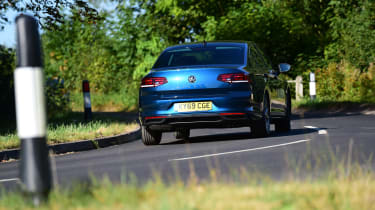
The smooth, refined Passat has long been known for its fuss-free, grown-up drive, and the eighth-generation model is the most premium and executive-style variant yet. However, thanks to its lightweight MQB platform, which is stiffer and has a lower centre of gravity, it also handles more dynamically than any Passat before it.
Similar to the VW Golf, the Passat is very easy to drive, with precise and accurate steering that doesn't offer much feel, but compensates with easy placement in corners. Because there’s less weight, the Passat turns more confidently into bends and has more agility than previous models. There’s lots of grip and traction, too.
The cushioned ride that’s become a trademark of the Passat is present, while running refinement is improved and the lack of road noise combines with low levels of wind noise to make the car extremely quiet on the move.
Improved body control adds to the comfort – passengers are rocked and rolled less, with the Passat’s greater composure adding to its smooth, unruffled feel. At speed on a motorway the Passat is more comfortable than it has ever been, and more than a match for a genuine premium-badged car. Its classy styling is now fully matched by a grown-up, classy drive.
The Passat GTE has a name and styling cues to invoke ideas of VW's GTI badge, but it doesn't feel all that sporty in corners. The hybrid set-up’s extra weight can be felt, and there’s plenty of body roll. Think of the GTE as a Passat GT with hybrid drive rather than a GTI, and it makes more sense. It’s a quiet cruiser and is comfortable on long trips, while the suspension soaks up bumps reasonably well, although not quite as good as the softer standard car.
Engines
Of the diesel engines, the 118bhp 1.6-litre TDI is a smooth, refined engine that boasts similar power to previous entry-level 2.0-litre TDI units. It’s been optimised to give linear, torquey response: 250Nm of pulling power is impressively available across a broad rev range. A 0-62mph time of 11.3 seconds (in SE saloon format) means it’s no rocket ship against the clock, but it's swift enough not to be embarrassed. The 1.6 TDI is only available with a seven-speed DSG dual-clutch automatic.
All the diesel engines are fitted with an SCR Selective Catalytic Reduction filter that minimises NOx emissions through the addition of AdBlue fluid. That means all models feature an AdBlue filler next to the fuel filler; the Passat's electronics will warn when the 13-litre AdBlue tank needs refilling.
The 2.0 TDI 150 is the core Volkswagen Passat engine. Its 148bhp output is backed up by, again, a broad spread of torque: 340Nm of pulling power is again available between 1,750-3,500rpm. This engine comes with either a six-speed manual or a DSG dual-clutch auto; in this instance, a seven-speed unit. 0-62mph takes 8.7 seconds in both manual and automatic guise and the top speed is 136mph.
The more powerful 2.0-litre TDI 190 produces 187bhp and a full 400Nm of torque between 1,750-3,000rpm. Against the clock, it’s a swift engine: 0-62mph takes 7.7 seconds with the standard seven-speed DSG. That’s warm hatch territory and a top speed of 147mph is pretty impressive as well. This engine is available in combination with SEL trim and above.
VW’s impressive-sounding 2.0 BiTDI motor produces 237bhp at 4,000rpm and a huge 500Nm slug of torque from 1,750-2,500rpm. Befitting its range-topping status, this engine is only available with a DSG dual-clutch seven-speed automatic. Volkswagen also only offers this engine with 4Motion all-wheel drive, which is sensible given the amount of pulling power it boasts. 0-62mph takes a hot hatch-rivalling 6.1 seconds, while the top speed is just shy of 150mph.
The tech-laden Passat GTE plug-in hybrid is the most advanced Passat ever sold. It mates a 1.4 TSI turbo petrol engine with a powerful electric motor and high-capacity plug-in batteries, for a system total power of 215bhp and system torque of 400Nm. This is good for 0-62mph in 7.6 seconds and a top speed of 140mph.
The GTE combines performance and economy; it can run solely on electric power for up to 30 miles at lower speeds if the battery is fully charged and can shuffle between its two power sources to deliver respectable fuel economy on longer journeys.
The GTE comes with a number of driving modes that alter steering and throttle response, along with different configurations of engine and battery performance. The Passat is quite lively in GTE mode, and synthetic engine sounds are played in the cabin to enhance this feel. However, the Passat isn’t quite the performance powerhouse that GTE mode would lead you to believe, with brisk rather than explosive acceleration.
Petrol engine choice used to include 1.4-, 1.8- and 2.0-litre TSI units, but now the choice is either VW's great 1.5 TSI EVO 150PS, or the more powerful 2.0 TSI 190PS. The former uses VW’s cylinder-deactivation technology, so it shuts down two cylinders when you’re cruising along on part throttle, in a bid to improve fuel efficiency.
Thanks to it having 250Nm of torque from as little as 1,500rpm, you can almost drive it like a diesel, with early upshifts. It’s smooth, too, and while you may hear a slight resonance when the cylinders shut down, for the most part you’ll only become aware of it kicking in when the indicator on the instrument panel lights up.
MPG, CO2 and Running Costs
Starting with the 1.6 TDI with 7-speed DSG gearbox, this engine returns up to 51.4mpg in SE and SE Nav trims. Moving to the 2.0 TDI, the 150PS version has either six-speed manual or seven-speed DSG auto options, which return up to 60.1mpg and 56.5mpg, respectively, in SE guise. The R-Line trim, with its bigger wheels, sees these figures drop to 58.9mpg and 55.4mpg for the manual and auto.
The 2.0 TDI 190PS only comes in SEL and R-Line specs with the DSG box, where it manages up to 50.4mpg. At the top of the range, the biTDI diesel takes a big hit under the new WLTP test, with claimed economy of up to 39.8mpg, demonstrating the combined penalty of added performance, the DSG gearbox and 4Motion four-wheel drive.
Opting for petrol power will obviously result in a dip in efficiency. The 1.5-litre unit, in SE trim, manages 47.1mpg, while the 2.0-litre TSI engine delivers 37.7mpg.
Emissions range from 101-151g/km, with the 2.0 TDI performing best. We'd recommend this engine for its combined efficiency and added power. All diesel Passats come with a 13-litre AdBlue tank to help reduce emissions, and this well need to be refilled every 5,000 miles or so.
The GTE model is one of the cheapest versions to run, especially if you regularly undertake short journeys and can keep its 13kWh battery topped up. You can charge the battery using the car’s engine but it’s far more economical to plug in – using a standard 2.3kW charging cable, the battery can be filled in around five hours to give an all-electric range of around 30 miles. You can hold onto this charge until required, or use it in tandem with the car’s petrol engine like a traditional hybrid.
Volkswagen claims combined fuel economy of 217.9mpg for the GTE saloon and 196mpg for the estate but it’s worth noting that you’ll only see such figures if the battery is full and you spend a large proportion of your time travelling under electric power. CO2 emissions are quoted at 33 and 32g/km respectively – London Congestion Charge exemption and the lowest possible company car tax are the result.
For non-company car users, the 1.5 TSI Evo petrol model might be attractive. Fuel economy claims range from 40.9-47.1mpg, wth the larger wheels and DSG gearbox contributing to the lower figure. It's a similar story with emissions, although a spread from 117-121g/km isn't quite as severe.
Interior, design and technology
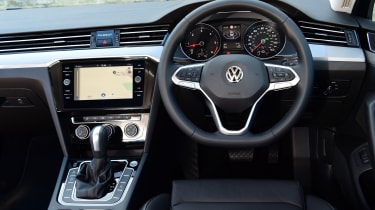
Volkswagen’s restrained styling works well on the Passat. The design features plenty of straight lines, but while other VW models are pretty bland, the Passat does at least look purposeful. Best of all, the latest Passat has a very appealing interior. The design isn’t flashy or standout, but it’s very satisfying and ergonomic, with a quality of materials to lift it above both the old Passat and many other cars in this sector.
The clear layout is designed around the central touchscreen, which is very well positioned, and intricate finishing touches such as beautiful chrome air vents and detailing on the perfectly-shaped steering wheel complete the showroom appeal masterclass.
The GTE boasts a subtle makeover inspired by the Golf GTE to mark it out from the standard car. This includes blue GTE badging on the grille, front wings and bootlid, VW’s signature blue trim for the top of the grille and the brake calipers, while the C-shaped LED daytime running lights in the lower grille appear on all of VW’s electric and hybrid models.
Further back, the GTE features the same 18-inch alloy wheels as the Passat GT, while the LED tail-lights are another hi-tech touch to the otherwise simplified exterior. Inside the GTE has blue LED strip lighting for the door trim, a blue GTE badge ahead of the gearlever and blue stitching for the leather-trimmed steering wheel and gearlever.
Befitting its executive car aspirations, the Passat can be had with lots of big car features, such as three-zone climate control (two-zone up front, with a third set of temperature controls for the back seats), an electric rear sunblind and a heated front windscreen. Top-spec models get LED headlights, and clever dynamic full-beam tech which allows you to keep the full beam on all the time without dazzling people is offered as an option.
A whole host of optional driver assistance technology is available for the Passat, including park assist, head-up display, lane assist, high beam assist and side scan – there is also a 360-degree Area View parking camera offered.
Sat-nav, stereo and infotainment
As standard, the Passat comes with an 80 watt, eight-speaker stereo with DAB, Bluetooth, SD reader, USB socket and pairing for two mobile devices, along with Apple CarPlay and Android Auto. A 8.0-inch touchscreen is also standard on SE Nav versions and above,
On SEL models and above, it is further enhanced by Discover Navigation sat nav, which includes the VW Car-Net system that pairs with a mobile device to offer real-time traffic, weather, fuel price and parking space availability updates.
Volkswagen’s latest infotainment system is extremely comprehensive and feature-packed, but the firm’s also kept it reasonably simple and straightforward to use. The touchscreen is particularly smart and will keep you entertained for hours (particularly if you pair it with your smartphone).
R-Line and GTE Advance versions get VW’s virtual cockpit as standard, which features TFT dials, a range of trip displays and the ability to display the navigation screen between the dials if required.
Practicality, comfort and boot space
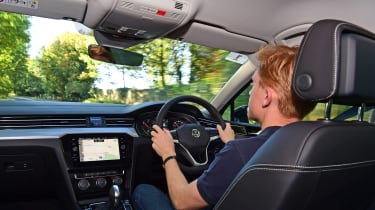
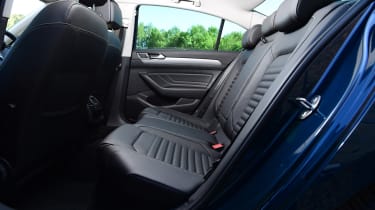
The VW Passat is an extremely comfortable car behind the wheel, again befitting its executive car aspirations. The firm, supportive seats are a treat to sit on and are great over long distances, while the driving position allows a natural relationship between seat, pedals and steering wheel to be achieved by most drivers. The range of control adjustment is enormous, and all models get Ergo Comfort seats with handy electric backrest adjustment as standard. Exceptional refinement further adds to the Passat’s comfort. It’s a quiet and peaceful car, with a free-running feel that’s very premium.
Size
The Passat B8 has a much longer wheelbase than its predecessor, but overall length is actually slightly down. The 79mm stretch boosts interior space, but overall length is kept in check at 4,767mm, with width of 1,832mm and height of 1,456mm. The Passat Estate is the same length as the saloon.
The tallest Passat is the Alltrack: this SUV-like model with its raised ride height model is the only one to top 1.5 metres tall, and is the longest Passat at 4,777mm – still under the 4.8-metre length some less space-efficient rivals clock in at. The raised ride height helps access, as you don't have to move so low to get in.
Leg room, head room & passenger space
The significant stretch to the Passat’s wheelbase has boosted interior space a lot. The old model wasn’t bad in this respect, but the latest one is another step on.
Legroom isn't quite as good as a Skoda Superb, but space and comfort for two adults in the rear is still impressive. The seats are supportive and it’s also easy to step in and out of the car. Only three-up does it become a bit less comfortable because of the wide central tunnel in the floor that restricts the room for feet. Headroom is good in both body styles, although be mindful of choosing the optional panoramic roof if you frequently carry adults in the rear, as this cuts headroom slightly.
Boot
As a practical family-focused VW, the Passat has always offered a big boot, but the latest model is bigger than ever. The saloon has a seats-up capacity of 585 litres, one of the best figures in this sector. 60:40 split seat backs are standard on all models, and when you fold them down, it stretches to a total of 1,152 litres.
In-cabin stowage is impressive. There’s a storage compartment in the driver’s door pocket that will take a 1-litre bottle; the one in the passenger door is even bigger, taking 1.5 litres. There’s further storage in the rear doors, plus a sunglasses holder in the roof.
Towing
The VW Passat is a competent tow car, with a range of braked towing capacities starting at 1,500kg and going all the way up to 2,200kg. Maximum towing power comes from either the 187bhp 2.0-litre TDI with DSG gearbox, or the 2.0-litre BiTDI 237bhp unit with 4MOTION and DSG gearbox. To make your life easier, you can even get a trailer assist system that will help to reverse-park your Passat even if you’re towing a caravan.
Our dealer network has 1,000s of great value new cars in stock and available now right across the UK. Find your new car…