Cupra Tavascan review
The Cupra Tavascan looks great and performs well as an electric family car, but certain versions are still rather expensive
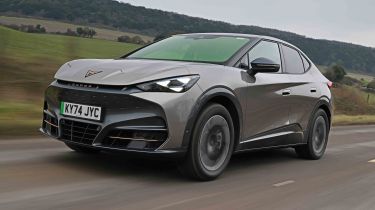

Our opinion on the Cupra Tavascan
You can't deny that the Cupra Tavascan certainly stands out from the electric family-car crowd. Fortunately, its head-turning looks don’t come at the expense of practicality, because there’s plenty of space inside for passengers and luggage. However, while Cupra is a sporting brand, the Tavascan isn’t quite the leading light of the class for sporty handling - that award goes to the Ford Explorer and Ford Capri twins - because its firm ride and inconsistent brakes are two minus points for the Spanish model. And then there’s the price, which is high when compared with rivals in the class that are equally capable.
About the Cupra Tavascan
Compared with other brands in the Volkswagen Group, Cupra turned up pretty late to the electric SUV party. While VW, Skoda and Audi offered a car in the compact SUV class for quite some time, SEAT’s sporty offshoot had to make do with just the Cupra Born hatchback before the arrival of the Tavascan. Still, given the patchy reception the earlier MEB-platform cars initially received, this window has provided Cupra with time to learn from previous shortcomings and create a more rounded package – at least in some areas.
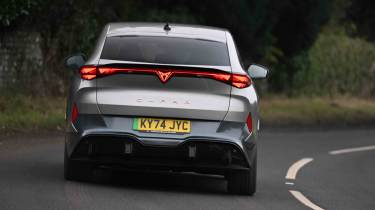
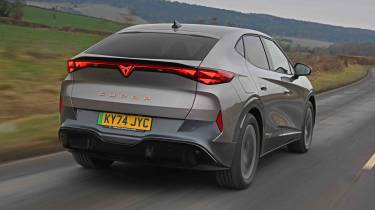
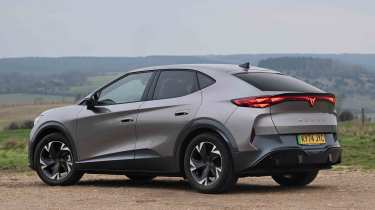
The Tavascan is a five-door, five-seat family car that we’d describe more as a coupe-SUV than a full SUV, courtesy of its swoopy styling. It’s the largest car in the Cupra line-up - bigger even than the combustion-engined Terramar.
Used - available now

2025 Cupra
Tavascan
3,779 milesAutomaticElectric
Cash £33,495
2025 Cupra
Tavascan
9,266 milesAutomaticElectric
Cash £32,295We’ve put the Cupra Tavascan through its paces against the Ford Capri in a twin test, and our pictures editor, Dawn Grant, has run a Cupra Tavascan V1 as part of our long-term fleet.
Performance & driving experience
Pros |
|
Cons |
|
The Tavascan’s powertrains are impressive, but the choice is more limited than in some other alternatives in this segment. With no entry-level model offered in the vein of the 168bhp option available in the Ford Capri or Ford Explorer (two cars that use the same running gear as the Tavascan), the Cupra’s base price is high. Instead, the range kicks off with a single-motor model which sends a healthy 282bhp to the rear wheels, while the 4Drive model has (as the name suggests) four-wheel drive, plus 335bhp from its twin-motor set-up. You pay for this performance, with the top-spec version of the Tavascan costing around £60,000.
Electric motors, 0-60mph acceleration and top speed
The Tavascan fitted with a rear-mounted electric motor has more than enough performance – more than most buyers will need, in fact. The 0-62mph sprint takes 6.8 seconds, so few buyers will require the 335bhp option.
Those who do will get some serious straight-line shove, with the instant torque – all 545Nm of it – deployed to the road via all four wheels to deliver a 0-62mph time of 5.5 seconds. That’s only a few tenths shy of Cupra’s fastest petrol-powered performance cars, but with no gearbox to contend with, it feels even quicker in many driving situations. Both versions of the Cupra Tavascan are limited to a top speed of 112mph.
| Model | Power | 0-62mph | Top speed |
| Tavascan V1 77kWh | 282bhp | 6.8 seconds | 112mph |
| Tavascan V2 77kWh | 282bhp | 6.8 seconds | 112mph |
| Tavascan VZ1 77kWh | 335bhp | 5.5 seconds | 112mph |
Town driving, visibility and parking
Keen handling and a smooth powertrain impress, but in some situations, the ride is a little too sporty, and the brake calibration needs some work. Around town, there’s a firmness to the damping in the Tavascan, which certainly sets its stall out as one of the more sporting options in this segment. The damping is better than on some contenders, and it doesn’t have the slightly brittle feeling you get from a Kia EV6. This is because the Cupra’s springs and dampers are better at taking the edge off the harshest bumps.
We have two caveats here, however: our time behind the wheel in the UK has been in a car on 19-inch wheels, the smallest available, and also we’re yet to try the Tavascan with adaptive dampers in the UK. Larger wheels can make the ride more fidgety, while our experience with the adaptive dampers on the Tavascan on smoother European roads saw a marked change to the car’s demeanour, as the ride tightened up significantly in the Performance and Cupra settings.
Country road driving and handling
Much like in the smaller Born electric hatchback, one of the Tavascan’s main weaknesses is the feedback through the brake pedal. Initially, this gives quite a firm, positive response, but press harder, and there seems to be a centimetre or two of travel where everything feels a bit soft and very little extra deceleration happens. A firmer shove brings back some more bite as the mechanical brakes chip in, but the transition between the motor regeneration and the interaction between discs and calipers is a little clumsy and not very reassuring.
It’s a shame, because elsewhere the Cupra feels decent to drive. The steering is light and precise, and the rear-wheel-drive model is sweetly balanced, capable of pushing the car gently through a turn as power is applied. You can never truly get away from the car’s weight, but there is fun to be had on the right road.
Motorway driving and long-distance comfort
It’s on the motorway where we’d wish for just a slightly more compliant suspension set-up. Here, there is still some fidgeting, giving the impression that the Tavascan never truly settles down.
That aside, the spacious cabin helps the motorway miles to slip by with little effort. There’s more than enough power to make accelerating along slip roads and inclines – and overtaking manoeuvres – feel effortless. It was very rare that we felt the need to explore the full travel of the throttle pedal on our test drive.
“Out on the road, the good points of the Tavascan’s MEB platform are on full display, which is to say the motors are very refined and come with excellent response and clarity through the throttle pedal.” – Jordan Katsianis, news editor.
Range, charging & running costs
Pros |
|
Cons |
|
Officially, the 58kWh version of the Cupra Tavascan can cover up to 274 miles to a charge, while rear-wheel drive V1 and V2 models with the 77kWh battery manage up to 346 miles. Adding four-wheel drive with the VZ1 and VZ2 trims reduces efficiency and range down to 332 miles.
During our group test of the Tavascan against a Ford Capri, we achieved an average of 3.3 miles per kWh from the Cupra in cold weather with a mix of urban, A- and B-roads, and motorway miles. If you do more urban driving, that figure will improve with greater opportunity to use regenerative braking. Warmer summer weather will also see efficiency increase significantly, as our picture editor Dawn Grant found out during her six months with a 77kWh V1 model, to the point where the car was achieving 3.7 miles per kWh, and the readout was regularly showing that over 300 miles of real-world range was entirely achievable.
Charging speeds peak at 105kW for the smaller 58kWh battery version, and 135kW on every Tavascan with the 77kWh battery. Despite this, a 10 to 80 per cent state of charge top-up using a rapid charger takes a similar amount of time in either version: 28 minutes in the 58kWh car and 29 minutes with the 77kWh battery. Utilise a typical 7kW home wallbox charger for cheaper running costs, and it'll take just over nine hours to fully recharge the 58kWh battery, or a little over 12 hours to do the same with the 77kWh battery.
| Model | Battery size | Range | Insurance group |
| Tavascan 58kWh Origin | 58kWh | 343 miles | 26 |
| Tavascan 77kWh V1 | 77kWh | 346 miles | 36 |
| Tavascan 77kWh VZ1 | 77kWh | 332 miles | 38 |
Insurance groups
Along with its higher starting price, the Cupra Tavascan also tops the Ford Capri in terms of insurance cover costs. The Cupra resides in groups 26 to 39 (out of 50) while the Ford is between groups 23 and 33.
Tax
The Tavascan’s zero-emission status means very low company car tax rates for business buyers, but the standard rate of vehicle excise duty (VED) applies. On top of this annual charge, you’ll also need to be aware that the luxury car tax might apply to certain versions of the Tavascan that breach the £50,000 threshold for electric cars, adding another £440 onto the annual tax bill between the second and sixth year after the car’s initial registration.
Depreciation
Our market data shows that the Cupra Tavascan is expected to maintain between 42 and 47 per cent after three years or 36,000 miles. In comparison, the Ford Capri retains a similar amount (41 to 49 per cent), performs better than the Skoda Enyaq Coupe (38 to 41 per cent), but trails the Tesla Model Y (51 to 60 per cent).
To get an accurate valuation on a specific model check out our free car valuation tool...
Interior, design & technology
Pros |
|
Cons |
|
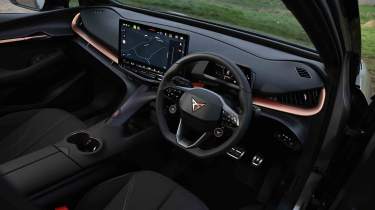
A striking design ensures the cabin is one of the most desirable in its class, while vastly improved infotainment tech makes the Tavascan far easier to recommend than Cupra models from even a couple of years ago.
Interior and dashboard design
When the Tavascan concept was first revealed to the public, its cabin matched the exterior for drama. The sweeping dashboard connected to the centre console through a floating Y-shaped central spine that looked like it had been beamed back from the future.
And the best news is that those concept-car looks have made it into production largely unchanged. Yes, the steering wheel isn’t trimmed in carbon fibre and shiny plastic, the digital instrument panel is a touch smaller, and the impractical white upholstery has been swapped for a more subdued shade, but the Cupra remains incredibly arresting inside.
Materials and build quality
It’s hard to knock the fit and finish, either. The colours and materials look and feel classy, what limited physical switchgear there is appears fairly solid, and even where plastics are used, they don’t detract from the overall experience. Sustainable materials have been used in the upholstery, with textiles created from up to 90 per cent recycled polyester, while 50 per cent of microfibre materials come from recycled sources.
Infotainment, sat-nav and stereo
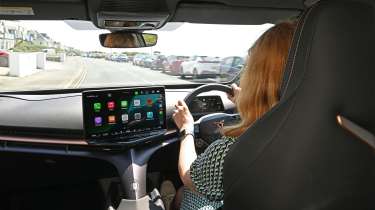
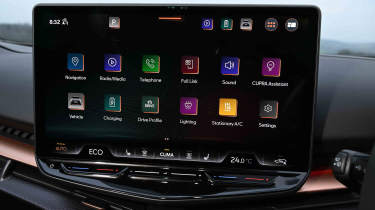
The Tavascan’s 15-inch touchscreen sits slightly awkwardly on top of the dash, but the system is fairly easy to use. Many of the foibles that affected early examples of Born have been ironed out, and the Tavascan’s system is much more intuitive.
It’s a shame that the climate controls are confined to the screen, but they’re fairly large and permanently positioned at the bottom of the display. Turning off the driver-assist systems can be accomplished via a shortcut that’s dragged down on the display.
Ahead of the driver sits a digital display that’s very similar to what you’ll find in a Cupra Born. This display only shows the most useful information, and a button on the steering wheel can bring up more detailed trip and driver-assistance data.
“Slim vents at the leading edge of the bonnet are designed to improve aerodynamic efficiency, but they have the side effect of funnelling road grime and water directly onto the windscreen in poor weather.” – Alex Ingram, special contributor.
Boot space & practicality
Pros |
|
Cons |
|
The overall wheelbase of the Tavascan is identical to that of its hatch sibling, the Born, but its taller roof and larger rear overhang make it the more spacious car overall.
Dimensions and size
While the Cupra Tavascan shares a platform with the Ford Capri and Skoda Enyaq, it’s slightly smaller than those two models. Its wheelbase is pretty much a match for those cars, though, and this means there’s decent space inside.
| Dimensions comparison | |||
| Model | Cupra Tavascan | Ford Capri | Volkswagen ID.4 |
| Length | 4,644mm | 4,634mm | 4,584mm |
| Width | 1,861mm | 1,872mm | 1,852mm |
| Height | 1,597mm | 1,626mm | 1,640mm |
| Wheelbase | 2,766mm | 2,760mm | 2,771mm |
| Boot space | 540 litres | 567 litres | 543 litres |
Seats & passenger space
Cupra has struck a great compromise with the Tavascan’s driving position, making it feel sporty and snug while still delivering the lofty feeling that SUV drivers find so appealing. The seat and steering wheel offer plenty of adjustment and comfort, and are great overall. Rear visibility is a little compromised by that rakish roofline and small rear window, and it’s made worse in wet weather because there is no rear wiper.
While the Tavascan still uses the fiddly touch-sensitive sliders that we’ve complained about in various Volkswagen ID products in the past, at least here they are backlit, so they can be used at night – a baffling oversight in some other early MEB-based cars.
A small shelf sits below the floating section of the dashboard, and a pair of cup-holders are located just ahead of a deep closed cubby beneath the centre armrest. Due to the position of the fusebox on the left side of the dashboard, the glovebox is very small, though.
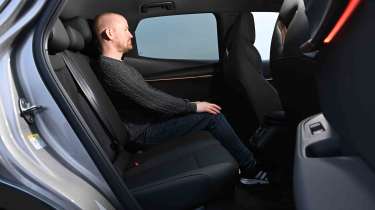
Space in the back seats is very similar to what you’ll find in other coupe-SUV alternatives, such as the Ford Capri. The Tavascan has near-identical rear headroom and ever so slightly less knee room than the Ford, but the flatter rear bench makes it a little more comfortable when three people are sitting in the back – especially in models that don’t feature a rear centre armrest or through-loading hatch.
Boot space
At 540 litres, the Tavascan’s boot is a little behind the Ford Capri but still very large. The area is a smidge under one metre square, and the rear seats fold down to leave an almost flat load space – at least they do if you go for a V2 model with a variable height boot floor that removes the lip when the rear seats are dropped.
Towing
The Tavascan can be equipped with a tow bar, but all rear-wheel versions can only handle a 1,000kg braked trailer or caravan, and you'll need the four-wheel drive VZ1 or VZ2 versions to match the far stronger 1,800kg towing capacity of the Kia EV6.
“There’s some extra storage under the boot floor for your charging cables, but as with other MEB models, there’s no front boot under the short bonnet, which is a shame.” – Jordan Katsianis, news editor.
Reliability & safety
Pros |
|
Cons |
|
The Tavascan earned a full five-star safety rating from safety experts Euro NCAP in 2024. It matches the scores of the Ford Capri (which was tested in the same year) in the adult, child, and vulnerable road user categories, but the Tavascan outdoes the Ford for safety assistance.
The ‘always on’ functions, such as lane-keeping assist and traffic-sign assist, are typically intrusive, but they can be easily switched off via the touchscreen or a button on the steering wheel. Other active safety elements include active cruise control with lane-keeping assist, blind-spot monitoring and autonomous emergency braking, to name just a few.
While the Tavascan didn’t appear in the 2026 Driver Power survey, the Cupra brand finished 27th out of 30 in the best manufacturer results. The brand's strongest areas were safety features and exterior design, but it was brought down by poor fit and finish, as well as ride and handling. Only Citroen, MG and Dacia performed worse, so there’s clearly room for improvement.
| Euro NCAP safety ratings | |
| Euro NCAP safety rating | Five stars (2024) |
| Adult occupant protection | 89% |
| Child occupant protection | 86% |
| Vulnerable road user protection | 80% |
| Safety assist | 79% |
Buying and owning
Best buy: Cupra Tavascan 77kWh V1
How much does the Cupra Tavascan cost? Well, official ‘on the road’ prices range from just under £40,000 and go up to around £60,000, but you can currently save an average of around £12,000 through the Auto Express Find A Car service. You can lease a Cupra Tavascan from £374 per month or buy a used model at prices starting from £26,727.
We’d keep things simple with the Tavascan and choose the V1 model with the 77kWh battery. It has a decent amount of kit, is more than quick enough for most, and it has the longest range. You can even add metallic paint and the worthwhile winter pack, which includes an energy-efficient heat pump plus a heated windscreen (and heated rear seats with VZ1 and VZ2 trims), and still dodge the luxury car tax surcharge with this model.
You can save a considerable amount by building your perfect Cupra Tavascan with the Auto Express Buy a Car service. We also have a wide range of Tavascan leasing deals to choose from. We can even help you to sell your car.
Cupra Tavascan alternatives
The obvious rivals for the Cupra Tavascan are from within the VW Group and include the Skoda Enyaq and Volkswagen ID.4 and Volkswagen ID.5, although like-for-like, these are all less expensive than the Tavascan. The Audi Q4 e-tron is actually closer to the Tavascan in price, but it’s smaller overall.
Non-VW Group options are the Ford Capri and Ford Explorer – although both use the same running gear as the Tavascan and are arguably more engaging to drive than their rival. Then there are electric SUVs such as the Hyundai Ioniq 5, Kia EV6 and Genesis GV60 (all of which share the same running gear), BMW iX1, Volvo EX40 and Tesla Model Y.
Cupra Tavascan V1 long-term test
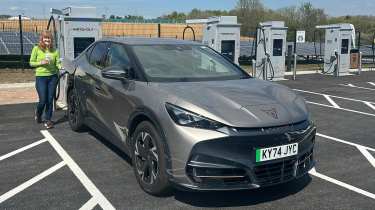
Our picture editor, Dawn Grant, ran a Cupra Tavascan V1 for six months as part of our long-term test fleet. Dawn found it more practical than expected, and nearly managed to achieve the car's official range figures once the weather warmed up. You can read the full long-term test here…
Key updates of the Cupra Tavascan review
14 August 2026: Include results from the 2026 Driver Power customer satisfaction survey
15 April 2026: General update of the Cupra Tavascan review
Frequently Asked Questions
Unlike other Volkswagen Group brands, Cupra provides a longer five-year or 90,000-mile manufacturer's warranty, while the battery gets the industry-standard 8-year or 100,000-mile policy. You only get one year of roadside assistance, though.
Deals on the Tavascan and alternatives