Geely Starray review
The Starray is a plug-in hybrid that offers a decent EV range and lots of kit for a bargain price

Our opinion on the Geely Starray
Keen pricing means you can get behind the wheel of the Geely Starray EM-i for the same price as non-PHEV versions of European, Korean and Japanese rivals. It’s very well equipped and feels well screwed together, while the big-battery model offers a long range and low CO2 emissions that will please company-car user-choosers. So far so good.
The looks will be a matter of taste, but we feel that the Starray is just one of a number of identikit SUVs from China. While there’s plenty of tech on board, the large touchscreen is used to control nearly everything, and it’s not the easiest system to use. The driving experience is forgettable at best, with a wallowy ride in corners and intrusive safety systems, while the petrol part of the powertrain isn’t very refined.
About the Geely Starray
While the Starray is only the second car from the Chinese Geely brand to arrive in the UK, the firm has a much larger foothold in our market than you might imagine. That’s because its parent company, Geely Holding, owns Volvo, Polestar, Lotus and LEVC, the firm behind the TX taxi. The arrival of the Starray is part of an effort by the parent company to establish Geely as a brand in its own right.
Used - available now

2026 Geely
Starray
1,500 milesAutomaticPetrol1.5L
Cash £26,495
2026 Geely
Starray
1,999 milesAutomaticPetrol1.5L
Cash £25,995The first model to land here was the Geely EX5, and now the Starray joins the line-up. Both cars share a conventional five-door, five-seat SUV bodyshell and are based on Geely’s grandly titled Global Intelligent New Energy Architecture (GEA for short), but the chief difference between them is that EX5 is all-electric, while the Starray is a plug-in hybrid.
There are two powertrains offered in the Starray, and it’s the battery packs (18.4kWh and 29.8kWh) that set them apart. The latter is good for a WLTP-tested all-electric range of 84 miles, which is impressive for any plug-in hybrid, let alone a compact family SUV.
As well as providing an impressive all-electric range, the Starray offers outstanding value for money when compared with other plug-in hybrid SUVs. While the likes of the Ford Kuga and Hyundai Tucson are available with PHEV power, you have to pay an extra £10,000 to get one on your driveway; the Starray is priced closer to more conventional ‘closed’ hybrid variants of those cars.
Geely Starray prices and latest deals
There are three versions on offer – Pro, Max and Ultra – with the latter being the only one with the larger battery. Pro kicks off at just under £30,000, but even the Ultra model offers good value at around £35,000. Similarly priced competition all comes from China, with the BYD Sealion 5 and Chery Tiggo 7 both starting from around £30,000, while the MG HS plug-in hybrid is around £32,000, and the Chery Tiggo 8 competes with the larger-battery Starray Ultra at around £33,000.
You can spec your Geely Starray right now on the Auto Express Buy a Car service or choose from loads of other plug-in hybrid SUVs.
Performance & driving experience
Pros |
|
Cons |
|
The Starray’s GEA platform is designed to accommodate plug-in hybrid, range-extending hybrid and fully electric powertrains, and it can handle front, rear or four-wheel-drive configurations.
For the Starray, the layout is traditional PHEV, with the 1.5-litre petrol engine and electric motor both located under the bonnet, while the drive battery is located under the passenger-compartment floor. Power is sent to the front wheels via a single-speed ‘E-DHT’ (electric dedicated hybrid transmission), which works much like a CVT automatic.
Front suspension is via MacPherson struts, and there’s a multi-link set-up at the rear.
| Model | Power | 0-62mph | Top speed |
| Starray EM-i | 258bhp | 8.0 seconds | 105mph |
Performance, 0-60mph acceleration and top speed
The 98bhp/125Nm petrol engine and 214bhp/262Nm electric motor combine to deliver a system output of 258bhp and 262Nm of torque. That latter figure tells you all that you need to know about how this powertrain works, with the electric motor taking care of most driving duties. The petrol engine (which, unlike some European rivals, isn’t turbocharged) is there to act as a back-up when extra power is needed at motorway speeds or when the battery is low on range.
Geely quotes a 0-62mph time of eight seconds for both powertrains, despite the fact that the 29.8kWh battery adds 85kg of weight over the entry-level version of the 18.4kWh car. That’s a decent time, while the car’s response is more measured than you might expect, because it builds momentum at lower speeds to avoid putting any undue stress on the transmission, rather than giving you an EV-style kick in the back.
When the engine is running constantly in Power mode, or the battery is low on charge, it can sound pretty harsh as you’re accelerating, because the E-DHT transmission lets the revs soar independently of your road speed, just like a CVT gearbox. As well as the Power setting, there are Pure and Hybrid modes, with the former offering all-electric drive when there’s enough charge available, while the Hybrid setting manages energy flow between petrol and electric sources.
Town driving, visibility and parking
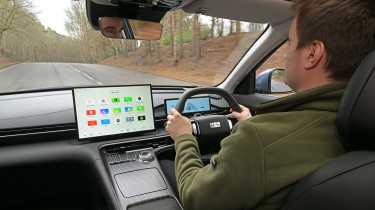
The Starray is fine to drive in urban environments. There aren’t hyper-responsive reactions from the controls, like in some plug-in hybrids, while the soft suspension makes reasonable work of big potholes and speed bumps at low speed. We did find the Starray’s steering lacked any kind of feedback in corners, although hitting those aforementioned bumps resulted in the rack shaking and rattling somewhat.
There’s a high driving position that gives a good view out, although the flat bonnet stretches out in front of you, so the Starray doesn’t feel all that small. The turning circle is a compact 10.4 metres, however, and every version of the Starray comes with a 360-degree camera system that gives you a complete view of your surroundings.
Country road driving and handling
With the engineering prowess of Lotus at Geely’s disposal, it will come as no surprise to learn that it called upon the Norfolk firm to fine tune the Starray’s suspension and dynamics. However, a quick blast along a B-road will leave you wondering exactly how much involvement Lotus had.
The steering is inert (except for those clonks from the rack) and the suspension wobbles and wallows during cornering. There’s decent overall grip, but many rivals, such as the MG HS, provide more involvement for the driver.
In the Comfort drive mode, the Starray’s brakes are on the soft side, but Sport mode makes the pedal feel much more positive and firmer under foot. However, the system defaults to Comfort each time you start the car, so you need to readjust to this setting or reselect Sport mode.
Motorway driving and long-distance comfort
The Starray does its best work when it’s running on electric power, which makes the Ultra version more attractive because of its longer electric range. Overall noise levels are kept to a minimum thanks to that focus on the electric side of the system.
The petrol engine isn’t particularly enjoyable when it does kick in – it’s pretty thrashy when accelerating to the national limit, and then it hums away when you’re there. It doesn’t add much to the total power available in the Geely, either.
Vehicle dynamics are an area where not just Geely, but all Chinese car makers are still playing catch-up with established brands. There’s comfort to be had, but not much in the way of driving fun." - Dean Gibson, senior test editor.
MPG & running costs
Pros |
|
Cons |
|
The petrol side of the Starray’s plug-in hybrid powertrain lets it down in terms of efficiency, too. The ultimate fuel economy of any plug-in hybrid will be at the mercy of how often it’s charged up, so we ran down the 18.4kWh pack on the Max model to see how it performed without any electrical assistance.
We saw a return of 43mpg overall, although this dipped as low as 39.5mpg on the motorway, with the engine working harder to make up for the lack of battery charge. Match our 43mpg, and you can expect a range of around 480 miles, because unlike some PHEVs that reduce the size of their fuel tank to make way for the battery, the Starray has a 51-litre reservoir.
Despite the generous electric range on offer, the Starray’s emissions figures aren’t outstanding. The small-battery model emits 54g/km, while the 29.8kWh car has a figure of 32g/km. In comparison, the Chery Tiggo 8 manages 31g/km and the MG HS just 12g/km.
| Model | MPG | CO2 | Insurance group |
| Starray EM-i Pro/Max | 117.7mpg | 54g/km | 30/31 |
| Starray EM-i Ultra | 201.8mpg | 32g/km | 32 |
Electric range, battery life and charge time
The smaller battery pack offers a longer range than you’ll get in many PHEV rivals. When fully charged in mild weather, our test car’s 18.4kWh battery had a predicted range of 51 miles, exactly the same as the official WLTP figure for this variant. That’s more than you’ll get from the Hyundai Tucson (43 miles) or Ford Kuga (42 miles) PHEVs.
The Starray will stick with electric drive for as long as there is charge in the battery, and on our test over a route that comprised 50 per cent urban/A-road driving, then 50 per cent motorway use, we heard the engine come to life once we had covered 38 miles in total. The range took a bit of a dip when travelling at 70mph, so if we had stayed at urban speeds, we’re confident we could’ve gone the full 51 miles that the trip computer predicted.
Both batteries accept DC charging, but speeds vary between the two packs. The 18.4kWh battery has a maximum charge rate of 30kW, so it can be taken from 30-80 per cent capacity (around 25 miles of range) in 20 minutes. As well as being bigger, the 29.8kWh battery can be charged at a maximum DC rate of 60kW; 30-80 per cent charging takes 16 minutes, and means you can add around 40 miles of range in that time.
Geely quotes AC charging times based on a 6.6kW source. The smaller pack can be charged from 25 per cent capacity to full in three hours, while the bigger battery takes just over four-and-a-half hours to do the same.
One feature of the Starray that isn’t commonly found on plug-in hybrids is vehicle-to-load capability. Plug in a special adapter and you can use the charging port to power external devices.
The warranty for the battery lasts for the same length of time as the car’s cover, at eight years, and there’s no mileage limit.
| Model | Battery size | Range | Insurance group |
| Starray EM-i Pro/Max | 18.4kWh | 51 miles | 30/31 |
| Starray EM-i Ultra | 29.8kWh | 84 miles | 32 |
Insurance groups
The three Starray variants fall into insurance groups 30, 31 and 32, which is roughly similar to other Chinese plug-in hybrids – the BYD Seal U starts in group 32, for example. However, the Ford Kuga PHEV starts in group 26 and the Hyundai Tucson PHEV is in group 24, so they should be cheaper to insure.
Tax
The Starray 18.4kWh’s CO2 emissions of 54g/km place it in the 10 per cent company-car Benefit-in-Kind tax bracket; it’ll cost standard-rate taxpayers around £600 a year for 2026/27. The bigger-battery Ultra sits three groups below the standard model, thanks to its 32g/km emissions, and means users can save over £100 in annual BiK costs.
Depreciation
Residual values in the 47-49 per cent range are fair for a plug-in hybrid, especially when you consider that the Ford Kuga only achieves a 42-43 per cent figure. The Hyundai Tucson is a stronger performer, in the 52-57 per cent range. The Starray’s figures are similar to those for other Chinese PHEVs such as the BYD Seal U.
Interior, design & technology
Pros |
|
Cons |
|
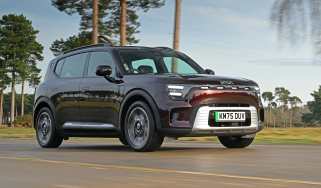
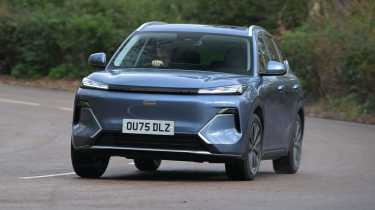
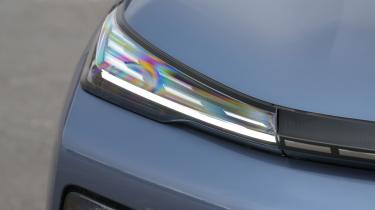
Design flair is something that Chinese car makers are still trying to get a handle on, and the Geely Starray is a pretty generic SUV. There’s a hint of Porsche Cayenne from the rear three-quarter, but the smooth nose, with its rather basic Geely badge, has the nondescript look of an unbranded model that you see in car-insurance ads.
Interior and dashboard design
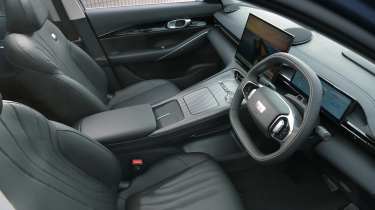
There’s little to differentiate the Starray’s cabin from those of other Chinese SUVs. We think that if you covered the badge on the oddly shaped steering wheel (the lower rim feels awkward in your hands when turning), most would struggle to tell where they were.
One peculiar feature is the large volume dial on the centre console, which seems randomly placed next to a row of shortcut buttons. Press it twice and you can change the wallpaper on the home screen, with preset options including coastal vistas, cityscapes or cute animals, such as a puppy or a kitten in a bucket. Yes, really.
Materials and build quality
Despite its relatively budget pricing, there’s some high quality to the Geely Starray. We haven’t experienced any significant rattles or creaks during our time with different cars, while elements such as the fake wood on the centre console, soft plastics and well damped (but scarce) buttons are all signs that Geely is taking an upmarket approach.
The window switches have a knurled metallic finish that is quite satisfying to touch, although their design feels a little counter-intuitive. Your instinct is to pull the toggle towards you to lower a window, but you actually have to push it away to do this.
Infotainment, sat-nav and stereo
There’s a shortage of buttons, but the large 15.4-inch touchscreen offers a lot of real estate for assorted functions. However, while the system provides quick-loading menus, it’s not the most intuitive set-up to use.
A row of permanent climate controls sits at the bottom of the screen with a Home button in the bottom right. Next to that is a shortcut to the three last-used settings, but the small pictograms it uses aren’t very clear about what each function is. Those climate controls don’t include a heated rear screen button, and there isn’t a physical button for this, either, even though there’s one for the windscreen.
You need to use the touchscreen for functions such as opening the sunroof and opening the tailgate, although voice control is also available. But we found this often took several, increasingly frustrating, attempts.
"Geely needs to rethink what buttons it puts in the cabin, because some useful controls are missing at the moment. The heated rear screen selector is pretty much essential, more so than the heated front screen, and yet it’s controlled via the touchscreen." - Dean Gibson, senior test editor.
Boot space & practicality
Pros |
|
Cons |
|
Geely claims there are more than 30 storage spaces in the Starray’s cabin, and features such as the two-level centre console and deep door bins help with practicality.
Dimensions and size
The Starray plays it safe inside, with boxy proportions that create a familiar compact-SUV shape that offers a decent amount of space.
| Dimensions comparison | |||
| Model | Geely Starray EM-i | Chery Tiggo 8 | MG HS PHEV |
| Length | 4,740mm | 4,725mm | 4,655mm |
| Width | 1,905mm | 1,860mm | 1,890mm |
| Height | 1,685mm | 1,705mm | 1,664mm |
| Wheelbase | 2,755mm | 2,710mm | 2,765mm |
| Boot space | 428 - 1,730 litres | 340 - 2,035 litres | 507 - 1,484 litres |
Seats & passenger space
There’s a generous amount of room in the Starray, and up front there’s enough space for a high-set centre console between the front seats. It comprises a covered storage slot big enough for a couple of bottles, with two wireless charging trays behind it, while there’s a tray lower down with two USB sockets and a 12-volt connection, although these can be a little tricky to access.
All versions of the Starray feature electrically adjustable seats, while higher-spec cars have a memory function and the heated seats are upgraded with ventilation.
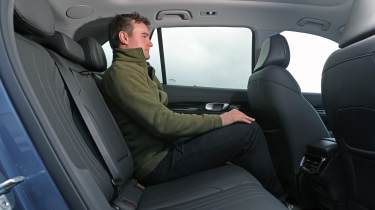
The opening panoramic roof doesn’t affect headroom, but the floor is a little on the high side, so you sit with your knees high in the back and under-thigh support could be better. A low window line and that glass roof help the Starray to feel bright and airy inside, and the cabin is wide, delivering plenty of elbow room. Back-seat passengers get air vents and twin USB ports for charging devices.
Boot space
The Starray’s drive battery is mounted under the passenger-compartment floor, so while some rival PHEVs have boots that are compromised by battery location, the Geely offers a generous amount of space. The company quotes a 528-litre capacity in five-seat mode for both battery sizes, which is 14 litres more than the non-plug-in Nissan Qashqai has to offer.
As with the Nissan, you get a false floor, and 100 litres of that quoted figure is reserved for the compartment beneath it. That’s more than enough room for charging cables and a tyre-repair kit, but the uneven floor doesn’t quite have enough room for a space-saver spare wheel. Helpfully, the area is lined to stop items rattling around.
A powered tailgate is fitted as standard to all cars, and there’s a roll-out load cover, although we did find it a bit tricky to locate the ends of the cover in the hooks on either side of the tailgate opening.
"There’s a wind deflector that pops up to help smooth airflow over the open roof, but it generates a lot of noise, even at speeds of around 40mph. Go faster and there’s an uncomfortable booming from the roof that can only be cancelled out by cracking open one of the side windows. Undesirable at motorway speeds." - Dean Gibson, senior test editor.
Reliability & safety
Pros |
|
Cons |
|
With the arrival of a number of new Chinese car makers comes question marks about their reliability and dealer service. Geely hopes to allay some of these fears by offering the longest new-car warranty on the market, with eight years and 125,000 miles of coverage, while the battery has no mileage limit. There’s four years of roadside assistance, too.
Safety is another strong point for the Starray. It was tested by Euro NCAP in 2025 and it earned a full five-star rating. There is a long list of safety kit on offer, although as with many rival Chinese models, the systems can be overzealous with their reactions.
The driver inattention and over-speed warnings are quick to react, while the lane assist can be quite strong when steering you back into line. You can set the systems up to your liking, but it’s a bit long-winded via the touchscreen, even if you use the quick set-up function. Unlike some rival systems that can be set with the push of one or two buttons, Geely’s system needs five touchscreen presses to activate and confirm your preferred settings.
| Euro NCAP safety ratings | |
| Euro NCAP safety rating | Five stars (out of five) |
| Adult occupant protection | 90% |
| Child occupant protection | 87% |
| Vulnerable road user protection | 86% |
| Safety assist | 77% |
Buying and owning
- Best buy: Geely Starray EM-i Ultra
While the Starray should attract plenty of new customers with its low headline price tag of under £30,000, the best model is at the top of the line up. That’s because the Ultra’s electric range and charging speed give it added flexibility to use pretty much as you would an EV. Overall kit is very good no matter which trim you go for, and there’ll be no difference to the driving experience across the Starray range either.
Geely Starray alternatives
There’s a whole load of mid-size SUV rivals that are targeting a similar market sector to the Starray. The BYD Sealion 5 offers the same amount of space and is priced almost the same, though it comes with either 38 miles or 53 miles of range. As for the MG HS, we know from experience in our plug-in hybrid range test that it’ll stay true to its claimed 75-mile electric range plus it feels more polished than the Geely or BYD behind the wheel.
Key updates of the Geely Starray review
5 May 2026: Latest driving impressions.
Frequently Asked Questions
Yes, Geely is rapidly expanding its dealership network with new stores nationwide.
Deals on the Starray and alternatives