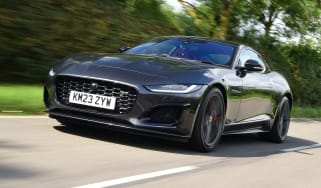
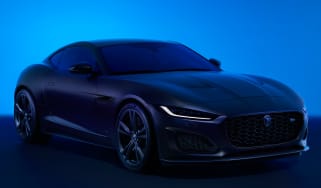
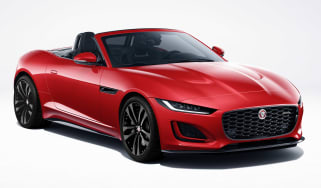
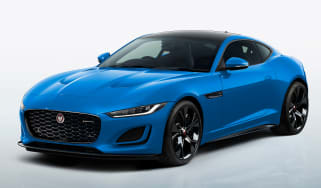
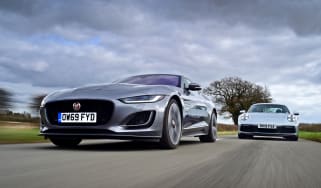
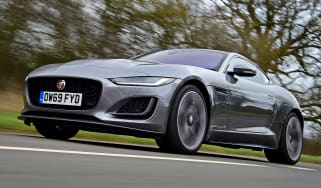
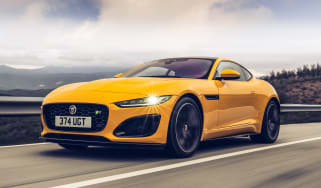
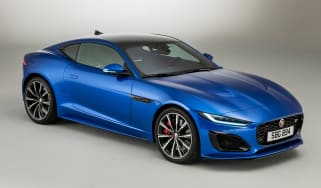
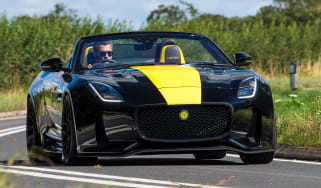
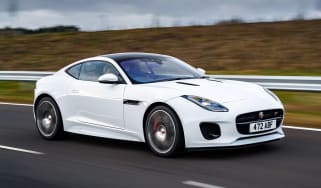
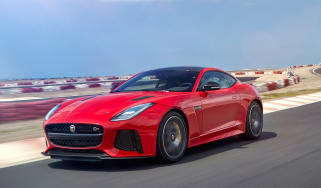
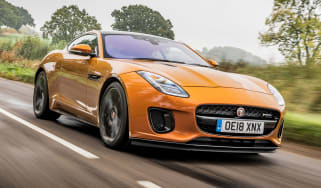
Used Jaguar F-Type (Mk1, 2013-2024) review
A full used buyer’s guide on the Jaguar F-Type covering the F-Type Mk1 (2013-2024)

Verdict
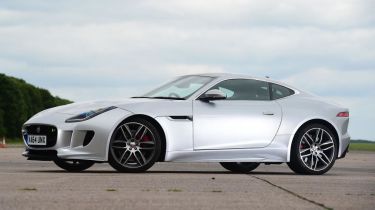
With its gorgeous looks and electrifying performance, the F-Type is a fabulous successor to the XK and very much worthy of its lineage from the classic E-Type. All F-Types are fast but, while the 2.0-litre four-cylinder engine has the right numbers, the V6 and V8 offer the sense of occasion that an F-Type should have, and are worth shelling out for. The F-Type comes with an extensive options list, so you must pin down exactly what you’re getting for your money. But even without any extras, these Jags are easy to recommend, with their gorgeous styling inside and out, manageable running costs and reasonable reliability. The latter can be a sticking point, which is why a pre-purchase inspection is essential.
The word ‘iconic’ is frequently misused in motoring. But if there’s one car that’s more than worthy of being called an icon, it’s the Jaguar E-Type, a sports car launched in 1961 to massive critical acclaim.
Replacing such an incredible machine was always going to be tough – so Jaguar didn’t. Instead, it came up with the XJS in 1975, which was more of a grand tourer. This was superseded by the XK8 in 1996, while the XK of 2006 made a pretty good job of being a sporting GT.
Used - available now

2023 Jaguar
F-Pace
33,225 milesAutomaticDiesel2.0L
Cash £25,720
2022 BMW
iX
31,605 milesAutomaticElectric
Cash £29,920
2022 MINI
Clubman
35,982 milesAutomaticPetrol1.5L
Cash £16,960
2026 Audi
A1 Sportback
9,061 milesAutomaticPetrol1.5L
Cash £22,051Jaguar gave us more of the same in 2013 when the XK’s replacement was announced: the dynamically excellent and gloriously designed sporting GT that is the F-Type.
After a successful seven year run, the model was heavily facelifted and renewed in 2020, with the biggest changes including a new front-end design and uprated interior.
Models covered
- Jaguar F-Type Mk1 (2013-2024) - This renaissance sports car is more affordable than ever. Here’s what to look for.
History
Jaguar unveiled the F-Type roadster at the Paris Motor Show in September 2013, and the car went on sale soon after. Buyers could choose between 3.0-litre V6 and 5.0-litre V8 petrol engines; both were supercharged, and the V8 model is known as the F-Type R.
In spring 2014 the F-Type coupé arrived, with the same engine and transmission options, then in November 2014 four-wheel drive became available on some models.
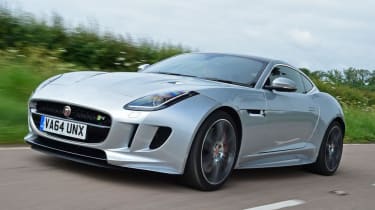
The 567bhp F-Type SVR arrived in summer 2016 with a 200mph top speed and ceramic brakes as standard. A spring 2017 facelift brought a new model with a 296bhp 2.0-litre four-cylinder engine, a revised interior that had redesigned seats, a much-improved infotainment system, LED headlights plus a raft of minor styling changes.
Jaguar performed a major overhaul on the F-Type in 2020 in order to keep it competitive with new releases from the likes of Porsche. Changes included sharper styling all around – including a new front and rear-end design, improved suspension and chassis components, new 20-inch alloy wheels, and a significant technology upgrade.
Which one should I buy?
Even the four-cylinder F-Type can do 155mph and 0-62mph in 5.4 seconds, so the 186mph and 4.2 seconds of the V8 models is a bit OTT, never mind the SVR’s outrageous pace.
The four-pot car has the lightest engine, so it handles more sweetly than its more powerful siblings, but all F-Types are great to drive. V6 F-Types come with a six-speed manual or eight-speed auto; only the latter was offered with AWD and V8 cars. The manual is particularly rare to find on the used market, so these can command a higher price.
All F-Types are well equipped. With the pre-facelift F-Type, entry-level cars get bi-xenon headlights, sat-nav, an eight-inch touchscreen display and 18-inch wheels. The V6 S adds 19-inch wheels, adaptive suspension, sports seats, upgraded brakes and ambient cabin lighting. V8-powered F-Types feature 20-inch wheels, premium leather trim and stronger brakes.
All post-facelift cars include an upgraded infotainment system, 6-way electric heated front seats and an interactive driver display.
Alternatives to the Jaguar F-Type
Four-cylinder F-Types are rivals for the Porsche 718 Boxster and Cayman, while the V6 and V8 models face the 911 coupé and convertible. All are formidable adversaries, with the 911 offered with rear or four-wheel drive and manual or auto transmissions.
A more left-field alternative is the Ford Mustang, especially in V8 guise, while the previous Aston Martin Vantage V8 (from around £29k used) is another alluring rival. The Nissan GT-R isn’t as engaging to drive as the Jag, but it’s astonishingly capable, fast and usable. Running costs can be high, though.
Less obvious rivals include the BMW M4, Audi RS 5 and Mercedes-AMG C 63, all of which are available in open or closed forms.
What to look for
Brakes
The V6 S and V8 versions of the F-Type could be specified with ceramic brakes, parts for which are very costly to purchase.
Gearbox
The automatic gearbox that’s specified on some cars is supposedly sealed for life, but it needs to have its fluid changed every 70,000 miles.
Dash
The central air vent on the F-Type’s dashboard should rise, while the door handles are meant to pop out; sometimes, though, these systems fail.
Corrosion
The bracing that runs beneath the F-Type can corrode. Dealers have been replacing parts under warranty on affected models.
Interior
After the dramatic exterior, you might be underwhelmed by the design of the cabin, but it’s nicely made, using plenty of premium materials, and all cars have leather trim.
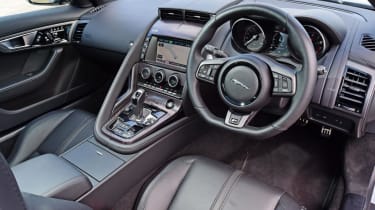
The original infotainment system is disappointing, with a better set-up fitted to cars from 2017 on and then a fully-upgraded system fitted to post-facelift models. All F-Types feature two seats and there’s decent space, but while the coupé’s boot is 407 litres, the roadster manages just 200 litres.
Running costs
F-Types need servicing every 12 months or 16,000 miles, alternating between minor and major. All models cost between £400-£700 for a minor service. The ninth and tenth services increase to £1,000-£1,600.
All engines are chain-driven, and transferable service plans are available for three or five years.
Recalls
The F-Type has been recalled 13 times, the first in October 2014 due to an engine-bay short circuit. The second came a month later because software glitches prevented the electric spoiler from deploying at speed.
Further recalls were due to faulty anti-roll bars and seatbelt pretensioners, failed front indicators, engine-bay fuel leaks, a fractured crank-pulley retaining bolt, excess CO2 emissions and an incorrectly fitted bumper reinforcement panel.
Driver Power owner satisfaction
The F-Type hasn’t featured in a Driver Power survey since 2015, when it came 34th in the new-car poll. Out of 200 cars, it came 72nd for reliability, 90th for running costs and 79th for in-car tech, plus 186th for practicality. Several top-10 scores – third for performance, seventh for handling and ninth for ease of driving – lifted the car’s position, while 35th for ride quality was decent.
Jaguar F-Type (2013-2024) review: What we said
Extracts from our in-depth review of the Jaguar F-Type...
Despite being on sale for around a decade, the F-Type is still a thrilling sports car that handles superbly. Available either in coupe or convertible form, it has enough dynamic talent to stand toe to toe with rivals from the likes of Porsche, BMW and Mercedes, while buyers also have the choice of lighter, four-cylinder models or the bombastic V8 versions which feel every inch the super car.
The 2020 facelifted F-Type model not only looks sharper, but drives much better, too, with sweeter steering, a crisper chassis, a mildly improved interior and, in 575 R guise, thundering performance to match. If you're looking for one last hurrah to celebrate the combustion engine, along with plenty of driving fun, the Jaguar F-Type might be just the ticket.
About the Jaguar F-Type
When it first appeared in 2013, the F-Type quickly showed itself to be the perfect flagship sports car for Jaguar. Whichever version you chose, it gave a thrilling driving experience and was almost universally acclaimed as one of the best-looking sports cars on sale. Together, these two points explain the F-Type’s success, as it satisfied the demands of driving enthusiasts and the style-conscious in one package.
But, the rate of progress in the car industry has always been fast-paced, to a point where the F-Type was starting to feel dated. In order to catch up with its rivals from Germany and America, Jaguar unveiled a heavily revised model at the beginning of 2020.
With the F-Type range priced to take sales from both the Porsche Boxster S/Cayman S and the larger 911, higher-spec F-Types provide more value for money, although you wouldn't be making a mistake if you picked the entry-level F-Type over one of its German rivals.
At the bottom of the range, the four-cylinder engine brings a welcome extra dimension to the line-up. And, if you’re thinking of a V8 F-Type, you can pick up a 4x4 version for around £5,000 more than the rear-drive version. The upgrade is worthwhile, because it makes the car safer and more secure without sacrificing any driving thrills.
Priced at more than £100k, the massively powerful 567bhp R flagship model is a serious investment, but in its favour it does have a top speed approaching almost 200mph. Previously, it didn't have the sharpness to beat the best of its rivals on the road, but the refreshed line-up feels much more honed, far lighter on its feet, and has a level of agility to its handling that was simply not there before.
Whether it's in coupe or convertible form, there aren't many cars for sale that can beat the Jaguar F-Type for head-turning looks. The 2020 revised model remains a striking piece of design that echoes the classic E-Type, while still delivering a contemporary feel. Previously available in F-Type, R-Dynamic, R-Dynamic Black or R specs, it's just the R-Dynamic and new 75 edition now included on the price list, with the performance R model sitting at the top of the range.
Power comes from a variety of engines. The entry point is the P300, which uses a 296bhp version of Jag's Ingenium 2.0-litre turbo, four-cylinder engine. The range then jumps to the P450 and P575, which both use Jaguar's powerhouse 5.0-litre supercharged V8 unit, making 444bhp and 567bhp, respectively.
The F-Type P300 is only offered with rear-wheel-drive, whereas the P450 V8 versions come with a choice of either AWD or rear-wheel-drive. The top-of-the-range P575 manages its monstrous 567bhp output by rather sensibly putting its power through all four wheels. All models use a revised version of Jaguar's great eight-speed auto transmission.
With price tags ranging from around £62,000 to more than £100,000, the F-Type has a lot of coupe and convertible rivals. Alongside competitors such as the Porsche Boxster and Cayman, buyers could look to more expensive versions of the Audi TT, BMW Z4 or Alpine A110, with cars like the Ford Mustang and BMW M2 also holding much appeal. At the top end of the range, the V8 F-Type is a cheaper (but still worthy) alternative to the Aston Martin Vantage, while the convertible version will have to face down the likes of the new Mercedes SL.
Engines, performance and drive
No matter what version of the F-Type you choose, you'll be rewarded with a superb driving experience. As it was developed as a convertible from the outset, there's very little twisting or vibration through the bodyshell, and body control in corners is excellent. But, it’s the new chassis modifications and improvements to the steering, in particular, that now define the F-Type.
Enhancing things further is plenty of strong grip, along with 50:50 weight distribution and either rear- or four-wheel drive. It all adds up to an extremely involving and agile car.
The overall result is still not quite as poised as a Porsche Boxster or Cayman, but the F-Type is an amazing car to drive nonetheless. What's different is that it blends superbly engaging performance with the sort of supple ride that makes cruising a pleasure. German rivals tend to adopt a more firmly sprung approach, which sometimes jars on Britain’s mixed bag of surfaces.
Four-wheel-drive cars are a real thrill. They feature an active system that generally sends only 30 per cent of torque to the front wheels, but feeds more in as the rear wheels lose traction. You don’t notice the added weight, and most of the time the car feels like it’s rear-wheel drive, but the extra grip and quick-witted 4WD system add to the fun, and the levels of grip are phenomenal.
0-62mph acceleration and top speed
The 2.0-litre four-cylinder engine is turbocharged, while the F-Type V8 versions basically use a re-map of the limited-run XE Project 8’s supercharged 5.0-litre unit.
That 2.0-litre unit in the P300 2.0 i4 is Jaguar’s Ingenium engine that's also used in the XE saloon and Land Rover's Discovery Sport. In the F-Type it makes 296bhp and 400Nm at just 1,500rpm. Top speed is 155mph, and 0-62mph arrives in 5.7 seconds.
The F-Type R, with its 5.0-litre V8, dispatches the 0-60mph sprint in 3.5 seconds (in coupe form) and hits a top speed of 186mph.
MPG, CO2 and running costs
Fuel economy is unlikely to be a big concern for those buyers lucky enough to be considering a Jaguar F-Type. Nonetheless, a stop/start system is standard on every model, and this helps to keep CO2 emissions to 214g/km for the 2.0-litre, four-cylinder P300 model, with a claimed 30.1mpg for the coupe also possible.
The rear-wheel-drive P450 V8 model produces a CO2 figure of 237g/km, with maximum fuel economy (under WLTP testing) at 27.2mpg. The AWD version is not quite as efficient, producing 242g/km and covering 26.7mpg. The range-topping R, costing almost £20k more than the P450, manages a respectable 27.0mpg, with a CO2 output of 239g/km.
Maintenance costs are pricey, but not out of the ordinary when compared to the F-Type's rivals. You can sign up to flexible service plans which help to spread the cost of scheduled maintenance.
Insurance groups
Insurance premiums for the F-Type are going to hit you hard in the pocket whichever way you look at it, so the question is how they compare to rivals.
The P300 Coupe sits in group 42, while the cabriolet version moves up to group 45. The Porsche Cayman is also in group 42, while the Porsche Boxster is positioned slightly higher than than the soft-top P300, at group 48. The V8-engined F-Type 75 R coupe is in insurance group 50.
Interior, design and technology
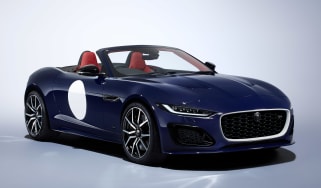
The F-Type looks dramatic enough to be a worthy modern incarnation of the show-stopping Jaguar E-Type. The short tail and slim rear lights hint at its predecessor, but at the same time its lines are finely detailed and completely modern.
The car also looks perfectly in proportion from almost any angle. Desirability is almost as important as performance and handling in this class, and the F-Type has both in abundance. The soft-top is particularly elegant: its tight lines work perfectly with the body design, and it folds down electrically in just 12 seconds.
The entry F-Type trim (now discontinued) featured 18-inch alloy wheels as standard, while R-Dynamic trim included larger 19-inch wheels. Now, every version of the new F-Type gets 20-inch alloys of differing design, LED headlights and tail-lights, an electrically-adjustable steering column with a leather-trimmed wheel, six-way electric front seats finished in leather and suede and adaptive cruise control.
The aggressive 575 R has upgraded Pixel LED headlights and a bespoke bodykit, which includes gloss-black detailing on the side sills, front splitter and grille surrounds, while the beefier brakes are finished with red calipers. Inside, the steering wheel gains R branding, there’s so-called ‘Premium’ ambient lighting, and the seats are adjustable in 12 directions and now finished in Ebony Windsor leather.
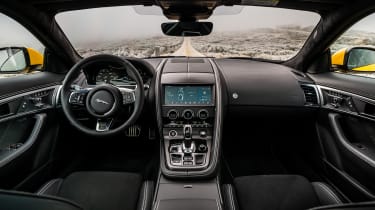
Sat-nav, stereo and infotainment
Sat-nav and Bluetooth connectivity are standard on all models, and the revised ten-inch touchscreen system in the F-Type is far better than previous Jaguar efforts – although it’s still not up to BMW and Audi standards of usability.
There’s an all-new 12.3-inch main instrument display with switchable designs, which allows you to choose between a big central rev counter for track work, or more traditional twin dials for road use.
Jaguar has included a Meridian sound system as standard across all models, although there is a £1,000 option to upgrade to a more powerful unit. Apple CarPlay and Android Auto are included at no extra cost.
Practicality, comfort and boot space
You don’t buy a two-seater sports car for its boot space, and the F-Type has certainly substituted practicality for style.
But while there isn’t lots of space for luggage, the driver and passenger should be very comfortable. Even owners standing well over six feet tall can find a suitable driving position, thanks to a full range of adjustment from the comfy yet supportive sports seats and grippy steering wheel.
You sit low in the car, though, which means the extremities are hard to see during close-quarter manoeuvres. Jaguar has rather sensibly included a reversing camera as standard, as it’s quite difficult to judge where that shapely tail ends.
A deep storage bin and twin cup-holders on the centre console provide plenty of room for housing odds and ends on the move. The slim doors feature decent pockets, and the glovebox is a pretty reasonable size, too.
Other practical touches include a soft-top that can be raised or lowered at speeds of up to 30mph, which is very useful in Britain’s changeable climate.
Dimensions and size
In terms of dimensions, the F-Type sits somewhere between the compact Porsche Boxster and larger Porsche 911. The Jaguar is 4,470mm long, while the two Porsches measure 4,374mm and 4,481mm respectively.
The F-Type is wider than both, though – at 1,923mm, it’s roughly 12cm wider than the Boxster S and Porsche 911 Turbo. Park the cars side-by-side, and the Jaguar’s roof is also a few millimetres higher than both the Porsches’.
Leg room, head room & passenger space
Luggage space is pretty limited, but the cabin itself feels quite roomy, even though it’s snug and enveloping with the roof up. The F-Type is strictly a two-seater, unlike the Porsche 911, which has the advantage of occasional rear seats, and this might put some potential buyers off the Jaguar.
Boot space
The F-Type Convertible has a 132-litre boot, and while the capacity is unaffected by folding the roof, if you add the optional space-saver spare wheel, it takes up all of the room. The F-Type Coupe is a little more practical in this respect, and Jaguar claims it has a 336-litre loadspace, although with the narrow opening and rather shallow dimensions, this could be slightly optimistic. By way of comparison, the Porsche Boxster S' mid-engined configuration allows luggage compartments at both ends, for a total of 280 litres.