Renault 4 review
The Renault 4 isn’t just a more practical R5, it has a unique retro charm all of its own

Our opinion on the Renault 4
We had high hopes for the bigger and more practical Renault 4 – and it's lived up to those expectations so well that we've named it our Small SUV of the Year for two years on the trot. This is still a small, urban-focused EV, but one that can also serve as a compact family car that’s capable of occasional long trips. Like its retro sibling, it’s got charm and character by the bucketload; opt for the mid-spec Techno+ trim and you’ll have one of the best-value new EVs currently on sale.
About the Renault 4
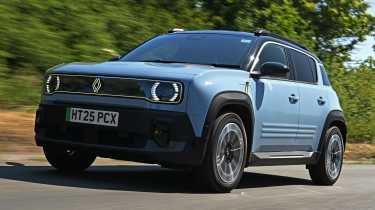
In a way, the Renault 4 is to the Renault 5 E-Tech what the Renault Captur is to the Renault Clio - essentially the same platform and powertrain, but with a unique style and a bit more practicality courtesy of a small SUV-style body.
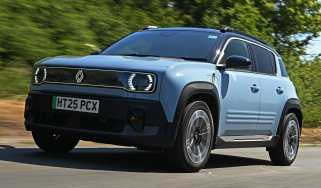
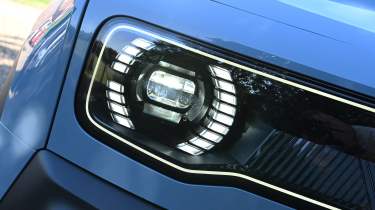
Of course, there’s much more to the latest R4 than that, with chunky lines and details that draw their inspiration from Renault’s famous budget hatchback introduced in the sixties. The side profile features the same window shape as that original model, and the lines moulded into the doors are another nod to the old R4, while the LED lighting features an illuminated surround and round daytime running lights up front, plus vertical tail-lights inspired by the first R4. These touches are combined with more modern, SUV-derived cues, such as the roof rails and squared-off black wheelarches.
Used - available now


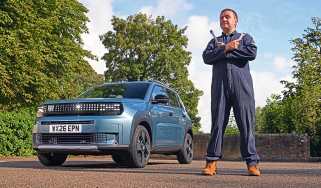
We've tested the Renault 4 against the Ford Puma Gen-E, and our picture editor, Dawn Grant, has been running an Iconic+ trim Renault 4 as part of our long-term test fleet.
Performance & driving experience
Pros |
|
Cons |
|
On the road, the R4 continues to impress. It feels neatly tied down, despite Renault claiming it has a slightly softer set-up than the Renault 5, with a willingness to change direction that’s missing in plenty of its rivals. We mention that softer set-up fleetingly, though; the Renault 4 is still quite stiffly sprung, with a hard-ish edge to the ride around town. Things are much smoother at higher speeds, however.
One thing we particularly like about the 4 compared with every Renault 5 we’ve driven to date, is the introduction of adjustable regenerative braking and a one-pedal drive mode. We say ‘to date’, because we’re told that this feature, along with the paddles behind the steering wheel, will be added to the R5 “during its lifecycle”. The system – similar to that found on recent Hyundai and Kia cars – is intuitive to use, and can slow the car to a controlled stop without using the brake pedal at all.
| Model | Power | 0-62mph | Top speed |
| R4 Evolution+ Comfort range | 148bhp | 8.2 seconds | 93mph |
| R4 Techno+ Comfort range | 148bhp | 8.2 seconds | 93mph |
| R4 Plein Sud Iconic+ 52kWh Comfort range | 148bhp | 8.2 seconds | 93mph |
Performance, 0-60mph acceleration and top speed
The Renault 5 comes with two motor options, but the Renault 4 only takes the more powerful of the pair. The lone offering sends its 148bhp and 245Nm to the front wheels, delivering decent performance; 0-62mph takes 8.2 seconds, which is more than enough for a car in this class.
It's also more than enough to occasionally overwhelm the front wheels. Torque steer – where the steering wheel squirms a little in your hands under hard acceleration – is noticeable at times, without having a detrimental effect on the driving experience. The Renault 4, like its smaller sibling, is really good fun to drive.
Knock it from Sport into Comfort, and it can do the relaxing stuff pretty well, too. You’ve still got enough power to surge away from junctions or traffic lights. However, as our pictures editor Dawn Grant found out during her long-term test, Eco pegs things back significantly – to the extent that you may struggle to maintain a steady speed on steeper inclines. We’d leave that mode for when you really need to maximise efficiency.
Town driving, visibility and parking
While the Renault 4 is pitched as a small SUV, it feels more like a supermini at lower speeds. There’s a relatively low-slung driving position, but the flat bonnet ahead of you allows you to position the car easily. Our pictures editor, Dawn Grant, had no issues with visibility in her long-term test car, but she did find that the window shape can result in the cabin feeling a bit dark and closed in at times.
The steering is quick and responsive, albeit with little feedback through the wheel’s rim. The electric powertrain is responsive enough for most situations, and the car easily keeps pace with traffic. You need to be deliberate with your actions when selecting between Drive and Reverse with the column-mounted selector – we found it often chose neutral if the driver didn’t apply enough pressure to the stalk.
While R4’s softer suspension set-up than the R5 improves comfort, smaller bumps can still be felt in the cabin. One addition to the R4 over the R5 is the option of one-pedal driving. This is selected using the steering-wheel paddles (it’s the strongest of the four recuperation strengths available) and offers a smoother alternative to using the brake pedal alone. When you apply the brakes, the transition between energy recovery and the actual discs and pads can be a little inconsistent and jerky.
Country road driving and handling
At higher speeds, the softer edge to the R4’s ride means it delivers decent comfort, but this doesn’t come at the expense of handling. There’s more body roll than in the R5 courtesy of this car’s additional height and weight, but in relative terms, the R4 is still a light EV with plenty of grip on offer.
The car's Comfort and Sport driving modes are better suited to B road driving, because the car's Eco mode blunts performance significantly. Using Comfort or Sport makes the accelerator pedal much sharper, which helps when keeping up with traffic or overtaking.
Motorway driving and long-distance comfort
At higher speeds, the Renault 4 remains a comfortable car, with just a hint of bounce over expansion joints. There’s very little wind noise, too, but the throttle response is slightly dull at higher speeds, so you can’t accelerate quite as hard at the national limit as you can at lower speeds.
“I’m not a fan of the gear selector. It’s not that it gets in the way when I’m driving, but its indistinct black finish leaves me grasping at thin air in the dark. Still, at least finding it awkward means I am double-checking the gear selection every time.” - Dawn Grant, pictures editor.
Range, charging & running costs
Pros |
|
Cons |
|
The Renault 4’s extra size relative to the R5 has only slightly dented the overall range. Officially, the R4 can cover up to 249 miles between charges, which is just five miles short of what the R5 can achieve. It is, however, rather down compared with the long range version of the Kia EV2, which has an official range figure of 281 miles.
During our group test, we saw 3.8 miles per kWh from an early Techno version of the R4 over a mixture of roads – including stop-start London traffic, a long run up the motorway and some more enthusiastic driving on our favourite rural roads. That equates to just shy of 200 miles on a full charge, and we reckon a more considered driving style would see you get much closer to the car’s stated WLTP range. With more urban driving, our long-term Iconic+ Renault 4 is averaging 4.1 miles per kWh or 213 miles per charge in colder weather, and 4.5 miles per kWh or 234 miles in summer.
Charging speeds are less impressive, but pretty much par for the course in this part of the new-car market. Renault claims a 100kW peak – identical to those of the Ford Puma Gen-E and the various Stellantis compact SUVs, plus marginally quicker than the MINI Aceman’s. But we saw no more than 65kW on a 150kW charger, having plugged in at around 40 per cent. It maintained this speed pretty consistently to almost 80 per cent, which is good to see. Charging using a typical 7.4kW home wallbox charger will take just under eight hours to fully recharge a Renault 4.
Although these times weren’t ideal when she was in a rush, our pictures editor, Dawn Grant, did find that a bit of planning could transform these stops from an inconvenience into something less inconvenient. While it might not work for everyone, Dawn found that recharging while doing the weekly shop or visiting an attraction soon became an easy habit to get into with her long-term Renault 4.
One smart feature of the charging system on the Renault 4 is that it has a vehicle-to-load capability. This means you can plug an adaptor into the car's charging port and charge or run external devices. The power source is rated at 3.7kW.
| Model | Battery size | Range | Insurance group |
| R4 Evolution+ Comfort range | 52kWh | 249 miles | 26 |
| R4 Techno+ Comfort range | 52kWh | 243 miles | 26 |
| R4 Iconic+ Plein Sud 52kWh Comfort range | 52kWh | 241 miles | 27 |
Insurance groups
There are three trim levels to choose from for the Renault 4, and these sit in insurance groups 26 and 27 out of 50. Some good news is that opting for the fabric-roofed Plein Sud doesn’t affect the insurance rating when compared to the equivalent hard-top. However, the Ford Puma Gen-E will be cheaper to cover, residing in groups 18 to 20.
Tax
The R4’s fully electric powertrain means it attracts the very lowest company car tax rates. At the same time, affordable pricing means it stays well below the £50,000 luxury car tax threshold for EVs You will still have to pay the standard rate of annual vehicle excise duty (VED) road tax, though, and the eVED pay-per-mile tax will be a concern when it comes into effect in 2028 as planned.
Depreciation
Our market data indicates that the Renault 4 will retain between 45 and 47 per cent of its initial value after three years or 36,000 miles. That's similar to the Kia EV2 (43 to 48 per cent) and a much stronger outcome than the Ford Puma Gen-E, which only manages 38 to 40 per cent. As quirky little electric SUVs go, though, the MINI Aceman does much better by maintaining between 45 and 54 per cent of its original value.
To get an accurate valuation for a specific model, try our free car valuation tool...
Interior, design & technology
Pros |
|
Cons |
|
Renault is on a bit of a roll at the moment with its designs. From the modern-looking Renault Scenic and the neat facelifts of the Clio and Captur, to the retro-modern charm of the Renault 5, there is plenty of good styling coming out of the French firm. The Renault 4 is no different, and judging by the sideways glances and looks of admiration we received when driving the car on its European launch, this reimagination of one of the French brand’s most famous past hits looks set to be a popular one.
There are three trim levels to choose from – Evolution+, Techno+ and Iconic+ – and kit levels are generous from the bottom up. All cars get the 10.1-inch touchscreen, a reversing camera, rear parking sensors, keyless entry and a heat pump.
We’d opt for the mid-spec Techno+ because it adds desirable elements such as:
- Roof bars
- Wireless phone charging
- Privacy glass
- Ambient lighting
- Google built into the infotainment system
- An upgraded Arkamys audio system
The flagship Iconic+ has two-tone paint, heated front seats and steering wheel, a Harman Kardon sound system, a power tailgate and extra safety features.
Plein Sud models are only available in the Techno+ and Iconic+ trims. The kit lists remain the same, but this model comes with a folding fabric roof.
Interior and dashboard design
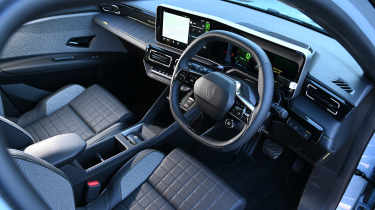
The Renault 4’s dashboard and infotainment system are an almost wholesale carryover from the R5, which is no bad thing. While we’d often cry out for a little more individuality between two models which look so different on the outside, the Renault 5’s fantastic cabin is a pretty strong starting point.
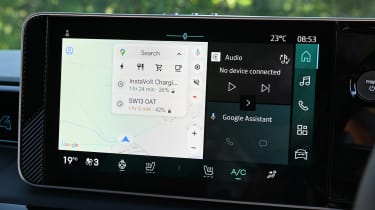
Drivers get a funky-looking dash that feels as expensive as anything else in the class, and has been designed with some genuine thought to usability. The dual-screen layout is clear and easy to read, while the Google-based software is intuitive and filled with functionality – including Google Maps with built-in EV routing in mid-range Techno+ trim and above. The climate controls take the form of a bank of physical switches lower down on the dash, which are super easy to use and have a lovely tactile quality.
Materials and build quality
The materials used are mostly very good, with the exception of some scratchier plastics used on the lower sections of the dashboard and door cards, and a cheap-feeling lid to the small bin in the centre console. The seats are comfortable – with different padding to the 5 – and the squared-off bonnet makes it easy to place the car when parking.
Infotainment, sat-nav and stereo
The R4 uses the same infotainment set-up as the R5, and it’s comfortably among the best in the small SUV class. The Google-based system looks great, loads quickly and is easy to figure out, while there are plenty of functions to choose from via the sharp-looking touchscreen. Route planning shows the estimated battery percentage left at the end of a trip, and can pre-condition the battery if you’re navigating to a charging station – ensuring the charge speeds are at their best when the car arrives.
Mid-range Techno+ models have an upgraded Arkamys sound system and wireless smartphone charging. The range-topping Iconic+ trim has a further enhanced Harman Kardon set-up.
“Although there are some hard plastics on show, the additional black quilted textile trim with yellow stitching really lifts it, and I love the plain, straightforward look.” - Dawn Grant, pictures editor.
Boot space & practicality
Pros |
|
Cons |
|
The retro Renault 5 has dominated headlines as one of the most stylish small cars since it first arrived. However, the Renault 4 addresses the R5’s biggest failing: its compromised practicality.
With its larger SUV shape, the R4 is far more appealing, and even makes a convincing case for itself as a family car.
Dimensions and size
At 4.1 metres long, the R4 is no giant, but it is considerably longer than the Renault 5, and 83mm of that increase sits between the front and rear axles, so interior space is boosted.
| Dimensions comparison | |||
| Model | Renault 4 | Ford Puma Gen-E | MINI Aceman |
| Length | 4,144mm | 4,313mm | 4,079mm |
| Width | 1,808mm | 1,805mm | 1,754mm |
| Height | 1,552mm | 1,555mm | 1,514mm |
| Wheelbase | 2,624mm | 2,588mm | 2,606mm |
| Boot space | 339-1,113 litres | 523-1,283 litres | 300-1,005 litres |
Seats & passenger space
Overall, the Renault 4’s interior is a pleasant place to be. The seats are comfortable and the layout is easy to get along with, while there’s a wide range of wheel and seat adjustment on offer, too.
We have one or two minor gripes, though. The column-mounted gear selector is a little easy to confuse with the wiper stalk during parking manoeuvres, causing some inadvertent windscreen swipes rather than a change in direction, while the rear quarter windows are pretty much useless, so there’s a reasonable blind spot over the shoulder. On the plus side, the squared-off bonnet helps with positioning the front of the car in tight spots.
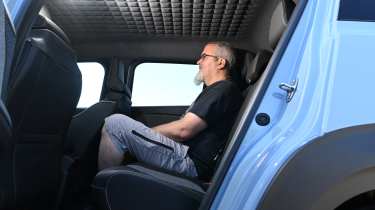
The Renault 4 gets a bit more head and legroom in the back than the R5, and it’s more spacious than a MINI Aceman or Jeep Avenger. There’s still not very much space under the front seats for your feet, and the high floor means it’s short of under-thigh support, but overall, there’s just about enough room for those approaching six feet tall not to feel too hemmed in. It’s just a shame our car’s dark interior doesn’t add to that sense of space.
Boot space
The R4's boot capacity is bigger than the R5’s; 339 litres with the seats up rising to 1,113 litres with the 60/40 split rear seats folded down. There isn't space under the bonnet for the charging cables, but you will find a 55-litre hidden cavern under the boot floor. The load lip is particularly low, and there is no step to haul things over, but the trade-off is a frankly huge tailgate that meant we had to park slightly farther from obstacles behind the car than we might have liked on several occasions. You’ll need quick reactions if you want to avoid damaging the electrically operated bootlid on top-spec Iconic cars, too.
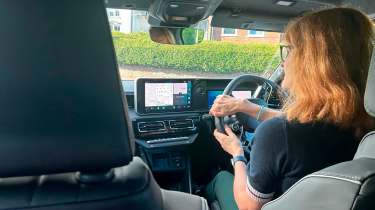
“My husband sat in the back to take an in-car driving photo. He is 6ft 2in and was happy to find he had a small amount of headroom to spare and enough legroom to be comfortable.” - Dawn Grant, pictures editor.
Reliability & safety
Pros |
|
Cons |
|
Since the Renault 4 shares so much with the Renault 5, it shouldn’t come as a surprise to learn that it earned the same four-star Euro NCAP rating as its supermini sibling. Its score was pegged back by the lack of a centre airbag between the front seats, and by the dashboard failing to provide the same level of protection for occupants of different sizes.
Get past the Euro NCAP score, and there are plenty of positives in terms of standard safety kit, with automatic emergency braking capability in both forward and reverse, lane-departure warning and emergency lane-keeping assist included. However, you have to upgrade to the top-spec Iconic+ model for blind-spot warning and safe-exit assistance, the latter helping to prevent you from opening the door into the path of approaching vehicles.
Speed-limit warning systems are now mandated to be active every time you start a car, but Renault makes it easy to disable the R4’s with the touch of a button. The My Perso mode can be set up via the touchscreen with all the safety features you’d like switched on and the ones you don’t want switched off. Then all you have to do is press the My Safety button on the dashboard to recall your preferred set-up, saving you from searching through menus as per some of its rivals.
The Renault 4 didn’t appear in the most recent Driver Power owner satisfaction survey, but the brand has continued to climb up the best manufacturer leaderboard in recent years. With a ninth-place finish out of 30 in our 2026 survey, Renault outperformed several key rivals including Nissan (12th), Hyundai (13th), Fiat (18th), and Skoda (20th). Owners told us they were impressed with the interior design and quality of their cars, the smartphone connectivity and ease of its built-in navigation system, plus the low cost of road tax and insurance. Rear seat leg room, visibility, and ride quality could be improved upon, though.
| Euro NCAP safety ratings | |
| Euro NCAP safety rating | 4 stars (2024) |
| Adult occupant protection | 79% |
| Child occupant protection | 85% |
| Vulnerable road user protection | 73% |
| Safety assist | 68% |
Buying, prices and deals
Best buy: Renault 4 E-Tech Techno+ Plein Sud
The Renault 4 starts from around £23,500 for the base Evolution+ model, while the mid-range Techo+ starts from £26,000 in hard-top form, or around £27,500 for the open-top Plein Sud. The range-topping Iconic+ costs almost £28,000 for the regular model and nearly £29,500 for the Plein Sud version.
We'd recommend going for the mid-range Techno+ trim for its much more useful Google-based navigation, and we'd also use some of the £3,750 'Band 1' electric car grant (ECG) saving this car is eligible for by getting the open-roof Plein Sud version. The electric opening canvas roof is a great throwback to the original Renault 4, and gives you the fresh-air benefits of a convertible without the practicality drawbacks usually associated with cabriolet cars.
If you want to save even more on the Renault 4, our Buy A Car service can help. You can configure your ideal Renault 4 now to get top offers from local dealers, and check out the latest Renault 4 leasing deals. You can even sell your existing car for a great price with Auto Express Sell My Car.
Renault 4 alternatives
The pricing of the Renault 4 works out pretty favourably against rivals such as the Kia EV2, Ford Puma Gen-E and MINI Aceman. The Ford’s interior ergonomics, quality and infotainment tech aren’t a patch on the Renault’s, and while the MINI has a stunning interior design, it's hampered by a ride that's too firm, a cabin that's too cramped, and poor electric driving range when compared with the R4. The EV2 is the one to watch thanks to its longer EV range and impressive efficiency.
Renault 4 pictures
Key updates of the Renault 4 review
28 September 2026: General update with the latest 2026 Driver Power customer satisfaction survey and resale valuation.
10 August 2026: Latest driving impressions from our long-term test.
Deals on the R4 and alternatives