Cupra Terramar review
The Cupra Terramar compact SUV delivers sporty looks, decent space and a well-rounded drive

Our opinion on the Cupra Terramar
Anyone after a five-seat family SUV with a sporting edge should consider the Cupra Terramar a strong choice. It strikes a good balance between comfort and driving dynamics, which means it’s well suited to UK roads, although if you’re looking for a family car that can deliver hot-hatch thrills, its size and weight mean it can’t quite deliver in that department. Prices are on the high side, too, while the eHybrid sacrifices some practicality courtesy of its large drive battery – you also need to keep the pack charged for the best efficiency and to deliver the sharpest responses from the powertrain.
About the Cupra Terramar
The Terramar is a mid-size SUV that slots into the Spanish sporting brand’s line-up above the Cupra Formentor. There’s a variety of power sources, from a 1.5-litre petrol with mild-hybrid assistance, a more traditional 2.0-litre petrol engine, or a plug-in hybrid setup. All models come with automatic gearboxes, with the 1.5-litre mild-hybrid and 2.0-litre petrol getting seven-speeds, and the plug-in hybrid using a six-speed auto.
Unlike many Cupra SUVs of old, the Terramar is a unique model that isn’t directly related to a SEAT. However, it still uses VW Group underpinnings, because it is based on the MQB platform.
Used - available now

2026 Cupra
Terramar
3,898 milesAutomaticPetrol2.0L
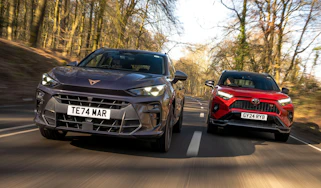
Cash £35,495We’ve lined up the Cupra Terramar against the top-selling Toyota RAV4 in a twin test. Despite the previous generation RAV4’s popularity, the Terramar took the win here as our experts feel that it offers a superior driving experience, good levels of comfort and competitive efficiency. We have also run a 2.0 TSI V2 Terramar for six months as part of our long term test fleet.
Cupra Terramar prices and latest deals
How much does the Cupra Terramar cost? Well, official ‘on the road’ prices range from £37,715 to £51,055 but you can currently save an average of £7,646 through the Auto Express Find A Car service, where prices start at £30,960. You can lease a Cupra Terramar from £329 per month or buy a used model at prices starting from £35,495.
Check out our latest new car deals, leasing deals and used car deals for the top offers available now on Auto Express. And don't forget we can help you sell your car, too.
Prices start from around £38,000 for a Terramar in V1 trim powered by a 148bhp 1.5 eTSI mild-hybrid petrol engine. The 201bhp 2.0 TSI petrol and similarly powerful 1.5 e-Hybrid are also similarly priced, at just over £44,000 in V1 trim. Upgrading to the high-performance 268bhp 1.5 e-Hybrid will set you back just under £48,000, while the 261bhp 2.0 TSI comes in at around £48,500.
If you're interested in getting yourself a Cupra Terramar, we can help. Configure your ideal Cupra Terramar now to get top offers from local dealers, check out the latest Terramar leasing deals, or search for used Cupra Terramar models with our Buy A Car service. You can even sell your existing car for a great price with Auto Express Sell my Car.
Performance & driving experience
Pros |
|
Cons |
|
Given that the company comes from a performance background, it’s no surprise that Cupra’s Terramar has a sporty edge to the way that it drives. The 148bhp entry-level model focuses more on comfort, though, while moving through the trim levels and engine range sees power increase, as well as sharper driving dynamics added into the mix.
The 148bhp 1.5 eTSI uses mild-hybrid tech to smooth out the powertrain, and it’s a similar story for the e-Hybrid, where the large drive battery helps to deliver sprightly acceleration. The 2.0 TSI is a more traditional drive, thanks to the fact that all its power comes from one source, offering better overall responses when compared with the more powerful PHEV.
Having driven the most powerful plug-in model in the UK, we’d say it really needs to have some charge held in the battery to make the most of its performance, because once the power pack is flat, the 1.5 TSI petrol engine isn’t strong enough to deliver rapid responses on its own. There’s a jerkiness in the transmission that can cause frustration as it brings in electrical assistance from the electric motor – this process is much smoother when there’s some charge in the battery.
One particular highlight of the top-spec VZ2 model is the standard-fit DCC Dynamic Chassis Control with adaptive dampers. These have a wide range of adjustment, so you can tailor their response to your needs. There are 15 stages in total, which seems a little excessive, especially when you can simply switch between the most comfortable and sportiest of settings using the switch on the steering wheel. There are Comfort, Race and Cupra modes, plus a Personal mode that allows you to set-up your own favourite engine, suspension, and gearbox settings.
On UK roads, the most comfortable setting delivers a smooth ride that is on the slightly firm side, but nothing that is likely to cause complaints from passengers. Even the stiffest setting isn’t harsh, with the car tending to follow undulations in the road rather than crashing over them, while boosting grip in corners with minimal body roll.
The Terramar is a heavy car, especially in PHEV guise, but it has a strong set of brakes as standard. There’s a slight softness to the pedal on the plug-in model as it transitions from energy recuperation to the physical discs and pads, so you need to give them a sharper prod than you might initially think, but they remain strong even after repeated use.
All versions of the Terramar feature a twin-clutch automatic gearbox, with the petrol models featuring a seven-speed transmission and the e-Hybrid coming with a six-speed unit. The shifts are crisp, and you can take manual control via the steering wheel paddles, although if you leave the paddles alone, the gearbox will revert to auto mode. There are standard and S modes, with the latter holding on to the revs for longer to make for a sportier drive.
In Race and Cupra modes, the engine note is enhanced with extra sound piped into the cabin. It’s slightly more aggressive in Race mode, while the Cupra setting delivers a sound somewhere between a race-tuned four-cylinder, V8 rumble and five-cylinder Audi RS 3 warble. It’s not unpleasant, but you can deactivate it by choosing the Personal setting.
| Model | Power | 0-62mph | Top speed |
| Terramar 1.5 eTSI 150 V1 | 148bhp | 9.3 seconds | 127mph |
| Terramar 1.5 TSI e-Hybrid 272 VZ1 | 268bhp | 7.3 seconds | 134mph |
| Terramar 2.0 TSI 265 VZ1 | 261bhp | 5.9 seconds | 151mph |
Performance, 0-60mph acceleration and top speed
At the entry point to the range, the 148bhp 1.5 eTSI offers a 0-62mph time of 9.3 seconds and a top speed of 127mph. These are respectable figures if not outstanding ones, but the Terramar line-up only gets faster from there.
Next most powerful are the 2.0 TSI and 1.5 TSI e-Hybrid models, which both come with 201bhp. The former is faster thanks to its lower kerbweight, with a 0-62mph time of 7.1 seconds quoted, while the e-Hybrid manages the sprint in 8.3 seconds. Top speeds are 140mph and 127mph, respectively.
The most powerful Terramar is the 268bhp 1.5 TSI e-Hybrid, but the weight of its battery and electrical system means it only sprints from 0-62mph in 7.3 seconds, whereas the 261bhp 2.0 TSI manages the sprint in 5.9 seconds, helped in part by the traction offered by 4Drive four-wheel drive.
Town driving, visibility and parking
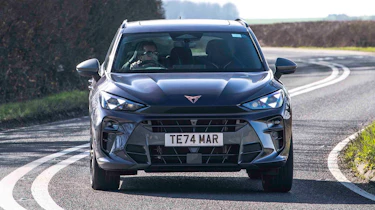
Around town, the Terramar’s sporty shape, with a high bonnet and small windows, means that visibility isn’t the best in the class, but it isn't the worst either. Light steering and a responsive rack make manoeuvring relatively simple, while front and rear parking sensors and a reversing camera are standard across the range. High-spec cars also include Park Assist, which offers the ability to let the car take over steering into and out of spaces.
During his time with our long-term Terramar test car, our creative director, Darren Wilson, found that the autonomous emergency braking (AEB) system sometimes became confused by pedestrian islands in the road and activated in heavy traffic.
Country road driving and handling
The Terramar copes well on twisty roads, although the extra weight of the e-Hybrid model means it’s not at its best when pushing to the limits. Keep to around seven tenths, and the Terramar feels agile and responsive enough for a compact SUV such as this. It’s not going to match a hot hatch on a twisty road, and only the most powerful 2.0 TSI model feels as if it has the punch of a performance car, but it’s still a satisfying family SUV to drive.
A boost mode is available that uses stored electrical energy to give some assistance when asking for harder acceleration. A small icon on the dash shows how much energy is available, and when it’s used, the rev counter turns blue – although this doesn’t give the Terramar the kind of uplift in power that you get from accelerating hard in an EV.
Motorway driving and long-distance comfort
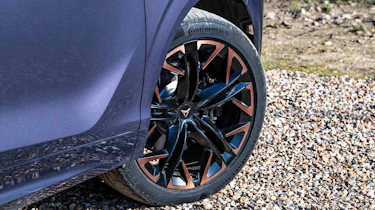
A pliant ride is available on V1 models featuring 18-inch wheels, but even the biggest 20-inch rims on the VZ2 don’t have much of a negative impact on the ride, particularly because these cars feature the adaptive dampers. There is more road noise from the top-spec model at motorway speeds, and this is amplified by the lack of wind or engine noise in the cabin. The VZ2 features sporty looking bucket seats up front, but they’re wide and deliver good comfort, making the Terramar a decent long-distance machine.
“It comes to something that a car is good because there isn’t anything that jumps out to annoy you, but that’s how it is in the Terramar. It’s largely competent in all circumstances, with the only real quibble being whether you get along with the firm ride – although this is unlikely to be a deal breaker.” - Dean Gibson, senior test editor.
MPG & running costs
Pros |
|
Cons |
|
The first obstacle to Terramar ownership is price, because it costs more than the equivalent Volkswagen Tiguan, which shares the same powertrains and is slightly larger and, therefore, more practical.
Fuel efficiency is decent across the range, although obviously the large-capacity 2.0 TSI petrols with four-wheel drive and more than 200bhp aren’t as efficient as the rest of the line-up. The best pure-petrol performer is the 1.5 eTSI mild-hybrid in V1 guise, which has a claimed fuel economy figure of 46.3mpg. Upgrading to V2 trim sees a slight dip in the claimed figure to 46mpg exactly, courtesy of its larger 19-inch alloys.
The 201bhp 2.0 TSI returns 37.4mpg in WLTP test conditions in V1 trim, while the best-performing 268bhp model is the VZ1, at 33.6mpg. Again, moving to V2 and VZ2 trims has a small knock-on effect for fuel efficiency. Our V2 trim 2.0 TSI averaged 32.3mpg over the course of nearly 5,000 miles.
The e-Hybrid models have official fuel economy figures in the 580-660mpg range, accounted for by the electric running that is part of the WLTP test procedure. When we tested the 268bhp version of the e-Hybrid, we saw economy ranging between 35-45mpg once the battery was fully discharged, while a relatively small 45-litre fuel tank (compared with up to 60 litres for the pure-petrol models) meant we only saw a range of around 350 miles.
| Model | MPG | CO2 | Insurance group |
| Terramar 1.5 eTSI 150 V1 | 46.3mpg | 140g/km | 21 |
| Terramar 1.5 TSI e-Hybrid 272 VZ1 | 661.1mpg | 10g/km | 30 |
| Terramar 2.0 TSI 265 VZ1 | 33.6mpg | 191g/km | 32 |
Electric range, battery life and charge time
The Terramar 1.5 TSI e-Hybrid is the plug-in model, and features a 25.8kWh battery, irrespective of which power output you choose. This pack is good for a claimed range of 74 miles in V1 spec, and even the most powerful VZ2 has a claimed range of 71 miles, so there’s every chance that you could do all of your daily driving on electricity alone.
The pack can be charged at up to 50kW, and doing so sees it go from 10-80 per cent capacity in 26 minutes. The other quoted charge time is from an 11kW AC source, which takes two and a half hours to go from zero to 100 per cent capacity, although most UK homes can only handle 7.4kW charging, so it’ll take around 3.5 hours to fully charge the battery.
There is no function to charge the battery using the engine, although hard driving in Cupra mode will see some energy ploughed back into the pack. You can save the charge for later use via the touchscreen, while scheduled charging is also available.
| Model | Battery size | Range | Insurance group |
| Terramar 1.5 TSI e-Hybrid 204 V1 | 25.8kWh | 74 miles | 28 |
| Terramar 1.5 TSI e-Hybrid 272 VZ1 | 25.8kWh | 72 miles | 30 |
Insurance groups
Insurance groups start at 21 for the entry-level model, while increasing power sees the ratings increase. The 2.0 TSI has group 28 and 29 ratings in its lower-powered form, while the 268bhp models are in groups 32 and 33. The e-Hybrid plug-in models are in bandings that are one group lower across the board, showing that the hybrid system isn’t seen as a major factor in repair costs.
All cars come with an anti-theft alarm, while keyless entry and starting are also fitted as standard.
In comparison, the closely related Volkswagen Tiguan falls into groups 18 to 32, which means several variants will be cheaper to cover than the sportier Cupra.
Tax
With high prices come additional costs in terms of VED road tax. Only the 1.5 TSI V1 version of the Terramar sits below the £40,000 combustion luxury car tax threshold, so for anything above, there’s a surcharge of £440 to pay on top of the standard rate of VED from the second time the car is taxed until it is six-years old.
The e-Hybrid models offer beneficial company car tax rates, with Benefit-in-Kind (BiK) costs that are around a fifth of the rest of the line-up. However, for the very biggest rate reductions, an electric SUV like the Cupra Tavascan will be a much better option.
Depreciation
Our market data shows that the Cupra Terramar is set to retain 51 to 57 per cent of its value after a period of three years or 36,000 miles. This is a strong outcome for a mid-size SUV, but it’s not massively different to the Volkswagen Tiguan’s performance at 48 to 53 per cent.
To get an accurate valuation on a specific model check out our free car valuation tool...
Interior, design & technology
Pros |
|
Cons |
|
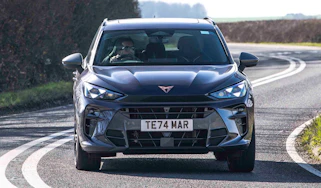
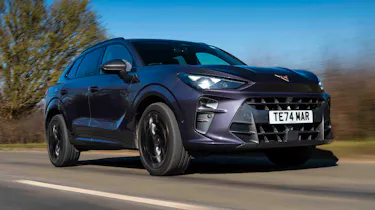
Cupra’s new corporate look, with a bluff nose and air intakes set lower down in the bumper, looks fine from some angles, but awkward from others, and the fussy front end of the Terramar is a mix of slashes and openings, some of which are blanked off. In terms of shape, the Terramar isn’t quite as rakish as a Cupra Formentor.
The colour palette that’s on offer is fairly restrained, too, with the most distinctive shade being Dark Void, a greyish purple option (for around £1,000) that only really stands out in sunlight.
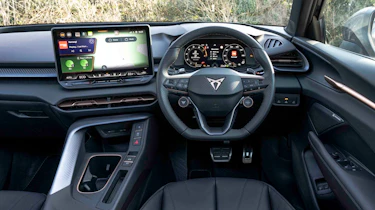
Inside, the cabin has a driver-focused layout, with plenty of copper detailing and sporty features to help it stand out.
Tribe Edition buyers gain unique green interior stitching along with Sulphur Green exterior highlights and the option of Manganese Matt paint. This car is metaphorically greener, too, because it comes with a number of recycled materials.
Interior and dashboard design
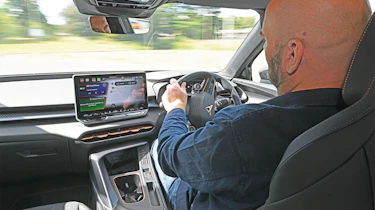
There’s copper detailing on the air vents, which feature a metal effect and feel good to use, with a smooth sliding action. The dashboard is curved towards the driver to emphasise Cupra’s sporty character. A large 12.9-inch touchscreen display dominates your view forward, while most of the physical buttons are located on the steering wheel.
There’s a large push starter on one spoke, with the drive mode selector on the other, while the only other buttons on the dash are the lighting control near the driver’s door and a handful of switches - including the parking brake - next to the cup-holders. As with most VW Group models that are now auto-only, the Terramar has a column-mounted drive selector to the right of the steering wheel, with all lighting and wiper controls on the left-hand stalk.
LED lighting makes an appearance, with a continuous strip running along the base of the windscreen and on the doors. This can be configured in a range of colours and at varying levels of brightness, from mild to harsh, while the outer edges change colour in conjunction with the car’s blind-spot detection system. There is more ambient lighting in the door skins, which adds a classy touch.
Materials and build quality
Overall, the cabin is a bit dark, although adding copper detailing to the air vents and doors offers a unique touch in this class. There is more satin silver plastic trim across the dashboard and centre console, while the plastics are soft to the touch in prominent places across the dashboard. The leather-trimmed steering wheel is also good to hold. Cabin quality can’t be faulted, because everything feels well screwed together and solidly built.
Infotainment, sat-nav and stereo
The large 12.9-inch touchscreen is standard on all models, and is the same as that found in other Cupra models. It features a full range of connectivity options, and the wireless Apple CarPlay and Android Auto both hook up seamlessly with the system. The built-in navigation is straightforward to use, and can be operated via the touchscreen or voice control, while large icons on the main screen are relatively easy to locate while you’re driving.
Two lines of shortcuts are located across the top and bottom of the display to help you navigate the system, with the bottom row dedicated to the climate system. The temperature controls are sliding items as found on other VW Group models, and they flank a volume control. They are still a bit tricky to use, even though they are now illuminated, with the volume function being much easier to operate via the steering wheel.
There’s a digital dashboard that offers four different display modes, although some options bury the speedometer in the corner of the layout. This isn’t an issue in cars fitted with the head-up display, but you might want to switch to a setting that makes it more prominent, our favourite one being the large central rev counter with the speedo in the centre.
There are four USB-C sockets in the cabin - two up front, two in the rear - while a wireless charging pad is also fitted across the range.
“The Terramar’s cabin looks smart and features plenty of tech, and we’re glad that physical buttons have been fitted to the steering wheel, rather than haptic controls. If you’re not a fan of speed-limit warnings, it’s simple enough to press a button on the wheel, then scroll to the alert and deactivate it." - Dean Gibson, senior test editor.
Boot space & practicality
Pros |
|
Cons |
|
The sole body option for the Terramar is a five-door compact SUV - there’s no coupe-SUV alternative, but we don’t think you need it because the standard model looks pretty sporty already. There’s room for five inside, while a sliding rear bench offers the option to prioritise passenger or boot space.
Dimensions and size
The Terramar is larger than the Cupra Formentor, but it’s not quite as long as the platform-sharing Volkswagen Tiguan, although both have a similar wheelbase. A lower roof line gives the Terramar a sportier look, but this doesn’t come at the expense of interior headroom.
| Dimensions comparison | |||
| Model | Cupra Terramar | Volkswagen Tiguan | Mazda CX-60 |
| Length | 4,519mm | 4,539mm | 4,745mm |
| Width | 1,863mm | 1,842mm | 1,890mm |
| Height | 1,584mm | 1,660mm | 1,680mm |
| Wheelbase | 2,681mm | 2,676mm | 2,870mm |
| Boot space | 540 litres (400 litres E-Hybrid) | 652 litres (490 litres eHybrid) | 570 litres |
Seats & passenger space
All versions of the Terramar feature sporty looking front seats with wide wings. However, unlike in some dedicated sports cars, these are broad enough so that they feel as if they wrap around you, but aren’t tight, and deliver good comfort as a result. Lower-spec cars have cloth upholstery, while in the mid-range there’s a Dinamica microfibre finish, and top-spec cars get burgundy leather with copper stitching that looks more attractive than it sounds.
There’s a good range of adjustment to get comfortable at the wheel, while the view out is fine, although the view through the rear window is slightly hemmed in by the rear headrests.
Storage up front is decent, with two large cup-holders and a wireless charging tray just beneath the central air vents, but there’s no cover for them. The central armrest bin is deep and goes forward a little way, but the opening is a little narrow. The door bins also go back a long way, so it might be easy to lose larger items inside. The glovebox size is fairly average.
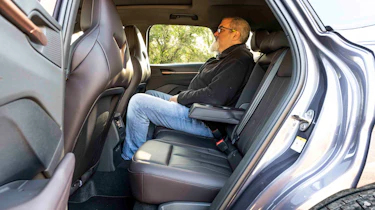
There’s enough elbow room across the back of the cabin to sit three abreast, although the middle chair is on the firm side, so anybody sitting there won’t want to do so for long. Foot space is good, with a narrow transmission tunnel to negotiate and plenty of room under the front seats.
Cars fitted with a panoramic glass roof don’t see an impact on headroom, while rear air vents and USB-C sockets add convenience. The rear door bins are big enough for a drinks bottle, but they’re not quite as large as the bins for the front doors. One neat touch is that the LED light panels within the front doors are repeated in the back, which adds a bit of class. You’ll find two sets of Isofix child seat mounts in the back of the Terramar that are easy to access between the seat cushions, while a third set of mounts is fitted to the front passenger seat.
Boot space
There’s a 540-litre boot in five-seat mode, although this can be expanded to 630 litres because the rear bench can be pushed forward to make more room. The load lip is a little high, but no worse than in rivals, and because the lip is level with the floor, loading items is easy. The back seat splits 40:20:40 for added versatility, although the parcel shelf is a fixed item, rather than being a rolling cover.
There are some compromises to be made when it comes to the e-Hybrid’s boot. The location of the drive battery under the boot floor restricts the space on offer, so there’s only 400-490 litres on offer. It also means there’s no under-floor storage (you can add a space-saver spare wheel as an option to the non-PHEV models).
Towing
The Terramar is rated to tow, but the amount it can haul depends on which engine is chosen. The 1.5 eTSI has a maximum capacity of 2,000kg, but the e-Hybrid version can only manage 1,800kg. The best option is the 2.0 TSI, which can pull 2,200kg, irrespective of power output. Cupra offers towbars and towing accessories on the options list.
The numbers are pretty much matched by the Volkswagen Tiguan, but the Mazda CX-60 is an even stronger tow car as it manages 2,500kg in all forms.
“The Terramar doesn’t demand much in the way of compromise for its sporty character, but we wish the hybrid model had space to store the charging cables – it’s impossible to stow them under the floor, so they have to take up room in the boot.” - Dean Gibson, senior test editor.
Reliability & safety
Pros |
|
Cons |
|
Safety experts Euro NCAP have awarded the Cupra Terramar the maximum five stars out of five rating after testing the car in 2025. It scored higher in the adult occupant category than the MINI Countryman, Toyota C-HR, and Volkswagen Tiguan, but comes up short against the Tiguan for child occupant protection.
The Terramar comes with a comprehensive suite of passive and active safety features, as you would expect from a modern VW Group family car. There’s active cruise control with autonomous emergency braking, which also works when reversing, travel-assist and blind spot monitoring, which can be seen working via the LED light strip that stretches across the width of the dashboard. This is in addition to the mandated speed-sign recognition and alert system, lane-keeping assist system and traction and stability control systems. There’s also front, side and curtain airbags, as well as a centrally mounted seventh airbag up front.
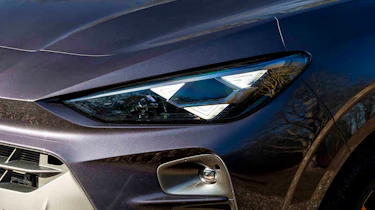
At the top of the range, cars with matrix LED headlights now feature additional lighting patterns to help guide you at night. When the car’s sensors are able to detect the edges of the road or the lane that you’re in, two parallel lines are projected on the road ahead. On the motorway, three bars are projected to signify the multi-lane road. We were left wondering about the usefulness of this feature, because the lines moved up and down as the automatically adjustable headlights moved in relation to the road, while the lines bend in relation to the direction of the steering.
The bigger issue is that the lines are projected only a car length or so ahead, and tend to draw your attention when you are likely trying to look as far ahead as possible. In comparison, we can’t fault the automatic main beam system that allows you to keep the lights on full without dazzling oncoming traffic.
Cupra offers a five-year, 90,000-mile warranty on its range, which could be an attractive bonus for potential buyers, especially when other marques within the VW Group only offer three years of cover. In addition, the e-Hybrid has an eight-year and 100,000-mile warranty for its hybrid battery.
Service intervals for the Cupra Terramar are annual or every 10,000 miles, whichever comes first. The first service is just an oil change, but thereafter, the work alternates between an oil change and inspection, then an oil change and extended inspection. Cupra Care service plans offer up to three years of servicing for a monthly cost, or you can pay for this outright.
| Euro NCAP safety ratings | |
| Euro NCAP safety rating | Five stars (2025) |
| Adult occupant protection | 89% |
| Child occupant protection | 87% |
| Vulnerable road user protection | 82% |
| Safety assist | 76% |
Buying and owning
- Best buy: Cupra Terramar 1.5 e-Hybrid V2
It’s pricey, and the big caveat is that you should keep the battery charged to reap the benefits of a smoother drive and all-electric miles, but the plug-in model shows the Terramar in the best light. However, you wouldn’t feel short-changed with the 1.5 eTSI. It isn't as quick as the 2.0 TSI, but the 1.5 still delivers a decent drive for families that still want a sporty car with respectable running costs.
Cupra Terramar alternatives
At this price point, the Cupra Terramar has plenty of rivals. The most obvious is the platform-sharing Volkswagen Tiguan, which is priced slightly lower, yet offers a bit more space inside, especially in the boot. There's also the posh Audi Q3 which uses the same running gear, but this is slightly more expensive than the Cupra. Elsewhere, the Skoda Kodiaq is a roomy option with seven seats available in some guises.
Beyond the VW Group, there are models such as the Toyota RAV4, Honda CR-V and Mazda CX-60, although these are more geared towards practicality and comfort than sportiness. The Alfa Romeo Tonale is another option that offers a racy character, as does the BMW X2.
Key updates of the Cupra Terramar review
9 April 2026: Updated to include driving impressions from our Cupra Terramar long-term test.
Frequently Asked Questions
The Terramar is a decent all-rounder that delivers sporty looks and a relatively sporty drive, while the suspension seems well suited to UK roads. Prices can get a little steep at the top of the range, where the more practical VW Tiguan might be a better option, but then that car isn’t quite as engaging to drive as the Terramar.
Deals on the Terramar and alternatives
More reviews
Long-term tests
Which Is Best