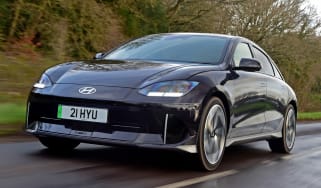
Hyundai Ioniq 6 review
The Hyundai Ioniq 6 is a very impressive electric car with a unique look and excellent technology

Our opinion on the Hyundai Ioniq 6
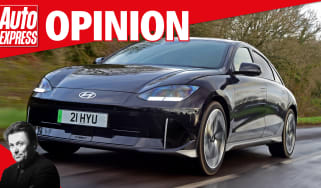
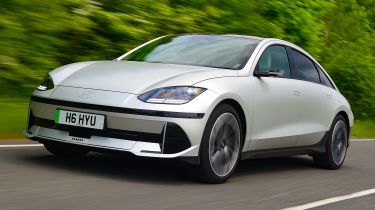
The Hyundai Ioniq 6 followed on pretty much directly from the Ioniq 5. It uses the same tech underneath but with a sleeker, saloon shape and slightly sharper handling than its hatchback sibling. Its bold looks aren’t for everyone, but its charging speeds, comfortable interior and excellent in-car tech mean this EV is up there with the best electric cars around.
The Ioniq 6 shares a lot of the same strengths as the Ioniq 5, which is actually its biggest downfall. The Ioniq 6 is a bit less practical than its stablemate while also being a little more expensive to buy. But if you love how it looks, the Ioniq 6 is a fantastic car and well worth a look.
About the Hyundai Ioniq 6
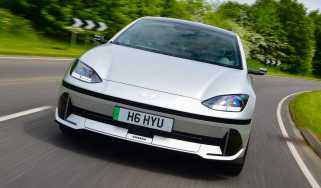
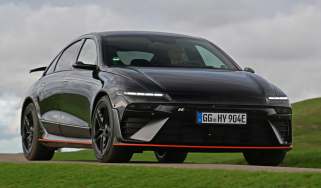
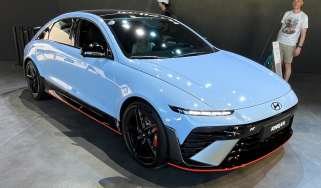
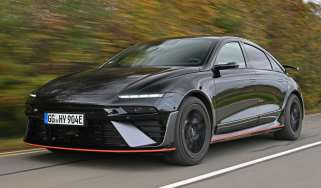
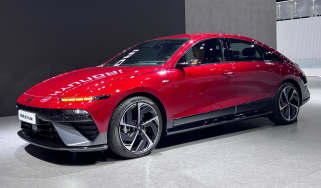
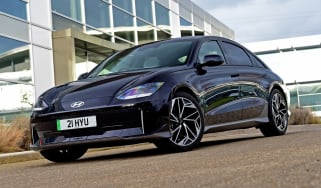
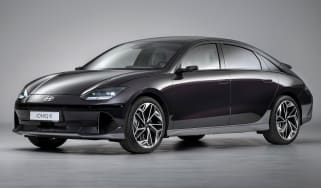
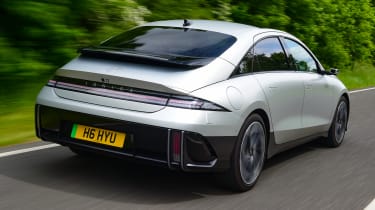
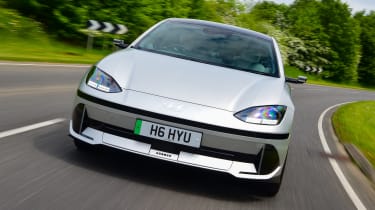
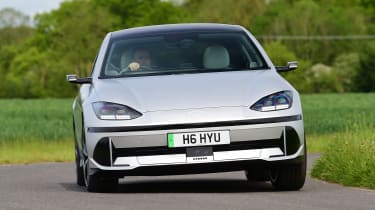
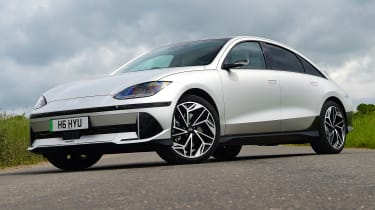
Dubbed the “electrified streamliner” by Hyundai, the Ioniq 6 draws heavily from the Hyundai Prophecy concept car we fell in love with back in 2020. This saloon also takes some of the Ioniq 5’s design cues, such as the square pixel lights and chiselled body lines, and applies them to a much more dramatic silhouette. The result is an incredibly low drag coefficient of just 0.21Cd, and looks that will turn more heads than some supercars.
The Ioniq 6 uses the same Electric Global Modular Platform (E-GMP) that underpins the Ioniq 5, along with other models such as the Kia EV6 and EV9, and the Genesis GV60. Power comes courtesy of a 77.4kWh battery pack, with ranges varying depending on spec.
Used - available now

2025 Hyundai
Ioniq 6
11,042 milesAutomaticElectric
Cash £21,600
2025 Hyundai
Ioniq 6
3,085 milesAutomaticElectric
Cash £22,300
2025 Hyundai
Ioniq 6
15,573 milesAutomaticElectric
Cash £20,200
2023 Hyundai
Ioniq 6
17,434 milesAutomaticElectric
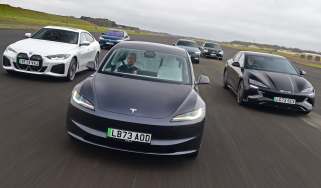
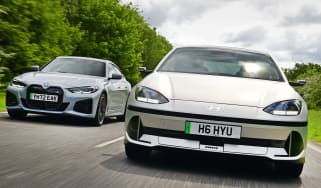
Cash £24,049We’ve tested the Ioniq 6 extensively on UK and European roads. When we put the Ioniq 6 up against the BMW i4 in a twin test, it was the German EV that took the win thanks to its more engaging drive experience and solid battery range. However, our road testers were still impressed by the Hyundai’s on-board tech and spacious interior. The Hyundai was also included in our 2024 company car megatest, finishing in 5th place.
Hyundai Ioniq 6 prices and latest deals
There are two trim levels to choose from with the Ioniq 6; Premium and Ultimate, and these are both available with the same two powertrain options. The Premium starts from around £47,000, rising to just shy of £50,000 for the more powerful model. If you’d prefer the posher Ultimate model, you’re looking at around £50,500 for the standard car, rising to £52,500 for the faster car.
If you’d like to save on the list price, you can do so by building your new Hyundai Ioniq 6 through the Auto Express Buy a Car service. We also have a wide selection of Ioniq 6 leasing deals, and can even help you to sell your car.
Electric motor, drive and performance
Pros |
|
Cons |
|
While the Hyundai Ioniq 6 has a sporty-looking silhouette, it doesn’t stand out in any particular area in terms of the driving experience. This isn’t necessarily a dealbreaker, though, as this car simply gets on with the task at hand in a no-frills kind of fashion.
In fact, due to the powertrain and cabin being extremely quiet, the Ioniq 6 is a relaxing place to spend time if you maintain a calm driving style.
Performance, 0-60mph acceleration and top speed
The Ioniq 6 is offered with a choice of rear-wheel drive (RWD) and all-wheel drive (AWD). The former uses a single motor producing 225bhp to drive the rear wheels, while the latter has another motor at the front for a combined power output of 321bhp.
Unsurprisingly, the AWD version is the faster of the two, with 0-62mph taking just 5.1 seconds. That’s less time than many sports cars and hot hatchbacks take, although the Tesla Model 3 Long Range (which also uses two electric motors for AWD) will do 0-62mph in an incredible 4.2 seconds. Regardless, the dual-motor Ioniq 6 feels very potent, plus there’s 605Nm of torque available as soon as you touch the accelerator.
The RWD model takes a little longer to get to 62mph – 7.4 seconds to be exact – but that’s still plenty quick enough for a family saloon car like this. Top speed for both versions stands at 115mph.
| Model | Power | 0-62mph | Top speed |
| Ioniq 6 168kW Premium | 225bhp | 7.4 seconds | 115mph |
| Ioniq 6 239kW Premium AWD | 321bhp | 5.1 seconds | 115mph |
| Ioniq 6 168kW Ultimate | 225bhp | 7.4 seconds | 115mph |
Town driving, visibility and parking
The driving position is higher than the Ioniq 6’s appearance might suggest, and this contributes towards good all-round visibility. This, combined with light steering, makes manoeuvring and parking a pretty stress free affair. The usual instantaneous EV acceleration can also be useful for getting away from tricky junctions and traffic lights with little fuss.
Country road driving and handling
Surprisingly, the Ioniq 6 leans over more in corners than the BMW i4. The Ioniq 6 doesn’t feel unstable or unpleasant, but you won’t be as keen to push the car quite as hard as you might like in tight turns. The four-wheel drive model feels a little nose-heavy during quick changes of direction.
The steering is really light, meaning the car is easy enough to manoeuvre around town. There is a slight delay in response from the accelerator, which takes the edge off the otherwise strong performance of the more potent four-wheel drive version. For that reason, we’d lean more towards the rear-wheel drive version, which still has enough performance to impress just about anyone and nip into gaps in the traffic at roundabouts and junctions.
The brakes are amongst the best in the class, providing plenty of stopping power that’s easy to modulate from its well-weighted pedal. We also appreciate the paddles behind the steering column that allow you to adjust the strength of the energy recovery from the regenerative braking system, which ranges from full coasting to one-pedal driving. We wish every EV had a similar arrangement.
Motorway driving and long-distance comfort
On motorways and faster roads, the Ioniq 6 is smooth and quiet, but the large 20-inch alloy wheels that are fitted as standard on all models mean that it isn’t quite able to keep lumps and bumps on B-roads in check. It feels unsettled and bouncy on rough sections, and the low-speed ride is no more than reasonable, feeling just as firm as the Polestar 2, and a little more crashy over potholes.
“Everything in the drivetrain seems to have been tightened up a notch, so while the Ioniq 5 was never whiny or jerky, the 6 achieves another level of refinement.” - John McIlroy, former editor-at-large.
Range, charging and running costs
Pros |
|
Cons |
|
Every Hyundai Ioniq 6 is fitted with a sizable 77.4kWh battery and boasts impressive rapid-charging capabilities. However, the electric saloon’s maximum driving range varies depending on whether you go for rear- or all-wheel drive.
The RWD version has an official range of 338 miles, while Hyundai says the AWD version can cover up to 322 miles before the battery is out of juice. Those figures are a long way off the 398-mile range of the updated Tesla Model 3 Long Range, or the 409 miles you can cover in Long Range Single Motor Polestar 2.
During our electric company car megatest with five of the main rivals to the Ioniq 6, the Hyundai posted the most disappointing efficiency figure. Its efficiency was only 3.1 miles per kWh, which was even lower than the 3.2 miles per kWh we got from an identical Ioniq 6 AWD when tested against a BMW i4 eDrive40. Based on a usable capacity of 74kWh, the Ioniq 6 AWD is likely only to have 230 miles of range, so we’d recommend sticking with the rear-wheel drive version to get better range and efficiency numbers.
It’s not the most efficient, but the Ioniq 6 makes up for that with its highly impressive 800V charging tech that allows it to accept a peak charging rate of up to 220kW. In other words, if you plug the Ioniq 6 into a 350kW ultra-rapid charger, a 10 to 80 per cent top-up can take as little as 18 minutes. That’s about 10 minutes quicker than it would take a BMW i4 to do the same job. Fully recharging the Ioniq 6’s 77.4kWh battery will take around 11 hours if you use a more typical 7kW home wallbox charger.
| Model | Battery size | Range | Insurance group |
| Ioniq 6 168kW Premium | 77kWh | 338 miles | 36 |
| Ioniq 6 239kW Premium AWD | 77kWh | 322 miles | 41 |
| Ioniq 6 168kW Ultimate | 77kWh | 338 miles | 37 |
Insurance groups
Insurance premiums for electric cars are generally higher than for the equivalent petrol or diesel-powered model, partly because of their rapid acceleration and the price of repairs. Battery packs, in particular, are costly to replace.
It’s the same story with the Ioniq 6, with the line-up sitting in insurance groups 36 to 41 (out of 50). The BMW i4 attracts similar insurance ratings (groups 35 to 43), while the recently updated Polestar 2 will cost a little more to insure, given that it lands in groups 40 to 44. However, following a number of revisions, the Tesla Model 3 now sits in groups 36 to 48.
Check if your car needs an MoT and view its complete history with our MoT History Checker...
Tax
Every Ioniq 6 is liable for the standard VED road tax rate, and the luxury car tax surcharge will also apply if you opt for a fancier spec or add one too many options. On electric cars costing more than £50,000, you’ll be looking at a combined annual bill of £625 between the second and sixth years after the car is initially registered.
The Ioniq 6 is a pretty strong choice for business buyers as it attracts the very lowest company car tax rates.
Depreciation
According to our market data, the Hyundai Ioniq 6 should retain between 42 and 43 per cent of its original value after a period of three years or 36,000 miles. The Tesla Model 3, meanwhile, manages 41 to 48 per cent after the same amount of time, while the BMW i4 only clings on to 37 to 40 per cent.
To get an accurate valuation on a specific model check out our free car valuation tool...
Interior, design and technology
Pros |
|
Cons |
|
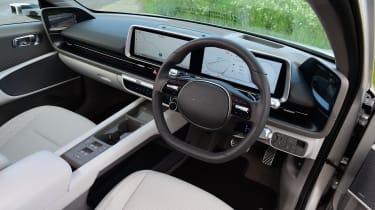
The interior of the Hyundai Ioniq 6 isn’t quite as futuristic as the exterior of the “electrified streamliner”, but it does feature Hyundai’s excellent infotainment system and plenty of neat design touches.
Interior and dashboard design
Some of the Ioniq 5’s switchgear, including the rotary drive selector on the steering column and the unbranded two-spoke steering wheel, have been carried over into this saloon, though that’s hardly a bad thing. One obvious difference is the high centre console that separates the driver and front passenger in the Ioniq 6. It gives this model a more traditional sporty saloon-like feel in the cabin, although the driving position is still quite high up.
Materials and build quality
There are some more black plastic surfaces in the Ioniq 6 compared to the 5, which some will like, and others may think it adds a slightly less premium feel. Regardless of how you see this, though, one thing that can’t be argued is that this car feels very well put together.
Infotainment, sat-nav and stereo
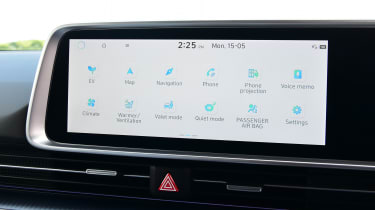
The Ioniq 6’s infotainment system is one of the more user-friendly set-ups around at the moment, and is packed with the latest features. Every Ioniq 6 comes with a 12.3-inch central touchscreen and a 12.3-inch digital driver’s display, which you can configure to show as much or as little information as you need.
All the menu layouts are logical, with large touchscreen buttons or a voice control system. The graphics aren’t quite as sharp as those in the BMW i4, but the screens respond just as quickly, and it’s simple enough to enter routes using the on-screen keyboard.
All models include Android Auto, Apple CarPlay, a wireless phone charging, and over-the-air updates. The built-in sat-nav system is also good and can direct you to nearby charging stations.
“There are a lot of light-coloured materials, and some of the plastics don’t have the same upmarket feel found in the BMW i4. It’s not obvious that they’re of a poorer quality; they just have different textures.” - Dean Gibson, senior test editor.
Practicality, comfort and boot space

Pros |
|
Cons |
|
The Hyundai Ioniq 6 has a very roomy interior, although it doesn’t feel as spacious and airy up front as the Ioniq 5. That’s partly because the Ioniq 6 features a large centre console, rather than the flat, open floor in its hatchback sibling.
At least you get plenty of storage space underneath the centre console, along with two cupholders and another cubby underneath the armrest. The centre console houses the controls for the windows, which is unusual. There’s a wireless phone charging pad on the console, although we found that devices can fall off quite easily.
Instead of a conventional glovebox, the Ioniq 6 features a very clever slide-out drawer that’s deeper than the glovebox in the BMW i4. Meanwhile, passengers in the rear have cupholders in the armrest, a pair of air vents, plus USB ports to keep their devices topped up.
Dimensions and size
The Ioniq 6 is longer than the Ioniq 5 and significantly lower, too. This is obvious from the car’s shape: the roofline is sleeker, and the overhang behind the rear wheels is where that extra length comes from. It’s also longer, taller and wider than a BMW i4, although not by a huge amount.
| Dimensions comparison | |||
| Model | Hyundai Ioniq 6 | BMW i4 | Tesla Model 3 |
| Length | 4,855mm | 4,783mm | 4,724mm |
| Width | 1,880mm | 1,852mm | 1,933mm |
| Height | 1,495mm | 1,448mm | 1,443mm |
| Wheelbase | 2,950mm | 2,860mm | 2,880mm |
| Boot space | 401 litres | 470 litres | 594 litres (measured to roof) |
Seats & passenger space
Unfortunately that rakish roofline does mean that there’s not as much room in the back seats for adults as you get in the Ioniq 5 hatchback. The roof slopes down over the seats and taller people will find their head brushing against it, which can get annoying on longer trips.
There’s plenty of legroom, though, and kids will be very comfortable in the back, especially as every model comes with heated rear seats. The tallest adults may also find that the low roofline affects them up front as well. The Ioniq 6 comes with Isofix child seat mounting points on the outer positions on the rear bench.
Boot space
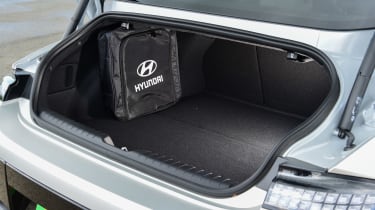
The boot in the Ioniq 6 is wide and long but quite shallow, and the opening itself isn’t the most practical shape – especially when compared to the hatchback tailgates on the BMW i4, Polestar 2, and Volkswagen ID.7. The Ioniq 6’s 401-litre boot is on par with that in both the Polestar and Tesla Model 3, though. Plus, there’s a further 45 litres of storage in the ‘frunk’ under the bonnet, which is useful for charging cables, but in the AWD model, this shrinks to a close-to-useless 14.5 litres.
You can fold down the 60:40-split back seats in the Ioniq 6, but they can only be operated by levers in the boot, not from the cabin. And with them down, you’re left with a narrow opening here, too.
Towing
The Ioniq 6 can tow up to 1,500kg, whether you opt for a RWD or AWD model. This is okay and better than many electric cars that aren’t rated for towing at all, but it’s still not ideal, and a combustion, hybrid or plug-in hybrid car is probably still a better bet for those who tow regularly.
“The front and rear door bins are quite narrow, while the wireless phone charging pad at the front of the centre console is set high up, so a device can fall off too easily.” - Dean Gibson, senior test editor.
Reliability and safety
Pros |
|
Cons |
|
The Hyundai Ioniq 6 didn’t make our most recent list of the best cars to own, but the Driver Power survey’s best manufacturer leaderboard shows that Hyundai has a bit of work to do. The brand only managed a 20th place finish out of 31, which left it trailing behind Tesla (11th) and BMW (8th).
More positive news lies with Euro NCAP, as the experts here crash tested the Ioniq 6 in 2022 and awarded it the industry body’s maximum five-star safety rating. It scored a very impressive 97 per cent in the adult occupant protection section and 90 per cent for its safety tech.
Every Ioniq 6 comes with autonomous emergency braking (AEB), Highway Drive Assist (autonomous cruise control) and Intelligent Speed Limit Assist, plus Lane Keep Assist, Blind Spot Collision Avoidance Assist and Rear Cross Traffic Collision Avoidance. Many of these functions are available in other electric cars, but they are usually optional extras, so it’s good to see that Hyundai includes them all in every version here. A 360-degree parking camera is the only item of safety tech reserved for higher-spec Ultimate models.
| Euro NCAP safety ratings | |
| Euro NCAP safety rating | Five stars (2022) |
| Adult occupant protection | 97% |
| Child occupant protection | 87% |
| Vulnerable road user protection | 66% |
| Safety assist | 90% |
Buying and owning
Best buy: Hyundai Ioniq 6 Premium
Because of its superior battery range and generous standard kit list, we see little point in paying out for anything other than the base Ioniq 6 Premium model. While the additional performance of the AWD models is nice to have, this is very much a car that's based on comfort rather than driver engagement, so we just don’t think it’s worth sacrificing battery range and extra money for.
Hyundai Ioniq 6 alternatives
Key rivals include the fellow electric saloons like the BMW i4, Polestar 2, BYD Seal, Tesla Model 3, and the Volkswagen ID.7. The closely related Kia EV6 is another alternative, but perhaps the most appealing option is Hyundai’s own Ioniq 5, which has most of the same appeal as the Ioniq 6 in a more practical package.
Key updates of the Hyundai Ioniq 6 review
10 March 2026: General update of the Hyundai Ioniq 6 with updated pricing and valuation information.
Frequently Asked Questions
A five-year, unlimited-mileage warranty covers every Hyundai. It’s one of the best packages around, beaten only by Kia and MG’s seven-year factory warranty. Also included in Hyundai’s coverage are 12 months’ roadside assistance and free annual health checks (visual inspections) of your vehicle.
The Ioniq 6’s battery pack is covered by a separate eight-year, 125,000-mile warranty, which guarantees that it will retain over 70 per cent capacity over that time and mileage period, similar to most electric vehicles.