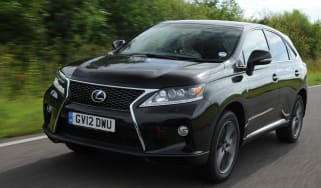
Lexus RX review
The Lexus RX is more efficient and stuffed with up-to-date technology, but it comes up short in terms of practicality

Our opinion on the Lexus RX
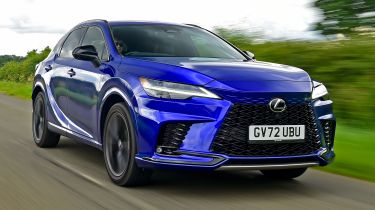
The arrival of the latest Lexus RX marked a big leap forward for the Japanese carmaker. The wealth of technology on board is much more impressive than what came before it, and Lexus’s build quality is still up there with the best. The plug-in hybrid version is also a welcome addition to the line-up.
Sadly, there’s no seven-seat version, and for such a large SUV, boot space is average rather than generous. But if you're looking for a comfortable, refined and easy-going SUV, Lexus’s flagship SUV is better than ever.
About the Lexus RX
Now in its fifth generation, the latest Lexus RX is exclusively fitted with hybrid power in the UK, with a choice of the brand’s ‘self-charging’ hybrid or plug-in hybrid powertrains. It’s currently the brand’s largest SUV, above the Lexus LBX and Lexus NX.
There’s a choice of six trim levels: Premium, Premium Plus, F Sport Design, Takumi, F Sport, and F Sport Takumi. You can get two versions of the regular hybrid, the entry-level 350h and the range-topping 500h. In between there is the 450h+ plug-in hybrid.
We’ve tested every variant of the Lexus RX since it first went on sale, including dedicated road tests of the 350h, 450h+ and 500h models.
Performance & driving experience

Pros |
|
Cons |
|
The entry-level Lexus RX 350h is powered by a 2.5-litre four-cylinder Atkinson cycle petrol engine that drives the wheels through an e-CVT automatic gearbox, assisted by a pair of electric motors supplied by a small battery.
Used - available now


Pushing this powertrain hard will result in little more than engine noise and reduced efficiency. Instead, you’re better off driving to the RX 350h’s strengths, which means being a bit delicate with the throttle to maximise usage of electrical power rather than the engine. This will help the engine settle down, allowing the RX to come across as more refined. The e-CVT gearbox is also at its best when you take a more leisurely approach.
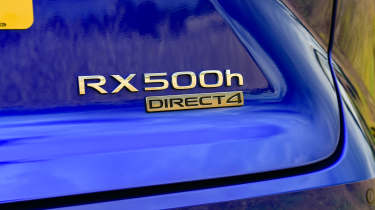
The RX 500h uses a very similar set-up, but under the bonnet is a turbocharged 2.5-litre four-cylinder petrol engine mated to a six-speed automatic gearbox. It was the brand’s first turbocharged hybrid, and it’s smooth rather than sporty but the Direct4 torque-distribution technology (the same system you’ll find in the all-electric Lexus RZ 450e) does help to keep body roll and pitching in check.
Much like the 350h, the RX 450h+ is the plug-in hybrid member of the line-up, and it’s a powertrain that rewards relaxed driving. Power delivery is perfectly smooth, even if the performance on tap feels a little underwhelming. It uses the same 2.5-litre petrol engine and hybrid set-up as its less potent sibling, but it also has a considerably larger 18.1kWh battery to allow for more extended electric-only driving.
| Model | Power | 0-62mph | Top speed |
| RX 350h Premium | 203bhp | 8.3 seconds | 124mph |
| RX 450h+ Premium | 292bhp | 6.6 seconds | 124mph |
| RX 500h F Sport | 366bhp | 6.2 seconds | 131mph |
Performance, 0-60mph acceleration and top speed
Every RX features a pair of electric motors for four-wheel drive, and even the least-powerful 203bhp RX 350h manages to sprint from 0-62mph in a reasonable 8.3 seconds. It’ll then proceed to a top speed of 124mph.
The plug-in RX 450h+ has the same top speed, but a total power output of 292bhp allows it to hit 62mph in 6.6 seconds. You can also drive at up to 84mph on electric power alone in the plug-in hybrid RX, so it is possible to get up to motorway speeds without needing the engine.
It’s the RX 500h that’s the quickest of the bunch with 366bhp on tap, a 0-62mph time of 6.2 seconds and a top speed of 131mph. This version feels quick enough for most needs, but it won’t challenge rivals from BMW, Mercedes and Porsche for outright pace. The six-speed automatic is best left to its own devices, because our test car rarely paid attention to us overriding it by using the gear shift paddles on the steering wheel.
Town driving, visibility and parking
The RZ feels comfortable and smooth at lower speeds, but you’ll need to be reasonably gentle with the accelerator in order not to wake the engine in the regular full hybrid versions. There’s a little more leeway with the plug-in hybrid, which has more battery capacity and a stronger electric motor to provide some instantaneous torque. It works well at getting the heavy RX off the line, imbuing the 450h+ with the extra pep needed to nip into gaps in the traffic.
When it’s time to park up, the RX does feel quite large, but the task at hand isn’t too intimidating thanks to the standard-fit parking assist monitor.
Country road driving and handling
It's obvious that the RX has been engineered to float over bumps and dips, rather than communicate the road surface to the driver. It’s not hopeless on twistier roads, however, because the steering has a reassuring weight to it and the handling is tightened by the six degrees of rear-axle steering. You’re always aware of the over 2.2-tonne kerbweight, but the RX still flows through corners nicely.
Motorway driving and long-distance comfort
Even though the previous RX was one of the most refined cars in its class, Lexus says it has worked hard on making the latest generation even better in this department. The near silent running of the plug-in hybrid version certainly helps, but thicker glass and more soundproofing means this latest RX is supremely quiet even at motorway speeds. Again, go easy on the throttle, and you’ll be rewarded with a generally peaceful experience.
MPG & running costs
Pros |
|
Cons |
|
The RX 350h comes with an official WLTP combined efficiency figure of up to 44.1mpg, and it emits up to 146g/km of CO2. The more powerful 500h is the thirstiest RX available, even though it’s also a full-hybrid. This model comes with a rather meagre claim of up to 35.3mpg and CO2 emissions of 181g/km. Although our test drive was more boisterous than the average owner will engage in, we think most RX 500h drivers will struggle to get a real-world mpg figure into the thirties.
| Model | MPG | CO2 | Insurance group |
| RX 350h Premium | 44.1mpg | 144g/km | 42 |
| RX 350h Takumi | 44.1mpg | 146g/km | 44 |
| RX 500h F Sport | 35.3mpg | 182g/km | 46 |
Electric range, battery life and charge time
If you’re really looking to cut down on your running costs, then it’s the RX 450h+ PHEV you’ll be interested in. It adds an 18.1kWh battery alongside the hybrid system used on other RX models, which helps to reduce the combined CO2 emissions figures for the RX 450h+ to 75g/km, while the weighted fuel economy figure sits at 85.6mpg. Based on our experience, you’re unlikely to achieve that efficiency in the real world, but with regular charging, we expect it to be ahead of its full hybrid counterparts.
The 450h+ has an electric driving range of around 40 miles, and we expect most people should get close to this figure with careful driving. However, it falls some way short of the BMW X5 xDrive50e’s 65-mile range.
Fully recharging the 18.1kWh battery via a standard 7.4kW home wallbox takes just under three hours.
| Model | Battery size | Range | Insurance group |
| RX 450h+ Premium | 18.1kWh | 42 miles | 45 |
| RX 450h+ F Sport Design | 18.1kWh | 42 miles | 47 |
| RX 450h+ Takumi | 18.1kWh | 42 miles | 47 |
Insurance groups
As expected for a premium SUV, insurance premiums for the Lexus RX won’t be cheap. The line-up sits between insurance groups 42 and 47 (out of 50), which is on par with the BMW X5 that resides in groups 43 to 50, and the Mercedes GLE, which slots into groups 45 to 48.
Tax
Due to every single model sitting well above £40,000, the luxury car tax applies to every Lexus RX. You’ll need to add £440 on top of your annual VED road tax bill from the second time the vehicle is taxed until it is sixth year old.
The RX450+ will be the better option for company car drivers because of its ability to drive under electric power alone, which brings some Benefit-in-Kind (BiK) tax relief. However, the fully electric Lexus RZ will be a better choice, because the BiK rate will be even lower.
Depreciation
Our market data shows that the Lexus RX maintains its value well after a typical ownership period of three years or 36,000 miles. The line-up should retain between 46 and 51 per cent of their initial value, with the plug-in hybrids being the strongest performers.
This is pretty similar to that of the BMW X5 faces, as the core line-up holds on to 48 to 52 per cent. The exception, though, is the fiery BMW X5 M, as that only clings on to 41 to 42 per cent.
To get an accurate valuation on a specific model check out our free car valuation tool…
Interior, design & technology
Pros |
|
Cons |
|
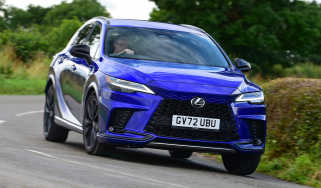
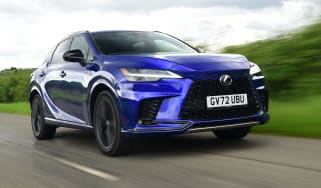
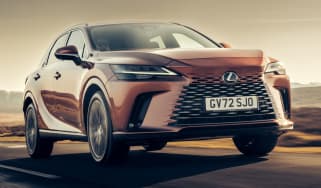
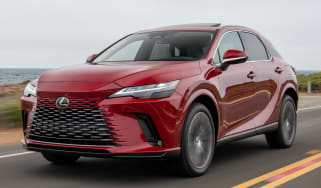
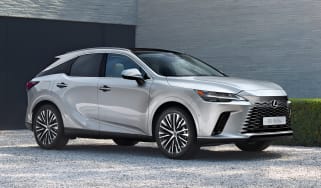
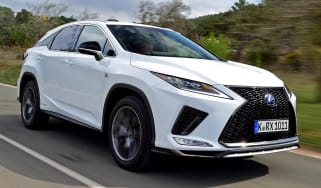
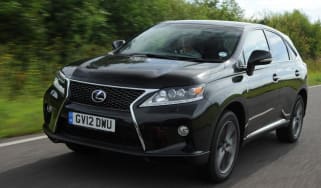
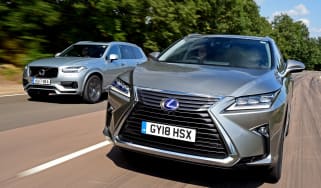
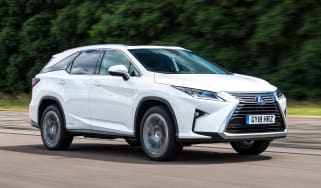
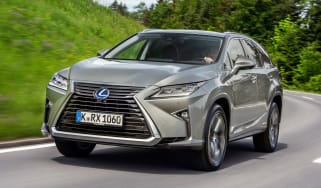
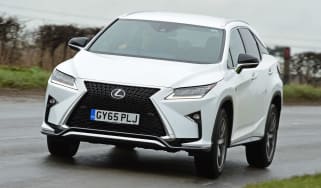
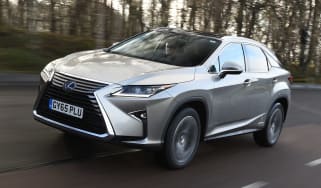
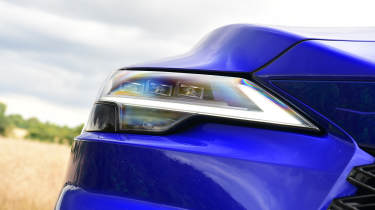
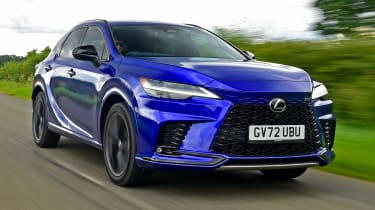
If you’re a fan of conservative car design, the RX is unlikely to win you over. The fifth-generation model features the latest interpretation of the brand’s signature spindle grille. In fact, it’s now called the ‘Spindle body’ because of how it’s integrated into the look of the taller, more squared-off front end. This is flanked by LED headlights that sport an L-shaped light signature, while the lower section of the front apron looks sportier than before, with more imposing vertical air intakes.
In profile, the previous model’s black C-pillars have been carried over, giving a ‘floating’ look to the roof. The lines are more sweeping compared with the angular surfacing of the previous car, plus at the rear is a full-width LED light bar.
Interior and dashboard design
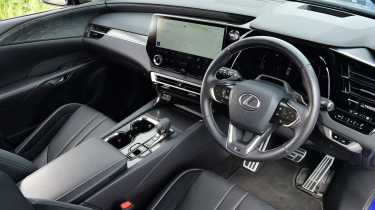
Unlike the exterior, the Lexus RX’s interior is rather more traditional in its design. It’s well thought-out and inoffensive on the eye, but there’s very little in the way of visual flair and excitement.
Materials and build quality
It might not have the same interior wow factor as the BMW X5, but there’s no faulting the RX’s materials or build quality. All the main touchpoints feel solid, and things like the door handles and centre console openings are superbly damped.
Infotainment, sat-nav and stereo
A major flaw of Lexus cars until very recently was their infotainment system, but thankfully, the set-up in the RX is a big leap forward. The previous-generation model’s infuriating touchpad has been replaced by a large 14-inch touchscreen that responds immediately to inputs, either from the touchscreen itself or from buttons on the steering wheel.
The user interface is also better than ever, but you might still prefer to use wireless Apple CarPlay or Android Auto to mirror your smartphone, which works well. The integrated sat-nav is a little hard to read at times, combining a white road with a light background.
This infotainment system is joined by a small digital instrument cluster and a set of digitised climate control dials taken from the smaller NX. These are much easier to use than any touch-sensitive sliders we’ve used, although you still have to use the touchscreen to control the heated and ventilated seats.
Voice control is taken care of by the ‘Hey Lexus’ virtual assistant, and the RX’s infotainment suite is compatible with over-the-air updates for fixes and new functions.
Boot space & practicality

Pros |
|
Cons |
|
Even though the latest RX isn’t that much bigger on the road than its predecessor, its redesigned seats, longer wheelbase and the more favourable packaging of the GA-K platform mean Lexus can claim that space inside is much better than before. The RX is only available as a five-seater, though.
Dimensions and size
The fifth-generation Lexus RX is 4,890mm long – exactly the same length as the previous model – but it’s now a little bit wider and lower. Wider front and rear track widths are joined by a shorter rear overhang, giving the latest car a different stance from the old model.
| Dimensions comparison | |||
| Model | Lexus RX | BMW X5 | Mercedes GLE |
| Length | 4,890mm | 4,922mm | 4,923mm |
| Width | 1,920mm | 2,004mm | 2,010mm |
| Height | 1,695mm | 1,745mm | 1,796mm |
| Wheelbase | 2,850mm | 2,975mm | 2,995mm |
| Boot space | 461 litres | 650 litres | 630 litres |
Seats & passenger space
The RX’s longer wheelbase means there’s lots of legroom in the rear, and despite its tapered roof (partly a styling trick), headroom is good, too. The rear seats will accommodate three adults, no problem, and by upgrading to the top-of-the-range Takumi spec, you also get heated and electrically operated rear seats, allowing those in the back to recline. There are also lots of handy cubbyholes dotted around the cabin.
Boot space
With 461 litres of boot space on offer, the RX’s luggage capacity is rather small for an SUV of this size, especially when compared with the 650 litres you get in a BMW X5, or even the Mercedes GLE’s 630 litres of cargo space. On the plus side, there’s no luggage space penalty in the RX PHEV.
Lower-spec models have levers for folding the rear seats down, but in pricier versions, they can be folded up and down with the touch of a button, and while that is labour saving, the process takes a little longer.
Towing
Whether you go for a self-charging or plug-in hybrid Lexus RX, the towing capacity is 2,000kg for braked trailers and caravans. While it can’t match the 3,500kg towing limit of a diesel Land Rover Discovery, two tonnes should be plenty for the majority of drivers.
Reliability & safety
Pros |
|
Cons |
|
Like its little brother, the NX, the Lexus RX received the full five-star crash safety rating after it was tested by independent experts, Euro NCAP, in late 2022. Every RX comes with the third generation of the Lexus Safety System+ suite of driver aids as standard, so you get pre-collision warning, adaptive cruise control, lane-departure warning, automatic high beams and blind-spot monitoring with rear cross-traffic alert.
We found some of these systems to be particularly impressive, such as the adaptive cruise control and lane-keeping assist. However, the speed-limit alert feels like overkill, beeping once you’ve gone 1mph over the speed limit.
Lexus has been a top performer in the Driver Power ownership satisfaction survey over the years, but none of its models made it onto the best cars to own list in 2026. However, the brand has held its own with a fourth-place finish out of 30 brands on the best manufacturer table. Owners have been impressed with their cars’ practicality and quality, but the driving experience appears to have been underwhelming.
| Euro NCAP safety ratings | |
| Euro NCAP safety rating | Five stars (2022) |
| Adult occupant protection | 90% |
| Child occupant protection | 87% |
| Vulnerable road user protection | 89% |
| Safety assist | 91% |
Buying, prices and deals
- Best buy: Lexus RZ 450+ Premium
In its entry-level form, the Lexus RX starts from around £63,500 for an RX350 in Premium trim. However, due to its more potent power output, increased efficiency, and the ability to cover up to 40 miles on electric alone, we’d spend a bit more for the plug-in hybrid RX 450+ Premium at just over £65,000.
There’s roughly £5,500 between the Premium and Premium Plus trim levels, and we’re not fully convinced that the extra kit is worth it. With Premium trim, you’ll still get touches like heated seats and climate control, along with plenty of advanced assistance systems.
You can save by building your perfect Lexus RX with the Auto Express Buy A Car Service. We also have new Lexus RX models in stock, along with a variety of used Lexus RX deals.
Lexus RX alternatives
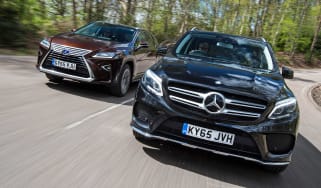
As always, the Lexus RZ’s most popular alternatives remain the BMW X5, which leans more towards sportiness, but does come with a bigger boot. Meanwhile, the Mercedes GLE goes the other way towards comfort. Either way, they’re both worth a look.
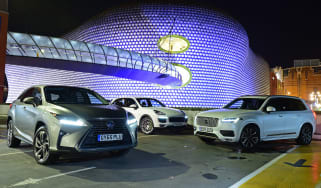
Elsewhere, there’s the Volvo XC90 to consider with the added practicality of seven seats, or the Alfa Romeo Stelvio, which may be a bit long-in-the-tooth, but can be made to hustle along a B-road far better than many contemporary rivals.
Lexus RX pictures
Key updates of the Lexus RX review
3 July 2026: Latest driving impressions and details about PHEV.
Frequently Asked Questions
Every new Lexus is covered by a standard warranty of three years or 60,000 miles (whichever comes first), but you can extend that by another 12 months or 10,000 miles every time you have your car maintained at a Lexus Service Centre. This lasts up to a total of ten years or 100,000 miles.
Deals on the RX and alternatives