Porsche Taycan review
More talented than ever, the Porsche Taycan is a sublime all-electric GT, blending impressive handling, practical range, and an engaging drive

Our opinion on the Porsche Taycan
We can't help but be impressed by the Porsche Taycan – and it remains one of our favourite electric cars. You'll need a supercar budget to afford one, but we think its combination of dynamic handling, breathtaking performance and superb long-distance comfort means it’s an obvious choice if you're after a reassuringly capable, premium all-electric saloon.
A midlife facelift increased the Taycan's skillset even further by adding more range, better efficiency and faster acceleration, while more recently the Taycan has gained improved infotainment and a virtual gearshift option for greater driver involvement. There’s no weak link in the model line-up either, and while the GTS and Turbo-badged variants may attract a lot of attention, the entry-level Taycan is as fast, efficient and comfortable as you could ever want.
About the Porsche Taycan
Launched in 2019, the Porsche Taycan showed the world that an EV could deliver true sports car thrills. But more than that, it blended its dynamic ability with surprising comfort, a practical range, and rapid charging – making it a superb, if slightly pricey, all-electric option.
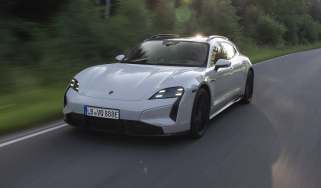
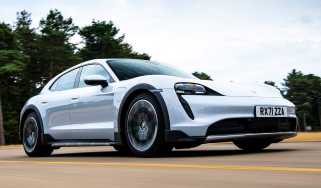
In addition to the four-door saloon (which is what we’ll cover primarily in this review), there’s also a five-door hatchback (or estate, depending on how you look at it) called the Porsche Taycan Sport Turismo, and a high-riding Porsche Taycan Cross Turismo variant as well.
Used - available now

2024 Porsche
Taycan
55,000 milesAutomaticElectric
Cash £41,999
2024 Porsche
Taycan
30,603 milesAutomaticElectric
Cash £41,484
2024 Porsche
Taycan
20,577 milesAutomaticElectric
Cash £56,899
2024 Porsche
Taycan
19,286 milesAutomaticElectric
Cash £59,499In the usual Porsche fashion, there’s a huge number of variants to choose from. These include 4S, GTS, Turbo, Turbo S and Turbo GT versions, plus a Turbo GT with Weissach package – a set-up that brings aerodynamic enhancements and weight reduction to further enhance its already blistering performance. And as long as you don’t mind left-hand drive, closely-linked Porsche tuner Manthey now offers a £94,000 upgrade package for the Turbo GT to turn it into a Nürburgring-worthy track car.
To see how the Taycan measures up against its petrol-powered counterpart, the Porsche Panamera, we drove the two side-by-side in a twin test.
Porsche Taycan prices and latest deals
You’ll pay around £88,000 for an entry-level Taycan, while the Taycan Black Edition and 4S cost around £96,000. If you’re really pushing the boat out, the flagship Turbo GT starts at around £189,000 – with or without the Weissach Package.
Our Buy A Car service also has a number of used Porsche Taycan models in stock right now.
Performance & driving experience
Pros |
|
Cons |
|
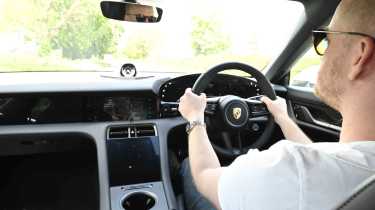
The Porsche Taycan has been built from the ground up to be a high-performance electric car. This means it’s brilliant to drive, which is all the more remarkable when you consider that this is a four-door coupe weighing over two tonnes.
You sit low in the Taycan, which gives the impression that you’re at the wheel of a Porsche 911, and it feels incredibly agile thanks to its low centre of gravity. The optional £1,600 rear-wheel steering certainly helps, as do the precise and well-weighted controls. Since 2026, Porsche has also offered E-Shift, a virtual gearshift function, with accompanying noise and vibrations, that gives you the feeling of operating a PDK transmission in a combustion car. On some variants it costs as little as £750 and it’s very convincing.
You can go even further on 4S models by adding something called Active Ride Control – a feature that works to improve comfort in corners and on bumpy roads while also being able to control body movements when accelerating, braking, or turning. It’s a nearly £6,500 option on 4S models and above.
That’s a rather expensive option that you can live without, because aside from some slight jiggle over broken surfaces at speed, the standard-fit air suspension does a brilliant job of dealing with large bumps in a way you wouldn’t expect a low-slung four-door sports car to be able to manage. Above all else, the Taycan is so communicative that you never feel anything less than ‘at one’ with it.
| Model | Power | 0-62mph | Top speed |
| Taycan 320kW RWD | 430bhp | 4.8 seconds | 143mph |
| Taycan 440kW 4S | 590bhp | 3.7 seconds | 155mph |
| Taycan 649kW Turbo | 871bhp | 2.7 seconds | 162mph |
Electric motors, 0-60mph acceleration and top speed
The base Porsche Taycan goes from 0-62mph in 4.8 seconds using launch control and up to a top speed of 143mph. Upgrade to the 4S model and the benchmark time drops to 3.7 seconds, with a top speed of 155mph. The GTS knocks four tenths of a second from the 4S's time, while the Taycan Turbo hits 62mph from rest in 2.7 seconds and will hit a top speed of 162mph.
Splashing out on the Turbo S helps cut the sprint time to 2.4 seconds. The Turbo GT is quicker still, at 2.3 seconds, with the Weissach Pack-equipped variant a tenth faster, plus it has a higher top speed of 190mph. No matter which Taycan variant you opt for, you’ll never feel the need to describe it as slow.
Town driving, visibility and parking
Considering the Taycan is capable of such ferocious performance, it's remarkably easy to pilot around town. With smooth acceleration and steering inputs, you'll find it as simple and effortless to get from A to B as any 'normal' saloon.
All-round visibility is pretty good despite the low-slung driving position, and parking manoeuvres are made easy with the standard reversing camera and front and rear ParkAssist technology. Drivers who spend most of their time in town may be put off by the Taycan's overall width – at 2.14 metres across, it's no city car, and it does take a little getting used to, particularly on congested urban streets.
Country road driving and handling
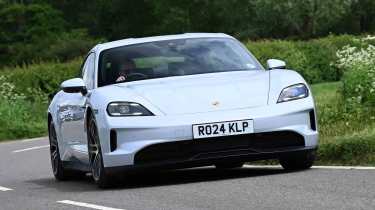
The Taycan is superb at piloting through twistier B-roads. It’s rapid, and handles brilliantly despite its two-tonne-plus weight, while the standard-fit air suspension just gives it even more dynamic polish. It's genuinely enjoyable to drive and encourages you to push on with confidence.
Being picky, we found the brake pedal a little light in feel, with other testers remarking on how the regen system engaged a little too sharply at times - but we're talking in fractions here rather than any major irks.
The optional E-Shift virtual gearshifts are well worth specifying for drivers missing the feeling of driving a combustion vehicle. While the synthesized engine sounds aren’t completely convincing, the rest of the package is, the E-Shift function doing everything from letting you hit a virtual rev limiter, to small interruptions in power under acceleration, and convincing levels of acceleration and ‘engine braking’ in each gear. It makes driving on twisty roads much more involving, and while you can leave it on all the time, it can be entirely turned off if you prefer silent cruising on the motorway or around town.
Motorway driving and long-distance comfort
During our own testing, the Taycan was a tremendous long-distance cruiser; a car you felt you might easily skip off to France in and take a lazy road trip down to the Med.
Comfortable, quiet and with plenty of power to tap into, the Taycan's GT ability is its real strength, while improvements to its efficiency and charging power mean you'll struggle to find any meaningful fault. Porsche has even added adaptive cruise control and lane change assist as standard to help smooth the journey along.
Range, charging & running costs
Pros |
|
Cons |
|
With the 105kWh battery pack now standard across the range, the entry model has a range of 434 miles on a single charge, thanks to a tyre update in 2026 that liberated an extra twelve miles. The Turbo-badged cars aren’t as efficient, with the top-of-the-range Turbo GT claimed to provide 344 miles of range before needing to be recharged.
Of course, what you achieve in the real world will depend on multiple factors, but we achieved a very impressive 4.0 miles per kWh efficiency on a dry 20-degree day doing predominantly motorway miles. Interestingly, in cars fitted with E-Shift, using the system doesn’t actually affect efficiency at all, since the sounds you hear and the ratios it creates are still entirely virtual. That said, it might change your driving style in such a way that reduces your efficiency…
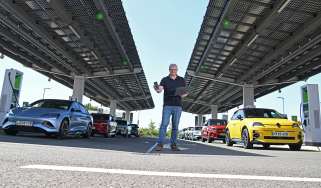
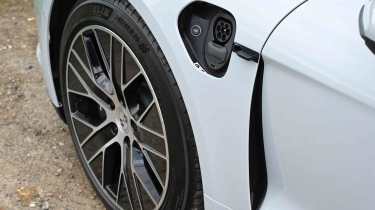
Maximum charging speed is 320kW, which means you could take a battery from 10 to 80 per cent in around 15 minutes at a suitable charging point, although topping up at a more common 150kW public charger requires a 33-minute pit stop. Utilise a typical 7kW wallbox charger at home, and it’ll take 15.5 hours to fully recharge the battery.
Owners can take advantage of the Porsche Charging Service; a network that allows Porsche EV owners to charge their vehicles at a variety of public and private charging stations – with a single, centralised billing system. It offers access to over 800,000 charging points across Europe, and new Porsche EV owners can receive free access to the Porsche Charging Service Plus for up to three years.
| Model | Battery size | Range | Insurance group |
| Taycan 320kW RWD | 105kWh | 434 miles | 48 |
| Taycan 440kW 4S | 105kWh | 400 miles | 50 |
| Taycan 649kW Turbo | 105kWh | 400 miles | 50 |
Insurance groups
There's no avoiding the reality of insuring a Porsche Taycan – it's going to be expensive, with the entry car in group 48 and all other models in group 50. In comparison, the Audi RS E-tron GT is also in group 50, along with the Lotus Emeya. A slightly cheaper option is the BMW i4 M60 in group 45.
Tax
As with all EVs, the standard rate of VED road tax applies to every Porsche Taycan. This car’s premium pricing also means that it crosses the £50,000 luxury car tax threshold, adding an additional £440 to your annual bill between the second and sixth year after first registration.
If you’re a very fortunate company car driver, you will also benefit from the lowest Benefit-in-Kind (BiK) tax rates.
Depreciation
The high purchase cost of the Taycan and EV market uncertainty has resulted in some unusually low residual values for Porsche owners.
After a typical three-year/36,000-mile ownership period, our market data shows that the Taycan saloon is predicted to only hold onto around 36 to 42 per cent of its original value. The Sport Turismo is slightly stronger at 37 to 46 per cent, but the Cross Turismo is the worst of the bunch at only 33 to 39 per cent.
These aren’t very reassuring numbers if you’re hoping for a decent return when it’s time to sell on your Taycan. However, rivals such as the Lotus Emeya and Audi RS e-tron GT perform very similarly.
Interior, design & technology
Pros |
|
Cons |
|
The Porsche Taycan is squat and wide, with the lowest centre of gravity of any of the brand’s current line-up. This is needed to counter the effects of the heavy battery pack it must carry around.
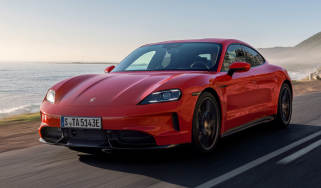
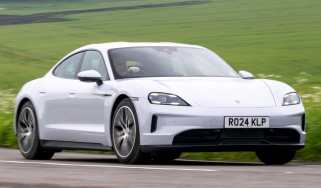
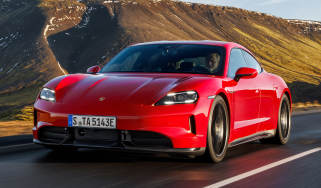
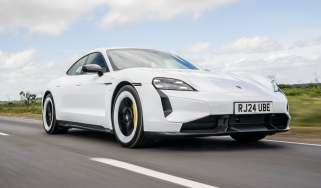
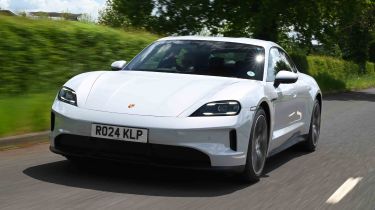
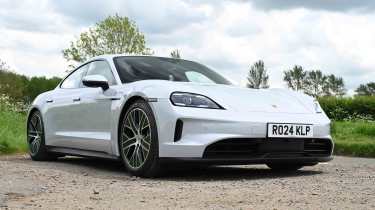
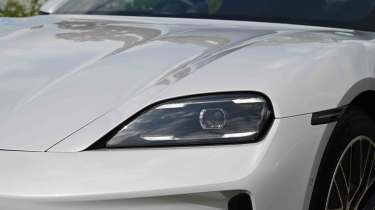
An update changed the look very slightly, but it remains unmistakably a Porsche. The front is dominated by a pair of four-point LED headlights, with an optional matrix beam available. In profile, the Taycan looks more like a sports car than a four-door coupe, with a set of flush, automatically extending door handles to add to the theatre.
The rear design features a glass light strip, with the Porsche logo running down the middle. Above it is the three-stage rear spoiler system, while the absence of exhaust pipes gives the rear a clean, uncluttered look.
Even the entry-level Taycan comes with a long list of standard equipment, including adaptive air suspension, LED headlights, part-leather seats, electric adjustment for the front seats, sat-nav and 19-inch alloy wheels.
The Taycan Turbo adds the likes of 20-inch alloy wheels, sports seats and Matrix LED headlights, while the Turbo S gets 21-inch alloy wheels, larger brakes and greater adjustment for the front seats. There’s also a long list of options to choose from.
Interior and dashboard design
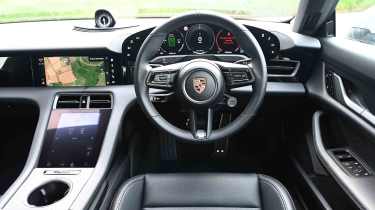
Inside, the seat position is derived from the Porsche 911, creating the best driving position you’ll find in the electric car segment. It’s a tech-heavy and minimalist approach, dominated by up to three digital screens and a centre console with touch control. There were some small tweaks as part of the facelift, but nothing major.
The only physical buttons are on the steering wheel and doors, creating a look that’s both modern and futuristic. Not everyone will appreciate the lack of buttons, but the interior looks stylish and upmarket.
Materials and build quality
With so many functions controlled via the touchscreen, the Taycan's interior can feel almost spartan at first glance. But take a moment to absorb the quality of the leather and softer materials in use, along with the excellent way in which everything is screwed together, and the Taycan is a very pleasant place in which to spend time.
Infotainment, sat-nav and stereo
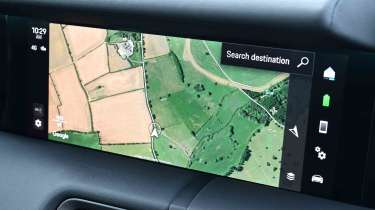
The Taycan has a dual-touchscreen layout: a 10.9-inch central touchscreen display as standard, along with a 16.8-inch curved display in front of the driver. The top display handles standard infotainment, and its fast loading times and clear graphics mean it does a great job. The one issue is with its position, which is recessed quite deep into the dash, so you might have to lean forward to adjust some functions.
This is mitigated slightly by the lower touchscreen, which includes shortcuts for the navigation, audio, telephone and system settings along its upper edge. The climate controls and heated seat functions are also operated using the screen, and because they are its primary function, they’re quite easy to access, if still not as easy to use on the move as a regular switch. It feels under used, too; the portrait display is quite large, but there’s a lot of blank space.
Wireless Apple CarPlay is a useful feature, and since 2026 the system itself has become Android Auto based. The system is five times more powerful than before so functions on-screen respond a lot quicker, and AI technology mean voice commands are more natural, letting you string commands together into sentences which the car will (mostly) carry out as you intend. The lower touchscreen has also been rejigged a little to incorporate commonly-used shortcuts based on customer data, so not quite as much screen-tapping is required now.
Boot space & practicality
Pros |
|
Cons |
|
The Porsche Taycan is a triumph of good design, but there’s a touch of smoke and mirrors about the way it looks. While the similarly sized Porsche Panamera can look a tad cumbersome from some angles, the Taycan looks low and lithe, with styling that’s closer in spirit to the 911 than a four-door coupe.
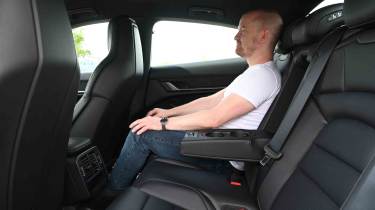
The Taycan can seat four adults in comfort, with the driver and front passenger enjoying the best experience. That said, it’s a big car, which is something you’ll need to remember when parking and passing through narrow-width restrictions.
If you're after increased practicality, you’ll want the higher-riding Cross Turismo body style, which offers improved interior and luggage space. A Sport Turismo model is also available and sits between the saloon and the Cross Turismo in the range.
Dimensions and size
The Porsche Taycan is wider but slightly shorter than the Porsche Panamera, but longer and wider than the Porsche Cayenne SUV, which gives you some idea of the sheer size of this electric car. It’s only 1,381mm high, though.
| Dimensions comparison | |||
| Model | Porsche Taycan | Audi e-tron GT | BMW i5 |
| Length | 4,963mm | 5,004mm | 5,060mm |
| Width | 1,966mm | 1,964mm | 1,900mm |
| Height | 1,381mm | 1,402mm | 1,515mm |
| Wheelbase | 2,900mm | 2,900mm | 3,000mm |
| Boot space | 407 litres | 405 litres | 490 litres |
Seats & passenger space
The front has plenty of headroom and shoulder room, and thanks to the electric seat adjustment, the driver will have no trouble finding the perfect driving position. The sports seats are comfortable and offer good support; perfect for longer journeys or more spirited driving.
The Taycan can seat four adults, but it’s quite tricky to get into the back. Once there, headroom is restricted by the sloping roofline, while tall adults might find there’s not enough room for their feet below the front seats. The middle seat of cars with the 4+1 option is suitable only for small children and occasional use.
With this in mind, it’s probably worth sticking with the four-seat configuration, which swaps the middle seat for an armrest. There are also two Isofix mounting points in the back, along with an optional front passenger seat airbag with a deactivation function.
Boot space
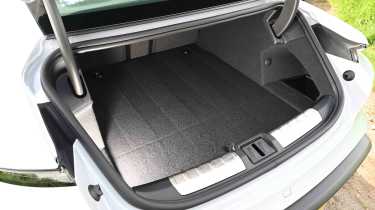
The Porsche Taycan benefits from an 81-litre luggage compartment in the front, while the main boot at the back is 407 litres. The saloon body style is a little restrictive when loading taller items, though this can be solved by opting for the more practical Taycan Sport Turismo or Taycan Cross Turismo, both of which have hatchback-style openings.
A large backpack or a soft bag can fit in the front boot, but the main boot isn’t as capacious as what you’ll find in some family hatchbacks. At least the Taycan boasts a pair of individually folding rear backrests, if you’re prepared to ditch your back-seat passengers in favour of more luggage space.
Reliability & safety
Pros |
|
Cons |
|
The Porsche Taycan itself didn’t appear in the most recent Driver Power customer satisfaction survey, but the Porsche brand has previously topped the best manufacturers poll on more than one occasion, which bodes very well for the ownership experience.
Safety experts at Euro NCAP awarded the Taycan a maximum five-star rating when it was tested in 2019. However, this has since expired due to the length of time that has now passed. It’s worth noting, though, that the car scored particularly well for adult and child occupant protection.
There are eight airbags, while pedestrians are protected by an active pop-up bonnet. Depending on the number of seats, four or five three-point belts with force limiters are fitted as standard.
As standard, you get an autonomous emergency braking system (AEB), a lane departure warning system, and a driver attention monitor, plus the previously optional adaptive cruise control and lane change assist are now also included without any additional charge. A head-up display is around £1,200, while a surround-view camera system with active parking technology is £1,100.
The optional Innodrive is a particularly clever system, using navigation data, radar, and video sensors to adjust the driving speed according to speed limits, topology, roundabouts, bends and traffic. It also features active lane-keeping assist, swerve assist and junction assist, which warns the driver if they have overlooked oncoming road users. A RECAS (Rear End Collision Alert System) actively warns the traffic behind of a potential rear-end collision.
Buying and owning
- Best buy: Porsche Taycan 105kWh RWD
Money no object? If so, then opting for one of the ludicrous Turbo-badged Taycan models would probably be too hard to resist. But, for real-world driving, the entry model is more than up to the job, bringing a gorgeous combination of performance, range and lots of standard kit - a package that costs around £50,000 less than a Turbo car, and a mind-boggling £100k compared with the Turbo GT.
Porsche Taycan alternatives
The closely related Audi e-tron GT is an extremely capable premium electric saloon and similarly priced, but we'd just give the edge to the Porsche on the fun factor.
The BMW i4, i5 and i7 are credible rivals, too, with the i4 M60 in particular delivering an enticing package: all-wheel drive, 593bhp and 0-62mph in 3.9 seconds – although its 338-mile range is well down on the Taycan. Other options include the luxurious Mercedes EQS, but it doesn't quite measure up if you're looking to combine a premium feel with good driving dynamics. A more dynamic but left-field choice would be the Lotus Emeya.
Keep an eye out for some of the incoming Chinese brands too. We’ve not yet driven one that’s as dynamically capable as the Taycan, but in pure performance terms the likes of the MG IM5 are right in the Taycan ballpark for half the cost. And as a driver-focused alternative to the Taycan, again for less money, then Korea also has an option with the fast, efficient and involving Hyundai Ioniq 6 N.
Key updates of the Porsche Taycan review
20 May 2026: Latest driving impressions and line-up information.
Frequently Asked Questions
Every Porsche comes with a three-year/unlimited mileage warranty as standard, while a separate eight-year/100,000-mile warranty covers the Taycan’s battery.
Deals on the Taycan and alternatives