Audi Q7 review
The latest Audi Q7 is far better to drive than before, but it’s also much more expensive

Our opinion on the Audi Q7
The most obvious improvement the latest Audi Q7 makes from the old car is in terms of its driving dynamics. The chassis and suspension tweaks should be enough to concern those at BMW, and the V6 diesel remains a very well-matched powerplant, even if the new mild-hybrid system hasn’t boosted efficiency as much as we’d like. There’s currently not as much choice as offered by the BMW X5 or Mercedes GLE – but as an all-rounder, the Q7 in TDI form remains a tough competitor.
About the Audi Q7
After a series of facelifts that kept the old Q7 going for over a decade, Audi has finally brought out its new, third-generation model. Its arrival is timely, because it has a fresh BMW X5 and revamped Mercedes GLE to contend with.
Put simply, the prime reason why the previous Q7 lived on for so long was that it was rather good. It felt premium inside – maybe not as posh as its Bentley Bentayga or Porsche Cayenne siblings, but just as well built, and a noticeable step above the Volkswagen Touareg. It also drove far better than you might have expected, once options such as rear-wheel steering were fitted.
The new car immediately has a problem, though, because it’s around £10,000 more expensive in its base form than the old car. That price tag is only going to go up once plug-in hybrid power joins the diesel powertrain, too.
Used - available now


In order to determine whether the big Audi lives up to its equally sizable price, our expert road testers have tested it across a wide variety of roads and driving scenarios in the UK.
Performance & driving experience
Pros |
|
Cons |
|
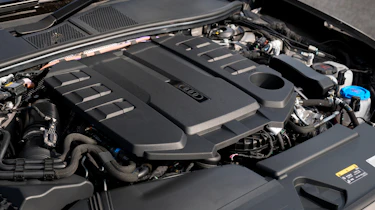
Plug-in hybrid power is on the way, but for now the Audi Q7’s sole power plant is a diesel unit that’s basically an evolution of the 3.0-litre turbocharged V6 found in the previous model. This time around, though, it has mild-hybrid assistance.
The eight-speed automatic transmission and quattro four-wheel-drive system are also carried over from the previous Q7, but what is new is a limited-slip central differential with a preload function that constantly applies pressure to split torque faster between the two axles. The idea is that this maximises traction before any wheel slip occurs, and it’s standard across the range.
Another neat feature is a revised rear-wheel-steering set-up, which was previously an option on the old car, but is now standard from the off. It can turn the rear wheels up to five degrees to aid cornering ability, but also low-speed manoeuvrability – which is just as well, because the Q7’s wheelbase is now over three metres long.
| Model | Power | 0-62mph | Top speed |
| Audi Q7 3.0 TDI quattro S Line | 295bhp | 6.2 seconds | 146mph |
| Audi Q7 3.0 TDI quattro Edition 1 | 295bhp | 6.2 seconds | 146mph |
| Audi Q7 3.0 TDI Vorsprung | 295bhp | 6.2 seconds | 146mph |
Performance, 0-60mph acceleration and top speed
The mild-hybrid system’s electric motor helps to boost the TDI’s total power output from 282bhp to 295bhp, and torque is also up by 30Nm to a colossal 630Nm. Other markets get a less powerful 242bhp option, but that’s not destined for the UK due to the perceived lack of customer demand. The result of this power output is a 0-62mph time of 6.2 seconds, along with a top speed of 146mph. These aren’t bad numbers for such a hefty SUV.
The Q7 was never the sharpest to drive of the large premium SUV cohort, but the tweaks show that Audi has started to focus more on this area, and there’s further good news in this respect. The engine’s new mild-hybrid assistance improves responsiveness by flattening the torque curve for smoother, more consistent acceleration throughout the rev range.
However, despite Audi claiming the tiny electric motor can power the Q7 by itself at slow speeds or for specific manoeuvres, it’s here that the engine delivers that unmistakably agricultural sound you get with a diesel.
Town driving, visibility and parking
There’s no avoiding the Q7’s sheer size when driving through town, and passing other large vehicles on narrower streets may get your heart racing now and then. However, all-round visibility is very good thanks to the large door mirrors and rear-quarter windows in the C-pillars.
Of course, there’s also an array of sensors and cameras to help prevent any incidents when parking. The aforementioned rear-wheel steering system also helps to make manoeuvres much easier than they otherwise would be.
Country road driving and handling
Weirdly, considering its 2,425kg kerbweight, one of the highlights of our Q7 testing came from winding, mountain roads. Alongside the revised engine there’s a new adaptive air-suspension system, which is an optional extra in other markets but standard on UK models.
That’s a very good thing, because Audi’s engineers have come up with a truly wonderful set-up. In the Balance drive mode it filters out crevices and bumps in the road superbly, even on the largest 23-inch wheels – not something we were able to say about big Audis of old. You don’t feel the need to switch to the Comfort mode, although if you choose to, there’s a bit more pitch and roll which helps if trundling over big speed bumps, but makes the Q7 a little unsettled at speed.
The surprisingly wide range of driving characteristics enabled by the air-suspension is most noticeable when you switch to Sport mode. The Q7 is no sports car, but it tightens in bends, with up to 30mm of lowered ride height, rear-wheel steer getting the back end in line and active anti-roll bars providing a stable platform to lean on the deep levels of grip. The steering in Sport mode becomes slightly weightier, too, although one issue is the hexagonal shape of the wheel itself. This means it can feel annoyingly clunky in bends while feeding it through your hands. It might make sense in a race car with very little steering lock, but on road cars it’s a design fad that simply doesn’t work.
Motorway driving and long-distance comfort
With the Q7’s newfound handling qualities (which bodes well for the sportier SQ7 variant), the uplift in power from the hybridised diesel is well matched to the chassis. In-gear performance is easily quick enough to make overtakes a breeze, and while the torque delivery is not as instant as you would find on an EV (as Audi claims), it never feels sluggish on the throttle, while the V6 sounds better at speed, too. The gearchanges are a bit more slack, though; even in Sport mode they blur from one gear to the next.
While the diesel can be noisy under strain, the Audi settles into a motorway cruise where the initial low-speed engine grumble almost completely dissipates, with wind and road noise also being kept at bay.
The brakes, meanwhile, are phenomenal, with massive 400mm discs up front and six-piston calipers. Stopping power is a given considering their size, but the travel in the pedal is very well calibrated.
MPG & running costs
Pros |
|
Cons |
|
You might think that with extra electrification the current Audi Q7 would be far more economical than the old one. And the good news is that it pumps out less in the way of CO2 emissions than before at 206g/km compared to 217g/km. However, the efficiency gains are marginal on paper at up to 36.6mpg on the WLTP combined cycle, as opposed to 35.6mpg for the old 282bhp TDI V6.
In the real world we found those figures to be even closer still, as around town we were lucky to get over 30mpg, with stretches of motorway and B-road increasing this to the mid-30s. The facelifted Mercedes GLE in 286bhp 350d diesel form beats the Audi only slightly when it comes to efficiency and emissions, claiming 37.7mpg and 197g/km, respectively.
If economy is super important to you, then it might be worth holding out for the Q7 plug-in hybrid. We know it’ll get the same system as the Audi A6 PHEV, meaning a battery capacity of 25.8kWh and an electric range of around 60 miles. Alternatively, you may wish to look towards the fully electric Audi Q6 e-tron instead, as that’ll be the cheapest to run by quite a long way.
| Model | MPG | CO2 | Insurance group |
| Audi Q7 3.0 TDI quattro S Line | 38.2mpg | 194g/km | 49 |
| Audi Q7 3.0 TDI quattro Edition 1 | 36.7mpg | 203g/km | 49 |
| Audi Q7 3.0 TDI Vorsprung | 36.2mpg | 206g/km | 50 |
Insurance groups
The Audi Q7 is a very large SUV from a premium brand, so we doubt there will be too many audible gasps when we say that it finds itself between insurance groups 49 and 50 (out of 50). What might come as more of a surprise, though, is that the BMW X5 could potentially save you a pretty penny here, as it can go as low as group 43. That being said, the fanciest models also wind up in group 50, so be careful.
Tax
It might have received an element of electrification, but the Q7’s CO2 emissions mean it’ll still attract a sizable VED road tax bill. The luxury car tax bracket is well and truly crossed, too, so you’re looking at an additional £440 on top of that bill between the second and sixth years of ownership.
Depreciation
Unfortunately, it’s not just the tax and insurance that’ll pack a punch, as the Audi Q7 is also pretty susceptible to the wrath of depreciation. Our market data shows that it’ll retain between 41 and 43 per cent after three years or 36,000 miles.
This means the Q7 follows behind the BMW X5 at 46 to 56 per cent. These figures don’t include the hot X5 M, though, as that only retains 41 per cent. The best-performing X5 here is the xDrive50e PHEV, so the Q7’s fortunes may improve when Audi adds a plug-in to the line-up, but only time will tell.
Interior, design & technology
Pros |
|
Cons |
|
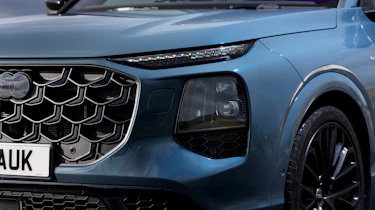
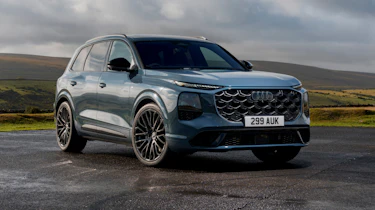
Due to its sheer size, it’s still difficult to mistake the Audi Q7 for any other member of the line-up. However, this time around the large SUV has been given a bit of a cosmetic injection of sportiness. A higher and squarer bonnet, bulging wheelarches and Audi’s revamped badging all contribute towards the new look.
Interior and dashboard design
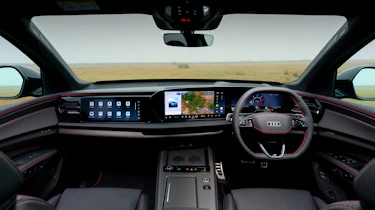
Jump inside the Q7 – which if you go for the Edition 1 or Vorsprung requires you to use the annoyingly slow electrically opening doors – and you’ll find an interior that’s a clear evolution over that of the old car. It’s quite conservative compared to the BMW X5’s radical dash layout incorporating Panoramic iDrive, and more akin to the Mercedes GLE’s, especially with the three-screen layout, which sees two 12.3-inch displays flank a central 14.5-inch touchscreen.
Initially, you might consider the Q7’s single-panel steering wheel buttons and the weird positioning of the gear selector and indicators on small tabs behind the steering wheel to be ergonomic missteps. But after a day of driving, using them became second nature.
One of our international test cars had a light beige leather and wood trim, which was reminiscent of Audi’s Chinese arm ‘AUDI’ and the lovely interior of its E7X SUV. It’s a shame this isn’t an option on UK-bound Q7s, as it breathes a bit of light into what is otherwise a drab interior. However, this problem can still be alleviated if you go for the Edition 1 with its huge panoramic sunroof, or the Vorsprung which adds the option of cream-coloured seats.
One complaint that a few of our testers shared, though, was Audi’s one-piece wiper and lighting control setup. Gone are the traditional stalks, and in their place sits a solid unit with a number of buttons and toggle switches. We feel that this setup is ergonomically flawed as it sits a bit higher than you’d probably expect, plus it takes a pretty strong push to turn the indicators on. The wiper controls also consist of a variety of buttons and knobs, so you need to remember which is which. Considering that stalks are seldom the source of any driver’s complaints, this does feel like a case of reinventing the wheel for the sake of it.
Materials and build quality
For the most part, the Audi Q7’s build quality is typically solid. However, one of our test cars developed quite an annoying rattle from behind one of the dashboard vents during testing. At this sort of price, this is something we’re willing to be picky about.
We also noticed that the passenger seat bolstering appeared misshapen. While we’d expect this in a car that’d covered 100,000 miles or so, it raises serious questions in a brand-new one.
Infotainment, sat-nav and stereo
Audi’s infotainment system is one of the better ones on the market, with a clear view of key information readily available and rapid response times between various menus and functions. We’re not sure if the loss of the dedicated climate control display from the old Q7 is a good thing, because the tab at the bottom of the touchscreen is a little more difficult to use while driving.
Boot space & practicality
Pros |
|
Cons |
|
The Audi Q7 is a seven-seater as standard, so it’s definitely suited to larger families with a healthy car-buying budget. This model’s height means it boasts a commanding view of the road ahead, but thankfully a fairly low floor means it’s easy to step in and out of.
However, we did have some issues when trying to find the ideal seating position. The root of our problem was the headrest; when we moved it closer, it was too upright. When we moved it further away, it was too slanted. Considering that this affects both comfort and safety, it’s rather disappointing.
Dimensions and size
| Dimensions comparison | |||
| Model | Audi Q7 | BMW X5 | Mercedes GLE |
| Length | 5,056mm | 4,922mm | 4,924mm |
| Width | 2,205mm | 2,004mm | 1,947mm |
| Height | 1,757mm | 1,745mm | 1,772mm |
| Wheelbase | 2,998mm | 2,975mm | 2,995mm |
| Boot space | 581-1,980 litres | 650-1,870 litres | 630-2,055 litres |
Seats & passenger space
We found the more upright driving position of the Q7 gave a clearer view of the driver’s instrument cluster than on other models, where the steering wheel tends to cut off the top of the display. However, while the seats offer plenty of adjustment, some testers didn’t like the one-piece seat design, which left the headrest too far away from their head when the backrest was reclined for a more comfortable position.
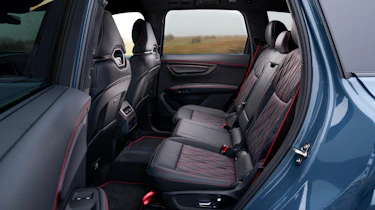
There’s a decent amount of space in the back for a 5 ft 11 in rear passenger to sit behind a similarly sized driver. However, like the previous Q7, the current car retains a wide central tunnel that the middle seat occupant has to straddle, and the runners for the front seats take up valuable foot space.
Plenty of USB-C charging points for those in the back to keep their devices topped up, plus there are separate climate controls and vents in the centre console and door pillars for extra ventilation. We’re not so sure about the chunky front seat design because shorter people will struggle to see around them, although that might not be a major issue if they prefer to keep their eyes glued to a tablet screen.
In our view, access to the third row is hindered more than helped because the Q7’s seats move electrically, and the motors are a bit slow if you’re in a hurry to get out of the rain, for example. Also, it isn’t immediately obvious what all the various buttons involved in the process of sliding and erecting the seats do, and while you might get used to it if you own the car, we reckon it’ll be a lengthy coaching session explaining to extended family how to get into the back of your Q7.
Once in the third row, you’ll have to ask those in front to move their seats forward because legroom is tight. Indeed, if you regularly carry extra passengers, you may want to look at the even bigger Audi Q9, which we found offers much more space for those in the rearmost seats.
You do get some USB-C charging and cupholders in the third row (and possibly heated seats if you go for the aforementioned comfort pack), but you don’t get third-row air vents like the Volvo XC90. It can also seem rather gloomy in the back if you don’t get the panoramic glass roof option.
Happily, all seats except the driver’s one get Isofix child seat mounting points, and they’re all accessed behind some easily removable plastic tabs or cushions.
Boot space
Even with the third row in place, there’s still a sizable 581 litres of boot space, so the Audi Q7 lives up to the family car brief. If you’d prefer to use it as a five-seater, though, this number jumps to 722 litres. Either way, you’ll be able to pack in quite a bit of cargo. If you’re taking on a furniture shop, folding the middle row ups things even further to 1,980 litres. That’s a lot of room, but not as much as the 2,055 litres you’ll find in the Mercedes GLE.
Towing
With the TDI diesel at its heart, the Audi Q7 can take on a trailer or caravan weighing up to 3,500kg. No competitor is able to top this figure. In fact, the BMW X5 doesn’t even come close at a maximum of 2,700kg.
Reliability & safety
Pros |
|
Cons |
|
We’d expect a German premium brand’s flagship to hold up in terms of safety, and the good news is that the Audi Q7 has landed a five-star rating from Euro NCAP. When the safety board put this large SUV through its paces in 2026, it also managed a highly impressive 100 per cent score in post-crash safety.
There’s plenty of standard-fit advanced tech to contribute towards this score, too. Every Q7 gets systems like collision avoidance assist, proactive passenger protection, adaptive cruise control, surround view cameras, front cross traffic assist, lane change assist and Park Plus.
While the Q7 is too new to have appeared in the Driver Power owner satisfaction survey, Audi only managed a 23rd-place result out of 30 in the most recent best manufacturer rankings. This is a pretty meagre score for an established premium brand, with owners being particularly underwhelmed with their cars’ powertrains and handling. What’s worse for Audi is that Mercedes topped the chart.
| Euro NCAP safety ratings | |
| Euro NCAP safety rating | Five stars (2026) |
| Safe driving | 72% |
| Crash avoidance | 77% |
| Crash protection | 88% |
| Post crash safety | 100% |
Buying, prices and deals
Best buy: Audi Q7 3.0 TDI quattro S Line
Starting from around £82,500, the Audi Q7 is anything but cheap. However, considering that the Edition 1 bumps this number up to nearly £90,000, while the Vorsprung costs no less than £102,500, we’d stick with the entry-level S Line in order to keep things somewhat sensible. There’s still more than enough features for most needs, and the 3.0-litre TDI produces its fair share of power.
If you’d like to save on the list price — and why wouldn’t you? — you can build your new Audi Q7 with the Auto Express Buy A Car service. We can also help you to sell your car.
Audi Q7 alternatives
The Audi Q7’s most direct rivals are the BMW X5 and Mercedes GLE. As is tradition, the BMW focuses more on sportiness while the Mercedes is geared towards comfort. Either way, though, these two are fiercely competitive in their own right.
Look a bit further afield, and you’ll soon come across the ever-popular Volvo XC90 and Range Rover. These two also have their own electric counterparts, the Volvo EX90 and Range Rover Electric, while the German brands have the likes of the BMW iX and Mercedes EQE SUV. If you’d rather stick with the four rings, there’s also the Audi Q6 e-tron to take a look at.
Audi Q7 pictures
Frequently Asked Questions
The Audi Q7 is covered by the brand’s standard three-year, 60,000-mile warranty. This is pretty average on the current market, but several cheaper marques, like Kia and MG, offer much longer plans.
Deals on the Q7 and alternatives