BMW 2 Series Gran Coupe review
The BMW 2 Series Gran Coupe has been handed a hefty overhaul, but many of its shortcomings remain

Our opinion on the BMW 2 Series Gran Coupe
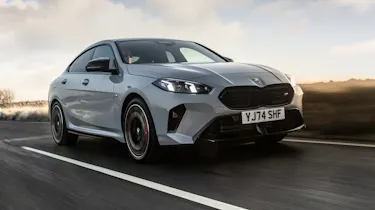
While it isn’t exactly a big seller, the BMW 2 Series Gran Coupe has been subjected to a pretty hefty overhaul. The new cabin has introduced fantastic quality and the in-car tech is class-leading, but this is all marred by an unconvincing driving experience.
The hottest M235’s powertrain is effective but lacks excitement, and the same can be said of its chassis. The Performance Pack doesn’t deliver huge changes, either, despite the extent of its upgrades. After driving the M235 against the base 220, we came to the conclusion that the latter is the one to have; not only is it much cheaper, but despite giving up some performance, it’s more fun, too.
About the BMW 2 Series Gran Coupe
The BMW 2 Series Gran Coupe is a model that, in the UK at least, doesn’t find as much love with buyers as its hatchback equivalent, the BMW 1 Series. However, with the ever-increasing size of modern cars, a four-door saloon whose footprint is nearly identical to the mid-Noughties E90-generation BMW 3 Series does have some appeal.
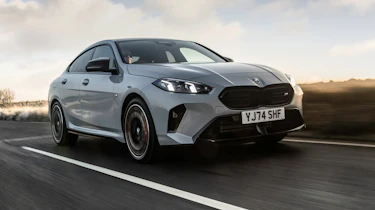
To keep this rather niche model feeling fresh, BMW treated it to a facelift in 2025. From whatever angle you approach the revamped 2 Series Gran Coupe, its look has changed fairly drastically.
Used - available now

2020 BMW
2 Series
93,500 milesAutomaticPetrol1.5L
Cash £9,700
2020 BMW
2 Series
45,132 milesAutomaticDiesel2.0L
Cash £13,289
2027 BMW
2 Series
61,810 milesAutomaticPetrol2.0L
Cash £24,999
2020 BMW
2 Series
39,823 milesAutomaticPetrol1.5L
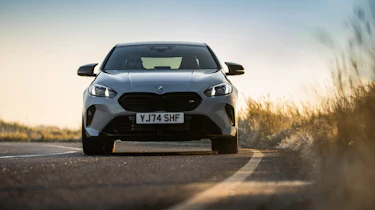
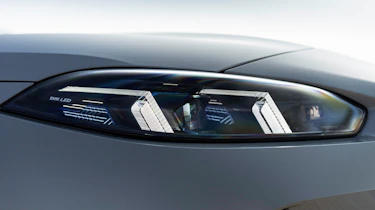
Cash £14,900The front-end design has now been brought more closely in line with the recently revised 1 Series – so the headlights have become slimmer and sharper, while the front grille is a little less pronounced than before, and the two elements have blended into one piece. We’re not sure the latter detail is the best move; there’s now more than a hint of Kia’s ‘Tiger Nose’ grille design that graced the front of most of the Korean brand’s cars a while back. To us, it feels like the 2 Series has lost some of BMW’s clear brand identity.
We’ve tested many versions of the BMW 2 Series Gran Coupe since it first arrived. This included a twin test of the pre-facelift M235i against the Mercedes-AMG CLA 35.
Performance & driving experience
Pros |
|
Cons |
|
BMW has softened the Gran Coupe’s suspension set-up a little to help deliver a more comfortable ride compared to its smaller 1 Series sibling. The changes haven’t resulted in the Gran Coupe becoming too wallowy when pressing on, and provide noticeable improvements in the car’s ability to glide over road imperfections.
The 220 petrol version uses the same 1.5-litre, three-cylinder engine from the MINI lineup and it offers adequate performance. Alternatively, opting for the 223 adds an extra cylinder along with more power.
At the top of the price list sits the M235 xDrive, which just about passes muster as a junior M-car, although the softer set-up of the Gran Coupe doesn’t really suit the remit of a model associated with BMW’s famous performance arm. The four-wheel-drive system works well and offers lots of traction, but there are slightly jarring upshifts from the eight-speed auto gearbox when accelerating hard.
Another disappointment is the rather lacklustre engine sound, offering very little in the way of character and prompting BMW into channelling a fake engine note into the cabin through the speakers when you select the sportier driving modes.
| Model | Power | 0-62mph | Top speed |
| 220 Gran Coupe M Sport | 168bhp | 7.9 seconds | 143mph |
| 223 Gran Coupe M Sport | 215bhp | 6.4 seconds | 155mph |
| M235 Gran Coupe xDrive | 296bhp | 4.9 seconds | 155mph |
Performance, 0-60mph acceleration and top speed
Ever-tightening emissions regulations have made it difficult for BMW to maintain the M235’s previous output. Power now stands at 296bhp – some 6bhp down on the old car’s peak, although that maximum rate is now available across a wider band of revs. However, torque has taken a bigger hit, falling from 450Nm to 400Nm.
Despite the drops, we don’t have too many complaints about how quickly it can get down the road – 0-62mph takes 4.9 seconds after all, and each upshift snaps quickly into place via the responsive seven-speed dual-clutch gearbox. However, the way it delivers that power feels a little bit flat. The driver doesn’t have much incentive to rev the car to the red line, and when they do, they’re exposed to a rather rough-sounding engine that can be quite unpleasant to listen to.
Like most turbocharged four-cylinder cars you can buy just now, sportier driving modes introduce some pops from the exhaust on the overrun, but even these are odd; the backfires are so soft that each one feels more like your ears have just popped than some trickery from the exhaust. While rivals like the Audi S3’s EA888 engine aren’t exactly bursting with character either, the BMW’s powerplant is particularly disappointing.
The entry-level 220 version delivers 168bhp from its 1.5-litre engine and is, unsurprisingly, the slowest car in the 2 Series Gran Coupe range – although all things being relative, its 0-62mph time of 7.9 seconds is still plenty fast enough for most needs. If it isn’t, then the 215bhp 223 model trims this to 6.4 seconds.
Town driving, visibility and parking
Because BMW has tried to keep the 2 Series Gran Coupe from being too firm, driving around town is a pretty calm experience. In fact, it’s pretty similar to the BMW 1 Series, but the steering can feel a little bit hefty at times. The biggest price you’ll pay with this car, though, is reduced rear visibility due to the coupe body shape. Fortunately, the standard reversing camera helps to resolve this issue.
Country road driving and handling
There’s a good level of steering feel, and you’d be hard pushed to tell that the 220 sends its power to the front wheels. It shows good composure and retains a decent sense of balance through the twisty stuff.
The chassis is one of the more convincing areas of the 2 Series Gran Coupe, although not perfect. Measurable performance is not in doubt; the nose is incredibly sharp to turn into corners to the point where you might poke around the rear axle to check that it doesn’t have rear-wheel steering.
There still isn’t the distinctive BMW rear-driven feel from the pricier models, though, because torque actually is sent to all four wheels. This tends to feel neutral rather than tail happy, but the traction is very impressive.
Regardless of this car’s capabilities, though, it’s the crucial fizz and excitement that’s missing. The steering may respond quickly off-centre, but the way it loads up through the corners doesn’t feel very progressive, making it harder to judge those high limits of grip.
BMW does offer buyers a more focused upgrade, known as the M Dynamic package. This brings chassis changes that extend to quite a nerdy level of detail. Extra bracing bars reach forward from the back axle to the underside of the floor; dampers are beefed up (in terms of construction rather than actual response), and there are more rigid front suspension mounting points.
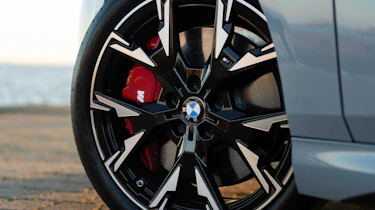
Some of that bracing adds a little weight, but a near-identical amount is removed from the car’s unsprung mass. First, the 19-inch wheels save 2.5kg per corner, and the huge front brake discs crammed behind them have an aluminium hub to further trim some grammes, making them lighter than the standard brakes. They’re gripped by beefier brake pads, too – the same as those fitted to the M3.
Perhaps most disappointing for the M235 was that a brief encounter with a base 220i showed the latter to be more fun to drive. It’s lighter over the nose so it’s even more keen to turn into corners, and there’s still loads of traction from its front-wheel-drive layout. Its three-cylinder 1.5-litre petrol engine is a little more grumbly, but it settles down nicely at speed. Mild-hybrid tech allows the 220 to move off from a standstill using electric power impressively smoothly, although the transition between electric and petrol isn’t quite as seamless as the system in the latest BMW X3.
Motorway driving and long-distance comfort
Adaptive dampers are standard, but unlike other cars where firmness adjusts with the driving mode, the 2 Series decides for itself based on road conditions and driving style. Generally speaking, the refinement is good and road noise well contained.
“You can feel the systems working together to tighten the car’s line through each corner, and it adds to the experience, rather than detracting from it. However, you have to be going pretty fast to exploit the car in this way.” - Dean Gibson, senior test editor.
MPG & running costs
Pros |
|
Cons |
|
For maximum fuel efficiency, you’ll want the entry-level 220 petrol because this can return up to 53.3mpg on the WLTP combined cycle, which means trips to the fuel station shouldn’t be a regular chore.
The more powerful 223 comes with an efficiency penalty, but it’s a pretty light one. Regardless of its larger engine, this model still claims up to 47.9mpg.
Customers opting for the performance M235i version probably won’t see fuel economy as a major sticking point. The official 37.7mpg figure isn’t exactly incredible, but it’s not bad for a performance car. Floor it, though, and this number will soon decline.
| Model | MPG | CO2 | Insurance group |
| 220 Gran Coupe M Sport | 53.3mpg | 120g/km | 23 |
| 223 Gran Coupe M Sport | 47.9mpg | 133g/km | 28 |
| M235 Gran Coupe xDrive | 37.7mpg | 170g/km | 31 |
Insurance groups
Insurance premiums shouldn’t be too alarming for 2 Series Gran Coupe owners. The entry-level petrol 220 M Sport resides in group 23 out of 50. The M235 isn’t lightyears away either, in group 31. However, the Audi A3 sinks far lower than the BMW, as it starts from group 15.
Tax
The most basic models just about avoid the grips of the luxury car tax. However, one too many options or moving up to a fancier trim will soon see this car cross the £40,000 threshold. If you do this, it’ll add £440 to your annual £200 VED road tax bill between years two and six after the car is registered.
A lack of electrification means the 2 Series Gran Coupe isn’t a prime company car candidate. For the lowest Benefit-in-Kind (BiK) rates, electric cars are the way to go. One of the closer alternatives to the 2 Series is the BMW i4, but this is larger.
Depreciation
The 2 Series Gran Coupe should hold onto a decent chunk of its value over an average ownership period of three years and 36,000 miles. Our market data shows that, over this time, it should retain 48 to 54 per cent of its original list price.
The Audi A3 Saloon, meanwhile, is more of a mixed bag depending on spec, as it retains anywhere between 37 and 51 per cent.
Interior, design & technology
Pros |
|
Cons |
|
Although the four-door coupe style has become more popular over the past few years, the overall look of the BMW 2 Series Gran Coupe still divides opinion.
The changes around the back were particularly drastic. Indeed, the update extended to a new pressing for the entire roof frame. The large panel that runs from A- to C-pillar was also revised to present a more distinct interpretation of another BMW signature, the Hofmeister Kink, at the tail end of the side windows, and to introduce an overhauled rear-end design to accommodate completely reshaped tail lights.
BMW also graced the M235 with plenty more sporty exterior garnish to lend it an even more menacing presence. The front bumper now features a deep lower air dam, with vents to each side emphasising the car’s width. Those vertical vents are mirrored on the rear bumper, and between them sits a deep rear diffuser section flanked by quad tailpipes.
Interior and dashboard design
Inside, you’ll find plenty of soft-touch materials throughout to raise the ambience. In fact, some of the Gran Coupe’s key touchpoints actually feel more premium than those you’ll find in some Mercedes models.
The 220 and 223 models now come in M sport trim as standard. Fortunately, this was already our pick of the bunch as it comes with sporty cosmetic enhancements along with plenty of standard kit including:
- 18-inch alloy wheels
- Adaptive suspension
- LED headlights
- Sports seats
- Dual-zone climate control
Materials and build quality
The original car’s build quality wasn’t bad, but the 2 Series Gran Coupe’s facelift has given it a significant boost.
With shift panels that look just like the ones you’ll find in a BMW M3, a smart (if, typically of BMW, still too thick) steering wheel, and redesigned, supportive sports seats, it all feels genuinely superb.
Infotainment, sat-nav and stereo
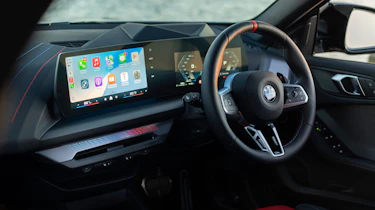
It’s inside where things have changed the most. The refreshed dashboard design is inspired by the BMW iX and BMW X3, lending the cabin a much less cluttered and more modern appearance than before. Unfortunately, this streamlining has come at the expense of the old car’s physical climate controls – as with other current BMWs, the temperature now needs to be adjusted on the touchscreen. The touchscreen is among the best in the business, though, with rapid loading times, sharp graphics and logical layouts. Even muting the speed limit warning bong is easy – a long hold of the ‘Set’ button on the steering wheel does the trick.
The central console gets a revised panel with a smaller toggle switch replacing the previous chunky gear shifter, further tidying up the design, and BMW hasn’t skimped on the quality, either. The iconic three-colour M Sport stripes have been hand-stitched into the dash top, and those new air vents are milled from a single piece of solid aluminium. Small etchings in the metal allow the ambient lighting to glow through the panel from behind.
Boot space & practicality
Pros |
|
Cons |
|
Customers considering the 2 Series Gran Coupe probably won’t be overly concerned with issues of practicality. It does offer more boot space than the BMW 1 Series hatchback, but the coupe style means there’s less head room in the rear and it isn’t as versatile in being able to easily carry family kit such as buggies and bikes.
Dimensions and size
The BMW 2 Series Gran Coupe is narrower than both the Mercedes CLA and Audi A3 Saloon, and it also has the smallest boot out of the three.
| Dimensions comparison | |||
| Model | BMW 2 Series Gran Coupe | Mercedes CLA | Audi A3 Saloon |
| Length | 4,546mm | 4,723mm | 4,504mm |
| Width | 1,800mm | 1,855mm | 1,984mm |
| Height | 1,445mm | 1,468mm | 1,417mm |
| Wheelbase | 2,670mm | 2,790mm | 2,635mm |
| Boot space | 360 litres | 405 litres | 425 litres |
Seats & passenger space
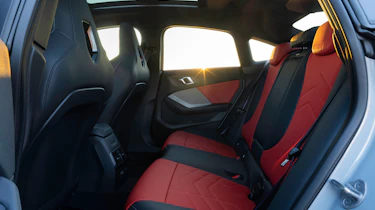
Four adults can fit perfectly comfortably in the 2 Series Gran Coupe, but we’d only recommend carrying a fifth occupant for shorter journeys because it isn’t wide enough to accommodate three adults in comfort, and the raised central position and sloping roofline restrict headroom. Rear legroom is also a little tight for taller adults, but there are no such issues up front, where you’ll find plenty of room for both the driver and front passenger.
Boot space
With 360 litres of boot space, the 2 Series Gran Coupe is 45 litres down on its Mercedes CLA rival, and 65 behind the Audi A3 Saloon. Loading bulky items easily could also prove to be a problem, due to the small ‘saloon-like’ boot opening.
Reliability & safety
Pros |
|
Cons |
|
While the 2 Series Gran Coupe didn’t feature in the most recent Driver Power owner satisfaction survey, the standard 2 Series Coupe achieved a very impressive 2nd place out of 50 in the best cars to own rankings. This bodes well for the Gran, and this is further enhanced by the BMW brand’s fifth place finish in the best manufacturer results.
Euro NCAP awarded the BMW 2 Series Gran Coupe with a four-star safety rating when it was tested in 2025. This is a bit disappointing as both the Audi A3 and Mercedes CLA (also tested in 2025) achieved the highest five-star rating.
Regardless, there’s still a good amount of Safety in the BMW, including an Active Guard Plus system which comprises a city braking function, lane departure warning and speed limit information including a no-overtaking indicator. Cruise control, front and rear parking sensors and automatic wipers and headlights are also standard.
The options list includes extra safety and tech equipment which you can spec individually or as part of a pack.
| Euro NCAP safety ratings | |
| Euro NCAP safety rating | 4 stars (2025) |
| Adult occupant protection | 78% |
| Child occupant protection | 86% |
| Vulnerable road user protection | 85% |
| Safety assist | 80% |
Buying, prices and deals
- Best buy: BMW 220 Gran Coupe M Sport
There are faster and fancier models to choose from, but the base 220 M Sport is fun, frugal and well-equipped, not to mention cheaper to buy from around £36,500. It’s more cost-effective to run, too, avoiding the dreaded luxury car tax surcharge. If you want more power, you’ll be looking at around £39,800 for the equivalent 223 M Sport, while the fiery M235 jumps to nearly £47,000.
You can always save by building your perfect BMW 2 Series Gran Coupe with the Auto Express Buy A Car service. We also have new 2 Series Gran Coupe models in stock, along with some highly tempting used 2 Series Gran Coupe bargains.
BMW 2 Series Gran Coupe alternatives
Because it’s quite an unusual car, there aren’t too many direct rivals for the 2 Series Gran Coupe to face. The Audi A3 Saloon is one of the longer-standing competitors to this model, but you’ll need to upgrade to the Audi S3 if you want any driving thrills. Alternatively, the Mercedes CLA features a more coupe-esque design, and is available with hybrid or electric power.
BMW 2 Series Gran Coupe pictures
Key updates of the BMW 2 Series Gran Coupe review
6 August 2026: Latest driving impressions of the facelifted car.
Frequently Asked Questions
BMW offers a three-year, unlimited warranty for the 2 Series Gran Coupe. The manufacturer also provides 12 months cover for all of its approved used models.
Deals on the BMW 2 Series Gran Coupe and rivals
More reviews
In-depth reviews
Road tests
Which Is Best