Used Honda Civic (Mk10, 2017-2022) review and buyer's guide
A full used buyer's guide on the Honda Civic, covering the Civic Mk10 that was on sale between 2017 and 2022

Verdict
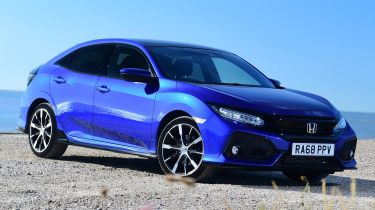
The Civic is an interesting proposition, because while it’s a long-established model that ticks all of the key boxes for many buyers, it’s not necessarily the first family car that those people think of at purchase time. In typical Honda fashion, the Civic is dependable, impressively engineered, well equipped and very easy to live with. But as a new car it’s not especially keenly priced, and the model range isn’t that extensive. Yet the Civic is good to drive, and in Type R form is something genuinely special, which is why it won our Best Hot Hatch award four times in a row (2017-2020). While the more mainstream Civics won’t excite you quite as much as the Type R, owning one should be about as drama-free as you could ever want, which is as good a reason as any for buying one.
The year 2022 marked 50 years since the original Honda Civic arrived, and there have been 11 generations of this globally popular family car. When the Mk1 model made its debut in 1972 it was revolutionary for Honda, and it sold well around the world thanks to its excellent reliability, frugal engines and generous standard equipment.
Later on the Civic got much more sporty, with the introduction of a Type R edition for the sixth-generation car in 1997. This halo model has remained a constant ever since, but the key selling points for most buyers of the standard versions are low running costs, dependability and decent value for money. Those traits are readily available elsewhere nowadays, but that doesn’t stop the Civic from still being a sound second-hand buy.
History
The Mk10 Civic arrived in the UK in April 2017, with either a 127bhp 1.0-litre three-cylinder or 179bhp 1.5-litre four-cylinder petrol engine (both turbocharged); the 315bhp Type R joined the range in July 2017 with a turbocharged 2.0-litre powerplant.
Used - available now

2021 Honda
Civic
42,389 milesAutomaticPetrol1.5L
Cash £15,299
2015 Honda
Civic
60,000 milesManualDiesel1.6L
Cash £7,500
2021 Honda
Civic
37,138 milesManualPetrol1.0L
Cash £12,267
2018 Honda
Civic
60,409 milesManualPetrol1.5L
Cash £13,658All Civics had a petrol engine until March 2018, when a 118bhp 1.6-litre diesel joined the range, initially only with a six-speed manual gearbox; a nine-speed automatic transmission was offered with the diesel from August 2018. A month later, a four-door saloon arrived; up to now all versions were five-door hatchbacks, because unlike the Mk9 there was no estate option.
A revised Civic appeared in January 2020 with LED headlights as standard, fresh alloy wheel designs, updated infotainment and extra exterior colour choices.
Which one should I buy?
The diesel engine is still easy to recommend if you cover lots of miles, but both petrol units are nice to use and muscular enough; if you’re on the motorway a lot we’d steer you towards the 1.5-litre, though. The manual gearbox is much nicer to use than the CVT , which like most such transmissions is best suited to urban driving.
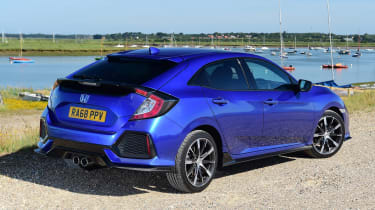
Entry-level S versions come with adaptive cruise control, steel wheels, automatic headlights and autonomous emergency braking. SE adds 16-inch alloys, climate control, front and rear parking sensors and a DAB radio, while SR trim brings 17-inch rims, dual-zone climate control, automatic wipers, sat-nav and a rear parking camera. EX gets leather trim, heated front seats, an opening glass roof and adaptive suspension, and Prestige adds heated rear seats.
Alternatives to the Honda Civic Mk10
The Civic has some very stiff competition, not least from the multi-talented Volkswagen Golf, which comes with excellent engines and transmissions, impressive build quality plus decent dynamics. The Ford Focus is another heavyweight that’s plentiful, great to drive, very practical and fine value for money as a used buy. The Ford also has a wide model range, just like the Vauxhall Astra, which is readily available and top value.
A less-obvious option is the Mazda 3, which feels like a premium car inside, with superb build quality and plenty of standard kit. The SEAT Leon offers most of the best bits of a Golf in a cheaper package, while other alternatives include the Volvo V40, Peugeot 308, Kia Ceed and Hyundai i30.
What to look for
Back seats
The Civic Mk9 featured Honda’s brilliant flip-up ‘Magic’ rear seats, but this 10th generation had to do without.
Sensors
The standard Civic Type R has no front or rear parking sensors. The GT gets these, though, plus a better infotainment system.
Towing
The most any Civic can haul is 1,400kg. CVTs can pull 800kg, but some, such as S, Sport, and Sport Plus models, aren’t homologated to tow at all.
Connectivity
Apple CarPlay comes as standard on SR trim and above; some owners have reported problems getting this to work as it should, though.
Interior
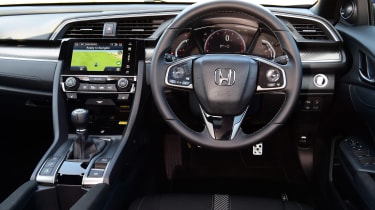
After some people found the previous Civic’s hi-tech dash confusing, Honda toned things down with the Mk10 to make it more user-friendly. The quality is generally good and the seats are comfortable, but the infotainment’s usability is beaten by rivals. The seven-inch touchscreen isn’t that well integrated and could easily be mistaken for an aftermarket unit, while the graphics are somewhat rudimentary in their appearance. Rear legroom is excellent, but headroom isn’t quite so generous. There are lots of cubbyholes and the 478/1,580-litre boot is very impressive, because the capacity is well above the class average.
Prices
Check out our Buy a Car service for used Honda Civic deals, or use our Free Car Valuation tool for prices on a specific model.
Running costs
All Civics need to be serviced every 12 months or 12,500 miles. Once a Civic turns three it’s eligible for fixed-price maintenance, with the services alternating between minor and major.
Major services include fresh brake fluid, needed every two years. All engines are chain-driven so there are no cambelts to replace, and there’s no set schedule for the coolant to be replaced. It’s checked at each service.
Recalls
Honda has issued 10 recalls for the Civic since the 10th- generation edition was introduced, but seven of those applied only to earlier models, all because of potential airbag problems. The first Civic Mk10 campaign came in July 2018, because of airbag glitches; the side airbags could fail to deploy correctly because of a manufacturing fault. Just eight cars were affected by this, all of which were built between April and July 2017.
Civics built up to March 2018 were then recalled in January 2020 because of excessive exhaust emissions due to faulty software, then in August 2020 the most recent campaign was issued. This was because some models made between January 2018 and March 2019 had been fitted with faulty fuel pumps, which could starve the engine of fuel, leading to it cutting out while the car was being driven.
Driver Power owner satisfaction
The Mk10 Civic has yet to make an appearance in our Driver Power used car surveys, but the Mk9 managed 38th place out of 75 in our 2019 poll, and 21st place the year before. The current Civic has made it into our Driver Power new car surveys however, taking 35th place in 2019, then 39th spot in 2020. Owners like the spacious boot and cabin, the car’s handling and running costs, but not the dashboard design.
Honda Civic (2015-2022) review: what we said
Extracts from our 2021 in-depth review of the Mk10 Honda Civic...
The current Honda Civic betters its practical predecessor in nearly every area. There's no hybrid powertrain option yet, but the two small-capacity turbocharged petrol engines are efficient, powerful and refined, while the diesel engine is both economical and punchy. With an all-new platform under the skin, the Civic is a much sweeter thing to drive than its predecessors, too.
The Civic isn't as well built as some of its European rivals, nor is it as economical as the fuel-sipping Peugeot 308. It's not as fun to drive as a Ford Focus, either, but it’s practical, desirable and filled with kit. All things considered, this British-built compact family car finally has what it takes to challenge the best cars in its class.
The Honda Civic is one of the longest-lived name plates that's for sale today in the new car market. The 10th generation car was introduced in 2017, and continues a line of models that stretches all the way back to 1972, when the first Civic arrived. It's fair to say that the Civic has transformed drastically in the intervening years, changing from a city car, to a supermini, to a small hatchback and into today's family hatch.
The latest car is a marked improvement on past models, which offered good boot and interior space, but not a lot else. The current Civic matches its most recent predecessors for space, but delivers it in a sharper package than before, so the Honda offers improved handling, performance and comfort.
It needs these traits to be competitive in the compact hatchback class against a number of excellent rivals. This includes the Volkswagen Golf, Vauxhall Astra and SEAT Leon - all past New Car Awards class winners - while the depth of talent in the class means the Civic has to contend with excellent cars such as the Toyota Corolla, Ford Focus, Mazda 3, Vauxhall Astra, Kia Ceed and Skoda Octavia. To round the class off, there's the Renault Megane, Peugeot 308 and Hyundai i30. All of these cars have their own talents, so trying to stand out is tough.
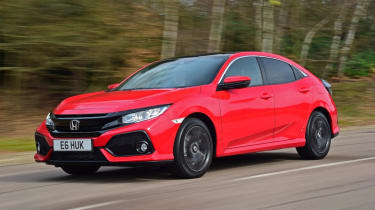
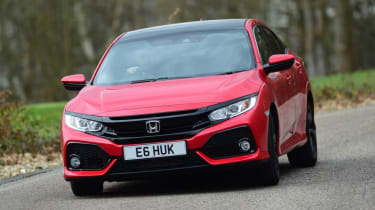
But the Civic does stand out, in the looks department at the very least. Its long, low lines mean it looks like no other compact hatchback, and the range-topping Honda Civic Type R has an aggressive look of its own. There's plenty of space for passengers in the rear, and if you need a bigger Honda, there's always the CR-V SUV.
As well as a new platform, the Civic Mk10 also saw the arrival of new downsized petrol and diesel engines, although the range is rather narrow when compared to rivals. The line-up kicks off with a 124bhp 1.0-litre turbo three-cylinder and is joined by a 180bhp 1.5-litre turbo four-cylinder. Both engines feature Honda's VTEC variable valve timing to switch between efficient and performance modes, and they're both strong performers for their size.
At the top of the range, the Type R packs 316bhp. All cars are front-wheel drive and use a six-speed manual gearbox, while a CVT auto is available as an option for the standard (non-Type R) cars.
Trim-levels include SE, SR, EX and EX Sport Line, which are only offered in combination with the 1.0-litre petrol engine, while Sport cars are matched solely with the 1.5-litre unit.
Standard kit is pretty good across the range. Entry-level SE trim comes with 16-inch alloy wheels, automatic LED headlights, front and rear parking sensors, climate control and cruise control.
SR trim and above adds navigation (although it's not the most user-friendly unit), while EX features leather upholstery and useful adaptive dampers as standard. To that, EX Sport Line adds black alloy wheels, red backlighting to the instruments and red stitching on the seats.
Engines, performance and drive
Honda has tried to deliver a more grown-up driving experience with the tenth-generation Civic, which means that refinement is improved, while the lower and wider stance delivers assured handling. More importantly, the company has dropped its tried-and-tested naturally aspirated petrol engines in favour of downsized turbos.
Under the skin is Honda’s latest global compact car architecture, which means that the Mk10 Civic is around 15kg lighter than the old car, and the structure is over 50% stiffer. It features fully independent rear suspension with struts at the front, so it’s the most sophisticated choice in the class from an engineering standpoint. Adaptive dampers are standard on EX models, and these allow the car to be optimised for comfort or more focused handling as you require.
The low driving position is comfortable and feels sporty, while the steering is well weighted and fast in its response, offering good feel. There’s lots of grip on offer and the clever torque vectoring technology helps the car hold its line through corners. The EX model with adaptive dampers is well controlled in terms of body roll thanks to the dampers’ sportier setting, and the Honda is agile as a result.
In comfort mode it’s refined and smooth, with a relatively compliant ride, although our noise tests showed the Civic was a little louder at 70mph than some rivals. The 1.0-litre turbo sits at higher revs at that speed, which contributes to that extra noise.
However, it’s a willing engine and is more characterful than the VW Golf’s four-cylinder 1.5 TSI unit, but not as fun as the 1.2 PureTech in a Peugeot 308. The Honda's manual gearshift is fantastic, though and it has a precise action that’s better than in almost any other hatchback on sale.
Engines, 0-60 acceleration and top speed
The entry-level petrol engine, a 124bhp 1.0-litre three-cylinder turbo unit, will take the car to a top speed of 129mph. However, it delivered some mixed results at the track when we tested it. Despite developing a muscular 200Nm of torque, and nearly matching the 127bhp 1.2 TCe engine in the Renault Megane, the Civic trailed the less powerful but lighter 108bhp 1.0 TSI VW Golf. It was half a second slower in the sprint from 0-60mph with a time of 10.1 seconds, while the Civic trailed the Golf in-gear, too.
On the road you have to work the Honda as hard as the Renault to keep up with the VW. The Civic’s engine is eager to rev, but there’s more vibration than in either rival, and it’s more vocal than the VW’s three-cylinder, too.
Some buyers may mourn the death of Honda’s famous naturally aspirated, high-revving VTEC engines, but in reality, the new turbocharged units are more responsive and easier to drive. There’s very little lag, and with the torque appearing lower down the rev range, you’ve less need to keep changing gear.
The more powerful 1.5 gets 180bhp, but feels heavier and not all that much faster on the road. Honda claims 0-62mph in 8.2 seconds (which falls to 8.3 seconds with the CVT), although in many situations you’d be hard-pushed to tell the 1.5 apart from the 1.0.
It's not as refined as the 1.0-litre, but it'll suit high-mileage drivers down to the ground. Not only is there a welcome lack of vibration through the steering wheel, pedals or gear lever, the engine also pulls strongly and willingly from low revs. In fact, it makes the Civic a tremendously easy car to drive. Rather than having to work your way up and down the six speeds in the gearbox, you can generally rely on nothing more than a gentle flex of the right ankle on the accelerator to keep up with traffic.
MPG, CO2 and running costs
The Civic range lacks a plug-in hybrid model, which means it can’t compete with rivals when it comes to rock-bottom running costs. That said, the two petrol engines offer low emissions and decent fuel economy, so neither should break the bank over three years or 36,000 miles.
The entry-level 1.0-litre turbo with a six-speed manual gearbox will do 47.9mpg and emit 110g/km of CO2, while the CVT auto is slightly less frugal – returning 44.8mpg, but lower emissions at 107g/km. Watch out, though, as the larger wheels on SR models and above adversely affect the official fuel economy and emissions figures.
Opt for the 1.5 VTEC with a six-speed manual transmission and you should see an average of around 46mpg with CO2 emissions of 128g/km. Opting for the CVT transmission sees economy fall to 42.8mpg with 137g/km of CO2.
Interior, design and technology
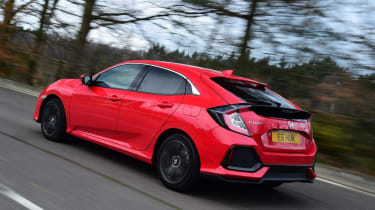
Honda has taken a relatively low-key approach to the design of the Mk10 Civic. Elements of the old model’s angular shape remain, but the newcomer has traditional hatchback proportions. However, the fussy treatment at the front and heavy-handed rear means it can’t match rivals like the Renault Megane or Mazda 3 for kerb appeal.
Trim Levels for the 1.0-litre turbo model range through SE, SR, EX and EX Sport Line. The 1.5-litre cars are available in Sport trim only.
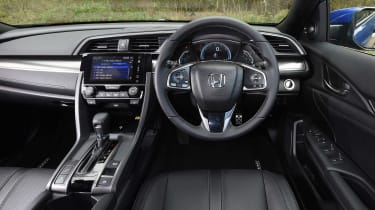
The watering down of the old car’s quirky design is most noticeable inside, where the double-deck dashboard has been ditched in favour of a more restrained and upmarket layout. The TFT dials give the cabin a hi-tech feel, while the angled centre console features the seven-inch Connect infotainment screen.
The Honda feels robustly constructed, but the plastics lower down in the cabin look and feel cheap, while the digital dials for engine temperature and fuel level are hard to read.
SE trim includes alloys and climate control, while a black grille, chrome trim for the windows and 16-inch wheels are also thrown in to decorate the exterior. SR versions add a leather steering wheel and gear knob, auto wipers and sat-nav, with privacy glass and bigger 17-inch wheels also included. EX spec features leather, a glass roof and an auto-dimming rear-view mirror.
Sport models with the 1.5-litre engine get some racy details like the central exhausts and a more aggressive bodykit, as well as LED headlights and a black grille. Sport is largely comparable with the smaller engine’s SR spec but adds some exterior styling embellishments, a central dual exhaust pipe, wireless phone charging and a more powerful stereo.
Sat-nav, stereo and infotainment
Honda's Connect infotainment system first appeared on the previous-generation Civic, so it’s already starting to look a little dated. It has an aftermarket look, and its seven-inch screen is relatively small. Plus, its graphics look a little blocky.
The set-up is standard on SR models and above (SE variants getting more conventional radio units) and features sat-nav, DAB, Bluetooth, Apple CarPlay and Android Auto.
It’s a match for rival set-ups in terms of features, but the overall package is lacking. It doesn't look particularly well integrated - appearing like an aftermarket unit. It’s the least responsive screen, and often your touch won’t register. Plus, the menus are confusing and very difficult to use, especially on the move. Parts of the air-conditioning system are only controlled via the screen, too, which can be frustrating.
The integrated sat-nav is easy enough to use, but it’s not as intuitive as the Golf’s. The smartphone link works well, though, so we found it easy to use our device.
Practicality, comfort and boot space
The latest Civic is crammed full of practical touches, while a big boot and wide opening make it enormously practical day-to-day. All hatchback models come with five seats, including ISOFIX points in the back.
As you’d expect for a family car, the Honda gets a decent amount of storage. There’s not quite as many cubbies as in the Golf, but there’s a large glovebox and decent door bins. The centre console has room for phones and trinkets – although opening the armrest is tricky on the move, because the catch is too far back. There are, however, useful cable clips ahead of the gearlever that give you somewhere to tidy your wires when charging your phone.
Leg room, head room & passenger space
Space inside the Honda Civic is good. There’s loads of knee room in the back, and while taller adults may struggle slightly for head room, getting comfortable shouldn’t be a problem for most.
Honda has done away with the previous-generation car’s innovative Magic Seats, allowing engineers to move the fuel tank from its unusual position under the front seats and lower the front seat hip point. This means both the driver and front seat passenger sit lower than before – offering a sportier and more engaging driving position. There’s loads of adjustment in the steering wheel, too.
Boot
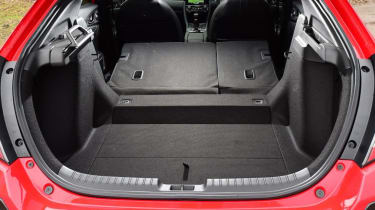
The Honda Civic’s 478 litres of carrying capacity is 44 litres up on the Renault Megane and 97 litres bigger than a VW Golf’s, and there’s plenty of underfloor storage. However, an awkward step in the boot floor means you don’t get a flat load area with the rear bench folded, while the parcel shelf is just a fabric retractable curtain that pulls across the load area from left to right; it feels flimsy and is awkward to use.
The sloping tailgate will pose more of a problem than outright space, however. Where a VW Golf gets a more upright rear end, the Civic’s sporty design might prove troublesome when it comes to loading big, square boxes.
Reliability and safety
The Honda Civic finished in 50th place (out of 75 cars) in our 2022 Driver Power customer satisfaction survey, although its CR-V sibling was rated more positively, securing seventh spot.
As a manufacturer, Honda’s overall finishing position is consistently in the top half of the leaderboard, and ahead of makers such as Audi, Ford and Mercedes. Customers haven't changed their minds over the past year, as Honda placed a creditable fifth place in the best brands poll.
Honda's SENSING safety systems are standard across the range, meaning all cars get lane departure warning, automatic emergency braking, adaptive cruise control and rear cross-traffic assist. The Civic was originally awarded just four stars in its Euro NCAP crash assessment, largely because of poor child occupant protection.
Following factory modifications to the side curtain airbag, the car was retested and it performed much better, receiving the full five-star rating. There were scores of 92, 67 and 75 per cent recorded in the adult, child and pedestrian safety categories respectively, while safety-assist tech protection scored an impressive 88 per cent.
Did you know you can sell your car with Auto Express? Get the highest bid from our network of over 5,500 dealers and we'll do the rest. Click here to try Auto Express Sell My Car now...