Used Peugeot 308 (Mk2, 2013-2021) review and buyer's guide
A full used buyer’s guide on the Peugeot 308 covering the 308 Mk2 (2014-2021)

Verdict
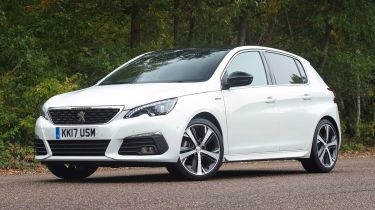
Whereas some of the 308’s predecessors suffered from poor reliability, the current family hatchback is proving far more dependable. With keen prices on the used market and ready availability thanks to six years of healthy sales, plus a wide model range, there’s no reason to avoid putting the latest 308 on your shortlist if you’re looking for a small family hatch or estate. Even more reassuring is the fact that the second-generation 308 was the 2014 European Car of the Year. That in itself is impressive, but when you bear in mind that the Peugeot beat the BMW i3, Mercedes S-Class, Skoda Octavia and Tesla Model S, it’s even more remarkable. Today, the 308 is still a solid option with plenty to go round, don’t pay over the odds for one.
Peugeot is one of the world’s oldest car brands; in the 130 years it’s been making vehicles it’s produced no shortage of family favourites. Many of its most appealing models have been hatches – not least its brilliant 205, which many reckon was one of the automotive high spots of the eighties.
Trying to come up with sequels to such a talented all-rounder was never going to be easy and Peugeot hasn’t always managed to recreate the magic that was present in its eighties’ cars. However, the second-generation 308 hatchback had plenty to offer, thanks to its stylish design, composed ride, engaging driving experience and high-quality interior.
Used - available now


Models covered
- Peugeot 308 Mk2 (2014-2021) - Family five-door is well worth considering if you’re in the market for a used hatchback.
History
The 308 Mk2 five-door hatch reached UK showrooms in January 2014, priced from £14,495. A 1.2-litre petrol engine came in 82bhp VTi non-turbo and 110bhp or 130bhp e-THP turbo forms. There was also a 1.6 THP petrol in 125bhp or 156bhp guises, plus 1.6 HDi (92bhp/115bhp/120bhp) and 2.0 BlueHDi (150bhp) diesel powerplants.
Only the 1.2 e-THP 130 and 2.0 BlueHDi 150 engines were offered with a (six-speed) automatic transmission. The 308 SW estate arrived in June 2014, then the sporty 308 GT hatch and estate joined the range in January 2015 in 1.6 THP 205 and 2.0 BlueHDi 180 forms – a year before the 1.6-litre 308 GTi arrived in 246bhp and 266bhp guises, the latter getting a limited-slip differential. A refresh in September 2017 brought better connectivity and safety features.
Which one should I buy?
We’d avoid the basic 82bhp petrol engine because it lacks power and it only comes in entry-level Access trim, while the EAT6 six-speed automatic transmission is nothing like as nice as the manual alternative.
That means any manual-gearbox turbo 308 is the way to go. The entry-level 308 Access is fitted with air-conditioning, electric front windows, remote central locking, DAB radio and cruise control.
The Active adds 16-inch alloy wheels, dual-zone climate control, automatic headlights and wipers, a 9.7-inch touchscreen display, rear parking sensors and navigation. Meanwhile, the Allure brings 17-inch alloys, LED headlights, electrically folding door mirrors, front parking sensors and reversing camera, while the Feline adds a panoramic glass roof, 18-inch wheels, privacy glass, Alcantara sports seats, keyless go, adaptive cruise control and auto emergency braking.
Alternatives to the Peugeot 308
The Ford Focus is readily available, features a wide model range, is great to drive and is also top value; you can take your pick from hatchbacks or estates. The Vauxhall Astra shares all of the Ford’s attributes, and although it’s not as engaging to drive, its dynamics are still fairly accomplished.
The Kia Cee’d and its cousin, the Hyundai i30, are desirable for their excellent value and reliability, while the SEAT Leon is a superb all-rounder thanks to its excellent practicality and usability, a great choice of petrol and diesel engines, and a design that still looks good seven years after its introduction. Closely related to the Leon is the Volkswagen Golf, which is even more desirable than the SEAT, while the Toyota Auris, Mazda 3, Audi A3, Honda Civic and Volvo V40 are also worth a look.
What to look for
Parking brake
All 308s have an electronic parking brake – apart from Access editions, which come with a conventional item.
Gearbox
Every 308 was fitted with a six-speed transmission, apart from the five-speed 1.2 VTi 82, 1.2 e-THP 110 and 1.6 HDi 92 models.
Rear axle
Cars built up to the end of 2015 could suffer from a damaged rear axle – given away by a metallic knocking sound.
Engine
Early cambelts could degrade (they run in oil), but from the end of 2015 onwards Peugeot started fitting a stronger part to resolve this issue.
Interior
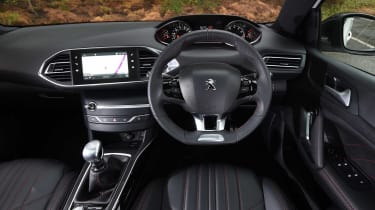
You'll either love or loathe the 308’s interior, with its minimalist dash design and a small, low-set steering wheel that sits below the instrumentation. The cabin quality is generally impressive, with most things well advanced over Peugeots of old. The huge 470-litre boot can hold around 100 litres more than the class average; this swells to 1,309 litres with the back seats folded. But that big boot comes at the expense of rear legroom, which is beaten by rivals.
Running costs
All 308s need some maintenance every 12 months, but whereas diesel-engined cars have a 20,000-mile limit between services, petrol examples have a cap of 16,000 miles. From the third service onwards, the schedule alternates between minor and major.
All engines have a cambelt apart from the 1.6 petrol, and it needs changing every 10 years. There’s a 120k-mile limit for the 1.5 and 2.0 diesels; for 1.2-litre petrol and 1.6 diesels it’s 112k.
Recalls
The Peugeot 308 has been recalled a total of 23 times since the first campaign was launched way back in February 2014 – only a month after the model went on sale. That initial recall was because of fuel leaks, which in the worst case scenario could lead to a fire, while the most recent campaign was launched in July 2020 because of corrosion in the front subframe.
In those intervening six years Peugeot issued recalls because of faulty door latches, turbocharger oil leaks, the rear window detaching – although this was only on 308 SW models – problematic starter motors and overheating engines. Furthermore, airbag glitches, engine-oil leaks, faulty diesel-particulate filters and incorrect software leading to excessive exhaust emissions were also reasons for recalls being issued.
Driver Power owner satisfaction
The fact the Peugeot 308 finished 63rd out of 75 entries in our Driver Power 2020 new car survey is a decent enough result given it was up against far newer models. It also came 56th out of 100 in the 2019 used car poll, with owners liking its safety and child-friendly features, cabin design and low servicing costs. However, they weren’t so keen on the lack of cubbyhole space and rear legroom, or the switch layout.
Peugeot 308 (2013-2021) review: What we said
Extracts from our 2018 in-depth review of the Mk2 Peugeot 308...
The latest Peugeot 308 is a far cry from the mediocre mid-size models the brand was making a decade ago. It's a classy and capable family hatch, with handsome styling and a well-finished interior. Updates for 2017 brought in fresh looks and safety tech, as well as a new diesel engine and auto gearbox.
Allure offers plenty of equipment for a relatively reasonable outlay. However, some rivals still offer better value, while so-so residuals and a clunky infotainment system count against it. Taller people may find the driving position difficult to get along with, too.
The 308 is relaxing and feels agile to drive, whie its pleasant ride quality and fluid handling inspire confidence. Nearly every engine is excellent, too, with the latest Peugeot PureTech petrol turbos being right on the pace of the BlueHDi diesels. For the first time, a petrol engine may be the better choice for many private buyers.
Passenger space isn’t as good as some rivals in the rear, as Peugeot has given the 308 a bigger boot than most of its rivals. Equipment is generous, and as of 2017 even the base model features sat-nav. Top models boast standard kit normally associated with premium cars, such as massage seats.
Overall, the Peugeot 308 is a top-notch family hatchback that should certainly be on your shortlist, alongside class favourites such as the Vauxhall Astra and Volkswagen Golf. Just make sure that the rear seats are big enough for you and that you can get on with the driving position before you sign on the dotted line.
The Peugeot 308 is one of the front-runners currently for sale in the compact hatchback class. Whichever model you choose, the 308 feels like an upmarket choice, thanks to its classy interior and handsome exterior looks. Body styles comprise a five-door hatchback and an estate called the 308 SW, while the flagship 308 GTi is a strong contender in the hot hatchback class.
If you want the looks of a GTi but not the running costs, Peugeot offers GT Line trim with smaller engines, while the 308 GT slots between the two with the option of petrol or diesel power. The rest of the range is made up by Allure and Active trims, while the Tech Edition is a special model with extra kit fitted as standard.
Rivals for the 308 are the usual suspects in the compact hatchback class. Chief among them are the Volkswagen Golf and Ford Focus, while the Renault Megane is an alternative French choice. Sister firm Citroen doesn't have a direct rival to the 308, although the C4 Cactus has been repositioned as a hatchback while the new C4 is developed. Elsewhere, the Hyundai i30 and Kia Ceed have both been updated recently, while the Honda Civic, Mazda 3, SEAT Leon, Skoda Octavia and Vauxhall Astra all have their merits, including practicality, low running costs, sporty handling and space.
The Peugeot 308 uses the PSA Group's EMP2 platform, which can also be found under the 3008 and 5008 SUVs, as well as the Citroen C4 SpaceTourer people carrier. This platform focuses on saving weight, and as a result the 308 handles far better than its predecessor, but is also more efficient without compromising performance. A major contributing factor to the 308's abilities is Peugeot's range of efficient yet punchy PureTech petrol and BlueHDi diesel engines.
The entry-level 1.2 PureTech 82 three-cylinder was dropped with the 308's 2017 facelift, and now there are just 110 and 130 versions of this engine offered with 108bhp and 128bhp respectively. Both cars get a six-speed manual gearbox as standard, while Peugeot's EAT8 eight-speed auto is an option on the more powerful petrol. Peugeot also offers a 1.6 PureTech 225 in the 308 GT, which has 222bhp, while the 308 GTi has a 1.6 PureTech 260 turbo petrol with 256bhp.
1.6 BlueHDi diesels were available at launch, but now the 308 uses Peugeot's latest 1.5 BlueHDi unit. There's a BlueHDi 100 offered in Active spec with 99bhp, while the rest of the range gets a BlueHDi 130 with 128bhp. The most powerful diesel is the older 2.0 BlueHDi 180 GT, which has 178bhp. The 1.5 comes with a six-speed manual gearbox, with an eight-speed EAT8 offered as an option on the 130 version. This gearbox is standard with the 2.0-litre diesel. All versions of the 308 are front-wheel drive, with no option for four-wheel drive, or even the Grip Control system that's available on the platform-sharing 3008 and 5008 SUVs.
One issue you might have with the 308 is its driving position. It was the third car, after the 208 and 2008, to get Peugeot's i-Cockpit layout, which features high-set dials and a small steering wheel designed to help you see them over the rim. While the driving position is better than you'll find in a 208, you still need to move the steering wheel down to your lap to see the dials properly, and not everybody will be able to get on with this low-armed driving position - combined with the small wheel some people might find it feels like you're driving a toy car.
Boot space in the 308 is good, and a capacity of 470 litres is among the best in the class. However, Peugeot has sacrificed rear passenger space to create the big boot, and rear legroom isn't the best - worth noting if you're planning on carrying passengers regularly.
If you want more carrying space, the 3008 SUV is larger, while the 308 SW is the estate version of the 308 hatch, and even bigger still. Biggest of all is the seven-seat 5008, which uses a similar platform to the 308.
The 308 is the latest in a long line of Peugeot hatchbacks, although not all have been class leaders. The previous generation 308 was a disappointment, which made the arrival of the new one a revelation in comparison, and one reason why it was awarded the 2014 European Car Of The Year title.
Before that was the ungainly 307, the elegant 306 and Peugeot's first compact hatchback, the 309, which itself replaced the Talbot Horizon within the PSA Group in the mid-eighties. There have been convertible versions of the hatch over the years, but the previous generation 308 CC has not been replaced.
Engines, performance and drive
The latest 308 has a strong balance of ride and handling. As indicated by the classy looks and interior, the focus of the mainstream models is on good long-distance cruising comfort: low noise levels, a supple ride and good stability make the Peugeot a fuss-free choice in everyday use. There are no changes to this for the 2017 update. The 308 is based on Peugeot’s versatile EMP2 platform, which also underpins the 3008 and 5008 SUVs. It uses the same MacPherson strut front and torsion beam rear suspension layout as a result.
It’s not soft or soggy, though. The car is much sharper to drive than older 308s, with decent turn-in and fair agility in corners. Over-assisted, artificial-feeling steering does cloak some of this, but it’s still an enjoyable car that doesn’t roll or wallow over twisting roads. It can get caught out by mid-corner bumps, however, particularly on cars with the largest wheel size.
In mid-spec Allure trim, the 308 serves up assured and agile handling. The quick steering and small wheel deliver sharp turn-in, while once settled into a corner, the Peugeot provides strong grip and good body control. It’s not as engaging as an Astra or as comfortable as a Renault Megane, but it offers a decent ride and handling balance. However, while the 308’s suspension does a decent job of soaking up bumps, there’s more wind and road noise than you’ll find in newer rivals.
GT models are firmer (their suspension is up to 10mm lower than on the equivalent GT Line version), but they remain comfortable, and the GT’s larger 18-inch alloys can give a more uncomfortable ride than models on smaller rims. The extra grip of this version is welcome though, and it’s a convincing warm hatch.
Stepping things up again is the 308 GTi, with a very focused chassis that proves Peugeot still knows what it takes to make a great hot hatch.
Engines
Historically, diesel engines have been quite popular in the 308, and despite favour swinging towards petrol, Peugeot isn't ready to ditch the black stuff entirely. To reflect this, a cleaner 1.5-litre diesel engine arrived in 2017, and it has now completely replaced the older 1.6 BlueHDi in the range.
The 1.5 feels largely similar to the outgoing 1.6. There's a 99bhp version, which should be better than the old 99bhp 1.6 just for the fact it comes with a more flexible six-speed gearbox as standard. The 128bhp version is slightly more powerful than most potent outgoing 1.6, although the performance difference is unlikely to be noticeable. It's slightly more refined, though. The main advantage is that it uses Selective Catalytic Reduction (SCR) to reduce harmful local emissions.
The 2.0-litre engine, was offered with 148bhp for a while, but now it just comes in 178bhp BlueHDi 180 guise. It's a little less refined than the newer 1.5, but its stronger performance makes this easy to forgive. It's only available with the EAT8 auto box, while 0-62mph takes 8.2 seconds.
The petrol engine choices are Peugeot's 1.2 PureTech turbo three-cylinder and 1.6 PureTech four cylinder. The 1.2-litre was previously available in non-turbo 81bhp guise, but this was dropped in 2017. The range now kicks off with a 108bhp turbo PureTech 110, which manages 0-62mph in 11.1 seconds, has a top speed of 117mph and offers 205Nm of torque delivered from just 1,500rpm. The 1.2-litre engine is virtually inaudible at idle and remains muted when extended, but there is a distant offbeat growl as the rev counter hits the red line.
The PureTech 130 lifts things further, with 0-62mph taking 9.6 seconds, a top speed of 129mph and torque swelling to 230Nm. It also has a six-speed manual gearbox as standard, or the optional EAT8 eight-speed auto. All PureTech engines have a pleasant throbbing engine note and the torque of the turbo makes them easy to drive and impressively refined. They’re very grown-up, appealing engines.
The sporty-feeling 1.6-litre PureTech comes with 222bhp or 256bhp in the GTi, delivered at an identical 6,000rpm. Even the PureTech 205 does 0-62mph in 7.4 seconds – a significant performance step up over other 308 engines. The GTi manages it in just 6.0 seconds, with both hitting a 155mph top speed. A healthy torque output of between 285Nm and 330Nm from less than 2,000rpm proves that this motor is as flexible as it is powerful – again, it’s ultra-smooth and appealing to use, too.
Curiously, the 1.6-litre PureTech can't be had with the EAT8 automatic gearbox: all versions are hooked up to a six-speed manual. We think the auto box would suit it well.
MPG, CO2 and Running Costs
Excellent fuel economy and low emissions make the Peugeot 308 one of the stars of the family hatchback market. No engine has emissions greater than 150g/km, and the diesel versions stand out most. The 1.5 BlueHDi 130 carries on where the older 1.6-litre diesels left off in terms of efficiency.
The BlueHDi 100 has emissions of 98g/km and claimed economy of 76.3mpg under the latest WLTP test regime, but it's not the most efficient engine available. That accolade goes to the more powerful BlueHDi 130 engine, which in Active trim with smaller wheels manages 80.7mpg and 93g/km of CO2. Adding the EAT8 auto doesn't harm the figures too badly, either, with claimed economy of 78.5mpg and 94g/km emissions. These figures aren't as good as the older 1.6 BlueHDi models could manage, but that's because they are tested under different conditions, and real-world MPG will be similar to before.
The 2.0-litre BlueHDi 180 with auto box has claimed economy of 64.2mpg, plus emissions of 116g/km, which is still pretty healthy for a powerful diesel.
The petrol engines are pretty impressive, too. The PureTech 110 manages up to 57.6mpg, while emissions are as low as 113g/km. Go for the 130 version, and 56.5mpg is achievable, and emissions rise only slightly to 116g/km.
Even the higher-performance 1.6 PureTech delivers strong efficiency. The PureTech 225 has a claimed average of 49.6mpg and emits a fleet-friendly 132g/km of CO2, while the 308 GTi claims a highly un-hot hatch-like 43.5mpg and 148g/km emissions.
Interior, design and technology
Viewed alongside some of its rivals, the 308’s smart yet subtle styling appears a little low key. But Peugeot’s designers have paid particular attention to the details, with some neat touches dotted all around the car giving it an upmarket air.
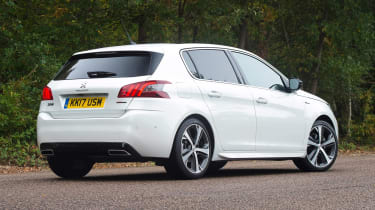
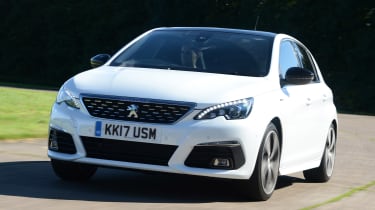
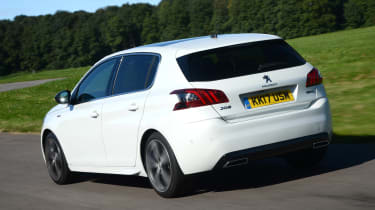
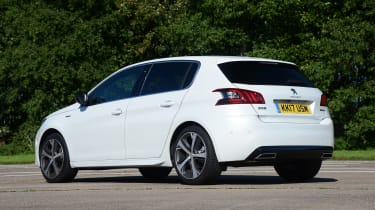
Gently flared side skirts and the ‘lion’s claw’ tail-lamps that reference the brand’s badge all sharpen up the standard 308’s flowing front end and squared-off tail. The classy look is reinforced on Allure models and above with eye-catching 17-inch alloys.
For 2017, Peugeot revised the front-end shape with a new, more prominent central grille, reprofiled headlights and tweaked bumpers. It's all designed to bring the 308 into line with the carmaker's SUV range, but doesn't alter the look dramatically.
From the outside, the 308 seems restrained rather than racy, and that theme continues inside, where the focus is on build quality and comfort. Peugeot has given the 308 a high-quality interior that’s modern and stylish in design. It’s more modern and contemporary than the slightly traditional layout of a Volkswagen Golf, while the premium materials, fit and finish seem right up there with the German hatchback. It’s a good achievement by Peugeot - although almost nothing has changed for 2017.
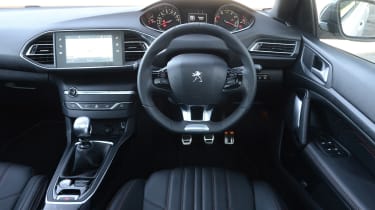
The dashboard has a couple of real highlights. The 9.7-inch touchscreen controls the navigation, radio and air-con, so there are very few buttons on the car’s centre console, giving the interior a sleek look. The instruments are novel, too, with the rev counter operating in a ‘reverse’ direction to the speedo. This is odd at first, but it’s a cool touch once you’re familiar with it.
It's part of Peugeot’s unusual i-Cockpit design. Along with the central touchscreen, i-Cockpit includes a smaller-diameter steering wheel and high-set dials that, Peugeot says, mean you don’t have to take your eyes off the road for too long. Trouble is, the low steering wheel and high seating position feel strange when you initially climb aboard.
In the centre of the soft-touch dash are some beautiful details, such as the sleek centre console surround and fancy air vents – but there are very few buttons. Everything, including the heater and stereo controls, has been centralised in the high-resolution touchscreen in the middle.
Once again, it’s something you have to ‘learn’: pressing two or three buttons just to change the heater temperature is fiddly at first. The system does work smoothly enough, though, and is nicely presented. It gives the 308 a hi-tech feel.
All versions of the 308 are well equipped. The (now defunct) Access featured DAB, USB and Bluetooth connectivity, air-con, cruise control and LED daytime running lights. Active is now the entry-level model and ups the equipment count with climate control, rear parking sensors, automatic headlights and wipers, plus 16-inch alloy wheels and sat-nav. Allure adds full LED headlights, front parking sensors, power-fold door mirrors, a space-saving electric parking brake and 17-inch alloys.
The sporty-looking GT Line includes visual extras, such as 18-inch alloys, dark-tint windows, twin exhaust trim and aluminium detailing inside. The GT goes further: it’s lowered, and the front foglights are replaced by cooling air intakes.
Plus, inside there’s a Driver Sport Pack – press its sport button and the steering is heavier, the throttle sharper and the dials turn from white to red. It also has a Driver Assistance Pack with autonomous emergency braking and radar cruise control. As for GTi models, they include all the high-performance extras you’d expect of a modern hot hatch.
Sat-nav, stereo and infotainment
A key selling point of the 308 is the fact that sat-nav is now standard on every model in the range. Peugeot even includes five years’ mapping updates with the 9.7-inch touchscreen system.
For 2017, the sat-nav graphics have been updated for a clearer look, while Android Auto and Apple CarPlay smartphone connectivity now features. The screen is no easier to use, however, feeling unresponsive and tricky to navigate.
While the touchscreen is neatly integrated, some owners are put off by the set-up’s complexity. This was reflected in the Auto Express Driver Power 2016 satisfaction survey, where the 308's lowest ranking was for in-car technology (98th out of 150 cars) – perhaps a bit disappointing for Peugeot, given the car’s reliance on the touchscreen system for so many of its major functions.
The interface isn’t snappy enough to make changing the air-conditioning settings easy, so you end up fighting with the system to do a simple task such as increasing the fan speed. The screen isn’t the most responsive, either, and is put to shame by the more intuitive, faster-to-respond unit in a VW Golf, for example.
Practicality, comfort and boot space
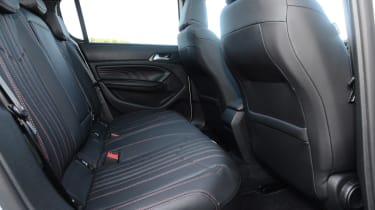
The latest 308 is more practical than earlier models. The new platform gives a better driving position and more flexibility, although the back seats could still be roomier. Peugeot seems to have traded rear passenger space for boot capacity: if you want a better all-rounder for passengers and luggage, try the Peugeot 308 SW estate, which has a longer wheelbase.
Owners were a bit lukewarm on the 308’s seat comfort when responding to the Auto Express Driver Power 2016 satisfaction survey. They told us it’s merely adequate, ranking the car 93rd out of 150. Still, the seats themselves are nicely finished, while low engine noise ensures impressive refinement on the move, adding to the classy, premium feel inside the car.
Size
It doesn’t look it, but the Peugeot 308 is a little bit shorter and narrower than the class norm. It’s 105mm shorter and 19mm narrower than a Ford Focus, and is a touch lower as well. This perhaps explains why interior space isn’t quite as good as it could be, particularly in the rear. Compared to the 4,465mm long Mazda 3, the 308 looks a bit short, at 4,253mm. It’s significant that the 308 SW estate has around 110mm added to the length of its wheelbase.
The 308 is a light car, though, with the 1.5 BlueHDi 130 Active model weighing in at just 1,204kg. A few years ago, this is the kind of figure we would have associated with a supermini, and shows the lightweight efficiencies of the new PSA Peugeot-Citroen EMP2 platform that the 308 uses.
The styling does make it hard to take full advantage of the car’s slightly more compact size, though: the back window is narrow and the C-pillars thick, and both compromise rear visibility.
Leg room, head room & passenger space
The Peugeot is rather disappointing for passengers in the rear, as a result of its short length and focus on maximising boot space. The rear doors are big enough, but there could be more space between the front and rear seats; climbing aboard can be a bit tricky. Foot space isn’t great, either, and the low-set rear bench only adds to the tight feel inside.
Getting out can be a struggle, too, particularly if you have bigger feet, and this is one of the few family cars in which adults in the rear may be asking those in the front to slide their seats forward. At least headroom isn’t bad – unless you choose the panoramic roof, that is. That's worth noting if you’re looking at Active models and above, as it’s a temptingly priced £500 option.
Boot
On paper, the 308 has a very spacious boot, offering 470 litres with the seats up and 1,185 litres once they’re folded. But this is a little misleading, as the shape of the boot doesn’t quite allow owners to make full use of the space. This isn’t the estate-rivalling luggage bay the figures suggest.
The 308 does offer extra hidden space below the load area, which is handy, but it’s a pity this versatility hasn’t been extended to the interior. The glovebox is tiny and the armrest cubbyhole, normally a useful stowage space, is also cramped.
Did you know you can sell your car with Auto Express? Get the highest bid from our network of over 5,500 dealers and we'll do the rest. Click here to try Auto Express Sell My Car now...