Hyundai Inster review
The Hyundai Inster may be small and quirky, but it’s also versatile, efficient, and lovable

Our opinion on the Hyundai Inster
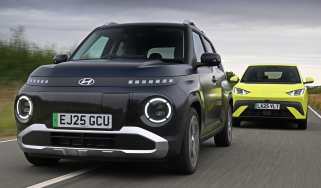
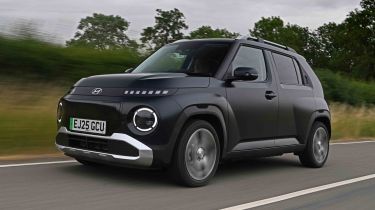
The Hyundai Inster is a very charming and lovable small car that’s so spacious it feels almost like a Tardis on wheels – the cartoonish proportions and boxy shape help achieve that, and turn heads in the process. Meanwhile, the effortlessly efficient powertrain highlights Hyundai’s expertise in the field of electric cars once again. However, the plastic-heavy interior is a letdown, and based on our time behind the wheel, we feel the similarly priced Renault 5 is a more refined and sophisticated car.
About the Hyundai Inster
The Inster is Hyundai’s foray into the growing world of quirky electric superminis, and it also happens to be the cheapest EV to come from the brand to date.
Ordering an Inster should be a straightforward process, because there are only three trim levels to choose from – 01, 02 and the 4x4-inspired Hyundai Inster Cross – and two battery sizes. The most basic model gets a 42kWh ‘Standard Range’ unit, while the rest feature a 49kWh ‘Long Range’ pack. However, it’s worth noting that the Inster is strictly a four-seater, like the Dacia Spring.
We've tried both the 42- and 49kWh versions of the Hyundai Inster, and pitched the mid-range Inster 02 against the BYD Dolphin Surf, a key rival in the small electric car class.
Performance & driving experience
Pros |
|
Cons |
|
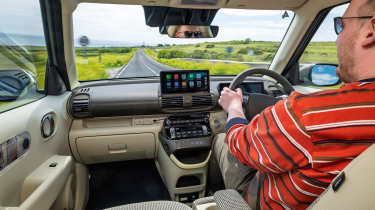
The Inster benefits from not only Hyundai’s expertise when it comes to producing excellent electric cars, but also the simple fact that this is a very narrow car. Much narrower than its French foes, in fact. Its slim figure makes you feel like you can thread the Inster through any gap in traffic or sneaky side road you fancy. Its decent motorway manners mean you needn’t feel confined to city driving.
| Model | Power | 0-62mph | Top speed |
| Inster 42kWh 01 | 96bhp | 11.7 seconds | 87mph |
| Inster 49kWh 02 | 113bhp | 10.6 seconds | 93mph |
| Inster Cross | 116bhp | 10.6 seconds | 93mph |
Electric motors, 0-60mph acceleration and top speed
Buyers can select one of two powertrains. The entry-level model is only available in the base 01 trim, which drives the front wheels with a single 96bhp motor – enough for a 0-62mph time of 11.7 seconds and an 87mph top speed. Sitting above that is a 113bhp option – available with all three Inster trim levels – which cuts the 0-62mph time by 1.1 seconds and adds 6mph to the top speed. Both versions have the same peak torque of 147Nm.
Used - available now

2026 Hyundai
Inster
4,772 milesAutomaticElectric
Cash £18,495
2027 Hyundai
Inster
2,214 milesAutomaticElectric
Cash £21,874
2026 Hyundai
Inster
3,849 milesAutomaticElectric
Cash £18,495
2026 Hyundai
Inster
AutomaticElectric
Cash £22,295We’ve driven both versions, and the performance provided in either Inster model is perfectly adequate for a car in this class; indeed, it’s far faster and more responsive than similarly sized petrol-powered city cars and superminis – Hyundai’s own i20 included. Predictably, the Inster does its best work at low speeds, where the instant torque from the electric motor in either version lets the Inster leap forward with plenty of enthusiasm, yet the power always remains easy to modulate. The only difference between the two is that outside the city limits, you'll need to push the accelerator in the least potent 01 version that little bit harder than its more muscular sibling, but it's still perfectly capable of handling the odd cross-country trip or motorway jaunt.
Town driving, visibility and parking
The upright windscreen and huge side windows, combined with the stubby front end and flat bonnet, mean the view of the road ahead is excellent. Rear visibility is good too, but the thick C-pillars create a sizable blind spot when looking over your shoulder. Hyundai’s solution is exterior cameras that show what's in that blind spot when you indicate. We think it's a terrific feature, but for some bizarre reason, it's only found on the range-topping Inster Cross.
Hyundai’s EVs use steering wheel-mounted paddles to alter the strength of the motor regeneration – a feature that we really like. Several settings between full freewheeling and one-pedal driving can be easily selected on the go – there’s no need to dip into a fiddly touchscreen sub-menu, as is the case with some of its rivals. However, when coming to a stop with motor regen, the transition between this deceleration and the car’s low-speed creep can be rather jerky.
The turning circle is 10.6 metres, which is decent and the same as the Citroen e-C3. But we’d expect it to be tighter, especially considering that the Skoda Elroq – a much larger family SUV – has a 9.3-metre turning circle.
The low-speed ride in the Inster is nice and soft, but hitting a pothole can send jolts through the cabin. This is partly due to the dinky wheelbase, but also, we suspect, partly due to the relatively unsophisticated torsion beam suspension at the rear.
Country road driving and handling
While the 113bhp motor doesn’t deliver the rapid acceleration that some drivers have come to expect from electric cars, it’s sufficient to make the Inster feel lively enough to keep pace on an open road. The handling is safe rather than exciting, with roll kept well in check, despite the tall body. Grip is reasonable, but when it runs out, the front end tends to gently lose traction.
Motorway driving and long-distance comfort
At high speeds, the Inster’s refinement starts to be shown up by rivals such as the Renault 5. The main issue is road noise, with tyre roar not as well suppressed inside the cabin as in some of its competitors, wind noise around the roof rails and door mirrors also makes its presence felt, too.
It’s worth noting that the Inster’s refinement still compares well with traditional petrol city cars like the Kia Picanto, because the lack of an engine buzzing away in the background makes long trips less tiring here.
Range, charging & running costs
Pros |
|
Cons |
|
Although the Inster’s battery sizes are called ‘Standard Range’ and ‘Long Range’, there isn’t a vast difference between them. Hyundai says the 42kWh battery used by the most basic model will provide up to 203 miles of range, while the 49kWh unit is good for 229 miles on a single charge.
Key rivals like the Renault 5 and MINI Cooper Electric offer more range on paper, but the Hyundai makes up for that by being very efficient on the road. We weren’t trying to maximise range when we put the Inster through its paces, mostly on winding country roads and dual-carriageways with the air-con on max, yet the car still achieved 3.9 mi/kWh during our range test – better than we’ve been seeing from the Renault 5 on our test fleet. Based on that average, the Inster could offer a real-world range of 191 miles from the 49kWh battery. Spend a little less time with the pedal to the metal, and we can guarantee that the efficiency figure will climb even higher.
Despite being driven on faster country roads outside the car's inner-city comfort zone, we saw a figure of 4.1 mi/kWh from the smaller-capacity 42kWh version, or 172 miles in total.
Most people buying a car like this won’t be too worried about lightning-fast charging speeds, which is good because the maximum charging speed is 85kW, or 73kW in the smaller-battery model. That fails to match the 100kW or so rivals can hit, but it still only takes around half an hour to go from 10-80 per cent on a suitably speedy rapid charger for both battery sizes. Those charging at home with a conventional 7.4kW home wallbox charger will find it takes just over six hours to fully recharge the Standard Range Inster, while the Long Range version takes around 7.5 hours.
| Model | Battery size | Range | Insurance group |
| Inster Standard Range | 42kWh | 203 miles | 21 |
| Inster Long Range | 49kWh | 229 miles | 23-24 |
| Inster Cross | 49kWh | 223 miles | 23 |
Insurance groups
Insurance groups start at 21 for the smaller-battery Inster, while the larger-battery cars in 01 and 02 trims sit in group 23. The Inster Cross also sits in group 23. This means the Renault 5 will be a bit cheaper in terms of insurance cover because it sits in groups 18 to 22. However, the electric Fiat Grande Panda is a little bit pricier in groups 23 and 24.
Tax
Inster owners will pay the standard rate of VED road tax annually, but the £50,000 electric luxury car tax threshold won’t be a concern thanks to this car’s affordable pricing. It’s important to be aware, though, that EVs are in line for a eVED pay-per-mile fee that’s set to arrive in April 2028.
As with all electric cars, business buyers will benefit from the very lowest rates of company car tax.
Depreciation
Our market data shows that residual values aren’t an Inster strong point. Figures of between 40 and 42 per cent after three years or 36,000 miles mean that its depreciation is steeper than the petrol-powered Kia Picanto, which maintains closer to 51 per cent of its starting price. Even fellow EV rivals like the Renault 5 do better, maintaining between 46 and 58 per cent of its original value over the same period.
Interior, design & technology
Pros |
|
Cons |
|
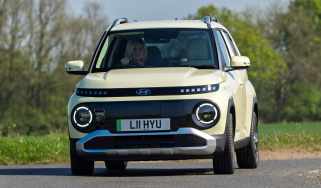
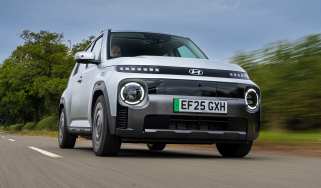
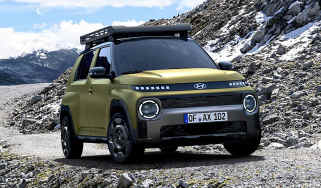
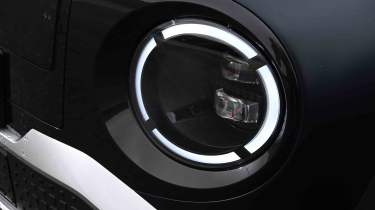
The boxy shape, bulbous wheelarches, comically large circular lights and extremely short overhangs were all features of the original Hyundai Casper – a slightly smaller petrol-powered Hyundai city car sold in the brand’s home market of South Korea. However, the square pixel lighting on the front and rear is taken from Hyundai’s other electric cars, such as the Ioniq 5 and Kona Electric. The charging port being located in the nose is something else we’ve seen in the brand’s EVs before.
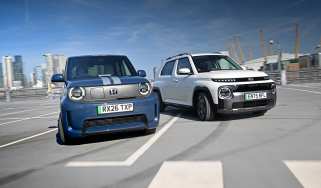
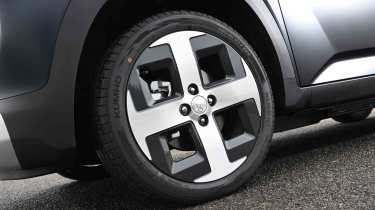
We like the rather cartoonish design of the Inster, which reminds us of the Suzuki Ignis, and some of the wacky kei cars sold exclusively in Japan. This is a car that suits a more vibrant paint finish than the standard black, and thankfully, Hyundai offers various hues and finishes, with the stand-outs being Sienna Orange and Buttercream Yellow. Base models are fitted with 15-inch wheels, while the rest of the range gets a more impressive set of 17-inch diamond-cut rims.
Interior and dashboard design
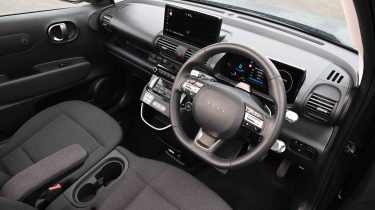
Those who have been drawn to the cheeky looks of the Inster on the outside are likely to be hoping for more of the same from the cabin, but the interior is a little more plain and sensible. The high-set dashboard design allows the main controls to fall easily to hand, though, and we’re glad to see that there are big, chunky buttons for adjusting the temperature and the fan speed.
To help brighten up the interior, you can specify a beige interior with a houndstooth fabric used across the seats – this dramatically lifts the cabin’s appeal, if not its practicality.
Materials and build quality
At the lower reaches of its range, Hyundai tends to compromise on interior quality a little more than some of its rivals – and that’s the case for the Inster, too. Aside from a bit of squidgy trim on the side of the armrests, there are next to no soft-touch materials throughout the cabin.
This is disappointing as rivals like the Renault 5 manage to pepper in some fabrics or other materials in places. At least the overall build quality is solid, and we couldn’t hear any rattling or squeaking from the plastic trim in our test car.
Infotainment, sat-nav and stereo
Apple CarPlay and Android Auto are standard, as is the 10.25-inch touchscreen mounted on top of the dashboard, which we wish had been positioned lower to make it easier to reach.
The Inster doesn’t feature Hyundai’s very latest software; instead it uses an infotainment system that’s actually two generations old. Sure, it doesn’t look quite as slick or modern as the stuff in the brand's newer models, but the benefit of using older software is that Hyundai has ironed out all the kinks and bugs. It also gets the job done, and the graphics are clear; however, there are numerous menus to navigate through, and they can be quite laggy.
“My biggest gripe though is that, despite the litany of buttons scattered across the dashboard, not one of them can turn off the car’s various driver-assistance systems (ADAS) and their irritating bonging.” - Ellis Hyde, news reporter.
Boot space & practicality

Pros |
|
Cons |
|
Hyundai has squeezed every possible millimetre of cabin space out of the Inster, managing to create a 3.8-metre-long city car with the Tardis-like quality of allowing six-foot adults to sit in the back of it comfortably. There are only four seats, however, and cabin storage is neither here nor there: there are spaces on the dashboard and in the centre console to store odds and ends, but the door bins are only large enough for a wallet.
Dimensions and size
Measuring 3,845mm long, 1,610mm wide and 1,575mm tall, the Hyundai Inster is a little bit longer than the Dacia Spring, but shorter than its more direct rivals such as the Citroen e-C3, Renault 5 and Fiat Grande Panda.
| Dimensions comparison | |||
| Model | Hyundai Inster | Renault 5 | Dacia Spring |
| Length | 3,845mm | 3,922mm | 3,701mm |
| Width | 1,610mm | 1,774mm | 1,583mm |
| Height | 1,575mm | 1,498mm | 1,519mm |
| Wheelbase | 2,580mm | 2,540mm | 2,420mm |
| Boot space | 280-1,059 litres |
326-1,106 litres (Evolution, Techno+) 285-1,065 litres (Iconic Five+, Roland Garros) | 308 litres |
Seats & passenger space
Hyundai has made the most of the narrow cabin by, in effect, joining the front seats at the hip. There’s no gap here; the fabric reaches out to produce what is basically a bench seat that’s split in the middle.
The seat offers plenty of adjustment, and while it’s a bonus that the steering wheel adjusts for both reach and rake, some testers wished it would extend out a little more. Some also found that the narrowness of the Inster meant that their right shoulder rubbed against the central pillar. The driving position is set fairly high, which some buyers will enjoy because it benefits visibility.
The driver’s side of the seat houses two cup-holders, one example of many storage spaces Hyundai has crammed into this very small car. A smartphone shelf sits just beneath the heating controls, and its position high on the dash helps make it easy to reach. Another smaller storage bin sits below it, while an open shelf is located above a fairly standard glovebox. The door bins are very slim, though.
It’s clear that Hyundai wanted to promote space and versatility with the Inster, and the result is excellent – few cars anywhere near this size offer so much space.
Rear knee room is fantastic, and against a tape measure, the Inster offers within a few millimetres of what back-seat passengers get in a Hyundai Ioniq 5, which is incredible considering it’s almost 80cm longer in terms of exterior dimensions. There’s even a sliding and reclining rear bench in the Inster (not on the base 01 trim) if you wish to sacrifice some knee room for boot space. Impressively, the Inster actually pips the Ioniq 5 for headroom.
Of course, the EV’s narrow body means something has to give, and it’s that the Inster’s rear bench is strictly for two – there’s no centre seat – but it’s hard to knock it for that.
Boot space
The Inster’s 238-litre boot is okay, rather than outstanding, for a car of this size. But slide the rear bench forward, and that figure grows to 351 litres. This does make knee room a little tight in the back, but unlike its rivals, the Inster at least gives owners the option to make that compromise.
Fabric panels attached to the parcel shelf clip to the back of the rear seats, so whichever position they are in, the contents of the boot are hidden from view. A 50:50 split drops the rear seat down to increase the total volume to 1,059 litres, which is slightly better than rivals such as the BYD Dolphin Surf.
“The boxy shape and clever packaging provide an astounding amount of headroom and ample legroom for six-foot-tall adults to sit comfortably in the back, as I can attest.” - Ellis Hyde, news reporter.
Reliability & safety
Pros |
|
Cons |
|
The Inster received a four-star score from Euro NCAP when it was tested in 2025. That’s one star short of the five-star BYD Dolphin Surf, but it puts the Hyundai on par with most of its closest rivals, including the Renault 4 and Renault 5.
There’s lots of safety kit, including seven airbags as standard (the Citroen e-C3 gets six), plus some driver-assistance systems, such as lane-keeping assist, a driver-attention monitoring system, and forward collision avoidance assist. The lane keep assistance system is easy enough to turn off by holding down a button on the steering wheel, but you'll need to set up the star button shortcut on the steering wheel to quickly access the driver assists menu in the infotainment system. Even then, it's a few further prods of the screen to silence them, whereas the Renault 5 has a single button to the right of the steering wheel to easily turn off these systems. It's also a shame that only the top-spec Cross comes with a blind-spot monitoring system.
The Inster didn’t appear in the latest Driver Power owner satisfaction survey, but the Hyundai brand wound up in 13th place out of 30 in the best manufacturer rankings. This was far higher than Kia’s 25th place finish, and Hyundai owners have been pretty impressed by the value for money on offer.
| Euro NCAP safety ratings | |
| Euro NCAP safety rating | 4 stars (2025) |
| Adult occupant protection | 70% |
| Child occupant protection | 81% |
| Vulnerable road user protection | 70% |
| Safety assist | 67% |
Buying, prices and deals
Best buy: Hyundai Inster 49kWh 02
If it wasn’t obvious, the Inster is Hyundai’s cheapest EV and it’s available from just under £24,000 (not including the brand's EV discount incentive). That’s a little higher than Citroen e-C3, which is a previous Car of the Year award winner and now starts from under £20k when the Government's Electric Car Grant (ECG) is included. Meanwhile, its much funkier sister car, the Fiat Grande Panda EV, is priced from just under £21k.
The entry-level Hyundai Inster comes well equipped with dual 10.25-inch displays, Apple CarPlay, Android Auto, keyless entry, a reversing camera and a smattering of safety kit. However, we recommend upgrading to the 02 trim, as it features a larger battery for extended range, a sliding and reclining rear bench for maximum versatility, and additional equipment, including heated front seats and a heated steering wheel.
If you're interested in purchasing a Hyundai Inster, we can assist you. Configure your ideal Hyundai Inster now to get top offers from local dealers, check out the latest Hyundai Inster leasing deals or search for used Hyundai Inster models with our Buy A Car service. You can even sell your existing car for a great price with Auto Express Sell My Car.
Hyundai Inster alternatives
The Inster is Hyundai’s champion in the small electric car class, which is more competitive than ever right now. Contenders include the reborn Renault 5 and Nissan Micra, along with the MINI Cooper Electric, BYD Dolphin and a previous Auto Express Car of the Year, the Citroen e-C3.
There are also Citroen’s numerous siblings to consider, including the funky Fiat Grande Panda, the more practical Citroen e-C3 Aircross, and the Vauxhall Frontera. The Peugeot E-208 and Vauxhall Corsa Electric are also still on offer, but they’re a bit long in the tooth now.
Key updates of the Hyundai Inster review
- 28 July 2026: Latest pricing and depreciation data, and information on AWD variants.
- 11 February 2026: Driving impressions of the entry-level 42kWh 01 version.
Frequently Asked Questions
The Hyundai Inster is covered by a five-year factory warranty with no mileage limits, while its battery pack gets a separate eight-year warranty.
Deals on the Inster and alternatives