Mazda CX-5 review
The latest Mazda CX-5 offers great practicality and plenty of kit, but the single engine option is disappointing


Our opinion on the Mazda CX-5
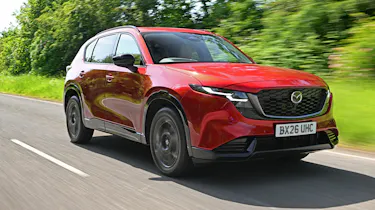
There are plenty of good points about the Mazda CX-5. It’s a clear evolution of its predecessor, and it offers more space for passengers and luggage, while the amount of standard equipment and tech on board has risen to compete with the class best. However, the latter is arguably harder to get along with now that Mazda has removed most of the physical buttons in the cabin, especially the useful control wheel that used to adorn the centre console.
Then there’s the powertrain. While the CX-5’s chassis still has a sporty edge, it’s not as much fun as before. The single petrol engine option that’s currently offered also needs to be worked hard to deliver performance, which comes at the detriment of fuel economy. In a competitive class, the Mazda CX-5 struggles to stand out.
About the Mazda CX-5
Buyers looking for a break from the mainstream in the compact SUV class have been well served by the Mazda CX-5. First launched in 2012, the CX-5 has offered a practical, spacious body combined with an engaging driving experience, while a range of diesel and petrol powertrains have suited the CX-5’s character. Now there’s an all-new third-generation version hitting dealers, and it aims to continue in the same vein.
Used - available now


As before, the Mazda CX-5 uses a typical five-door, five-seat compact SUV body, although for its European launch it’s only available with one powertrain. Unlike rival manufacturers, Mazda has stuck with its ‘right-sizing’ philosophy and has foregone turbocharging in favour of a naturally aspirated 2.5-litre four-cylinder petrol engine. The only concession to electrification is a mild-hybrid system with stop-start, while all models come with a six-speed automatic gearbox as standard. As before, front-wheel drive is standard, while the top-spec models can be had with four-wheel drive at extra cost.
Mazda CX-5 prices and latest deals
A starting price of around £31,000 puts the Mazda CX-5 in the thick of it when it comes to the compact SUV class. It’s reasonably equipped in base Prime-Line trim, but we’d recommend upgrading to the Centre-Line or Exclusive-Line versions for £3,500 or £5,000 extra to improve the ownership experience. At £39,000, the top-spec Homura is reasonably priced, too, while four-wheel drive adds £2,000 to the Exclusive-Line and Homura models.
Head direct to a Mazda dealer, and it will offer you a £750 deposit contribution if you take out a personal contract plan. You can also save by checking out the latest Mazda deals with the Auto Express Buy A Car service.
Performance & driving experience
Pros |
|
Cons |
|
Mazda has a reputation for injecting its sports car DNA into the most humdrum of its models. However, more recent SUVs have struggled to match past generations for driving enjoyment, and the latest CX-5 isn’t as engaging as its predecessor.
| Model | Power | 0-62mph | Top speed |
| CX-5 2.5 Skyactiv G auto | 139bhp | 10.5 seconds | 116mph |
| CX-5 2.5 Skyactiv G auto AWD | 139bhp | 10.9 seconds | 115mph |
Performance, 0-60mph acceleration and top speed
One of the big changes with the third-generation CX-5 is the engine line-up. At the moment, there’s just one powertrain option available in the shape of a 2.5-litre four-cylinder naturally aspirated petrol engine, and this comes fitted with a six-speed automatic gearbox as standard. The only variation on this is the option of four-wheel drive that’s available on Exclusive-Line and Homura trims.
Maximum power is rated at a modest 139bhp at 4,500rpm, while there’s 238Nm of torque available in a narrow window from 3,500-3,750rpm. Those aren’t particularly potent figures, and a 0-62mph time of 10.5 seconds (10.9 seconds for the AWD models) only tells half the story.
The CX-5 comes with a traditional torque converter-style automatic, and when you ask for maximum acceleration the engine revs soar like a CVT gearbox. It’s not a very pleasant experience, especially when we’ve become accustomed to the low-down torque offered by rivals with smaller-capacity turbocharged engines.
Town driving, visibility and parking
The Mazda’s relatively tall ride height provides a good view of your surroundings, while all models come with front and rear parking sensors as part of the comprehensive safety systems that are fitted as standard across the whole range. Lower-spec Prime-Line and Centre-Line cars have a reversing camera, while the two higher specs add 360-degree cameras that can offer different viewing angles.
Light steering helps to make parking easy, while the stop-start system is smooth and unobtrusive at low speeds, helping to save fuel without any effort. The automatic gearbox doesn’t like to be rushed, and besides, the engine’s revvy nature means you’re better off taking things easy to keep the cabin quiet.
There’s a slightly firm edge to the ride at lower speeds, which is surprising because the 19-inch wheels that are standard on all models bar the base car (which has 17-inch rims) still feature a relatively high tyre sidewall. It’s not unsettled enough to cause passenger discomfort, though.
Country road driving and handling
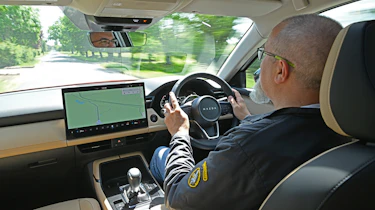
At higher speeds, the CX-5 doesn’t show the same keen handling that helped previous generations endear themselves. While past cars gave the feeling that they hunkered down and shrank around you, the third-generation still maintains a high-riding, top-heavy gait that doesn’t really encourage you to push any harder than necessary. There’s a soft edge to the ride that means there’s more lean in corners than we’ve come to expect from a Mazda SUV, although grip is acceptable.
The slow initial reactions of the auto gearbox mean that overtaking needs to be planned carefully, but the naturally aspirated engine picks up quickly once the box has selected the appropriate ratio. There is a manual shift function via the drive selector or paddles behind the steering wheel, while Sport mode also sharpens the car’s responses.
Motorway driving and long-distance comfort
While there’s plenty of noise from under the bonnet when accelerating up to the national limit, the powertrain soon settles down once you’re up to speed. Good sound insulation means there’s very little wind or road noise in the CX-5 at motorway speeds.
"Mazda’s innovative Skyactiv X compression ignition petrol unit, as used in the Mazda 3 hatch and CX-30 SUV, isn’t being earmarked for the CX-5. Instead, Mazda will add a new Skyactiv Z hybrid to the line-up It’s based on the 2.5-litre petrol used in the Skyactiv G, but it’s not due here until 2027." - Dean Gibson, senior test editor.
MPG & running costs
Pros |
|
Cons |
|
The sole engine option that’s offered in the CX-5 at the moment is a large-capacity 2.5-litre naturally aspirated unit featuring stop-start. However, even the official fuel economy figures look fairly ordinary when compared with most rivals.
Mazda quotes a WLTP-evaluated return of 40.4mpg for the front-wheel-drive CX-5, while the best figure for the AWD models is 38.2mpg. In comparison, the more powerful 148bhp Volkswagen Tiguan with an auto box and front-wheel drive has a best figure of 47.7mpg on the WLTP cycle, while a Nissan Qashqai manages 45.6mpg.
We tested the top-spec CX-5 Homura in warm weather on a mix of roads and saw a return of 37mpg overall. This translates into a range of 456 miles, courtesy of a larger-than average 56-litre fuel tank.
| Model | MPG | CO2 | Insurance group |
| CX-5 2.5 Skyactiv G auto | 40.4mpg | 157g/km | TBC |
| CX-5 2.5 Skyactiv G auto AWD | 38.2mpg | 169g/km | TBC |
Insurance groups
Ratings for the latest CX-5 are still to be finalised, but we expect it to sit in similar groups as the petrol version of its predecessor, because while engine capacity has increased, power has decreased. Expect ratings in the region of 17-20.
Tax
With no hybrid model on offer, let alone a PHEV or full EV, the CX-5 isn’t a very tax-efficient family SUV for business users. All versions sit at the highest 37 per cent Benefit-in-Kind (BiK) rate, so even the entry-level Prime-Line trim will cost more than £2,200 a year for lower-rate taxpayers.
List prices for every CX-5 bar one dip below the £40,000 luxury car tax threshold, even if you add metallic paint, so VED is £200 a year. The one exception is the top-spec Homura AWD, which starts at just under £41,000. That means it’s subject to road tax costing £640 for years two to six.
Depreciation
Our experts have yet to calculate residuals for the new CX-5, but if the last model is anything to go by, retained values in the 44-50 per cent range can be expected.
Interior, design & technology
Pros |
|
Cons |
|
Mazda took a largely evolutionary approach when creating the third generation of its family-focused SUV. And yet there are major differences between this new CX-5 and the last one – some good, some definitely not.
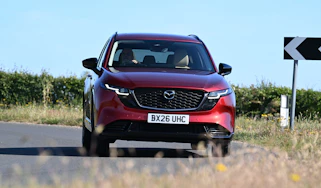
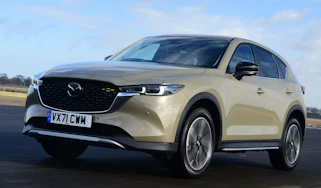
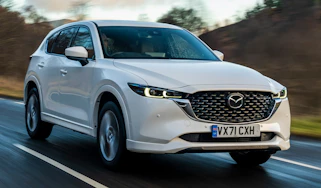
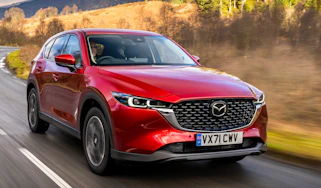
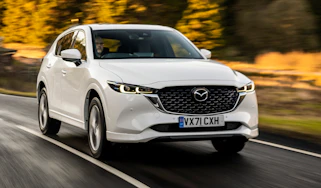
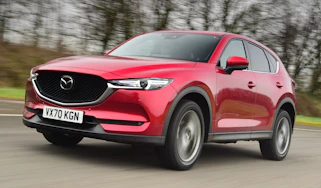
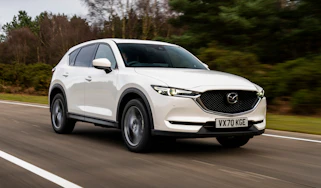
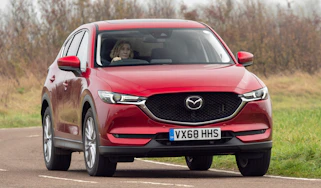
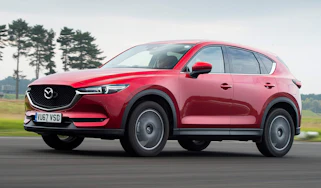
The latest model is handsome and has a more traditionally sophisticated, understated look compared with some compact SUV rivals, while it takes some inspiration from the brand’s posher SUVs: the Mazda CX-60 and Mazda CX-80.
The twin exhaust tips poking out the back give the CX-5 a slightly sportier flavour than its pricier siblings, and the traditional badge on the tailgate has been replaced by Mazda lettering – something that has become a bit of a trend with other brands. Base models feature 17-inch alloy wheels, while all others get 19-inch rims which, to our eyes, look rather small because they don’t fill the wheelarches.
Interior and dashboard design
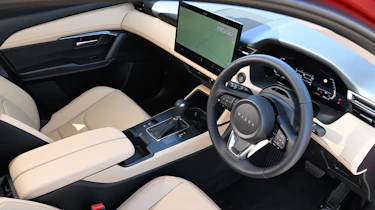
There’s a familiarity about the CX-5’s cabin that will please existing Mazda owners, although look more closely and you’ll see that there are hardly any physical buttons on the dashboard.
We counted six in the top-spec Homura model: the hazard switch and heated front and rear screen controls are grouped together between the central air vents, while there’s a push-button starter by the steering wheel, then there are two buttons low and to the right of the wheel to set the safety warning sounds (a welcome inclusion) and to remotely open the tailgate. (The latter means the Prime-Line model has one less button because it has a manual door).
Thankfully, the steering wheel still gets physical buttons, including a volume control and a drive-mode selector, although the layout does take a bit of getting used to, and having the volume controls towards the centre of the steering boss might be a bit of a reach if you have small hands. We like that there’s a button for activating the surround-view camera system, which could come in handy in tight car parks.
Materials and build quality
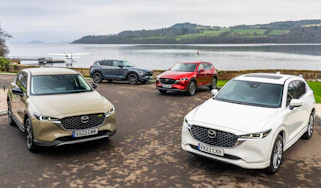
Mazda has attempted to move upmarket with its most recent cars, especially its large SUVs, and the CX-5 feels decent enough. All models bar the entry-level Prime-Line feature leather or an artificial substitute, while the top-spec Homura can be specced with tan leather, as seen in our pictures, in place of the standard black upholstery, at no extra cost. Everything feels well built, although the plastic lower down is on the hard side and seemed to pick up scratches a little too easily on the car that we tested.
Infotainment, sat-nav and stereo
There are two infotainment displays available in the CX-5, with all models bar the top-spec Homura featuring a 12.9-inch display. Pick the flagship, and this is upgraded to a vast 15.6-inch touchscreen. The display looks sharp and has plenty of features, but we found that the screen wasn’t particularly responsive.
There’s a thin strip of shortcut controls across the bottom of the display, and while temperature and fan speed are permanently shown along the bottom of the screen, adjusting the airflow or activating the heated seats and steering wheel is done via a separate pop-up menu. This has a very dark background and small icons make it rather distracting to use when on the move.
Less distracting is the Google-based navigation system, which is just as effective here as it is when using the smartphone app for route planning and guidance. You get three years of Google services when you buy a CX-5, which includes maps, access to the Google store for compatible apps, and also the ability to use Gemini AI for more advanced functions.
Behind the steering wheel on all versions of the CX-5 is a 10.25-inch instrument display. It’s clear enough, but there are only three very basic layouts and, unlike some rivals, there’s no option to show the navigation map.
"The My Mazda smartphone app allows owners to send destinations to the CX-5’s navigation system, remotely lock and unlock the car or help to find it in a busy car park by registering the vehicle’s last location." - Dean Gibson, senior test editor.
Boot space & practicality
Pros |
|
Cons |
|
There’s enough space in the Mazda CX-5 for it to be a practical family car for five, with decent space throughout and some handy practical touches dotted around the cabin.
Dimensions and size
The third-generation CX-5 has grown slightly when compared with its predecessor. It’s 115mm longer, 15mm wider and 30mm taller, while the wheelbase has been stretched by 115mm to help improve space in the back.
| Dimensions comparison | |||
| Model | Mazda CX-5 | Ford Kuga | Kia Sportage |
| Length | 4,690mm | 4,615mm | 4,540mm |
| Width | 1,860mm | 1,882mm | 1,865mm |
| Height | 1,690mm | 1,623mm | 1,645mm |
| Wheelbase | 2,815mm | 2,711mm | 2,680mm |
| Boot space | 583-2,019 litres | 645-1,534 litres | 591-1,780 litres |
Seats & passenger space
Only the base Prime-Line model has manual driver’s seat controls; the rest of the line-up uses electrical assistance, while the Homura also has a seat memory function, plus seat ventilation to go with the three-stage heating. Passengers also benefit from the same level of heating and ventilation through the range, although only the top-spec Exclusive-Line and Homura models offer electric adjustment. It’s easy enough for most drivers to get comfortable, and the view out is good, too.
Storage is decent, with an open space ahead of the drive selector featuring twin cup-holders and a storage shelf, while a wireless charging pad sits behind this and just in front of the central armrest. It’s angled back to stop a phone sliding back and forth, and the sides are high enough to prevent it falling out during hard cornering, too. The centre armrest has a split-opening lid to reveal a deep bin that contains a pair of USB sockets. Elsewhere, there’s a small cubby to the right of the steering wheel by the driver’s knee that won’t be able to hold very much, but the door bins are deep and have cutouts designed for drinks bottles.
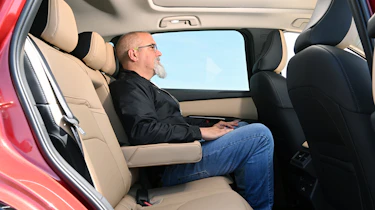
Access to the back is easy, courtesy of doors that open to almost 90 degrees to leave a wide opening. Six-foot-tall adults will have plenty of legroom to stretch out, even when the front seats are set well back, and there’s foot space under the seats, too. There’s decent headroom, although the panoramic opening roof that’s included on Exclusive-Line and Homura cars does eat into space a little. The back seats also recline manually, while Exclusive-Line and Homura cars feature heated outer rear seats.
The CX-5 is wide across the back, but the design of the seats means it’s better suited to two adults because the middle seat is quite narrow. There’s a hump in the floor to make space for a propshaft in AWD cars, so foot space isn’t great for anyone sitting in the middle, either. Storage comprises decent door bins and back-seat pockets, while there are rear USB sockets on the two higher trim levels. At the bottom of the range, the Prime-Line does without rear air vents, too. While the middle seat is narrow, it makes for a wide armrest when travelling two-up, and there are two cup-holders inside.
Boot space
Increased dimensions on the outside have boosted boot space when compared with the last CX-5. The 583-litre capacity is 61 litres up on the previous model and is also more than a Nissan Qashqai, MG HS or Jaecoo 7 offers. However, the Kia Sportage is still slightly ahead, at 591 litres.
When you need to haul as much stuff as possible, the rear seats fold down to provide 2,019 litres of space, although you can play around with the 40:20:40-split folding functionality to give yourself however much space you need for passengers and luggage.
Towing
If you need even more capacity, then the CX-5 retains the same 2,000kg maximum towing limit as the previous generation.
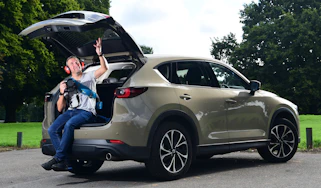
"It’s not just the CX-5’s boot capacity that’s impressive, because Mazda has lowered the boot opening, which has boosted access; if you’re trying to lift heavier cargo in and out there’s no load lip to lift it over. The boot area is longer and deeper than before, too." - Dean Gibson, senior test editor.
Reliability & safety
Pros |
|
Cons |
|
The third-generation CX-5 is an evolution of the car that came before it, while the 2.5-litre engine is carried over. There shouldn’t be many issues in terms of reliability, although recent Mazdas haven’t necessarily run as smoothly as you might expect. To help give buyers peace of mind, Mazda introduced a six-year/100,000-mile warranty on new cars registered after 1 September 2025, but roadside assistance remains unchanged, albeit still fairly generous at three years or 60,000 miles.
A five-star Euro NCAP safety rating is also likely to instil confidence in the CX-5’s ability. The sole safety feature that isn’t included on every model in the range is hill descent control, which is only offered on the AWD model that only comes in higher specs. Blind-spot monitoring, lane-keeping assist, traffic sign and speed-limit assist, forward collision mitigation and vehicle exit warnings are all included, while Mazda has made it easy to set the safety warnings to your liking with the push of a button. While there are very few physical controls on the dashboard, we applaud Mazda for including this.
Driver-attention alert is another new technology that’s becoming mandatory on new cars, but the system in the CX-5 works well. A sensor mounted on top of the steering column monitors the driver at all times, and while it will sound an alert if it detects distraction or tiredness, it’s not as sensitive as some rival systems that will chide you when looking away from straight ahead when negotiating roundabouts or junctions.
| Euro NCAP safety ratings | |
| Euro NCAP safety rating | Five stars (2025) |
| Adult occupant protection | 90% |
| Child occupant protection | 89% |
| Vulnerable road user protection | 93% |
| Safety assist | 83% |
Buying and owning
- Best buy: Mazda CX-5 2.5 Skyactiv G Exclusive-Line
With only one engine option available, all you’re left with is picking which trim you like the look of. While the Homura has plenty of fancy add-ons (and is the only option if you want the no-cost tan leather upgrade), most are also found on the Exclusive-Line version.
Mazda CX-5 alternatives
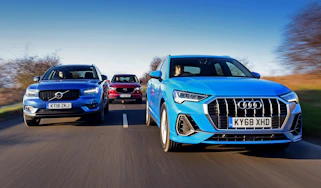
The mid-size SUV class is packed with rivals, even if you just stick to those with petrol power. The Ford Kuga is a perennial best-seller, while the Volkswagen Tiguan offers a mix of quality and kit to match the CX-5. Elsewhere the Hyundai Tucson and Kia Sportage are worth considering, as are the Citroen C5 Aircross, Nissan Qashqai, Vauxhall Grandland, Renault Austral or Dacia Bigster. Most of these are available with more efficient hybrid or even PHEV powertrains, too.
Frequently Asked Questions
It’s a fine car, but it doesn’t offer the same fun driving character that past generations have delivered. What you get in return is greater practicality and decent comfort, but the only petrol engine option isn’t very efficient when compared with rivals.
Deals on the CX-5 and alternatives