MG HS review
The MG HS may be an inexpensive mid-size SUV, but it’s well-equipped and built to a high standard
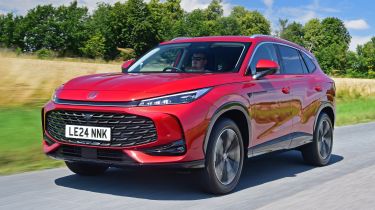

Our opinion on the MG HS
The MG HS will appeal to drivers who like getting their money’s worth, or perhaps are on a tight budget but still want a practical SUV for their next family car. Value for money is still front and centre with the HS, which comes generously equipped, feels spacious and has a starting price that’s similar to the much smaller Ford Puma.
However, we’d strongly recommend investing a bit more cash for the hybrid or plug-in hybrid-powered HS, the latter of which we've voted as the winner of the best Affordable Hybrid Car of the Year award. These electrified models offer a much more refined and enjoyable driving experience than the pure-combustion version, and have much more appealing running costs.
About the MG HS
The previous MG HS was one of the brand’s biggest sellers in the UK, and the latest model treads a similar path with its predecessor, which should prove popular with budget-conscious British buyers.
Just like the rest of MG’s line-up, the HS is a step in the right direction in terms of quality and value for money. There’s no escaping a few pitfalls here and there, but most of these are pretty forgivable when considering that this is one of the most affordable mid-size SUVs that you can buy. The selection of petrol, full-hybrid and plug-in hybrid power also broadens this SUV’s appeal to a wider range of buyers, and all of them are competitively priced when compared with similarly powered rivals.
Used - available now


We've recently pitted the plug-in hybrid version of the MG HS against 15 other plug-in hybrid SUVs as part of our PHEV megatest.
Performance & driving experience
Pros |
|
Cons |
|
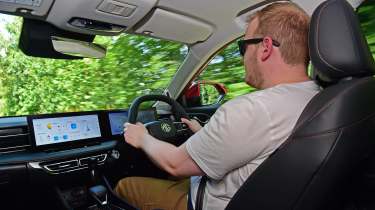
Our first experience of the MG HS was in the pure-petrol model, and to say we weren’t overly satisfied with the driving experience would be something of an understatement. Its key drawback is the brakes, which we felt didn’t do much until about halfway through the pedal travel, and then required significantly more force before the car began to slow down.
However, our drive in the plug-in hybrid version quickly revealed it to be the far superior choice. Adding regenerative braking seemed to solve the brake pedal issues we'd experienced in the petrol and felt far more natural, with the transition from regenerative braking to the physical discs being imperceptible.
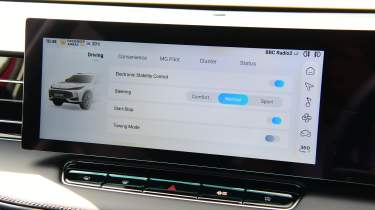
In every HS, the steering feels rather heavy when in its ‘normal’ setting, so we much preferred the lighter ‘comfort’ mode, with its linear steering feel.
| Model | Power | 0-62mph | Top speed |
| HS 1.5 T-GDI SE | 167bhp | 9.4 seconds | 118mph |
| HS 1.5 T-GDI Hybrid+ SE | 224bhp | 7.9 seconds | 118mph |
| HS 1.5 T-GDI PHEV SE | 299bhp | 6.8 seconds | 105mph |
Performance, 0-60mph acceleration and top speed
The petrol HS uses a turbocharged 1.5-litre petrol engine that produces 167bhp and 275Nm of torque, which is enough to get from 0-62mph in under 10 seconds. However, in the automatic version we tried, the car took about a second to respond whenever we hit the throttle when trying to accelerate hard. When accelerating, the engine sounded strained, emitting a loud and gravelly note as we slowly gained speed.
In comparison, the plug-in hybrid HS, with its total output of 299bhp, suffers from no such issues. Power delivery from its electric motor is instant, making for effortless acceleration and a 0-62mph time of 6.8 seconds. It often felt like we were driving an EV because the electric motor provided enough acceleration to keep up with traffic without needing to wake the engine, even when we stomped on the accelerator.
The Hybrid+ model, meanwhile, is something of a Goldilocks variant, offering up a respectable 224bhp and a swift 0-62mph time of 7.9 seconds. This model also offers some of the benefits of electrified driving but without the need for plugging in.
Town driving, visibility and parking
The HS’s ride is firm but not uncomfortable at low speeds, and the high driving position offers a good view ahead.
All versions of the MG HS come with front and rear parking sensors, plus a reversing camera to help make parking in a tight multi-storey just that little bit easier. The top-of-the-range Trophy version features a full 360-degree camera system, should you require additional camera views.
Country road driving and handling
For the most part, the MG HS feels stable, but when you reach an uneven section of road and hit a succession of bumps in the petrol version, things become quite bouncy. Hybrid versions tend to be a little more settled in this regard due to their extra weight and firmer suspension, giving a more controlled ride. The latter is also better when pressing on because the awkward brake pedal modulation of the petrol robs you of some confidence when slowing down for a bend. On the whole, the HS isn’t as fun to drive as rivals like the Ford Kuga, but hybrid versions should fulfil most SUV buyers' expectations.
Motorway driving and long-distance comfort
We found the HS best suited to the motorway, where, aside from a fair bit of road noise, it’s a reasonably calm place to be once the engine has settled down.
“All versions of the MG HS are fitted with adaptive cruise control to help you maintain a safe distance from the car in front, lane keep assistance to help keep you within your lane, and a blind spot monitoring system to warn you of vehicles alongside when you go to change lanes.” – Ellis Hyde, news reporter.
MPG & running costs
Pros |
|
Cons |
|
MG claims that the petrol HS should be able to average 38.1mpg when equipped with the six-speed manual, dropping to 37.1mpg with the optional seven-speed automatic. During our testing of the automatic version across a mixture of town and motorway driving, we managed to achieve 33.6mpg, but we’ve seen the equivalent Nissan Qashqai and Kia Sportage return over 40mpg during our testing.
The full-hybrid HS offers a more respectable claimed fuel economy of 51.3mpg, and this powertrain is capable of driving on pure electric power for short periods without needing the engine. Unlike the PHEV, this model doesn’t need to be plugged in because its small 1.8kWh battery is charged using the energy recovered by its regenerative braking system and the car’s engine.
On paper, the PHEV has a remarkable combined figure of 705mpg, although based on our experience of plug-in hybrid cars, you're unlikely to achieve that in the real world, even with regular charging. To this car's credit, we did manage to achieve 46.3mpg during our PHEV megatest on a mixed test loop of urban, B road, and motorway driving using engine power after we depleted the battery, which is a few miles per gallon better than the pricier Volkswagen Tayron, but less than what we achieved in a BYD Sealion 5 and Chery Tiggo 8 in similar conditions.
| Model | MPG | CO2 | Insurance group |
| HS 1.5 T-GDI SE | 38.2mpg | 168g/km | 24 |
| HS 1.5 T-GDI Hybrid+ SE | 51.3mpg | 126g/km | 27 |
Electric range, battery life and charge time
The big news is that the plug-in hybrid HS gets a sizable 24.7kWh (23.2kWh usable) battery and boasts a massive pure-electric range of 75 miles. During our PHEV megatest, we managed to get an all-electric range of 68.1 miles without needing the engine on our test loop, which was considerably more than the 58 miles we got out of a VW Tayron, 40 miles in a BYD Sealion 5, and 33.2 miles we achieved in a Hyundai Tucson driving in similar conditions.
The HS should take around four hours to charge from empty to full at home when utilising a 7.4kW home wallbox charge point. If you use a domestic three-pin plug, it’ll take seven and a half hours.
| Model | Battery size | Range | Insurance group |
| HS 1.5 T-GDI PHEV SE | 24.7kWh | 75 miles | 26 |
Insurance groups
While it’s cheaper to buy than many of its medium-sized rivals, the MG HS incurs higher insurance premiums than some of its competitors. The HS line-up sits between groups 24 and 26 (out of 50), while the Kia Sportage and Hyundai Tucson both sit as low as group 19. The entry-level Skoda Karoq is even lower in group 12.
Tax
Due to the long electric range and low emissions of the plug-in hybrid HS, it fits into a low 7 per cent Benefit-in-Kind (BiK) tax rate for company car drivers. However, you’ll be even better off with a fully electric car like the MGS6 EV, because zero-emission cars have even lower BiK rates.
The affordable pricing of the MG HS means it avoids the supplementary luxury car tax for combustion-powered cars that cost over £40,000 when new. This means the HS is charged at the standard rate of Vehicle Excise Duty road tax.
Depreciation
Based on a typical ownership period of three years or 36,000 miles, our market data suggests that the MG HS should retain between 48 and 51 per cent of its initial value. That's on par with the pricier Hyundai Tucson, which holds 48 to 53 per cent, and it’s a slightly better outcome than that of the BYD Sealion 5, which retains around 48 per cent.
To get an accurate valuation of a specific model, check out our free car valuation tool...
Interior, design & technology
Pros |
|
Cons |
|
The MG HS is really well equipped as standard. Our preferred entry-level SE trim comes with:
- A 12.3-inch touchscreen infotainment with sat-nav and Apple CarPlay and Android Auto connectivity
- LED headlights
- A reversing camera
- 19-inch alloys
- Adaptive cruise control
- Blind spot assist
Move up to the slightly more pricey Trophy trim, and you get all that plus wireless phone charging, a 360-degree camera, a stereo upgrade, dual-zone climate control, a powered tailgate and heated front seats.
Interior and dashboard design
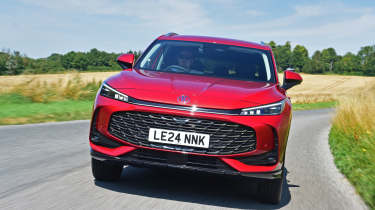
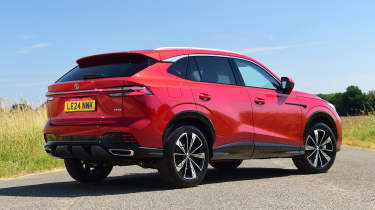
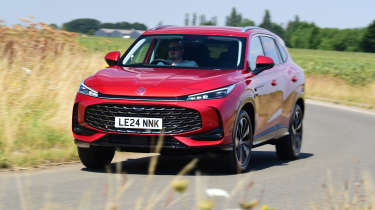
For its second generation, the MG HS has stepped up its game in several areas. For starters, the design is much cleaner and more sophisticated this time around, incorporating a full-width rear light bar, sharper headlights, and a whopper of a front grille – a styling cue shared with the MG3.
Materials and build quality
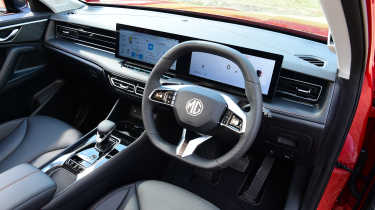
The interior is all new and looks far more modern than before. We were particularly impressed by the material and build quality, especially considering the price tag, because everything feels well screwed together, and most surfaces are covered with soft-touch or squishy materials. It’s only lower down on the door cards or centre console that you’ll start to find hard, cheaper-feeling plastics.
Infotainment, sat-nav and stereo
Technology has seen some definite upgrades compared to the previous MG HS. That being said, the large central touchscreen and digital driver’s display are the same as those in other MGs, so resolution and loading times are below average for this class. We’re also familiar with the infotainment system, which does the job but can be tedious to navigate. We expect most people will just bypass it using Apple CarPlay or Android Auto.
“There isn’t an option to get an uprated sound system, so the only difference is that you get a 6-speaker system with the entry-level SE or an 8-speaker version in the top-of-the-range Trophy.” – Max Adams, online reviews editor.
Boot space & practicality
Pros |
|
Cons |
|
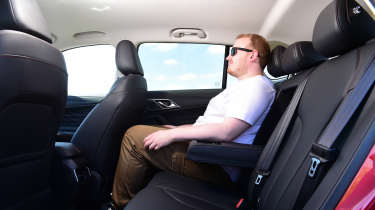
To make the HS more practical than its predecessor, the wheelbase is 45mm longer, and the car is 14mm wider. Even with six-foot-tall adults up front, there’s plenty of legroom in the seat behind for anyone similarly tall to sit comfortably, with headroom to spare, and space under the front seats to tuck their feet under the seat in front.
Alternatively, if you’ve got young children, the wide rear door opening will help when installing a child seat, and there are easily accessible Isofix points for the outer positions. Another small detail we appreciate is that there are more storage cubbies in the latest HS, including large door bins and a cavernous glove box.
Dimensions and size
At 4,655mm long (4,670mm for the PHEV), 1,890mm wide and 1,664mm tall, the MG HS is a little larger than key rivals such as the Kia Sportage, which was already one of the largest mid-size SUVs at 4,515mm long, 1,865mm wide, and 1,650mm high. Even though the MG is one of the larger models in its class, you shouldn’t have trouble finding a suitable parking spot.
| Dimensions comparison | |||
| Model | MG HS | Hyundai Tucson | Ford Kuga |
| Length | 4,655mm (4,670mm plug-in hybrid) | 4,525mm | 4,604mm |
| Width | 1,890mm | 1,865mm | 1,882mm |
| Height | 1,664mm | 1,650mm | 1,680mm |
| Wheelbase | 2,765mm | 2,680mm | 2,710mm |
| Boot space | 507-1,484 litres | 620-1,799 litres | 645-1,534 litres |
Seats & passenger space
There’s plenty of space inside the MG HS, and there should be enough headroom for the tallest driver and front seat passenger. There are some useful cubby spaces to store water bottles and, on higher-spec models, there’s a wireless smartphone charger for your phone.
Just like in the front, there’s plenty of headroom for passengers in the back of the MG HS. There’s also enough legroom to get comfortable, and you can fit three adults across the back bench. Although the middle-seat passenger might feel a little squished, it would be fine for a short trip.
Boot space
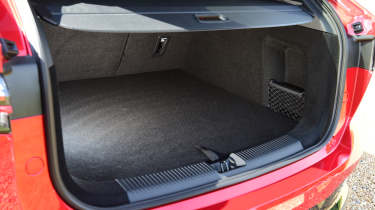
Boot space has increased from 463 litres in the previous model to a much more competitive 507 litres – it’s ever so slightly more than you get in a Nissan Qashqai, though it’s still a long way off the up to 587 litres the Kia Sportage boasts. With the 60/40 split folding rear seats lowered, the amount of space increases to 1,484 litres.
There’s no load lip to contend with in the HS, and unlike its rivals, boot space is unchanged for the hybrid versions compared with the regular petrol model. The rear seats fold down quite flat without a large step, so you should be able to slide larger and longer items into the load bay without much trouble.
Towing
“All versions of the latest MG HS are rated to tow 1,500kg, which is enough for a reasonably-big caravan or trailer, and matches the tow rating of the petrol version of the Kia Sportage. If you need a mid-size SUV that can haul more, the Ford Kuga in four-wheel drive hybrid and plug-in hybrid forms has a maximum towing rating of 2,100kg.” – Max Adams, online reviews editor.
Reliability & safety
Pros |
|
Cons |
|
The latest MG HS received the maximum five-star crash safety rating from Euro NCAP, scoring higher than the four-star Renault Symbioz and three-star Dacia Duster. The Toyota C-HR also received a five-star rating and scored higher than the HS in the child occupant, vulnerable road user, and safety assistance categories, while the MG did a little better for adult occupant protection.
All versions of HS feature autonomous emergency braking (AEB) with pedestrian and cyclist detection, lane-keeping assist, blind spot detection and driver attention alert, to name but a few of the systems onboard. As we mentioned, the constant chimes caused by these systems are incredibly annoying and highly distracting when driving.
The latest MG HS placed 22nd out of 50 in the most recent best cars to own list of the 2026 Driver Power customer satisfaction survey. It was voted the best-value car among the cars included, thanks to the HS's low servicing costs. Owners were also impressed by its rear leg room and the car's child-friendly features. The userfriendliness of its controls drew criticism, and owners didn't much care for the driving experience, having issues with the smoothness of the drivetrain and the car's handling. Fuel economy wasn't much to write home about either.
The MG brand climbs one position above its last-place result in 2025, to finish in 29th out of 30 car makers in our 2026 best manufacturer rankings. MG owners like the value-for-money prospect of their cars, but that was one of the few highlights of MG ownership. They didn't like the infotainment system, with some respondents describing it as clunky and unresponsive, and one respondent said that the sat-nav system is "often wrong".
| Euro NCAP safety ratings | |
| Euro NCAP safety rating | Five stars (2024) |
| Adult occupant protection | 90% |
| Child occupant protection | 85% |
| Vulnerable road user protection | 83% |
| Safety assist | 74% |
Buying and owning
Best buy: MG HS Plug-In Hybrid SE
Pricing kicks off from around £26,500 for the petrol-powered MG HS in SE trim. Hybrid buyers will need to spend around £29,500 to get into a Hybrid+ SE model, while the least expensive PHEV is the SE version for £32,500. The range-topping Trophy trim is around £2,500 more than its SE equivalent, and adds a healthy dose of extra kit.
The HS plug-in hybrid is our preferred choice as it’s more refined overall and doesn’t suffer the same braking issues we encountered with the petrol. Its 75 miles of pure-electric range is a big advantage over both the petrol and standard hybrid, too. The PHEV is also usefully faster. While the top-of-the-range Trophy comes with lots of equipment, the SE isn’t exactly spartan and saves you £2,500 in the process.
If you really want to get the best value from your new car, you can save by building your ideal MG HS via the Auto Express Buy a Car service. We also have a range of new MG HS models in stock, as well as HS leasing deals for those who require a shorter commitment.
MG HS alternatives
The MG HS is significantly cheaper than the most basic Ford Kuga, Hyundai Tucson, Kia Sportage, and Nissan Qashqai. Cars much closer in price to the HS are small SUVs like the Ford Puma, while there are plenty of Chinese plug-in hybrids to tempt you, from the BYD Sealion 5 to the Chery Tiggo 8 - the latter providing the option of seven seats.
One car that does manage to meet the MG HS in both size and price, though, is the Dacia Bigster, so this is definitely worth a look if you’re in the market.
MG HS pictures
Key updates of the MG HS review
8 July 2026: Update to include the latest Driver Power customer satisfaction survey results
15 May 2026: General update and inclusion of real-world plug-in hybrid efficiency data
Frequently Asked Questions
The MG HS comes with a seven-year/80,000-mile warranty as standard, which is among the longest offered by a mainstream manufacturer. It’s very nearly a match for the seven-year/100,000-mile warranty provided by Kia, plus it’s not conditional on yearly services like the 10 years of coverage Toyota promises its customers. There’s only one year of breakdown cover provided with a new MG, whereas rivals such as Renault offer three years of coverage.
Deals on the HS and alternatives