Polestar 4 review
The Polestar 4 offers smart design, premium feel, and an impressive EV powertrain

Our opinion on the Polestar 4
The cutting-edge Polestar 4 likes to do things a little differently and is sure to attract buyers who want to make a statement. The lack of a rear window will always be a talking point, but it’s just that, really, and doesn’t detract from the day-to-day driving experience or sophisticated interior. That said, some of the technology onboard can feel overwhelming at times, and it isn’t engaging to drive – although the brand has just announced a raft of changes aimed at making it a bit more fun.
About the Polestar 4
Unintentionally or not, the Polestar 4 has done a fantastic job of raising the profile of what was already a much-discussed and rapidly growing brand. Before a single example had hit the streets, so much had already been said about ‘the car with no rear window’, but there is much more to this car than that.
The fourth model to emerge from the all-electric spin-off of Volvo, the Polestar 4 is a premium electric coupe-SUV, with the Audi Q6 e-tron and Porsche Macan Electric being its most direct rivals. However, we expect potential buyers may also consider everything from low-slung saloons, such as the Audi A6 e-tron, to practical mid-size SUVs, such as the Tesla Model Y.
Used - available now


We’ve tested the Polestar 4 against a Kia EV6 GT in a twin test, and our News editor, Jordan Katsianis, ran a Dual Motor Polestar 4 as part of our long term test fleet.
Performance & driving experience
Pros |
|
Cons |
|
The Polestar 4 uses the SEA (Sustainable Experience Architecture) platform from parent company Geely, variants of which have been used for electric cars of all shapes and sizes, from the Zeekr X hatchback and Smart #1 compact SUV to the Lotus Emeya four-door GT.
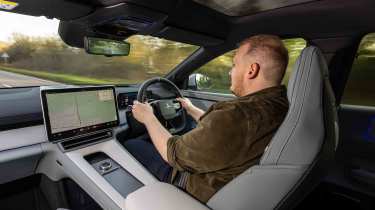
Something you’ll quickly notice behind the wheel of the Polestar 4 is that the driving position is spot on and so are the seats, providing ample support and comfort, plus lots of adjustability. The real elephant in the room is, of course, the lack of a rear window, but you actually quickly forget the car relies on a 8.9-inch digital rear view mirror once behind the wheel, and you can adjust the display’s brightness and view to make it look as natural as possible.
Another curious detail is that there are no traditional drive modes. Instead, the driver can individually tailor the setting for the steering feel, power delivery and regenerative braking, plus the suspension tuning if the Polestar 4 is equipped with adaptive dampers from the Performance Pack.
There are three strength levels for the brake regen/one-pedal driving system: Off, Low and Standard. The strongest setting brings the car to a halt at a predictable pace, and delivers a good amount of stopping force when you lift off the throttle. Turn off the Creep mode, and it will ensure the car comes to a complete stop. Meanwhile, the Low setting provides about the same amount of deceleration as traditional engine braking.
| Model | Power | 0-62mph | Top speed |
| 4 Long Range Single Motor | 268bhp | 7.1 seconds | 124mph |
| 4 Long Range Dual Motor | 536bhp | 3.7 seconds | 124mph |
Performance, 0-60mph acceleration and top speed
The Polestar 4 in single-motor form will go from 0-62mph in a sprightly 7.1 seconds, while the dual-motor version’s extra power and traction allow it to complete the same sprint in 3.8 seconds. Both cars top out at 124mph, however.
The single motor’s 268bhp and 343Nm of torque are close to half the power of the supercar-quick, dual-motor version, but that’s still more than enough for everyday driving, and we like the smooth ramp-up in delivery. In Range mode, there is a slight delay in power delivery from your throttle pedal inputs, but it’s more responsive if you switch into Performance mode.
Those looking for more straight-line impact will need the Polestar 4 dual motor, which ups power to a supercar-like 536bhp with a meaty 686Nm of torque. It feels more responsive, too – although not to the point where you can confidently adjust power mid-corner. Both versions feel pretty similar in terms of the feel you get back from the driven wheels; the car doesn’t seem obviously rear-driven in single-motor form, or all-wheel drive in dual-motor guise. Plus, there’s precious little lift from the nose once you’ve planted your right foot.
Town driving, visibility and parking
At lower speeds, the Polestar 4’s lack of rear window doesn’t cause any headaches because the suite of parking sensors and cameras surrounding the car all help during low-speed manoeuvres.
A bigger issue is the car’s size. At more than two metres wide (excluding mirrors), this is a big vehicle, so width restrictions might be a squeeze.
Factor the large turning circle into the equation, and the Polestar 4 isn’t necessarily the most nimble car for urban use. That’s a shame, because the car’s ride at lower speeds is pretty comfortable – firm, but not harsh – and the cabin is quiet, while the one-pedal driving system is intuitive to use.
Country road driving and handling
Find the right twisty road and switch the stability control into Sport mode, and you’ll feel the rear of the car pushing around tighter corners. The steering is well weighted out of the box and there’s plenty of grip, but the front end doesn't respond rapidly to your inputs, and smooth actions are required so as not to unsettle the car’s mass. Increase your pace, and the ride starts to deliver more pronounced fidgeting at around 40mph, although it’s not a deal-breaker in terms of overall comfort.
Polestar has decided not to pipe fake engine noises or any kind of synthesised soundtrack into the cabin, which some may consider a novelty, but does help to create a more engaging driving experience, as proven by the thrilling Hyundai Ioniq 5 N, while the Porsche Macan Electric features such a system too.
Ultimately, the Polestar 4 isn't as exciting or engaging to drive as the Porsche Macan Electric it competes against, but the brand has announced some changes for the 2027 model year Polestar 4, which is said to address some of these concerns with revised suspension dampers, springs, and anti-roll bar settings to make the car both more engaging and a touch more comfortable.
Motorway driving and long-distance comfort
Cruising at the national limit, the Polestar 4 is quiet and refined, while the suspension feels settled. We’d recommend disabling the energy-recovery systems completely for a smoother drive – there’s little resistance in the powertrain at motorway speeds, which makes it feel like the car is coasting without much sign of slowing when you’re off the throttle.
There’s some wind noise from the side mirrors on the motorway, but road noise isn’t excessive. Overall, the Polestar 4 is a competent motorway cruiser, but not exceptional.
“While I’m in no way under the impression that the Polestar 4 is a performance car, I enjoyed the sheer ease with which it can deploy its vast reserves of power.” – Jordan Katsianis, news editor.
Range, charging & running costs
Pros |
|
Cons |
|
Officially, the big 100kWh battery has 94kWh of usable capacity, and that’s good enough to give the Single Motor model a range of 385 miles. The more powerful Dual Motor model isn’t far behind with a range of 367 miles, though. We’ve seen 3.5 miles per kWh from the Dual Motor model during our long-term testing, which translates into a range of 310 miles from a full charge. A heat pump comes as standard to help maintain range figures in the colder winter months.
The maximum DC charging speed of 200kW, which means a powerful enough source will be capable of taking the battery from 10 to 80 per cent capacity in half an hour.
Quicker 11kW AC charging is provided as standard and allows for a 0-100 per cent recharge in 11 hours, but most homes aren’t set up with a three-phase electricity supply capable of supplying that much power, so a more common 7.4kWh wallbox charger will take 17.5 hours to recharge a Polestar 4 fully.
| Model | Battery size | Range | Insurance group |
| 4 Long Range Single Motor | 94kWh | 385 miles | 45 |
| 4 Long Range Dual Motor | 94kWh | 367 miles | 48 |
Insurance groups
The Polestar 4 falls into insurance group 45 out of 50 in Single Motor guise, while the much more powerful Dual Motor variant is in group 48. By way of comparison, the Porsche Macan Electric ranges from groups 45 to 50, while the Kia EV6 GT is in group 46.
Tax
The Polestar 4’s high list prices mean that every model surpasses the £50,000 electric luxury car tax threshold. This means every version is liable for a surcharge on top of the standard annual VED road tax charge, so you’ll have to pay £640 per year from the second time the vehicle is taxed until it is six years old.
As with all EVs, though, the Polestar 4 sits in the lowest Benefit-in-Kind company car tax bracket. Combine this with this model’s long battery ranges, and it's a viable option for business buyers with a pretty generous budget.
Depreciation
According to our expert data, the Polestar 4 holds on to between 37 and 40 per cent of its original value after three years or 36,000 miles of ownership. That’s far behind the Porsche Macan Electric, which is predicted to retain 56 to 59 per cent of its value after the same time period, while the Audi Q6 e-tron manages to maintain between 45 to 50 per cent of its original value.
To get an accurate valuation of a specific model, check out our free car valuation tool…
Interior, design & technology
Pros |
|
Cons |
|
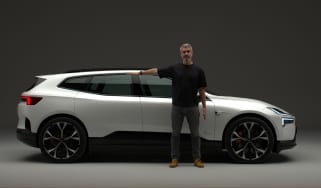
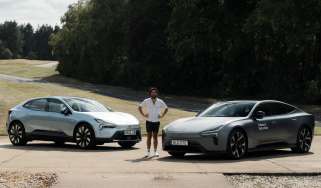
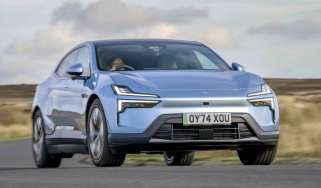
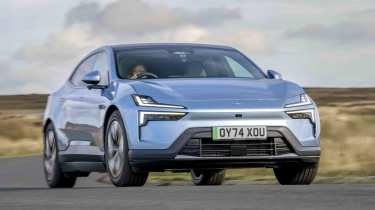
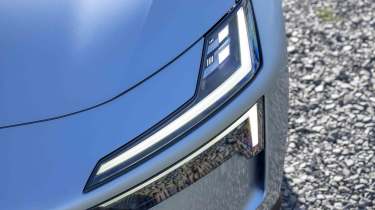
Influenced by the Precept concept from 2020, the Polestar 4 features a purposeful front end with ultra-slim headlights. The car features a higher-riding side profile with contrasting lower-body panels to help hide the battery's position within the wheelbase. The Polestar 4's large dimensions mean it’s bigger than the pictures would suggest, and it has the looks of a low-slung coupe-crossover, but that doesn’t detract from its futuristic look.
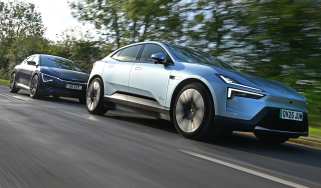
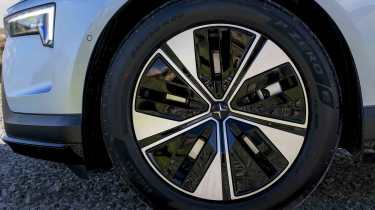
Start to take in the details of the Polestar 4, and you’ll notice the technology on full display, with many of the 12 exterior cameras clearly visible. Flush-fitting door handles, aerodynamically optimised wheels, and a shallow windscreen rake help make the car as slippery as possible through the air, which in turn allows for its impressive range figures. At the rear, you’ll immediately notice there’s no window – a bold move by Polestar and one that could potentially put off some prospective buyers.
The theory behind this is that a rear window is made irrelevant by the standard-fit digital rear-view mirror. It’s an 8.9-inch display, with a nice, clear resolution, despite the rear camera only having 2.5 megapixels. In our test cars, the image moved left and right when indicating, although we didn’t like how the image suddenly jumped rather than gradually panned – we’ve been assured that customer cars will have the option to turn this feature off.
That’s fine, because the 121-degree field of view is great anyway. You can also switch the camera feed off so it becomes a standard mirror for you to check up on rear-seat occupants.
Interior and dashboard design
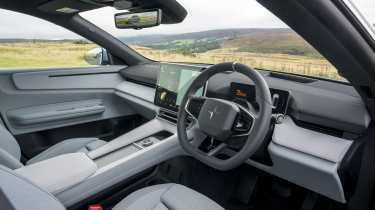
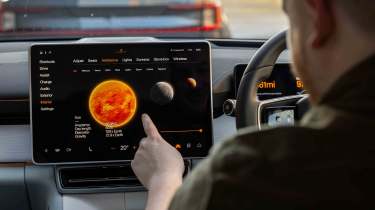
Inside, the cabin is free from clutter. The only physical control that’s not on the steering column is the rotary volume knob on the centre console – even the front air vents are adjusted via the touchscreen. Novel interior lighting gives the cabin a boost at night, which might sound a little cheesy, but there are 10 different colour themes linked to the solar system. Each theme also offers statistics about the sun, moons and planets depicted.
Materials and build quality
The volume knob and column stalks have an upmarket feel, but the touch-sensitive steering wheel controls need a deliberate action to use, while the lack of pictograms takes a bit of getting used to. There are soft plastics in all of the right places, and the sliding metal cover over the centre console cup-holders is a neat touch. The optional Nappa leather seats feel upmarket to the touch, which is good considering they cost an extra £2,600.
Infotainment, sat-nav and stereo
The driver’s display is large, measuring 10.2 inches across, and carries plenty of immediate information for the driver. It’s augmented by a head-up display that can show your speed, navigation direction and road signs.
Next to that is the large 15.4-inch main touchscreen that’s used for everything from adjusting the steering wheel and mirrors to opening the glovebox. Both displays are super-sharp and feature crisp graphics.
With precious few physical buttons, most of the car’s functions are operated via the screen. The steering wheel does come with physical control pads, although the arrows on the side are lit up as they work for a variety of different menus – a strange decision, but one that doesn’t affect the Polestar 4’s usability all that much.
As with other Volvo products, the Polestar 4 has a Google based infotainment system, but the Polestar version also incorpurates AI into its Google Maps app. It should be able to utilise the car's cameras to read road signs and assertain which lane you're in, and feedback with on screen prompts to make sure you're in the correct lane when navigating to a destination.
“By law, you have to have a physical button for the hazard warning lights, and it’s up on the ceiling near the rear-view mirror. It’s not the most obvious place, so there’s also a shortcut on the central touchscreen.” – Max Adams, online reviews editor.
Boot space & practicality

Pros |
|
Cons |
|
A high-set centre console splits the front cabin in two to create a cockpit-style feel up front. There’s plenty of space, while a wide range of seat and wheel adjustment is on offer, although the latter is fiddly because you have to access the settings via the touchscreen, like in a Tesla Model Y, and then utilise buttons on the steering wheel. It’s the same story for mirror adjustment.
The glovebox also uses a screen command to open, but it unveils a useful amount of space once the lid is open. The door bins are long and deep, while the centre console has a sliding cover that reveals twin cup-holders and a wireless charging pad, with an open storage tray below. The centre armrest is long, and although the bin beneath is a little shallow, it does contain two USB-C sockets.
The benefit of the Polestar 4’s headline-grabbing rear end design, with no window, is an impressive amount of headroom for rear passengers – and not just in comparison with other rakish coupe-SUVs.
Dimensions and size
Although it sits below the Polestar 3 in the firm’s line-up and is not as long from nose to tail, the Polestar 4 has a longer wheelbase than its sibling, which provides an impressive amount of interior space. It’s wider than the 3, too, and sits lower to the ground for a more athletic look.
| Dimensions comparison | |||
| Model | Polestar 4 | Porsche Macan Electric | Tesla Model Y |
| Length | 4,840mm | 4,784mm | 4,790mm |
| Width | 2,139mm | 1,938mm | 1,982mm |
| Height | 1,534mm | 1,622mm | 1,624mm |
| Wheelbase | 2,999mm | 2,890mm | 2,890mm |
| Boot space | 526-1,536 litres | 540-1,348 litres | 890-2,130 litres (measured to the roof) |
Seats & passenger space
The seats, which are superbly comfortable, are heated in the front and electrically operated. In addition to the Plus Pack that’s currently standard-fit on every Polestar 4, you can upgrade to perforated Bridge of Weir Nappa leather upholstery, which adds a massage function and headrest speakers to go with the excellent Harman Kardon sound system. The tall floating centre console makes the driver feel cocooned but not hemmed in, although it’s not particularly easy to access the storage underneath when you’re sitting in the car.
The lack of a rear window means the designers have been able to maximise rear headroom, while retaining the sleek exterior look. We’re pleased to report there’s more than enough for six-foot-tall adults, plus even more legroom available, although there’s no space under the front seats for rear passengers’ feet. The side windows also extend further back than normal, and a panoramic glass roof is fitted as standard, so passengers shouldn’t feel claustrophobic sitting in the back.
Boot space
The biggest compromise in the Polestar 4 is its luggage space. It’s not impractical, but the capacity on offer isn’t the greatest for a car of this size. Up front, a 15-litre storage space lies under the bonnet, but it’s not quite big enough to fit a charging cable comfortably, so it’s easier to stow them in a handy 31-litre storage compartment underneath the boot floor.
There’s a high load lip to negotiate, but the boot has a large floor area and a false panel that creates additional shallow storage, although the panel only sits on a thin ledge at the back of the boot, making it too easy to drop down to the lower level. The solid rear door is power operated, but it can be difficult to judge whether the lid will fully close when taller items are loaded up.
In terms of luggage capacity, the Polestar 4 isn’t on the same level as some traditional boxy SUVs, but still gets a sizable 526-litre boot – exactly the same as the Audi Q6 e-tron’s, and very nearly as big as the Porsche Macan’s. Plus, it comes with a height-adjustable boot floor.
The rear seats fold flat in a 60/40 split, which isn’t as flexible as the 40/20/40 split of the Macan Electric. Dropping the rear seats increases the luggage capacity of the Polestar 4 to 1,536 litres.
Towing
The Polestar 4 has a commendable towing capacity of 2,000kg if you get the dual-motor version, or 1,500kg for the single-motor. The former beats the similarly four-wheel drive version of the Tesla Model Y (1,600kg), and matches the Macan Electric.
“Much like the Volvo EX90, the Polestar 4 has frameless side mirrors that you cannot clamp traditional extended towing mirrors to.” – Max Adams, online reviews editor.
Reliability & safety
Pros |
|
Cons |
|
Polestar hasn’t appeared in the Driver Power owner satisfaction survey for a fair while, but the last time it did show, it managed an impressive second-place finish in the 2023 best car manufacturer rankings.
Along with 12 exterior sensors, the Polestar 4 has 12 cameras and a front radar to provide systems such as autonomous emergency braking, lane-keeping assist, adaptive cruise control, driver alert and post-impact braking with as much information as possible. All these systems are standard, plus there are seven airbags and an interior radar to help prevent children and pets from being accidentally left inside. All of this equipment explains the excellent five-star Euro NCAP crash test rating the car earned in 2025.
| Euro NCAP safety ratings | |
| Euro NCAP safety rating | Five stars (2025) |
| Adult occupant protection | 92% |
| Child occupant protection | 85% |
| Vulnerable road user protection | 81% |
| Safety assist | 79% |
Buying and owning
Best buy: Polestar 4 Long Range Single Motor Prime
The Polestar 4 starts from just under £57,000 in Business form, which is a good few thousand pounds less than the Audi Q6 e-tron models, and significantly less than the Porsche Macan Electric. The higher specification Prime starts at around £61,000 in Single Motor form. Those wanting a four-wheel drive Polestar 4 will need to fork out around £64,000, while the Prime trim costs around £68,000. The quickest Performance Prime model comes in at just over £71,000.
Unless you are pulling a caravan or trailer and need the extra towing capacity, the Single Motor version is the pick of the range. It goes further on a charge than other Polestar 4 models, and it’s still quick enough for most needs. We’d advise you to go for the Prime trim because it adds plenty of other useful extras and the comfort pack. You may also want to add the £600 Mist Tailored knit with zinc deco interior because the brighter interior shade seems even more inviting than the charcoal interior.
If you're interested in purchasing a Polestar 4, we can assist you. Configure your ideal Polestar 4 now to get top offers from local dealers, check out the latest Polestar 4 leasing deals or search for used Polestar 4 models with our Buy a Car service. You can even sell your existing car for a great price with Auto Express Sell My Car.
Polestar 4 alternatives
The Tesla Model Y is a little more practical and is cheaper, too. Other alternatives include the Porsche Macan Electric, which costs more but is ultimately more enjoyable to drive, while the Audi Q6 e-tron offers more traditional looks, but can’t match the range of the entry-level Polestar 4.
The main appeal of the Polestar lies in its style and the way it embraces modern technology, even if some tech features are more successful than others.
Polestar 4 Dual Motor long-term test
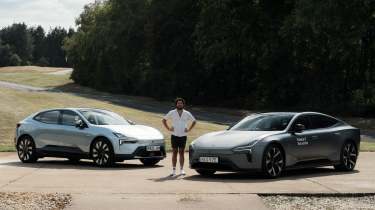
Our news editor, Jordan Katsianis, ran a Polestar 4 Dual Motor Long Range as part of a six-month test, and enjoyed the prodigious performance of the most powerful model in the 4’s range.
Its vast exterior dimensions weren’t ideal for parking in tight London streets, but at least it translated into plenty of interior space when chauffeuring friends around. Read more about our long-term Polestar 4 here...
Frequently Asked Questions
All versions of the Polestar 4 require servicing every 24 months or 18,600 miles, whichever comes first.
Deals on the Polestar 4 and alternatives