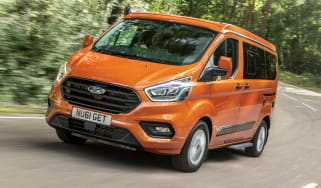
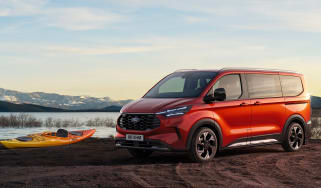
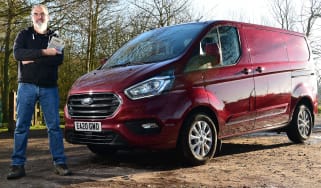
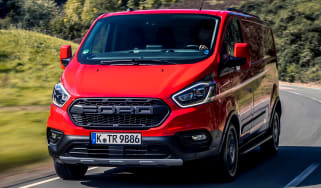
Ford Transit Custom van review
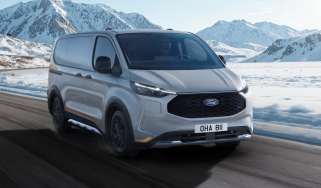
The Ford Transit Custom is as easy to drive as a car, while remaining a highly versatile van
Our opinion on the Ford Transit Custom
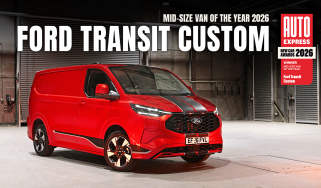
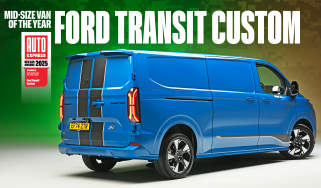
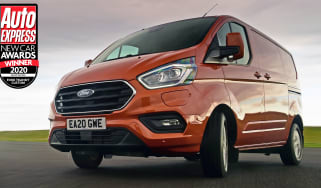
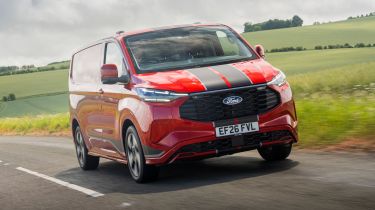
The recipe for the success of the Ford Transit Custom is obvious: take strong cargo carrying capability, add loads of customisation options, a healthy list of standard kit, a car-like driving experience, and you’ll have the best mid-size van around. It’s a familiar name for a reason, and continues to be one of the Ford brand’s best-selling vehicles in the UK. The Transit Custom continues to impress us, retaining its title as Mid-size Van of the Year at the Auto Express New Car Awards, and it’ll take a very strong contender to change this.
About the Ford Transit Custom
It’s fair to say the Ford Transit has changed an awful lot since the first generation arrived in 1965. Today, the Transit is a brand in its own right, with the Ford Transit Courier and Ford Transit Connect fulfilling small van duties, the full-size Ford Transit topping the range, and this Transit Custom sitting in the medium-size category.
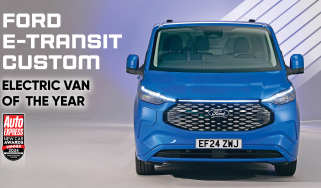
While capacity and payload are still key for any van buyer, many are also keen to save on tax and maximise their vehicle's efficiency. Therefore, the latest generation of Transit Custom has been designed from the ground up to accommodate diesel and plug-in hybrid powertrains. There’s also the fully electric Ford E-Transit Custom to consider, and we have a separate in-depth review of it.
Used - available now

2025 Ford
Transit Custom
3,260 milesAutomaticPetrol1.2L
Cash £18,999It isn’t just the powertrain line-up that’s been worked on, because the Custom now has more sophisticated suspension than its predecessor. This includes an independent rear setup that replaces the solid axle that gave the old model a choppy ride when unladen. The aim has been to deliver an even more car-like drive.
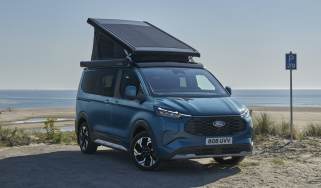
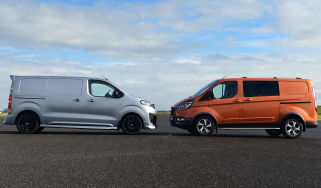
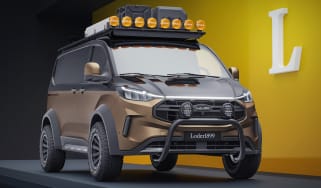
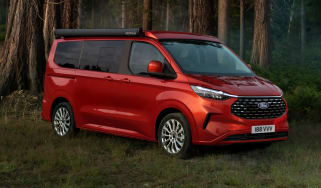
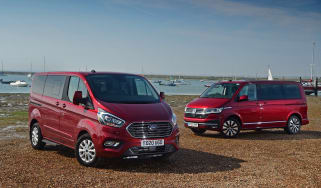
As always, there’s a vast array of configurations for the Transit Custom to suit different scenarios. You can have a Double Cab in-Van with seating for up to six people and a full-width bulkhead behind the second row of seats; a Kombi to transport up to eight people and has a reasonable boot for airport runs, and a passenger-carrying Tourneo Custom – a posh Kombi with plusher seats and seating for up to nine people.
There’s also a MultiCab that meets the needs of those who require extra seating but still want to transport sheets of 8x4 plywood. It has seating for five along with an L-shaped bulkhead around the rear seats to give you a longer load area than a Double Cab in-Van model. There are five trim levels available across the line-up, depending on which engine and bodystyle you go for.
MPG and running costs

Pros |
|
Cons |
|
Improvements to the aerodynamics of the Transit Custom have yielded small gains in fuel economy compared with the previous model. This allows the most economical diesel to return 39.8mpg on the WLTP combined cycle. This isn’t quite as economical as the 118bhp 1.5-litre or 148bhp 2.2-litre diesel units in the Vauxhall Vivaro, though, which are both capable of averaging 42.8mpg.
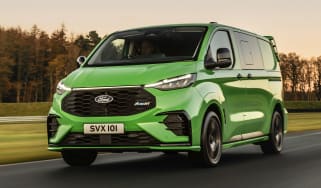
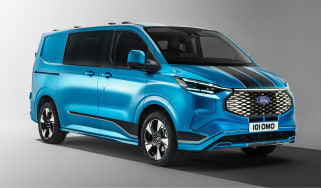
If you opt for the sporty Transit Custom MS-RT with all-wheel drive fitted, this is the thirstiest model at up to 30.1mpg. Generally speaking, you’ll need to opt for the front-wheel-drive variants with a manual gearbox if you want to see higher economy numbers.
All diesel models come with a 20-litre AdBlue tank, and this is used to reduce NOx emissions in the exhaust.
Electric range, battery life and charge time
The Ford Transit Custom PHEV is powered by a 2.5-litre petrol engine combined with a single electric motor. The result is up to 176.6 miles on the WLTP combined cycle, and while it’s unlikely that you’ll see this sort of number in the real world, it is rated to average 39.2mpg when the battery is drained, and you’re relying on the petrol engine, which is the equivalent of the diesels.
Another highlight of this model that’ll be especially important to last-mile delivery drivers is its ability to travel up to 33 miles on electric power alone.
Charging the 11.8kWh battery will take just over 90 minutes to fill from flat to full through a typical 7.4kW home wallbox. DC rapid charging is not supported.
Naturally, it’s the electric Custom that offers the lowest running costs and highest efficiency. However, that’s offset by its higher starting price. Be sure to read our dedicated Ford E-Transit Custom review if this model takes your fancy.
Load space and practicality
Pros |
|
Cons |
|
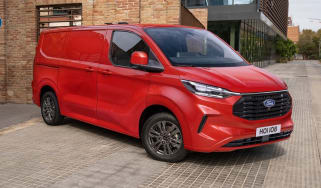
Buyers can choose to have their Ford Transit Custom in multiple height and length combinations, along with the typical Van, Double Cab-In-Van, Kombi or MultiCab bodystyles.
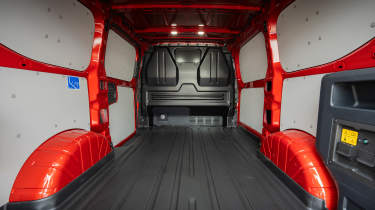
The shortest L1 variant with the H1 roof height has a cargo area capacity of 5.8 cubic metres. This is slightly less than the old model’s six cubic metres, but access has been improved with the sliding side door opening on the passenger (near) side to reveal a gap that’s more than a metre wide.
The double rear doors also have a 1,400mm wide opening, which is slightly wider than that of a Renault Trafic, and there’s a 1,392mm distance between the wheel arches, which is, again, wider than the Trafic. The rear doors have ditched the retaining arms to create less obstruction, but they still open to 90 or 180 degrees.
Go for the longer L2 with the same roof configuration, and you’ll increase capacity to 6.8 cubic metres. The L1 H2, is even more spacious at 7.7 cubic metres, while the longest L2 with a high roof offers 9.0 cubic metres of space. Shorter L1s have six tie-down points (four if it’s a plug-in hybrid), while longer L2s have eight hooks on the load bay floor to lash cargo down to (again, the PHEV has two fewer, at six).
The Transit Custom’s payloads vary depending on the chosen bodystyle and powertrain. The weakest of the bunch is the L1 in Trend trim, with the least-powerful 2.0L EcoBlue diesel, an eight-speed automatic, and front-wheel drive. This variant can take up to 915kg.
At the top end of the payload scale is the L1 in Limited trim, fitted with the most powerful 2.0L diesel, a 6-speed manual gearbox, and front-wheel drive. This is capable of carrying up to 1,355kg.
A full-width metal bulkhead is provided as standard, but you’ll need to step up to a Limited trim to get a pass-through hatch on the passenger side to load even longer items. Double Cab-In-Van versions feature a full-width bulkhead behind the second row of seats, while the MultiCab has an L-shaped bulkhead to offer a best-of-both scenario for carrying people and cargo.
Additional LED cargo area lighting can be added to entry-level Trend models (it’s standard in Limited and above) to help you to find things in the back when you’re out and about in the dark. Additional deadlocks and reinforced door locks are available as options to help protect any tools you may have to leave in your van. It’s a shame an alarm isn’t standard, but it can be added for a small fee.
Reliability, safety and security
Pros |
|
Cons |
|
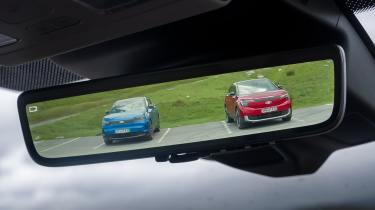
The Ford Transit Custom bagged the full five stars from Euro NCAP when it was tested in 2025. Subcategory-wise, it scored 80 per cent for safe driving, 93 per cent for crash avoidance, and 80 per cent for post-crash safety.
This is in part thanks to a full suite of standard safety kit, including active emergency braking to warn you if it thinks you’re about to collide with something, speed limit recognition and assist (which can engage a soft limiter that restricts your speed to the last recognised limit) to hopefully prevent you from having to sit through a speed awareness course, lane departure warning to let you know if you’re straying out of your lane, and a driver tiredness alert if you’ve been behind the wheel for a while and ought to take a break.
As standard, you get driver and passenger airbags. The latter airbag can be removed for free, though we think you’d be mad to do so given the additional safety it provides to a driver’s mate. Side and curtain airbags are also available as a reasonably priced option for even greater safety, and the pack adds the luxury of heated driver and passenger seats – ideal after a cold, wet day on the job site.
The van is holding up well against the challenges of day-to-day work, but there's a three-year or 100,000-mile manufacturer's warranty should you need it, and there are plenty of Ford service centres dotted around the country whenever maintenance is required.
Driving and performance
Pros |
|
Cons |
|
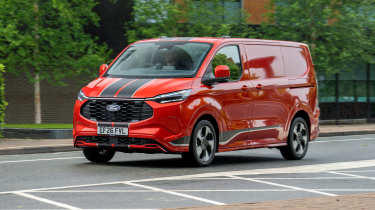
A diesel engine is never going to be as serene or punchy as a PHEV, let alone an EV, but Ford’s EcoBlue unit is relatively smooth. It comes with four outputs, and the mid-range 148bhp version delivers strong pace. The six-speed manual gearbox is also slick to use, so it’s still easy to keep the Transit Custom in its power band if you don’t want to pay out more money on an automatic.
Our diesel-powered test van was carrying around half a tonne of payload in the back, so we’d experience what it’d be like to carry a typical amount of weight. We have to say the suspension does a great job of ironing out bumps, delivering excellent comfort for a commercial vehicle. Engine, road, and wind noise are also well suppressed, especially at higher speeds. The door mirrors, despite being quite large, are sculpted so that there’s next to no wind noise from them.
The steering, brakes, gearshift and throttle are all brilliantly calibrated and easy to use, so you’ll have no trouble jumping from a smaller Ford car and spending the day driving a Transit. Thanks to these excellent driving manners, the Transit remains the standout leader in driving dynamics in the class.
For maximum oomph, you’ll want the PHEV as this pumps out 229bhp. The initial shove that this powertrain provides allows the Transit Custom to get away from a standstill quickly, but the most beneficial feature for long-distance drivers will be the much quieter running of the petrol engine and electric motors.
Town driving, visibility and parking
The Custom is pretty easy to drive around town thanks to its high driving position giving a clear view forwards. The mirrors also feature a lower wide-angle section for better rearward visibility. The steering is responsive, the turning circle is tight, and this van feels agile even when navigating tighter bends.
Motorway driving and long-distance comfort
Motorway refinement is good overall, with bumps sent through the body. The ride quality is generally better and more stable with a payload on board, though. The more powerful diesels are particularly responsive at higher speeds.
Cab interior and technology
Pros |
|
Cons |
|
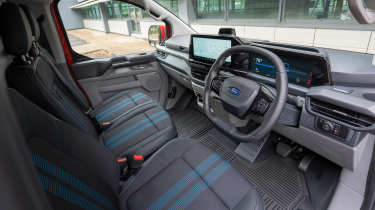
There are plenty of innovations within the Ford Transit Custom’s cab. The brand has fitted 5G connectivity for telematics, while opting for the Mobile Office option pack adds a tilting steering wheel that can be used as either a tablet stand or a desktop when stopped – there are built-in safety systems that mean it can’t tilt when driving.
Whether it’s fitted with the tilting function or not, the oblong-shaped steering wheel requires some acclimatisation, especially as the heavily canted angle at which it operates seems to exacerbate how tall it is rather than its width.
Some of the layout for the dashboard in the Transit Custom is a bit scattered – the starter button for vans with keyless entry is up next to the touch screen, while the electric handbrake release is set between the air vents, for example, but all of these quirks will become familiar over time.
Infotainment, sat-nav and stereo
All versions of the Transit Custom come with a 13-inch landscape touchscreen featuring SYNC 4 and Alexa integration as standard. You can pay for an internal navigation system, but it’ll probably make more sense to use a navigation app via the infotainment screen’s standard Android Auto and Apple CarPlay.
The climate controls are located on the screen, which is a shame, in our opinion. The physical dials used in the older Transit Custom were very straightforward to use on the move, so it feels like the Transit has taken a step backwards in terms of usability. Rivals like the Renault Trafic still retain physical controls for frequently used functions, making them less distracting on the move.
Buying and owning
For those who want to eke out the lowest running costs but aren’t ready to switch to a fully electric van, the Transit Custom PHEV will be the best choice. Shorter-distance drivers will also benefit from this van’s electric range when travelling around towns and cities.
However, opting for this powertrain commands a price premium over the equivalent diesel, so our overall recommendation is the more powerful 148bhp engine, because it can handle heavier payloads while providing ample acceleration for motorway runs and decent efficiency.
When it comes down to bodystyles, the best one for you will often boil down to the requirements of your business, but we like the double-in-cab, short wheelbase model - especially for those also using this as their family weekend wheels. Its rugged appearance makes this more appealing than a typical van with windows, and it has seating for up to six people.
Alternatives
The medium panel van market is a very popular one, so there are plenty of Transit Custom contenders to choose from. Stellantis has no fewer than four models up for grabs: the Citroen Dispatch, Fiat Scudo, Peugeot Expert and Vauxhall Vivaro. All of these models are closely related, and they were all commended at the 2026 Auto Express New Car Awards.
Another van that we rate rather highly is the Volkswagen Transporter. This now shares many underpinnings with the Transit Custom, and it’s worth taking a look as it brings its own unique pros and cons to the platform. Compare the two and you might just find a superior finance deal along the way.
If this still isn't enough choice, you can always move towards the Nissan Primastar and Renault Trafic.
Ford Transit Custom pictures
Frequently Asked Questions
A three-year, 100,000-mile warranty covers all new Ford Transit Custom models, which is the same time and mileage period as many rivals. The battery warranty for the plug-in hybrid is eight years or 100,000 miles, whichever comes first.
| Van dimensions | |||
| Body style | Height | Width | Length |
| SWB low roof (L1H1) van | 1,968mm | 2,032mm (2,275mm inc mirrors) | 5,050mm |
| SWB high roof (L1H2) van | 2,471mm | 2,032mm (2,275mm inc mirrors) | 5,050mm |
| LWB low roof (L2H1) van | 1,966mm | 2,032mm (2,275mm inc mirrors) | 5,450mm |
| LWB high roof (L2H2) van | 2,464mm | 2,032mm (2,275mm inc mirrors) | 5,450mm |
| Load area dimensions | ||||
| Body style | Height | Width | Length | Volume |
| SWB low roof (L1H1) van | 1,322mm | 1,392-1,777mm | 2,602mm | 5.8m3 |
| SWB high roof (L1H2) van | 1,322mm | 1,392-1,777mm | 2,602mm | 7.7m3 |
| LWB low roof (L2H1) van | 1,822mm | 1,392-1,777mm | 2,794mm | 6.8m3 |
| LWB high roof (L2H2) van | 1,822mm | 1,392-1,777mm | 2,794mm | 9.0m3 |