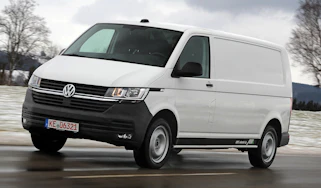
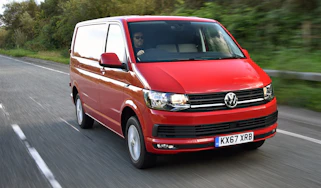
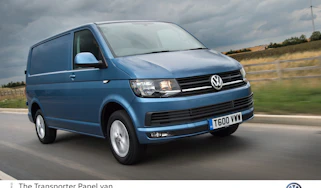
Volkswagen Transporter van review
The latest Volkswagen Transporter is based on the Ford Transit Custom, both are top vans but a few things help the VW stand out

Our opinion on the Volkswagen Transporter
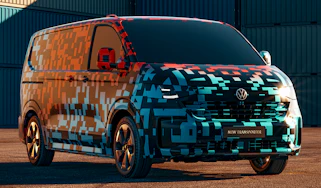
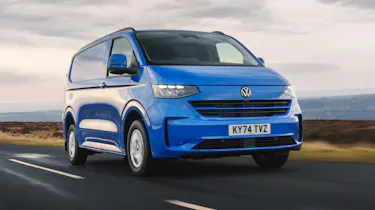
The latest Volkswagen Transporter now shares a great deal with the top-selling Ford Transit Custom as a further continuation of the two brands' ongoing partnership. Some may bemoan that the Transporter has lost some of its individuality as a result, but elsewhere, things are very positive.
The latest Transporter has more space, impressive payloads and a diverse range of powertrains encompassing diesel, electric and PHEV power to best suit the needs of customers. There are even some reasons to pick the VW over the Ford - its wheel arches are lined as standard for better refinement, and most notably, it gets a five-year warranty and five years of servicing as standard.
About the Volkswagen Transporter
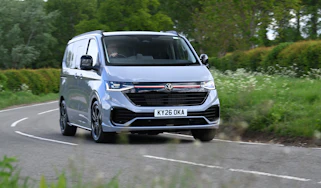
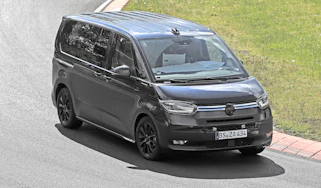
They say you should keep your friends close and your enemies even closer. Volkswagen clearly subscribes to this mantra, because its seventh-generation Transporter panel van and Shuttle people carrier share a good deal with the Ford Transit Custom. It’s part of a collaboration that’s already given us a Volkswagen Caddy-based Ford Transit Connect and a Volkswagen Amarok derived from the Ford Ranger, so the question is, can the Transporter beat the Transit Custom at its own game?
Spoiler alert, but which option buyers end up choosing is likely to come down to the nitty-gritty of specifications, which van is offered on a better deal or which badge they prefer – and if it’s not already obvious, the Transporter and Transit Custom are very closely matched. There are some notable differences, though, and something as simple but important as the standard five-year aftercare packages and warranty VW throws in as standard could swing it.
Used - available now

2018 Mercedes
C-Class Coupe
26,070 milesAutomaticPetrol2.0L
Cash £18,995
2019 BMW
1 Series
28,945 milesManualPetrol1.5L
Cash £12,497
2023 Ford
Puma
65,365 milesManualPetrol1.0L
Cash £10,997
2021 Kia
Sportage
50,010 milesManualPetrol1.6L
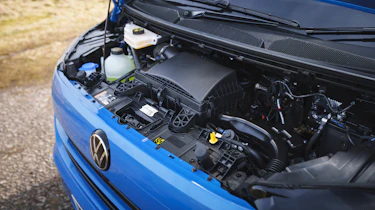
Cash £12,697Volkswagen claims that space, payload, towing ability, and features are all improved over the outgoing T6.1 Transporter, plus there’s a host of engine options to pick from. As before, there’s a 2.0-litre TDI diesel, which comes in 109bhp, 148bhp or 168bhp outputs. This engine has a six-speed manual in 109bhp form, while an eight-speed automatic is standard with the 148bhp and 168bhp versions. The brand’s 4MOTION four-wheel drive system is an option if you pick the 148bhp diesel.
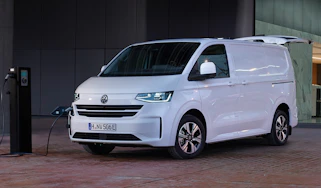
Urban-based fleet operators will be most interested in the electric versions with 134bhp, 215bhp or 282bhp and rear-wheel drive, a 64kWh battery and a range of around 200 miles. There’s also the Transporter eHybrid plug-in hybrid with a 2.5-litre petrol engine, electric motor and battery pack for customers who need to drive into city centres as well as regularly tackling longer trips.
Numerous versions of the Transporter will eventually be available, kicking off with the short and long wheelbase panel vans that arrived first, and then a Kombi, a Transporter Shuttle passenger version with up to nine seats, a dropside and high-roof versions with up to nine cubic metres of load space.
Measuring 5,050mm in short wheelbase guise, the Transporter is 146mm longer than the T6.1, resulting in a 61mm longer load compartment, while its wheel arches have also been pushed further apart to boost load space by around five per cent.
In the UK, the Transporter is available in Commerce, Commerce Plus, Commerce Pro, Commerce Pro S and Sportline trims, with the entry model featuring black bumpers, LED headlights, rear barn-style doors, a sliding side door on the passenger side, air conditioning, electrically adjusted and heated door mirrors and an alarm system. The aforementioned infotainment set-up is standard, and it includes rear parking sensors and keyless start.
Upgrading to the Commerce Plus version adds items including body-coloured exterior trim, climate control, a spare wheel, front parking sensors, a reversing camera and a larger fuel tank, with electric versions gaining a heat pump.
Commerce Pro raises the luxury with heated seats (standard on electric Commerce Plus models), adaptive cruise control (for automatic gearboxes), a heated windscreen, additional charging ports, extra LED load compartment lighting and 16-inch alloy wheels.
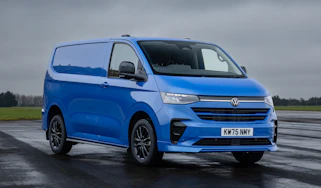
The Pro S is one of two sporty-looking options in the range. It swaps the rear barn doors for a single tailgate while adding 17-inch black alloy wheels, a sportier front bumper, and a rear spoiler. With all of that plus the normally optional Mid Blue paintwork included as standard, there’s a certain Golf R vibe about the Pro S.
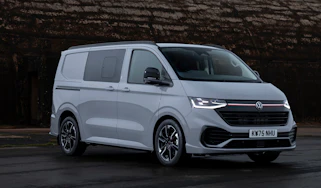
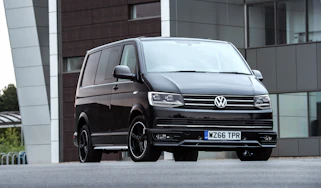
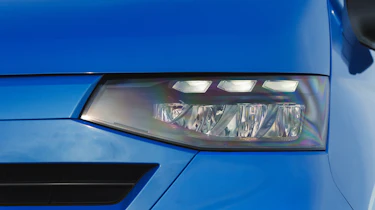
If the Pro S is the Volkswagen Golf R of the range, the Sportline is the Golf GTI. A staple of the Transporter range for some time, the new model’s Ford roots haven't stopped Volkswagen from adding it this time around. Joining the line-up in 2026, it includes a different design of front bumper, a rear spoiler, gloss black mirror housings, 19-inch diamond-cut alloy wheels, lowered suspension, Matrix LED headlights, and, of course, a GTI-style pinstripe between the headlights.
MPG and running costs
Pros |
|
Cons |
|
Volkswagen clearly wants the Transporter and its Shuttle passenger derivative to appeal to more customers than ever, because there are no less than seven powertrains to choose from, spanning diesel, electric and plug-in hybrid (PHEV). The latter is particularly interesting, because it marks the first time such a powertrain has ever been offered in the Transporter, and it remains a rare thing in the van world.
Stick with diesel, and these are engines carried over from the Transit Custom, so while there have been some minor aerodynamic tweaks, the Transporter can only hit a maximum of 40.9mpg while emitting 181g/km. That’s in its entry-level 2.0 TDI diesel, short wheelbase guise with a six-speed manual gearbox; with 148bhp and an eight-speed automatic, it posts 37.7mpg (196g/km). Add 4MOTION four-wheel drive, and this sinks slightly further to 34mpg, and it puts out at least 218g/km, so you’ll want to consider how often you tackle slippery terrain before ticking this option.
This is fractionally ahead of the 40.4mpg of the Ford Transit Custom and matches the 40.9mpg of the Renault Trafic 2.0 130 DCi manual. The Transporter comes standard with a 55-litre fuel tank, which is quite a bit smaller than the 80-litre tank of the Renault, so drivers will need to pull in a bit more often on really long trips.
Just like its Ford sister vehicle, the Transporter gets a PHEV option, badged eHybrid. This version targets city-based operators who require a longer range for an occasional extended trip.
Electric range, battery life and charge time
The e-Shuttle and e-Transporter both use a 64kWh lithium-ion battery, with a WLTP range of up to 201 miles for the 134bhp version – eight miles down on the Ford. This is a slightly smaller capacity than the Ford E-Transit Custom, which can go 236 miles between charges. The e-Shuttle can charge at up to 11kW using an AC charger and 125kW using a DC rapid charger, for a top-up from 10-80 per cent in as little as 39 minutes – that’s the same peak charging speed as the Ford.
The eHybrid has an 11.8kWh battery pack to give a range of up to 34.8 miles depending on the trim level and body style. The fuel economy is rated at up to 76.3mpg, with the usual caveat about the actual figure varying depending on how much charge you start with, how far you’re going and the kind of driving you’re doing.
The eHybrid’s maximum recharging rate is limited to 3.7kW, much lower than the 7.4kW outputted by most home wallbox chargers. A full charge from empty will take 4.5 hours.
Load space and practicality
Pros |
|
Cons |
|
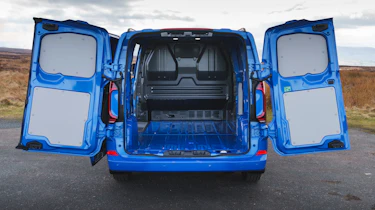
Versus the outgoing Transporter T6.1, there’s more space and increases in both payload and towing figures. The standard height panel van has 5.8 cubic metres of capacity, and the sliding side door measures 1,030mm by 1,301mm. Cargo volume grows to nine cubic metres for the long wheelbase high-roof version, which can accommodate three standard pallets – two loaded from the side and one from the rear.
The gap between the Transporter’s rear wheel arches has grown by a very useful 148mm to 1,392mm. The load compartment has also grown, gaining 61mm in length (2,602mm total) in standard length, while the long wheelbase version tops out at 3,002mm. Customers can also pick between a rear tailgate or wing doors. Sadly, you won’t be able to get the same L-shaped bulkhead offered in the Transit Custom that provides a full-length load area for pipes and long planks, but there is a load-through hatch into the space under the bench seats inside the cabin.
VW was keen to tell us it had targeted a payload of more than one tonne for the latest Transporter, with up to 1,088kg in the e-Transporter and 1,280kg in the diesel. It’s important to check the payload for the precise version you’re ordering, because it can drop as low as 767kg in the long wheelbase 148bhp diesel automatic. Again, depending on the spec, the Transporter can tow up to 2,800kg (300kg more than the T6.1) and carry 170kg on its roof, which is a 20kg increase.
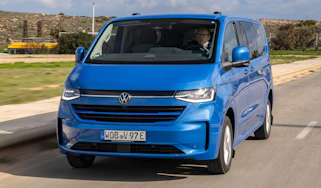
Buyers can spec the Transporter Shuttle (still called Caravelle in Europe) with eight or nine seats, and VW sees it as a more commercial offering aimed at, well, executive and airport shuttle drivers, while both the Volkswagen Multivan and Volkswagen ID. Buzz cater to recreational buyers. Pick the most basic Shuttle and there are three individual seats in the middle row, along with a removable three-seat bench for the third row. Legroom impresses, particularly in the long-wheelbase version. The Pro S, Sportline and Shuttle get a giant hatchback, which doesn’t take too much effort to open and close, but requires a fair bit of room to be left behind the vehicle for it to swing out into.
Reliability, safety and security
Pros |
|
Cons |
|
Safety used to be a bit of a sore subject for vans, but independent crash-test body Euro NCAP has upped its testing of late, helping to promote increased safety levels. The Transporter gained the top rating, with a 96 per cent safety score and Platinum award. Safety kit includes items such as autonomous emergency braking, lane assist, traffic sign recognition and driver, front passenger and curtain airbags.
There’s also some extra safety kit in higher trims, with the Commerce Plus adding front parking sensors, a rear-view camera and towing protection. The Commerce Pro grade adds cross-traffic and lane assist, blind spot and exit warnings and adaptive cruise control.
Being an all-new model, there’s no data yet on how reliable the Transporter will prove to be. It’s reassuring, though, that VW trumps Ford and Renault’s three-year/100,000-mile warranty thanks to its impressive and standard ‘5+ Promise’ that includes a five-year/124,000-mile warranty, five services, two MoTs and five years’ roadside assistance. This alone could sway buyers wondering why they’d pick the VW over the Ford or one of its other rivals.
Driving and performance
Pros |
|
Cons |
|
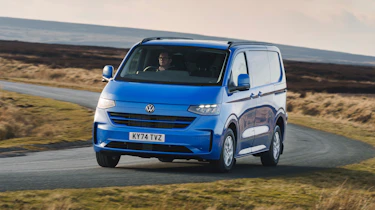
The Transit Custom already has a reputation for being the best van to drive, so the Transporter has a good platform to build upon. The steering of the Transporter is a little light at low speeds, and lacking some of the clarity of older Transit models, but it’s still impressively precise for a van and miles ahead of most rivals.
While it certainly isn’t as smooth as the electric motor in the e-Transporter, the 2.0-litre TDI diesel engine is also pretty inoffensive once it warms up, and the van settles into a hushed cruise. There’s a tiny bit of vibration through the steering wheel, but it’s only really noticeable when you first pull away, and the eight-speed automatic gearbox in the 168bhp version we tested did a good job of smoothing out upshifts. It struggled a bit picking the right gear when we tackled a twisting mountain road, but we doubt this will be an issue during most Transporter drivers’ daily duties. If anything, we’d say the less powerful 148bhp should offer the best compromise, while the 109bhp van will be okay for urban tasks, but might feel a bit out of its depth at higher speeds with a heavy load onboard.
Handling is certainly assured, with the van happily turning into sharp bends keenly and without too much body lean. It’s impressively resistant to understeer, but if you do get over-excited, the van’s electronic systems will gently intervene to keep things on track.
The Sportline is inevitably the best-driving version of the lot. It has a lowering kit from suspension specialist Eibach, dropping the ride height by 29mm to give it a sportier look and a noticeable reduction in body roll. The wider tyres add grip, while the sports seats do a better job of holding you in place.
The improved looks and sharpened handling come at a slight cost in ride comfort. It can be a little crashy over potholes, but it’s not drastically worse than the regular Transporter.
We also tried the 282bhp electric motor in the Transporter e-Shuttle, and found it both impressively smooth and refined, providing an even more car-like driving experience. While it’s a lot of power for a van, the throttle is tuned to introduce it gradually, so speed builds rather than arriving all at once.
Town driving, visibility and parking
While it might be a fairly big van in terms of its cargo space, the Transporter feels pretty wieldy from behind the wheel. It’s no wider than a large SUV, you have a great view out, and it boasts a sharp turning circle. Short overhangs also make it easy to place when parking.
The suspension doesn’t get too bouncy when faced with potholes either. The e-Shuttle is especially well-suited to short hops thanks to its lack of gears, smooth acceleration and regenerative braking.
Motorway driving and long-distance comfort
With a long wheelbase and precise steering, the Transporter feels easy to pilot at the national speed limit. It’s not badly affected by cambers as you drive along, and if you do need to make a sudden lane change, it feels reassuringly well tied down.
Cab interior and technology
Pros |
|
Cons |
|
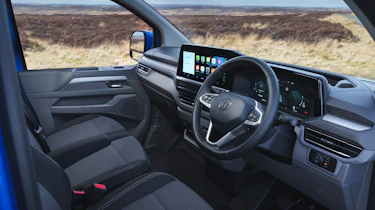
Climb inside and there’s a lower roof than the old Transporter, so the cab has a more cosy feel. You’ll still find plenty of headroom, and it’s easy to get comfortable. There’s excellent visibility with Volkswagen retaining large twin door mirrors with normal and blind-spot mirrors on both sides.
There’s no shortage of clever features in the cab, and the designers have paid lots of attention to making sure you can keep all your mobile devices and tools topped up between jobs. There are USB-A, USB-C and 12-volt chargers, along with a 230-volt outlet mounted at the base of the driver’s seat in diesel versions. PHEV and electric versions can offer even more juice, with two optional 230V sockets in the luggage compartment that can provide up to 2.3kW in total. One item that hasn’t been carried over from Ford to VW is the Transit Custom’s optional tilting steering wheel, which can also double as a table.
Infotainment, sat-nav and stereo
For better or worse, the cockpit of the latest Transporter is all new and fully digital, featuring a 12-inch instrument display and a 13-inch central touchscreen that supports Apple CarPlay, Android Auto, and numerous online services. This is based on Ford software, but with new graphics to tie in with VW’s ecosystem.
The central screen also takes care of the climate control settings, which is something of a backwards step for usability from the physical controls of the old T6.1. However, they do at least remain in a band that’s always on display across the bottom of the screen, so you don’t have to go hunting for them in sub-menus. Beneath the screen there are also a few physical buttons to jump straight to important settings such as the parking cameras, windscreen demister and driving mode.
Buying and owning
The core VW Transporter diesel range is straightforward, and most buyers are likely to stick with the entry-level trim and 109bhp engine with a manual gearbox. This offers great value and the best fuel economy figures. If you think the black bumpers on this version look too low-rent, the Commerce Plus gets body-coloured trim and extra features, so it’s a pretty big upgrade. The Pro S and Sportline models feel like more of an indulgence, but there’s no denying how good they look.
For extra performance, the 148bhp diesel could also be a worthwhile option, while operators with lots of short trips and urban driving should consider the electric e-Transporter.
Volkswagen Transporter alternatives
The medium van class is the most popular in the UK, so the Transporter isn’t short of rivals. First off, it has to beat the Transit Custom, which was designed alongside. That’s no mean feat, because the Ford is widely regarded as the best medium panel van. It just pipped the Transporter to be named our best mid-size van choice in the 2026 Auto Express New Car Awards, helped by a wider choice of engine options that aren’t available at the moment in the Transporter.
Then the Transporter needs to fend off the Vauxhall Vivaro, Citroen Dispatch, Peugeot Expert, Fiat Scudo and Toyota Proace - all of which also share the same fundamental underpinnings. After that, there’s the Renault Trafic and Nissan Primastar. If you fancy an upmarket van, you could also consider the electric Volkswagen ID. Buzz Cargo - although it does offer less cargo space - or the Mercedes Vito.
Volkswagen Transporter pictures
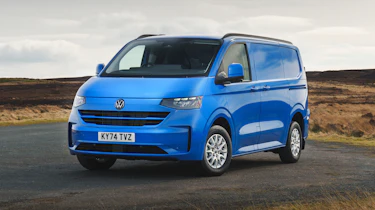
Key updates of the Volkswagen Transporter review
26 October 2026: Latest driving impressions and pricing data.
Frequently Asked Questions
Thanks to Volkswagen’s ‘5+ Promise’ package, the Transporter comes with an impressive five-year/124,000-mile warranty. This beats quite a few rivals, including the Ford Transit Custom, which, with which it shares many of its parts.
Van dimensions
| Body style | Height | Width | Length |
| L1H1 van | 1,978mm | 2,032mm | 5,050mm |
| L2H1 van | 1,978mm | 2,032mm | 5,450mm |
| L2H2 van | 2,480mm | 2,032mm | 5,450mm |
Load area dimensions
| Body style | Height | Width | Length | Volume |
| L1H1 van | 1,316mm | 1,392-1,777mm | 2,602mm | 5.8m3 |
| L2H1 van | 1,316mm | 1,392-1,777mm | 3,002mm | 6.8m3 |
| L2H2 van | 1,870mm | 1,392-1,777mm | 3,002mm | 9.0m3 |