Used Mazda 2 (Mk3, 2015 - 2025) review and buyer's guide
A full used buyer’s guide on the Mazda 2 covering the Mazda 2 Mk3 (2015 - 2025)

Across Europe, more new superminis are sold each year than any other type of car. As a result the stakes are high; you need a really good product to stand out.
Thankfully, Mazda has a habit of coming up with great cars, even if some buyers won’t immediately think of them at purchase time. The original Mazda 2 was launched in 2003, when it replaced the Demio, and since then this smart-looking supermini has provided a stylish and well made alternative to more obvious small hatches.
Never a budget option, the Mazda 2 has always been good to drive, reliable and distinctive, and that’s certainly the case with this third-generation model.
Models covered
- Mazda 2 Mk3 (2015-2025) - Low sales numbers mean Japanese hatch is a hidden gem in the supermini class.
History
The Mazda 2 Mk3 went on sale in February 2015 with a choice of 1.5-litre diesel (Skyactiv-D) or petrol (Skyactiv-G) engines. The former came only in 104bhp form whereas the latter was offered in 74bhp, 89bhp and 114bhp flavours. All came with a manual transmission, but the 89bhp petrol engine had an automatic option.
Suspension and steering improvements in April 2017 sharpened the Mazda’s handling, while extra soundproofing improved refinement. Further updates in October 2019 brought a tweaked nose, upgraded interior, extra standard equipment and mild-hybrid tech (dubbed M Hybrid).
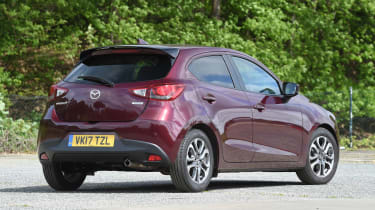
There have been numerous special editions along the way, including the Sport Black (September 2015), the Red Edition (September 2016), the Tech Edition (July 2017) and another Sport Black (April 2018), all with the 89bhp petrol engine only.
Used - available now

2022 Mazda
2 Hybrid
35,254 milesAutomaticPetrol1.5L
Cash £13,249
2022 Mazda
2 Hybrid
10,666 milesAutomaticPetrol1.5L
Cash £15,630
2022 Mazda
2 Hybrid
24,378 milesAutomaticPetrol1.5L
Cash £15,146
2022 Mazda
2 Hybrid
13,261 milesAutomaticPetrol1.5L
Cash £15,100The Mk3 Mazda 2 was discontinued in 2025 but the Mazda 2 Hybrid, a completely different model based on the Toyota Yaris, remained on sale.
Which one should I buy?
Mazda has stuck with a non-turbo petrol engine, which doesn’t feel as zesty as some rival units; even the diesel doesn’t feel as torquey low down as you might expect. We’d buy at least an 89bhp petrol; even better if it’s the 114bhp unit, although this only came in pricier range-topping trims.
The entry-level SE comes with air-con, a multifunction steering wheel and powered front windows, while the SE-L adds 15-inch alloys, power-folding heated door mirrors, electric rear windows and Bluetooth; the 89bhp SE-L and diesel SE-L also get a DAB radio and a seven-inch touchscreen display.
The range-topping Sport comes with 16-inch alloys, privacy glass, automatic lights and wipers, climate control, rear parking sensors and keyless go; 114bhp cars also include LED headlights.
Alternatives to the Mazda 2 Mk3
The Mazda 2 is up against a lot of high-profile rivals, not least of all the Ford Fiesta which is plentiful, well made, brilliant to drive and has a wide model range. The Vauxhall Corsa is another top-value supermini that’s plentiful and roomy, while the Renault Clio and Peugeot 208 offer decent value and ready availability with reasonable build quality; both have wide model ranges, too.
If you want a supermini with a hybrid option, the Toyota Yaris is reliable, but uninspiring to drive and sit in. Two other premium superminis that major on ease of use over excitement are the Audi A1 and Volkswagen Polo – or you could buy a Skoda Fabia or SEAT Ibiza, both of which are related but more affordable, despite sharing the same efficient engines and transmissions.
What to look for
Towing
Every Mazda 2 model is homologated for towing, and they all have a 900kg braked limit to what they can pull.
Safety kit
SE and 74bhp SE-L cars don’t have auto emergency braking; 89bhp petrol and diesel models in SE-L trim and above do.
Climate
One of the more common gripes with the Mazda 2 is faulty air-con. It might just need regassing, but don’t assume that this is the case.
Diesel
Don’t buy a diesel Mazda 2 unless you regularly undertake long journeys; short trips are known to clog up the diesel particulate filter.
Interior
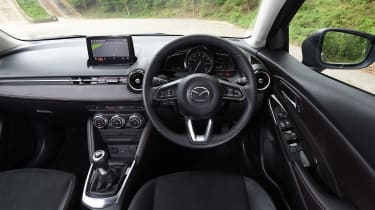
The Mazda’s cabin looks upmarket and is well built; top-spec models feel quite premium. There are a fair number of soft-touch materials, although some lower-quality plastics can be found.
It’s well designed and uncomplicated, with intuitive infotainment on all models apart from SE – this entry-level model has an AM/FM radio with a CD player and USB connectivity, and it also foregoes split-folding rear seats; SE-L models and above have a 60:40 function. Rear seat and boot space are disappointing; the 2 can hold just 280 litres with the back seats up, or 960 litres with them folded. As you might expect, sat-nav is standard on Nav models.
Prices
Check out the latest used prices for the Mazda 2 on our Buy A Car service or use our Free Car Valuation tool for a price on a specific car.
Running costs
All Mazda 2s need to be serviced every 12 months or 12,500 miles, whichever comes first, regardless of engine. Services alternate between minor and major, but they’re perhaps not as cheap as you might expect for a supermini, costing £179 and £299 respectively.
However, the cost of a major service does include brake fluid, which is due every two years, and because all Mazda 2 engines are chain driven there are no cambelts to replace. The sixth service is a big one, at £449, because as well as oil and filter replacement, the air and pollen filters, plus the brake fluid, are changed. To help you budget for maintenance, Mazda dealers offer service plans for up to three years and 37,500 miles.
Recalls
Only two recalls have been issued for the Mazda 2 since summer 2014, and the most recent (in May 2017) was for the second-generation car. The third generation reviewed here has been recalled only once, in August 2016.
This action affected 1,489 Mazda 2s built in January 2015, which could suffer from fuel leaks. During the manufacture of their fuel tanks, silicone may have not been removed from the metal before everything was welded, leading to the tank not sealing. The solution was to fit a new tank, which was done under warranty.
Although this was a fairly serious issue, the fact that this generation of Mazda 2 didn’t have to be recalled on any other occasions is impressive, and a testament to its build quality, which should be encouraging to anyone looking at a used example.
Driver Power owner satisfaction
The Mazda 2 finished 39th out of 75 in the 2019 Driver Power new car survey, while it achieved 45th out of 100 in our used car poll. The Mazda scores above average in most areas, but owners aren’t impressed by the all-round visibility, cramped cabin and boot, or the ventilation. Encouragingly, the Mazda 2 averages 4.7 out of 5 in the Carbuyer owner reviews, with most owners awarding the full five stars.
Verdict
Although higher-profile alternatives such as the Clio, Fiesta and Corsa often dominate supermini talk, the Mazda 2 does a great job of being an impressive all-rounder, if not a class leader. The biggest shortcomings are the relatively cramped cabin and small boot, so if practicality is key for you the Mazda probably won’t suit. Another downside is the narrow model range, because while at launch there were 16 derivatives to choose between (albeit with just two engines), this had been slimmed down to just five petrol models by the time of the 2019 facelift. However, if one of those editions fits in with your needs the Mazda is well worth a closer look, with its low running costs, excellent dynamics and distinctive design.
Mazda 2 (2015-2025) review: what we said
Good looks, practicality and engaging driving characteristics mean the latest Mazda 2 is a serious contender in the supermini class. While other brands seek efficiency through small capacity engines and turbocharging, Mazda sticks to larger, naturally-aspirated engines that give punchy performance and decent economy.
The Mazda 2’s spacious, well-designed interior has a quality feel for the most part, and the car is good value and safe too. With low running costs and strong demand for used versions meaning residual values should stay pretty healthy, the Mazda 2 is a supermini that can appeal to the head as well as the heart.
About the Mazda 2
The Mazda 2 is the company's smallest car, but there are plenty of small Mazdas in the company's history. One of its first cars was the Carol, a tiny saloon with a 360cc petrol engine. Since then, Mazda has offered the 121 and the Demio, and the latter is what the Mazda 2 is still called back in Japan.
If you want something different from your supermini, then the Mazda 2 could be right up your street. The current car is the Mk4, which was introduced in 2014. And while it's gunning for sales in the hard-fought supermini class, it has plenty of appeal for buyers looking for a sporty small car with fun handling and decent economy.
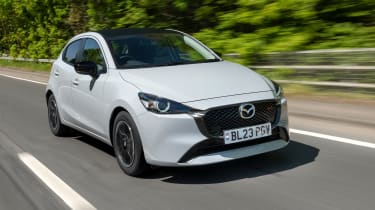
The sharp shape is compact and appealing, while the large grille, distinctive eagle-eye headlights and LED running lights on higher spec cars add to its looks. Mazda refreshed the range in 2021 with tweaks to the engine range and a new trim level lineup, and another refresh in 2023 added a choice of grille designs and handful of new colours. While its predecessor was offered as a three-door, the 2 is now only offered in five-door format.
There are three petrol versions to choose from with the Mazda 2. They're based on the same 1.5 Skyactiv-G powerplant and come with either 74bhp, 89bhp or 113bhp; the 89bhp manual and 113bhp variants featuring mild-hybrid tech. The entry 74bhp unit is paired with a five-speed manual 'box only, while the 89bhp version has the option of the manual or a six-speed automatic transmission. The 113bhp Mazda 2 is only offered with a six-speed manual gearbox.
The most recent updates replaced the old trim lines with a new range of models, so the Mazda 2 lineup now starts in Centre-Line trim (and a price of £18,615), before stepping up to Homura for around £1,200 more, Exclusive-Line for another £500, and Homura Aka (Aka being ‘red’ in Japanese, though you can have it in other colours…) for £1,000 on top of that. The range tops out with the 113bhp engine in Homura Aka trim, at just shy of £24,000.
Mazda also offers the 2 self-charging hybrid model which is based on the Toyota Yaris. It uses a 1.5-litre, three-cylinder engine alongside technology that is able to capture energy as the car slows down and store it in an onboard lithium-ion battery. The extra energy can then be used to drive the front wheels (where possible) to help reduce fuel economy and CO2 emissions. The full hybrid has a different trim structure from the regular 2 range, including Pure, Agile and Select specifications.
There are a lot of rivals for the Mazda 2 in the supermini class. At the head of the pack are established models like the Ford Fiesta, VW Polo and Citroen C3. Of these three, the Fiesta matches the 2's handling fun, though now that Fiesta production has ended (a fate that has also recently befallen the Kia Rio), so you’ll only be able to buy from existing stock. The SEAT Ibiza is also a front-runner for an entertaining drive. Elsewhere, the Hyundai i20 and Toyota Yaris are sensible choices, while the Nissan Micra adds some tech and funky looks to the mix. The Peugeot 208 and Vauxhall Corsa offer solid quality but are getting on a bit, while the Skoda Fabia, Honda Jazz and Renault Clio are practical alternatives.
Engines, performance and drive
The Mazda 2 is a pleasure to drive in most respects and the chassis feels keen to impress. The steering is heavier than a Ford Fiesta’s and provides a little less feel, with a slightly more rubbery sense to its response, but there’s a good level of grip for a standard supermini. Mazda has added its G-Vectoring Control to the range. This varies the engine’s torque in corners to improve turn-in and handling. It’s a smooth addition that’s difficult to notice, and it enhances the 2’s agile character.
It allows you to carry plenty of speed through corners thanks to the decent body control, but it does mean over rougher roads the ride can become unsettled, transmitting vibrations through to the cabin which makes some of the harder plastics buzz and fizz. But otherwise the driving experience is refined and comfortable enough to make the 2 an excellent long-distance cruiser, not just an urban runaround. The 2 is also impressively quiet and composed on the motorway, with little wind or road noise.
Engines, 0-60 acceleration and top speed
While diesel was offered in the Mazda 2, it has now been dropped from the range. That leaves the 1.5-litre Skyactiv-G petrol, which comes in three power outputs: 74bhp, 89bhp or 113bhp. These engines do without a trendy turbo but have a compression ratio of 15:1, a strategy that Mazda insists delivers better real-world economy. The figures certainly back that up. Whichever engine you choose, the naturally aspirated unit revs sweetly, although it’s noisy. It’s something you don’t experience too often in a supermini these days.
There is the option of a six-speed automatic gearbox with the 89bhp version, but only manual models include Mazda’s M Hybrid mild-hybrid tech.
The petrol engines really encourage you to drive hard, and you’ll be rewarded with near-hot hatch levels of performance in even the 89bhp version. It’s a sweet unit, but the lack of a turbo means the Mazda kicks out only 151Nm of torque at 3,500rpm. You have to wind the engine up to extract the full performance as a result, but this is no great hardship as the four-cylinder unit revs sweetly to its 6,000rpm power peak.
The slick five-speed manual gearbox (only the more powerful 113bhp engine has a six-speed) draws you in further. You can slot upshifts easily as the throw is just the right length, and weighted nicely, too. However, the lack of torque becomes more of an issue around town and at lower speeds. It means the Mazda isn’t as flexible as a turbocharged supermini, so is a bit more taxing to drive.
The Mazda 2 is no slouch though, and we recorded a 0-60mph time of 9.9 seconds when we tested the 89bhp model. It also took 10.2 seconds to accelerate from 30-70mph. However, this performance is under full throttle, and in-gear the engine's lack of torque becomes much more noticeable. Mazda claims the 113bhp version is capable of reaching 62mph from a standstill in 9.1 seconds.
The entry-level 74bhp petrol is adequate but it needs to be worked hard to get up to speed. However, at the national limit, this affordable petrol cruises well.

MPG, CO2 and running costs
Mazda likes to think of itself as an honest car company, more interested in giving customers real-world fuel savings than focusing on spectacular results in the official economy cycles. That’s why its strategy is based around high-compression naturally-aspirated petrol engines rather than following the trend for downsizing and turbocharging.
As a result its engines aren’t the cleanest in the class, but they are pretty close. The entry-level 74bhp version of the 1.5 Skyactiv-G petrol engine returns economy and CO2 emissions of 58.9mpg and 109g/km. Our pick and likely to be the most popular model, is the 89bhp version. It features mild-hybrid tech and returns 60.1mpg and 107g/km with the five-speed manual gearbox or 52.3mpg and 122g/km with the six-speed auto.
The range-topping mild-hybrid 113bhp petrol is only available with a six-speed manual gearbox and returns 56.5mpg and 113g/km. Mazda reckons its larger capacity engines have a better chance of attaining ambitious claimed figures in the real world motoring – away from the test bench.
Interior, design and technology
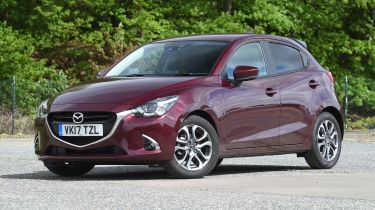
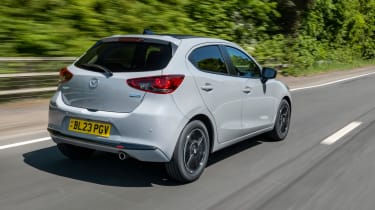
Mazda has applied its Kodo design language to the 2, and as a result it looks very much like a scaled-down version of the Mazda 3 hatchback. There’s the familiar trapezoidal grille that features the brand’s chrome-finished ‘wing design’ insert first seen on the Mazda 6 saloon, while elsewhere you’ll spot the bold creases and curves along the car’s flanks, the swooping roofline and the steeply rising waist. It looks a bit heavy-handed and bulbous at the rear, but overall the 2 is a smart and distinctive small car.
A 2023 facelift added pep to the 2’s styling. While the metalwork hasn’t changed, new bumpers, new wheel styles, and a choice of grille designs – including a smooth, almost EV-style grille in black or body colour options, and a sportier mesh version – give the 2 a fresh look, and Mazda has revised some of the interior materials too. There are new colour choices too, though Mazda’s characteristic Soul Red aside, it’s still a pretty monotone palette.
All models get body-coloured door mirror housings and a subtle tailgate spoiler, as well as 15-inch alloy wheels, while upgrading to Exclusive-Line trim nets larger 16-inch alloys, rear privacy glass, and keyless entry. Homura trim gets the mesh grille design, electric folding and heated door mirrors, and a reversing camera, among other toys, while Homkura Aka models add heated seats and a heated steering wheel, and are visually distinguished by a contrasting black roof.
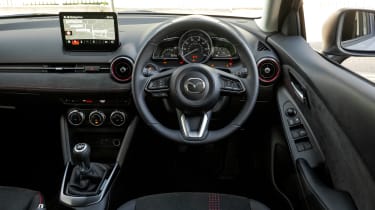
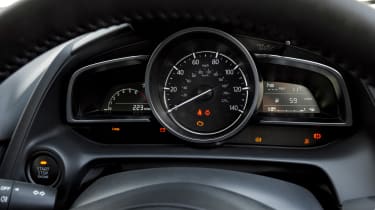
The eye-catching design continues inside, where Mazda has attempted to push the 2 upmarket. For instance, the neatly styled dashboard gets a trio of eyeball air vents (the fourth is cleverly hidden in the facia below the infotainment touchscreen) that feature controls with an Audi-style, metal-effect knurled finish. Another highlight is the large speedometer flanked by digital readouts for the rev counter and trip computer.
Yet while the cabin looks smart and is robustly constructed, it can’t match the Volkswagen Polo for premium appeal. There are few soft-touch materials, while the plastics covering the top of the dash and door trims look and feel a little low rent. Also, the rear doors shut with a tinny clang.
On the plus side, soft leather covers the steering wheel and gearlever, while the switchgear feels sturdy in its operation.
Sat-nav, stereo and infotainment
All Mazda 2 models include a high-definition seven-inch touchscreen and command wheel controller with a clear and intuitive menu system that’s very straightforward to use. Integrated sat-nav is available on all trim-levels, along with Apple CarPlay and Android Auto connectivity.
Practicality, comfort and boot space
By stretching the wheelbase by 80mm over the last Mazda 2, Mazda has managed to boost interior space in every direction and as a result the little supermini is a reasonably practical choice, especially for young families.
The ergonomics are spot-on, too; the range of adjustment for the front seats and steering wheel is superb, while the pedals are nicely positioned without any offset.
There’s nothing radical in terms of oddment storage though - just a large glove box in the front, along with door pockets shaped to hold large bottles.
Size
At 4,070mm the Mazda 2 is a little shorter than the Ford Fiesta, VW Polo and Toyota Yaris, while it measures 1,695mm across, which is a little narrower than its three rivals.
Leg room, head room & passenger space
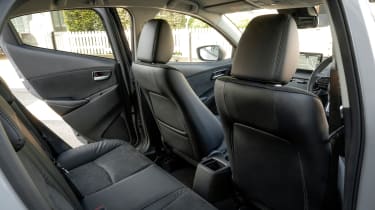
There’s more room in the back than a Ford Fiesta, and while two six-footers will probably struggle to sit one in front of the other, you could just about fit five adults at a squeeze.
It’s only-offered as a five-door (the three-door was canned when the old model was replaced), so getting in and out of the rear seats is simple. Isofix child seat mounts are standard in the rear too.
Overall, we reckon the Mazda 2 it’s a pretty good package from an accommodation standpoint. The new Hyundai i20 just has it beaten on interior space, though.
Boot
In spite of a usefully wide tailgate the deep boot means you have to lower objects down into it, but the trade-off is much more space than in the old Mazda 2. There’s 255 litres with the rear seats in place, or 887 litres with them folded down. That’s a fair way behind the luggage space of a Volkswagen Polo, which measures 351 litres with the rear seats in place, and 1,125 litres with them folded. There’s also a step up from the boot floor when you fold the rear seats.
Towing
If you want to tow a small trailer you’ll be limited to 900kgs – but that isn’t bad for a supermini. There’s no spare wheel though, as Mazda supplies a can of repair foam instead and no option to add a spare.
Did you know you can sell your car with Auto Express? Get the highest bid from our network of over 5,500 dealers and we'll do the rest. Click here to try Auto Express Sell My Car now...