MINI Countryman review
The MINI Countryman is the brand’s most convincing SUV to date, with a standout interior and petrol or EV power

Our opinion on the Mini Countryman
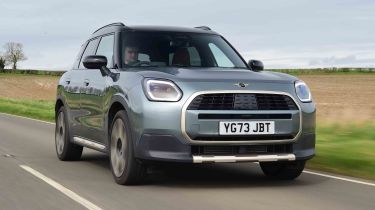
The classy interior and high-end technology of the MINI Countryman really help it to stand out from its rivals, and it has a cheeky fun character about it that can so often be missing from a family car.
In its latest form, the Countryman has grown over its predecessor, so it now offers genuine practicality, while the optional sliding rear seat boosts flexibility, whether you need to transport people or luggage. There’s an affordable petrol version for those with an eye on their bank balance, or a strong all-electric option.
About the MINI Countryman
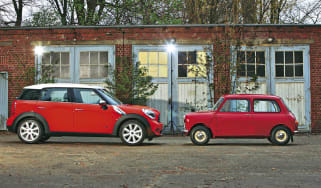
Sure, the growth spurt of the latest MINI Countryman may take it further away from the original Mini rationale, but that size increase makes it far more worthwhile to its target audience who are looking for a practical mid-size family SUV with a touch of style.
Countryman buyers have a choice of 1.5-litre and 2.0-litre petrol models, the latter coming with all-wheel drive. Then there’s the electric MINI Countryman that received a significant battery range boost in 2026 and is offered in E (front-wheel drive) or SE (4x4) forms. Finally, a high-performance MINI Countryman John Cooper Works (JCW) is available in petrol form.
Our road testers have been sure to put both the petrol and electric MINI Countryman through their paces. We tested the petrol-powered model against the popular Volvo XC40 in a real-world twin test where the Countryman won due to its spacious and stylish interior, useful sliding seats, and clever tech. We’ve also had both the electric MINI Countryman SE ALL4 Sport and petrol-powered MINI Countryman C Exclusive on our long-term test fleet, covering thousands of miles in each.
MINI Countryman prices and latest deals
Pricing for Countryman petrol and EV models is very close. Starting off the petrol line-up is the Countryman C which is priced at under £29,500. The Countryman SE pushes this number up to around £35,500, while the zesty JCW will set you back by at least £44,000. The electric MINI Countryman kicks off at a little over £29,000 thanks to the Government’s Electric Car Grant (ECG), which delivers a discount of £3,750.
Used - available now

2022 Mini
Countryman
76,660 milesAutomaticPetrol1.5L
Cash £14,634
2022 Mini
Countryman
18,962 milesAutomaticPetrol2.0L
Cash £22,871
2022 Mini
Countryman
52,587 milesAutomaticPetrol2.0L
Cash £17,965
2022 Mini
Countryman
11,040 milesAutomaticPetrol1.5L
Cash £21,917You can save even more by building your perfect MINI Countryman through the Auto Express Buy A Car service, and we also have plenty of used Countryman models to choose from. Prefer a shorter commitment? We have lots of top MINI Countryman leasing deals, too.
Performance & driving experience
Pros |
|
Cons |
|
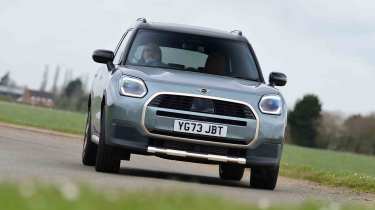
MINI would like you to believe that the Countryman has ‘go-kart’-like handling, MINI even names one of the Experience driving modes as such. The reality is far from that, though.
That’s not to say the Countryman doesn’t provide a decent drive. Driven as most people normally would, it offers enough ride comfort and competent handling. It’s just not as much fun as the MINI hatch.
| Model | Power | 0-62mph | Top speed |
| MINI Countryman E | 201bhp | 8.6 seconds | 105mph |
| MINI Countryman 1.5 | 168bhp | 8.3 seconds | 131mph |
| MINI Countryman 2.0 JCW | 296bhp | 5.4 seconds | 155mph |
Performance, 0-60mph acceleration and top speed
Despite having the least power, the 168bhp 1.5-litre three-cylinder turbo manages to get the MINI Countryman through the 0-62mph dash in a respectable 8.3 seconds, while the four-wheel drive, 215bhp 2.0-litre four-cylinder turbo cuts this down to 7.1 seconds.
The fastest Countryman is the John Cooper Works (JCW), with a very healthy 296bhp, also distributed to all four wheels, for a 5.4-second sprint time.
We shouldn’t discount the electric versions, though. The two-wheel drive 201bhp E will get to 62mph in 8.6 seconds, while the four-wheel drive 309bhp SE takes 5.6 seconds.
Town driving, visibility and parking
You might think that the larger size of the Countryman might put it at a disadvantage in town, but the tall driving position and relatively short overhangs mean the Countryman is fairly easy to place when parking.
In order to limit body lean, the suspension is a bit on the firm side to keep things controlled, but we wouldn’t suggest it’s uncomfortable.
The standard-fit automatic (especially when fitted to the entry-level 168bhp engine) is very hesitant when pulling away, so it’s advisable to give yourself a bigger gap when merging onto a busy roundabout. The lack of manual controls on the gear lever or steering wheel paddles in non-Sport Countryman versions means you have little say over which forward gear the gearbox is in, robbing you of some control and putting you at the mercy of the car’s electronics.
Switching off the engine start/stop feature helps a little, but the best way to get around this is to choose the all-electric Countryman, which has snappier responses. Our six-month long-term test of the four-wheel drive SE suggests it has all the punch you’d need to nip out of junctions around town, or squirt between corners on a fast country road.
Country road driving and handling
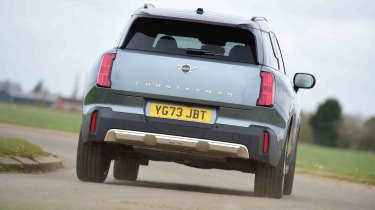
Country roads are generally a good fit for the smaller models in the MINI range, but this isn’t the case for the bigger Countryman – even if you try its sharpest Go Kart mode that comes as part of the eight ‘Experiences’ available.
The quick steering of the Countryman feels strange in a car this tall. Small inputs cause the car to dart around, making it difficult to place in a bend, sometimes leading you to make multiple steering corrections mid-corner. It’s a particular problem with the high-performance JCW version, which tends to tramline across all but the smoothest of surfaces.
We’d like a more settled ride on JCW models, too. Despite having adaptive suspension (also provided as standard on Sport trim), its larger wheel sizes (19- or 20-inches) tend to bounce you from bump to bump. It never really settles, no matter the speed.
The chassis can’t quite keep up with your inputs – intentional or otherwise – at the wheel, so it feels as if it's getting out of shape rather drastically, even if you’re not pushing the car all that hard.
Motorway driving and long-distance comfort
While the Countryman suffers from a little wind noise around the door mirrors at speed, it isn’t annoying and doesn’t drown out the sound system. The ride is still firm, but ultimately it becomes more forgiving at higher speeds than it is when trundling around town.
“Hitting the boost button is a real crowd-pleaser. The nav-screen switches to a red, black and white chequered flag countdown from 10 to one and boosts acceleration. I’m not sure it’s quicker than popping the car into Sport Mode and flooring it, but it’s fun.” - Darren Wilson, creative director.
MPG & running costs
Pros |
|
Cons |
|
On paper fuel economy for the petrol MINI Countryman is decent rather than class-leading, with the most efficient 1.5-litre model getting 47.9mpg and emissions of 134g/km. The 2.0-litre ALL4 manages 39.7mpg and emits 149g/km, because the additional weight of its four-wheel-drive system hurts efficiency. On a country road blast, we saw the economy dip to 29.7mpg, but this should improve in more regular day-to-day driving and on longer motorway trips.
The high-performance JCW model has the worst fuel economy and emissions of the Countryman range, with 35.3mpg and 180g/km of CO2 but that’s no surprise given its extra performance.
| Model | MPG | CO2 | Insurance group |
| MINI Countryman 1.5 C Classic | 47.9mpg | 134g/km | 20E |
| MINI Countryman 2.0 ALL4 S Classic | 39.7mpg | 149g/km | 25E |
| MINI Countryman 2.0 ALL4 JCW | 35.3mpg | 180g/km | 30E |
Electric range, battery life and charge time
MINI carried out some upgrades to the electric Countryman in 2026 that increased the usable battery capacity to 65.2kWh. This, along with a new silicon-carbide inverter and reduced-friction wheel bearings, boosted the official range to 311 miles for the front-wheel drive model, and 290 miles for the four-wheel drive - gains of around 25 miles
The closely related BMW iX1 also received similar upgrades, and this car’s new 318-mile maximum means it still has the slightest edge over its British counterpart. Both cars outperform the Volvo EX30, which achieves up to 296 miles in the official tests.
During our six-months living with the 4x4 Countryman SE, we were able to regularly return over 3.5 miles per kWh for a range of up to 260 miles in real world driving. This fell to around 200 miles in the coldest winter weather, though.
Using a 7.4kW home wallbox charger, it’ll take around 10 hours to fully recharge a Countryman, while a 10-80 per cent top-up from a rapid charger will take around 30 minutes. A maximum charging speed of 130kW is again competitive, but there are similarly priced and sized EVs that’ll charge much faster.
| Model | Battery size | Range | Insurance group |
| MINI Countryman E | 66.5kWh (65.2kWh usable) | 311 miles | 23 |
| MINI Countryman SE AWD | 66.5kWh (65.2kWh usable) | 290 miles | 31 |
Insurance groups
Insurance costs for the MINI Countryman should be reasonable considering they start in group 20 for the entry-level 1.5 Classic, and rise to group 30 for the quickest JCW model. Even the electric version is comparable with the regular petrol version, starting in group 23 for the least powerful E model, and ending in group 31 for the quicker SE four-wheel drive. That’s a few groups lower than the BMW iX1, and well below the Volvo EX30’s positioning in groups 35 to 40.
Tax
The electric MINI Countryman will be the most appealing to business buyers because these versions sit in a much lower Benefit-in-Kind (BiK) company car tax bracket than the petrol model.
Every Countryman qualifies for the standard rate of VED road tax, while the fanciest variants can find themselves on the wrong side of the £40,000 luxury car tax threshold for petrol-powered examples, especially if you’re a bit too liberal with the options. The electric Countryman E and SE models have a little more leeway with a higher £50,000 limit. However, EVs could face a new eVED pay-per-mile tax if it’s introduced as planned in 2028.
Depreciation
According to our expert data, the MINI Countryman retains its value well after three years or 36,000 miles, whether you go for a petrol or electric version.
The petrol maintains between 52 and 60 per cent of its value after three years, which is on par with the Volvo XC40 (54 to 58 per cent) and a little higher than the BMW X1 (48 to 54 per cent).
The electric Countryman maintains between 54 and 61 per cent, which is significantly better than the BMW iX1 (42 to 44 per cent), and the Volvo EX30 (47 to 51 per cent).
To get an accurate valuation of a MINI Countryman, check out our free car valuation tool…
Interior, design & technology
Pros |
|
Cons |
|
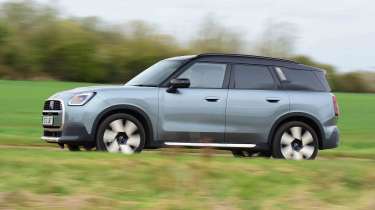
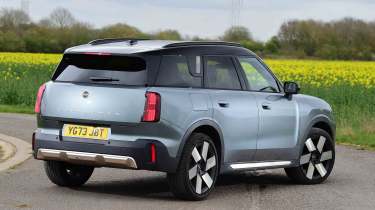
While the MINI Countryman has grown in size and has gained some Land Rover Defender-esque trim squares on the C-pillars, it still retains the floating roof look, large grille and black wheel arch trim of the previous Countryman.
There are four trim levels (which MINI refers to as styles) to match the MINI Cooper hatch range: Classic, Exclusive, Sport, and JCW. Classic trim includes a heated steering wheel, a rear-view camera, cruise control, and satellite navigation. Exclusive trim has a fuller colour palette, a brighter cabin, and adds larger 18-inch alloys. Sport gets its own mix of body colours, introduces some 19-inch JCW wheels, adaptive suspension, JCW sports front seats and a JCW steering wheel.
Additionally, all trim levels have one of three packs you can add. Level 1 with Classic trim adds adaptive LED headlights with automatic high-beam control, electric folding and dimming side mirrors, heated front seats, a head-up display and a wireless phone charging pad. If you add Level 2 to Classic, then you get everything from Level 1 plus a panoramic glass roof, privacy glass, and an upgraded Harman Kardon sound system.
Interior and dashboard design
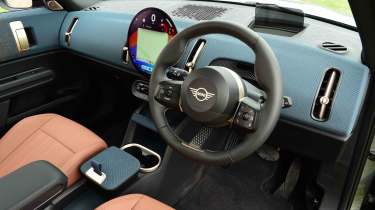
There are four neat-looking vertical air vents across the dash, but the centrepiece is literally the 10-inch diameter central touchscreen display. Not only is it large, but the use of OLED technology means it has some of the sharpest graphics offered in any car.
The use of a central screen means you don’t get a driver’s instrument cluster displaying your speed within your line of sight, although that is a trait that dates back to the very first MINI. Things have moved on a lot since then, which is why we’d suggest you select the Level 1 pack at the very least to give you a heads-up display, which projects navigation and speed onto a small perspex screen near the base of the windscreen, allowing you to see this important information without having to glance away from the road.
Materials and build quality
Inside the Countryman you’ll find a clean design that, on mid-range Exclusive trim, utilises a large amount of fabric to cover the dashboard. This creates a warmer, more welcoming look when compared to the grained soft-touch materials usually used for car interiors. Quality is good, with the MINI living up to its premium billing.
Infotainment, sat-nav and stereo
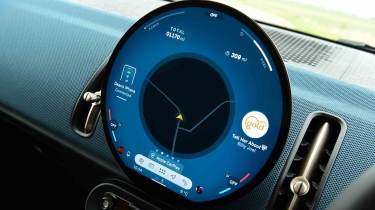
Every version of MINI Countryman comes with the same size infotainment screen. It includes the usual Apple CarPlay and Android Auto (although they are only displayed in the centre part of the screen), sat-nav, plus an on-screen assistant called ‘Spike’, a canine who can help you use the car’s various functions.
You may love or loathe Spike, but it reflects the times we’re living in and attempts to maintain the sense of humour and fun we’ve come to expect from MINI. The screen has a staggering scope for customisation with its ‘Experience Modes’, although we anticipate that bored children will find more use for this gimmick than drivers, who’ll probably just pick a display style they like and stick with it.
The screen incorporates some games, which are likely to be more useful in the electric version while waiting for the car to charge. The designers of the rally game missed a trick by opting for Toyota Celica replicas instead of original Monte Carlo Rally-winning Minis - one for the mid-life refresh, we think.
If you choose the Level 1 pack, you’ll gain a wireless smartphone charging pad, while paying more for Level 2 will upgrade the standard audio system to a 12-speaker, 365-watt surround sound system from Harman Kardon.
“Initially, I had reservations about the MINI’s admittedly quite lovely textured interior finish, and its ability to withstand children’s sticky fingers. But my fears have proven unfounded, because lollies and fruit residue have just wiped away with no serious marks left.” - Darren Wilson, creative director.
Boot space & practicality
Pros |
|
Cons |
|
While traditionalists may moan about the MINI Countryman using the brand name synonymous with small cars for a chunky SUV, buyers of this type of car will be pleased about this five-seat versatility. The Countryman is a much more practical proposition than the brand’s smallest MINI Cooper supermini.
LED headlights are standard, but the Level 1 pack includes more advanced adaptive headlights to improve visibility at night without dazzling oncoming traffic. Parking sensors are included all around, as well as a reversing camera.
Dimensions and size
The Countryman is MINI's biggest car, but it's slightly smaller in all dimensions than the closely related BMW X1.
Dimensions comparison | |||
| Model | MINI Countryman | BMW X1 | Volvo XC40 |
| Length | 4,444mm (4,445mm in EVs) | 4,500mm | 4,440mm |
| Width | 1,843mm (2,069 inc mirrors) | 1,845mm (2,104mm inc mirrors) | 1,938mm (2,034mm inc mirrors) |
| Height | 1,661mm (1,635mm in EVs) | 1,642mm | 1,657mm |
| Wheelbase | 2,692mm | 2,692mm | 2,702mm |
| Boot space | 450-1,450 litres (460-1,450 litres in EVs) | 500-1,545 litres | 443-1,432 litres |
Seats & passenger space
There are a few traits from other MINI models in the Countryman, such as the windscreen that seems more upright than those of rivals, along with chunky front pillars that you’ll have to look around when navigating roundabouts or pulling out of junctions. There’s a decent amount of adjustability in the driving position, but in order to get lumbar controls, you’ll need to add the Level 3 pack to the mid-range Exclusive trim. Doing so gets you electric seat adjustment with a driver’s side memory function.
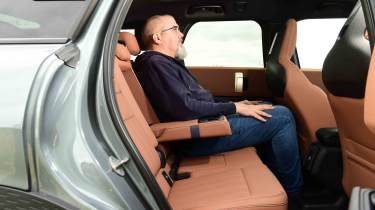
Parents looking to use the MINI Countryman as a family car will be pleased to find that it's a genuinely roomy mid-size SUV, with lots of elbow room in the back in order to carry three people abreast. That middle seat occupant will also find a dedicated cut-out beneath the central console to give them somewhere to put their feet.
The rear backrest can be made to recline in order to increase passenger comfort, while adding any one of the ‘Level’ packs to petrol versions of the Countryman gives you a sliding rear seat that you can use to increase leg room for those in the second row.
There’s an Isofix child seat mounting point on the front passenger seat and two more points located on the outer positions of the rear bench.
Boot space
A 450-litre boot in the MINI Countryman means it should have plenty of space for five people’s luggage. The cargo area is square with flat sides, making it easy to pack, and the floor is only slightly below the boot entrance, meaning there isn’t an awkward lip to lift items over. Lift the false boot floor and there’s a deep hidden storage compartment beneath.
If you need even more capacity, you can drop the flexible 40:20:40 split rear seat backs for up to 1,450 litres of space. A powered tailgate is standard.
As mentioned in the previous section, adding a ‘Level’ pack to petrol versions of the Countryman allows you to get a sliding rear bench seat to increase boot space if you don’t have anyone tall in the back. The seats slide in a 60/40 split, which means they don’t all move individually from one another, unlike the seat backs.
Towing
When powered by petrol, the four-wheel drive Countryman can tow up to 2,000kg braked which is competitive with rivals. The front-wheel drive can manage 1,700kg. You’ll want to avoid the JCW for these duties, though, as it can only handle up to 750kg. If you’re also considering the closely-related BMW X1, you’ll want the xDrive23i as this matches the MINI’s 2,000kg peak, and it’s the same story with the Volvo XC40 B4.
The electric Countryman can’t match its petrol-powered companion for pulling ability, but the four-wheel drive model does at least manage up to 1,200kg braked. This drops to 750kg for the front-wheel drive car. The Volvo EX30 Extended Range is a stronger car here, as it can take on up to 1,600kg.
“The boot space was more than enough to swallow buggies, bikes, boots and toys, plus even some decking after a DIY store visit.” - Darren Wilson, creative director.
Reliability & safety
Pros |
|
Cons |
|
The latest MINI Countryman hasn’t featured in our Driver Power owner-satisfaction survey, but the MINI brand hasn't improved in the best manufacturers' rankings since 2024, placing 22nd out of 31 manufacturers included in the latest results. While that does put it ahead of fellow premium small SUV manufacturers such as Volkswagen and Jeep, it has fallen behind Volvo, BMW and Mercedes.
Safety experts Euro NCAP awarded the latest MINI Countryman five stars out of five for safety after it was tested in 2024. It matched the Volkswagen Tiguan for adult occupant protection and beat its rival in terms of its safety assistance technology, but the Tiguan is ahead for child occupant and vulnerable road user protection.
As with most small SUVs, the Countryman has plenty of the latest safety assistance tech, from autonomous emergency braking (AEB) to help prevent or mitigate low-speed collisions with pedestrians and other vehicles, to blind spot monitoring to warn you of other vehicles alongside you on the motorway when you go to change lanes. Adaptive cruise control comes with the Level 1 pack, while the Level 3 pack on higher trim Exclusive models and above works at a higher speed and also incorporates a lane change assist function for use on dual-carriageways and motorways.
| Euro NCAP safety ratings | |
| Euro NCAP safety rating | Five-stars (2024) |
| Adult occupant protection | 83% |
| Child occupant protection | 87% |
| Vulnerable road user protection | 81% |
| Safety assist | 79% |
Buying and owning
- Best buy: MINI Countryman 1.5 C Exclusive (Level 2)
Unless you specifically need four-wheel drive for tougher terrain, or the additional towing capacity, the 1.5-litre petrol model should meet most needs. The fact that it’s the cheapest MINI Countryman powertrain only increases the appeal.
Trim-wise, we’d go for a mid-range Exclusive version because not only can you get it in more interesting colours, but adding our recommended Level 2 pack gives a more advanced Driving Assistance Plus package and the flexibility of sliding rear seats.
MINI Countryman alternatives
While the old Countryman was available only with petrol, diesel and plug-in hybrid powertrains, this version makes full use of the BMW Group’s UKL2 platform. This means you can get a petrol version to challenge the likes of the BMW X1 and BMW X2 (both of which use the same underpinnings), Range Rover Evoque, and Volvo XC40, while the electric version does battle with other similarly sized EVs like the Audi Q4 e-tron, BMW iX1, Hyundai Ioniq 5, Kia EV6, Mercedes EQA, and Volvo EX30.
If you want something smoother with a less laggy gearbox, then the Volvo XC40 might fit the bill. The electric version of the Countryman has a decent range, but there are similarly priced alternatives with greater range and charging speeds.
MINI Countryman long-term test
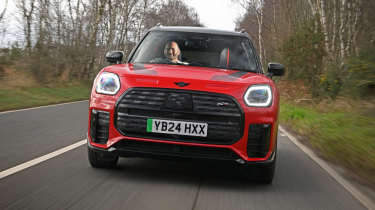
Creative director, Darren Wilson, has run both petrol and electric versions of the MINI Countryman. He’s enjoyed the easy-to-use infotainment system, while his children love its interactive features. The Countryman has proven to be a practical family car, with a boot big enough to tackle a trip to the DIY store. Darren was less taken with the hesitancy of the petrol version, but that issue was solved by going for the more responsive electric alternative. You can read the full long-term test here…
Frequently Asked Questions
You’ll be notified by a message either in the car or via your MINI app when your car needs servicing. Inclusive service packages start from a little under £400 or around £10 per month to cover electric versions for four years' worth of servicing, or a little over £1,000 (£1,100 for JCW models) or £14 per month for petrol and plug-in hybrid models.
Deals on the Countryman and alternatives