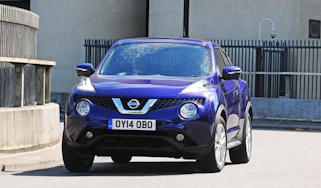
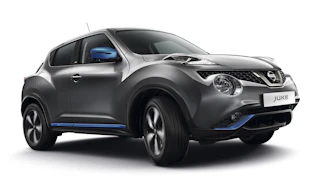
Nissan Juke review
Once a trend-setter, the Nissan Juke now plays catch-up to a bunch of rivals it helped to inspire

Our opinion on the Nissan Juke
It took the best part of a decade to replace the Nissan Juke because the original was such a successful concept. But like a band following up with a difficult second album, there was a lot expected of the next-generation Juke when it arrived in 2019, and not just from its loyal fans.
Ever since the first Juke entered the charts, scores of rivals have come along to cash in on its success. Some are more practical, others are more fun to drive. And, of course, a number have gone down the electrification route. In the process of making something that tried to cater to all tastes, the resulting second-generation Juke doesn’t quite hit all the right notes, and now finds itself playing catch-up to some seriously accomplished competition.
About the Nissan Juke
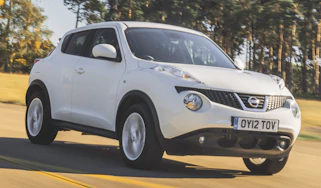
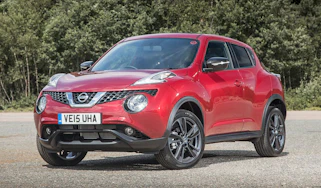
Nissan pretty much invented the small SUV class when it launched the first Juke back in 2010. It offered butch, if slightly caricatured ‘off-road’ styling, a pleasingly elevated view of the road, and looked nothing like the boring old hatchbacks or mini MPVs that cost similar money.
However, it was just as easy to own and drive, and as a result, sales boomed. Rivals naturally pitched in behind the Juke with small SUVs of their own, but it took a while for the industry to catch up, and Nissan made hay.
Used - available now


Fast forward to now, and the playing field is littered with rivals. While this may be a credit to Nissan’s visionary product planners, it’s a significant challenge for the firm’s engineers. Regrettably, it’s a challenge we find the second-generation Juke, launched in 2019, struggles to meet.
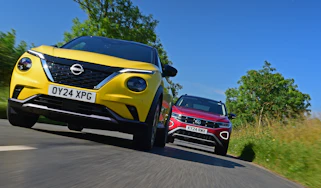
We’ve tested the Juke against the previous-generation Volkswagen T-Roc in a twin test. We have also run a pre-facelift example as part of our long-term test fleet.
Performance & driving experience
Pros |
|
Cons |
|
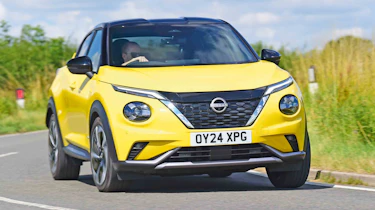
While the official line is that the Nissan Juke has been tuned for UK roads, we think it was specifically tested around the roundabout-laden roads of Milton Keynes. For that, the Juke is rather adept thanks to bags of grip and excellent body control that resists body lean well in corners.
The power (and efficiency) of the 1.6-litre petrol hybrid unit certainly improves things. Keep things relaxed, using its EV mode as much as possible, and it’s relatively refined. The Juke can remain in EV mode up to 34mph before the petrol engine cuts in, but it is quite coarse when it does. The automatic gearbox with the hybrid Juke is generally fine if you take things easy, but it can be reluctant to change down when you put your foot down when trying to overtake.
The brakes of the regular petrol Juke work well, while the hybrid version utilises a regenerative braking system called e-Pedal that’s borrowed from the brand’s electric car range. It’s a system that lets you top up the batteries by simply lifting off the accelerator to slow down. With the e-Pedal system switched on, the car will slow very quickly (much more so than most other hybrid cars) without you needing to touch the brake pedal, as the system tries to generate as much electricity as possible to recharge the battery. Once you get the hang of it, you can almost drive the Juke with one pedal.
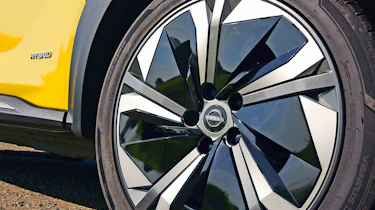
Both petrol and hybrid versions can suffer quite a bit of road noise – especially on the biggest 19-inch wheels. And despite its sleek body, wind noise from its chunky door mirrors can be an issue at higher speeds.
| Model | Power | 0-62mph | Top speed |
| Juke 1.0 DiG-T 114 | 112bhp | 10.7 seconds | 112mph |
| Juke 1.0 DiG-T 114 DCT | 112bhp | 11.8 seconds | 112mph |
| Juke 1.6 Hybrid | 141bhp | 10.1 seconds | 103mph |
Performance, 0-60mph acceleration and top speed
The 1.0-litre turbocharged three-cylinder petrol engine produces 112bhp and 200Nm of torque, which is enough to achieve 0-62mph in 10.7 seconds (11.8 seconds with the DCT auto) and a top speed of 112mph. The 1.6 Hybrid is a little quicker, thanks to its 141bhp and 205Nm of torque, reaching 62mph in 10.1 seconds. Its top speed is slower at 103mph, though.
The standard 1.0-litre petrol pulls the Juke along reasonably well – but only if you keep the revs up. It can feel laggy, especially if you misjudge the revs when trying to pull away, because it takes ages before the turbo kicks in to deliver the sort of punch you need to merge into traffic quickly.
The 141bhp hybrid is the quickest Juke on offer, proving to be swifter than hybrid rivals such as the Hyundai Kona. However, the Juke doesn’t deliver its power as smoothly as its competitor. It’s almost EV-like in its responsiveness away from the lights, but demands more power out on the open road, and the Juke’s hybrid system seems to confuse itself. After an initial burst, there’s a noticeable delay before the combustion engine wakes up rather coarsely.
Town driving, visibility and parking
Around town, the quick steering of the Juke should make it feel alert and eager, but its eagerness to self-centre gives it an unnatural feel that seems odd compared to the well-weighted, accurate steering of the Ford Puma.
It also can’t match that rival’s slick manual gear change, while the pedals in the Juke have an oddly spongy feel that makes it difficult to drive smoothly in traffic. The DCT automatic gearbox that’s available with the 1.0-litre engine isn’t much better in terms of refinement, because it’s jerky at slow speeds.
Parking is made quite difficult by the small rear windscreen and thick C-pillars, so you’ll often find yourself resorting to cameras and sensors. However, you’ll have to fork out for at least the N-Connecta trim if you want these particular luxuries.
Country road driving and handling
The current Nissan Juke is undoubtedly better to drive than the original model, but it doesn't quite provide the outright driving enjoyment of the Ford Puma.
On B-roads, we found that the automatic gearbox tended to change down a gear more often than we would have liked, especially on steeper inclines. However, the Juke’s composed handling means corners rarely pose a problem. The Juke’s steering is well weighted, too, though a little bit lacking in feedback.
Motorway driving and long-distance comfort
The downside of the Juke’s decent handling is that the suspension has been firmed up to ensure the SUV remains level in corners, so the ride quality suffers. Go for a Tekna trim car on 19-inch alloy wheels, and the ride feels fidgety at all speeds, and unfortunately, rather unsettled and bouncy on the motorway. Such constant movement can become quite tiring, making more supple rivals like the Skoda Kamiq much better suited to long-distance road trips.
Both petrol and hybrid versions can suffer quite a bit of road noise – especially on the biggest 19-inch wheels. And despite its sleek body, wind noise from its chunky door mirrors can be an issue at higher speeds.
“The Nissan Juke is nimble at higher speeds, but it’s hardly what you’d call fun.” - Dean Gibson, senior road test editor.
MPG & running costs
Pros |
|
Cons |
|
Emissions and fuel economy for the 112bhp 1.0-litre model are dictated mainly by gearbox type and wheel size; Nissan quotes up to 48.7mpg for the manual and up to 47.9mpg for the seven-speed dual-clutch automatic. We managed to achieve a respectable 44.1mpg over the course of 7,000 miles from the manual during our long-term test.
In terms of CO2 emissions, the range starts from 131g/km, with the manual being the marginally cleaner option, rising to 136g/km for the auto. While those numbers aren’t bad, the Peugeot 2008 and Skoda Kamiq are cleaner and more frugal options.
The answer to those two rivals is to consider the Juke petrol hybrid, with a combined efficiency of up to 60.1mpg and emissions from 106g/km. We didn’t come close to that during our Juke Hybrid versus VW T-Roc twin test, with the Nissan managing 49.7mpg. That was better than the non-hybrid T-Roc, but fellow hybrid rivals such as the Hyundai Kona and Toyota Yaris Cross are still better.
All models get stop/start as standard, as well as an Eco drive mode that helps save fuel – but you’ll notice a drop in performance as a result.
| Model | MPG | CO2 | Insurance group |
| Juke 1.0 DiG-T N-Connecta | 47.9mpg | 131g/km | 13 |
| Juke 1.0 Acenta Premium DCT | 47.1mpg | 135g/km | 12 |
| Juke 1.6 Hybrid N-Connecta | 60.1mpg | 106g/km | 14 |
Insurance groups
The Juke is unlikely to break the bank in the insurance stakes; the standard petrol model range mostly occupies groups 12 and 13 (out of 50), while the hybrid is a little higher in group 14.
If you need a small SUV that’s even less costly to insure, the SEAT Arona is currently one of the cheapest cars to insure in the UK, sitting as low as group 11.
Tax
While there’s no escaping the standard VED road tax, the Nissan Juke does avoid the clutches of the luxury car tax, even if you are quite trigger-happy when ticking the options boxes.
Company car drivers will be far better off looking towards fully electric cars like the Nissan Leaf, because you’ll pay much lower Benefit-in-Kind (BiK) tax rates.
Depreciation
After three years or 36,000 miles, the Nissan Juke is expected to hold on to 41 to 44 per cent of its original value. In comparison, the Toyota Yaris Cross retains 46 to 50 per cent, while the Hyundai Kona manages 46 to 53 per cent.
To get an accurate valuation for a specific model, check out our valuation tool...
Interior, design & technology
Pros |
|
Cons |
|
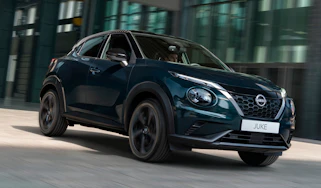
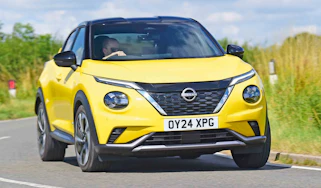
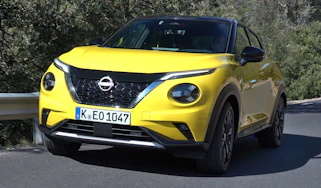
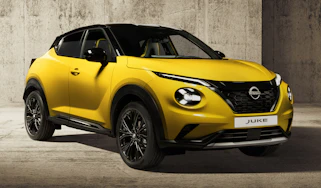
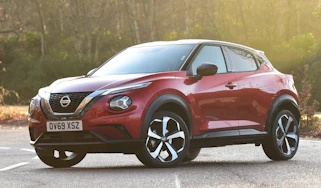
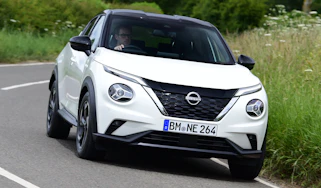
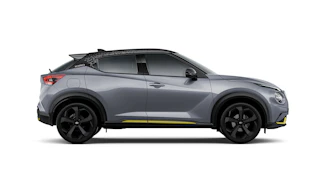
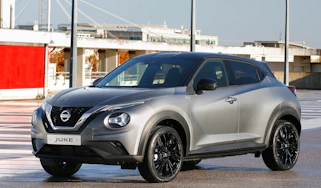
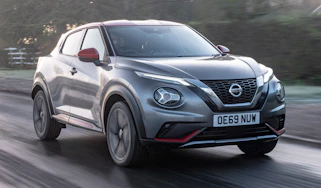
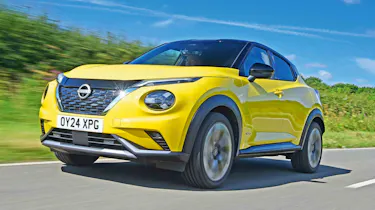
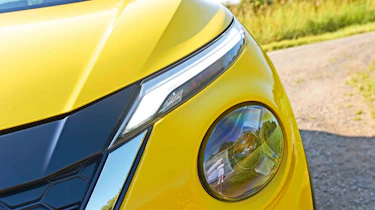
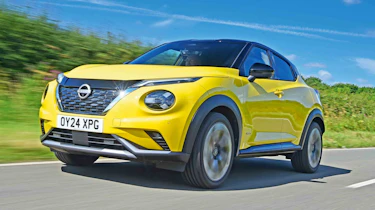
The second-generation Nissan Juke is instantly recognisable as an evolution of the original compact SUV. The car’s slim daytime running lights and oversized headlamps mimic the old version’s, while the pronounced haunches and hidden rear door handles are another nod to the original.
The Juke shares many parts with its French siblings, the Renault Clio and Renault Captur, since it’s based on the same platform. The Captur is more intelligently packaged, offering a sliding rear bench and up to 536 litres of boot space. Still, there’s much to like about the Nissan’s interior, including a logically laid-out dashboard and lots of adjustment in the driver’s seat.
Interior and dashboard design
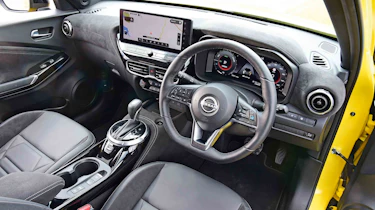
The Juke may not look as upmarket as a Skoda Kamiq inside (we didn’t rate the faux carbon-fibre trim in our N-Sport test car much), but there’s loads of kit, and the dials are easy to read. All models come with a 12.3-inch touchscreen display that’s angled towards the driver by eight degrees and is similar to what we’ve seen on the larger Nissan Ariya. Some physical shortcut buttons are provided along the bottom of the screen.
Materials and build quality
We have few complaints regarding the Nissan Juke’s build quality. While it’s not the most luxurious small SUV out there, it feels well screwed together. However, the centre console’s gloss black plastic trim is perilously vulnerable to scratches.
Infotainment, sat-nav and stereo
The revised Juke comes with a 12.3-inch infotainment screen, which is significantly larger than the older eight-inch system. The home screen is customisable, allowing you to display frequently used widgets. The system also features sat-nav, wireless Apple CarPlay and Android Auto smartphone connectivity. Opt for the mid-range N-Connecta, and it comes with wireless phone charging to save on trailing charging cables everywhere.
A four-speaker sound system comes standard on Acenta Premium models, moving up to a six-speaker system in N-Connecta trim. However, we prefer the 10-speaker Bose sound system that comes with Tekna trim and above. This set-up features speakers in the front headrests, which means you not only get a much clearer sound, but it’s less harmful to your hearing. The quality is excellent, and it works well no matter what kind of music, radio or podcast you like to listen to.
“The Juke’s physical climate buttons and knobs have been retained. I’m glad that Nissan hasn’t moved them to the touchscreen, because while they’re set low on the dashboard, they’re easy to locate and use without taking your eyes off the road.” - Dean Gibson, senior road test editor.
Boot space & practicality
Pros |
|
Cons |
|
Despite its myriad specs, there is only one body style to choose from when specifying your Nissan Juke. Every version has five doors, five seats, a decent-sized boot, and a roomy cabin.
The driving position has plenty of adjustment; you sit low, and the steering wheel moves fore and aft, as well as up and down. Visibility is fine out the front, but the small side windows and rear windscreen can make parking more challenging, especially in the entry-level Acenta Premium, which only comes with a reversing camera. That might make mid-range N-Connecta worthwhile because it gets front and rear parking sensors, and you can add the Advanced Safety Shield pack (standard on Tekna and above) to get a 360-degree camera system.
In terms of cabin storage, there are some large door bins and a sizable glovebox, but the cubby between the front seats is only just big enough for a modern smartphone, and the small area ahead of the gearlever isn’t very useful. In the back, there is a pair of door bins big enough for a 500ml bottle of water.
Dimensions and size
The second-generation Nissan Juke is wider and longer than the original, and it certainly looks more imposing on the road thanks to its raised haunches and bulbous front end. However, it’s slightly shorter than a Skoda Kamiq.
| Dimensions comparison | |||
| Model | Nissan Juke | Skoda Kamiq | Toyota Yaris Cross |
| Length | 4,210mm | 4,241mm | 4,180mm |
| Width | 1,800mm | 1,793mm | 1,765mm |
| Height | 1,593mm | 1,534mm | 1,595mm |
| Wheelbase | 2,640mm | 2,650mm | 2,560mm |
| Boot space | 350-1,305 litres | 400-1,395 litres | 266-1,097 litres |
Seats & passenger space
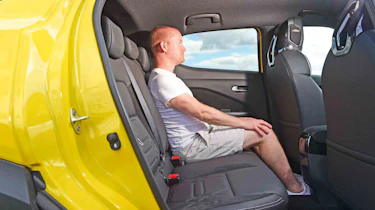
The sloping roofline of the Juke makes the back seats feel pretty dark, and the small windows might bother children who want to look outside on longer trips. Adults under six feet should be able to get comfortable, although those over six feet will have a much easier time in the practically palatial Kamiq.
Two rear Isofix child seat points are included as standard in the Juke, which helps when travelling with younger passengers in car seats. All versions feature two USB charging sockets for rear-seat passengers to top up their smartphones or tablets.
Boot space
The Nissan Juke’s 422-litre boot is much bigger than before, and sizes up well in this class. However, the hybrid version has a smaller 354-litre (350 litres with the Bose sound system) boot due to parts of the hybrid system taking up space, and the Juke doesn’t get a sliding rear bench seat like the closely related Renault Captur. This would allow you to increase the available boot capacity at the expense of rear leg room.
The Juke’s back seats do at least fold down to reveal a 1,305-litre space (1,237 litres for the hybrid, or 1,114 litres for a hybrid version with the Bose speakers), which should be enough for most jobs, although the Skoda Kamiq offers an even greater 1,395-litre total capacity.
Also worth noting is the Juke’s boot opening, which is wider than before but isn’t as generous as the Volkswagen T-Roc, making it harder to load larger items into the boot. The boot floor is adjustable for height; you’ll sacrifice some space in its highest setting, but the flip side is that you won’t have to contend with any kind of nasty load lip.
The fixed parcel shelf attaches to the boot lid via a pair of strings and lifts out easily, although it feels super-flimsy, and there’s nowhere to store it. Nevertheless, there’s enough space for a road bike in the back.
Towing
The 112bhp petrol model has a maximum braked trailer weight of 1,250kg, while the hybrid version is rated to tow a braked trailer with a total 750kg load.
For greater towing capacity in a small SUV, look at the Dacia Duster, because some versions can tow up to 1,500kg.
“As if to prove that the Juke isn’t very big in the back, it doesn’t have a fold-down centre armrest in the middle seat. There’s a seatbelt, but shoulder space will be tight if you’re travelling three-up.” - Dean Gibson, senior road test editor.
Reliability & safety
Pros |
|
Cons |
|
The Nissan Juke is a thoroughly modern small SUV offered with an array of active safety and driver assistance systems: all models get an emergency call system, cruise control with speed limiter, autonomous emergency braking (AEB), lane-departure warning and traffic-sign recognition.
However, while this will all be a welcome sight to many prospective buyers, it’s important to note that the Juke’s Euro NCAP safety rating has expired due to its age. When this model was originally tested in 2019, it achieved a maximum five-star result, but the testing criteria have changed considerably since then.
The optional Advanced Safety Shield pack on N-Connecta (standard on Tekna models and above) adds traffic jam and lane-keeping assist, adaptive cruise control, driver-alertness monitoring, blind spot warning and intervention, and rear cross-traffic alert. It is a shame adaptive cruise and blind spot warning aren’t standard, though, like they are on every version of the Volkswagen T-Cross.
The Nissan Juke placed 13th out of the 50 cars in the 2026 Driver Power survey with a 86.07 per cent score. Its standout category is Infotainment, where it ranked 3rd out of all 50 cars, Exterior came in 10th and Ride & Handling 15th. The weakest areas were Economy & Running Costs at 28th and Powertrain at 29th, suggesting some owners find it thirstier than expected. Nissan ranked 12th out of 30 brands in the manufacturer standings with a score of 85.09 per cent.
| Nissan Juke | Position | Score |
| Overall | 13 | 86.07% |
| Powertrain | 29 | 84.61% |
| Exterior | 10 | 90.31% |
| Interior | 15 | 85.26% |
| Practicality & Bootspace | 21 | 83.99% |
| Ride & Handling | 15 | 89.44% |
| Safety Features | 21 | 83.50% |
| Economy & Running Costs | 28 | 78.68% |
| Quality & Reliability | 28 | 86.73% |
| Infotainment | 3 | 88.04% |
| Value | 18 | 84.44% |
What owners said
- "Comfortable, easy to drive, well equipped and reliable. Rear nearside door tricky to open".
- "It's great value for money with loads of added extras. I love the colour and styling and it's really nippy".
- "It is a lovely car to drive, and the added benefit of having heated seats, windscreen & steering wheel were a real bonus."
- "Value for money, comfortable, good mpg, good tech features."
Buying, prices and deals
Best buy: Nissan Juke 1.6 Hybrid N-Connecta
Prices start from around £24,500 for an entry-level Acenta Premium model with petrol power, and they gradually rise all the way to just shy of £33,000 for the range-topping Tekna+ with hybrid power. The hybrid-powered Jukes command a premium, on the whole, of at least £1,500 compared to their hybrid counterparts.
We think the best variant of Nissan Juke is the N-Connecta because it adds lots of useful equipment. The choice between the two engines depends on your circumstances, but we’d go for the hybrid if you can afford it, because it offers lower running costs and a better ownership experience. However, it is hard to overlook how much cheaper the 1.0-litre petrol is in comparison if you just want the essentials for as little outlay as possible.
No matter which model takes your fancy, you can save by building your ideal Nissan Juke with the Auto Express Buy A Car service. We also have plenty of new Juke models in stock, along with used Juke deals to choose from. You can also choose from a wide range of tempting Nissan Juke leasing deals.
Nissan Juke alternatives
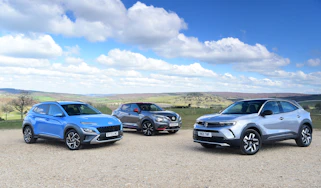
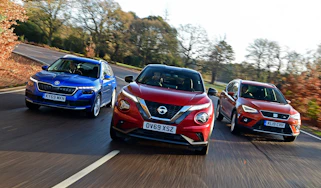
The market is awash with small SUVs, and plenty of them make a convincing case for themselves. The Ford Puma is by far one of the nation’s best-selling cars, as well as being one of the very best small SUVs to drive. Elsewhere, the Vauxhall Mokka, Peugeot 2008, Skoda Kamiq, Toyota Yaris Cross and SEAT Arona make up just some of the Nissan Juke’s rivals. In other words, you really are spoilt for choice here.
Nissan Juke pictures
Key updates of the Nissan Juke review
26 August 2026: Latest pricing and depreciation data.
Frequently Asked Questions
All Nissan models are covered by a three-year, 60,000-mile warranty that’s a match for the identical warranties offered by Ford, Skoda and Volkswagen, among others.
Deals on the Juke and alternatives