Suzuki Vitara review
The Suzuki Vitara is a traditional SUV, but it’s beginning to show its age in some key areas

Our opinion on the Suzuki Vitara
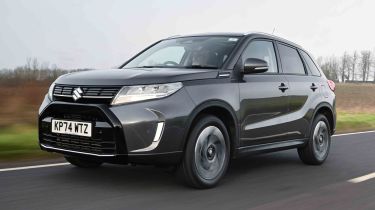
The Suzuki Vitara has been around for a decade now, and it’s really beginning to show its age when you compare it with rivals in the small to medium-sized SUV class. There’s not much wrong with its efficient Boosterjet engine or nimble handling, but the tech on board and general layout aren’t up to the standards of the class leaders these days, while cabin space is only really average. If you need efficient transport that will be a breeze to live with, then it’s worth checking out, although you’ll have to see if you can put up with the touchscreen infotainment and other cabin quirks.
About the Suzuki Vitara
When the fourth-generation Suzuki Vitara first landed in showrooms back in 2015, it marked a sea change for the company’s small SUV. Gone was the ladder-frame construction and focus on off-road ability, in favour of a lighter unibody shell, while front-wheel drive was the most common drivetrain configuration. The changes were designed to boost the Vitara’s appeal to a wider demographic, so that it had the qualities that would allow it to compete with rival small SUVs.
More than a decade later, the Vitara’s basic structure remains the same, but it has been given regular updates in an attempt to keep it fresh. The most recent of these introduced a new set of safety systems and a revised trim structure, while the exterior was freshened up with a new grille and wheels. Inside, both trim levels (Motion and Ultra) now feature a nine-inch touchscreen display and wireless smartphone connectivity.
Used - available now

2022 Suzuki
Vitara
20,315 milesAutomaticPetrol1.5L
Cash £16,000
2020 Suzuki
Vitara
33,746 milesManualPetrol1.4L
Cash £12,904
2020 Suzuki
Vitara
22,290 milesManualPetrol1.4L
Cash £12,315
2020 Suzuki
Vitara
36,905 milesManualPetrol1.4L
Cash £12,722The engine range has been reduced over time, so now you’ll find the same 1.4-litre petrol mild-hybrid powertrain underneath every brand-new Vitara. However, we also have a dedicated review for the fully electric Suzuki e Vitara, as this an entirely different (and far newer) car in all but name.
Our expert road testers have put the Vitara through its paces during its long production life, and in order to see if it can keep up with its more youthful rivals, we tried it out alongside a Mazda CX-30 in a twin test. Unfortunately for Suzuki, the Mazda was the winner thanks to qualities like its engaging driving characteristics, high-quality cabin and generous kit list.
Suzuki Vitara prices and latest deals
One area where the Suzuki Vitara stays reasonably competitive is in the pricing stakes. A two-wheel drive model in base Motion trim with a manual gearbox will set you back around £22,000. The fanciest Ultra trim can be had with either two- or four-wheel drive, and these models start from £23,700 and £25,500 respectively. If you want an automatic transmission, though, you’ll have to add a significant £1,600 premium to the final price.
If you want to save plenty on your new car, you can build your perfect Suzuki Vitara through the Auto Express Buy a Car service. Here you’ll receive tempting offers from our huge network of UK dealers, and we also have plenty of new Vitara models in stock and ready to go. You can even find a wide range of Vitara leasing deals along with used Vitara models.
Performance & driving experience
Pros |
|
Cons |
|
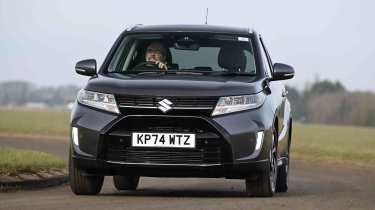
The 1.4-litre Boosterjet turbocharged petrol was originally introduced to the range in 2020, and is now the sole engine option when buying a brand-new Vitara. This powertrain features a 48-volt mild-hybrid electrical system with a belt-driven starter generator and is tuned to make a combined 123bhp and 235Nm of torque. A six-speed manual gearbox is the standard, or you can pay extra for a six-speed automatic.
One advantage that the Vitara holds over competitors is that it’s one of the few small SUVs that’s available with four-wheel drive. Suzuki’s Allgrip system can be had on top-spec Ultra cars for £1,800 extra.
| Model | Power | 0-62mph | Top speed |
| Vitara 1.4 Boosterjet MHEV Motion | 123bhp | 11.4 seconds | 111mph |
| Vitara 1.4 Boosterjet MHEV Ultra Auto | 123bhp | 10.1 seconds | 111mph |
| Vitara 1.4 Boosterjet MHEV Ultra Allgrip | 123bhp | 12.2 seconds | 111mph |
Performance, 0-60mph acceleration and top speed
Performance across the Vitara range is modest, with the fastest-accelerating version being a two-wheel drive automatic which can get from 0-62mph in 10.1 seconds. Adding Allgrip four-wheel drive sees that time increase to exactly 11 seconds.
Cars fitted with the six-speed manual are slower on paper, and will be slower still if you aren’t bang on with every shift. The two-wheel drive car has an 11.4 second 0-62mph sprint time, while the four-wheel drive is the slowest of the bunch at 12.2 seconds.
Town driving, visibility and parking
The Vitara’s upright proportions mean you sit relatively high, so there’s a good view of your surroundings as a result. There’s a rear parking camera fitted as standard on both trims, while Ultra models add front parking sensors to the mix (both models get rear ones). Light steering means low-speed manoeuvres are a doddle, while the mild-hybrid powertrain offers pretty quick responses.
There’s a slight disconnect between engine revs and forward motion as the electrical system cuts in to offer assistance, but you’ll soon get used to that. The ride in town is a little choppy over bumpy surfaces, though.
Country road driving and handling
At higher speeds, the Vitara smooths out, while the car’s relatively low weight means it feels surprisingly nimble for a chunky-looking small SUV. The steering and gearshift are light but positive, while the chassis offers reasonable grip, too, without an excess of body roll in corners – it’s more like a supermini than an SUV in that regard.
The engine has a revvy nature and makes its peak power at 4,500rpm, so you need to work it hard to make good progress. It can get a little harsh and noisy when you do that, though.
Motorway driving and long-distance comfort
When testing the Vitara at the national speed limit, our test car was turning over at around 2,000rpm in sixth gear, so there was a constant hum from under the bonnet. Apart from that, the Vitara makes for a fairly pleasant cruiser with a settled ride quality and not too much wind or tyre noise.
“In a class where many rivals offer safe yet dull handling, Suzuki shows it’s possible to make a small SUV that feels fun on the road.” – Dean Gibson, senior test editor.
MPG & running costs
Pros |
|
Cons |
|
The Suzuki Vitara has always offered good value for money, and that continues with the latest iteration. You get more kit for your cash following the most recent updates, along with a revamped exterior look, more safety equipment, a bigger nine-inch touchscreen with wireless smartphone connectivity and three years of connected services, keyless entry and starting, plus auto main beam.
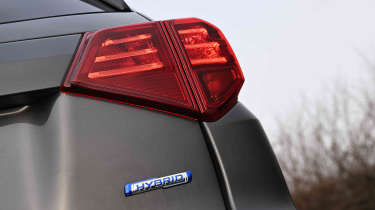
Every Vitara is fitted with mild-hybrid tech to accompany the 1.4-litre Boosterjet engine, but economy varies depending on your chosen drivetrain and transmission. With the six-speed manual fitted, Suzuki claims the Vitara can return 53.2mpg on the WLTP combined cycle, dropping slightly to 52.3mpg for the four-wheel drive.
The automatic cars are a little bit thirstier, with the two-wheel drive achieving 49.5mpg on paper, dropping to 47.8mpg in the four-wheel drive.
When we tested the two-wheel drive manual model, we saw a return of 47.8mpg over a variety of roads in cold conditions. That’s good for a range of nearly 500 miles, which is pretty good for a small SUV. This figure looks even more impressive when we consider that the Mazda CX-30 only managed 36.7mpg after the exact same round of testing, which is a long way off the brand’s official claim of 47.1mpg.
| Model | MPG | CO2 | Insurance group |
| Vitara 1.4 Boosterjet MHEV Motion | 53.2mpg | 119g/km | 17 |
| Vitara 1.4 Boosterjet MHEV Ultra Auto | 48.7mpg | 130g/km | 20 |
| Vitara 1.4 Boosterjet MHEV Ultra Allgrip | 52.3mpg | 128g/km | 17 |
Insurance groups
Insurance group ratings for the Vitara range from 17 to 22 (out of 50), which makes it pretty average in terms of small SUV premiums. In comparison, the highly popular Ford Puma sits in groups 12 to 21, while the Mazda CX-30 sits in groups 15 to 21. The Renault Captur offers some of the cheapest quotes in this sector, though, as it resides in groups 11 to 16.
Tax
While luxury car tax won’t be a concern on any Vitara, there’s no other tax relief to be found here. The usual standard rates of VED road tax apply, and company car drivers will be far better off looking towards a fully electric car like the Suzuki e Vitara, as zero emissions result in some of the very lowest Benefit-in-Kind (BiK) rates.
Depreciation
After a period of three years or 36,000 miles, the Vitara should retain between 39 and 44 per cent of its initial value, according to our market data. That’s not really a result to shout about, as the Ford Puma manages 41 to 53 per cent. Just like with insurance, the Renault Captur leads the way here, too, at 50 to 55 per cent.
To get an accurate valuation on a specific model check out our free car valuation tool...
Interior, design & technology
Pros |
|
Cons |
|
The arrival of the fourth-generation Vitara gave the car a softer look than before, but these things are all relative, and today the boxy proportions and upright dimensions stick out in the new-car market.
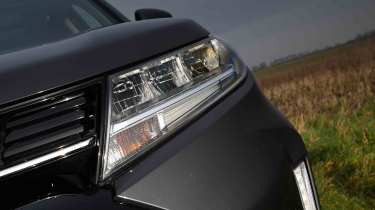
The most recent update introduced a simplified grille with less chrome, plus new daytime running lights, but overall, the Vitara’s look has remained largely unchanged since 2015.
Interior and dashboard design
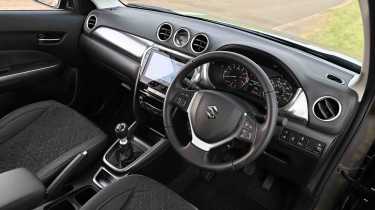
It’s a similar story inside where, instead of redesigning the layout, Suzuki’s engineers have shoehorned in the safety tech where possible. The most obvious example of this is the driver-monitoring camera, which is located between the two air vents in the centre of the dashboard. It’s fortunate that the old car had three vents that could facilitate this, but it does draw unnecessary attention to the system.
Materials and build quality
Another obvious sign that the Vitara is a generation behind class leaders is the finish of the materials on board. While everything feels robust, there are plenty of hard plastics on show.
Suzuki has tried to give the black plastic a lift with silver inserts on the dashboard and doors, but the sections on the armrests are positioned along the edges next to where you would place your elbow, and in our test car we could see some of the finish was already worn thin.
Ultra trim features synthetic leather upholstery with suede inserts, which help to give the cabin a lift and boost the feeling of quality.
Infotainment, sat-nav and stereo
The other big update for the Vitara was the addition of a nine-inch touchscreen system across the range. It comes with navigation and the usual connectivity, while Suzuki has retained separate climate controls located lower down on the dashboard, rather than trying to integrate them into the screen.
The upgraded display moved the shortcut buttons from either side of the panel on the older model to beneath the display, which creates more space for the menu and mapping. However, the shortcut buttons are a little small, so you need to be accurate with your screen presses to avoid selecting the wrong thing. There’s a home button beneath the main display, along with shortcuts to the climate and phone functions, plus a star that you can map to your favourite sub-menu, but all of them are fiddly to use.
“Instead of being controlled via the touchscreen or with extra dashboard buttons, the Vitara’s safety systems are set via the reset trip computer stalk that protrudes from the corner of the dials. It’s fiddly because you have to give it a long press, then move it from side to side to select options on the dot-matrix display between the dials.” – Dean Gibson, senior test editor.
Boot space & practicality
Pros |
|
Cons |
|
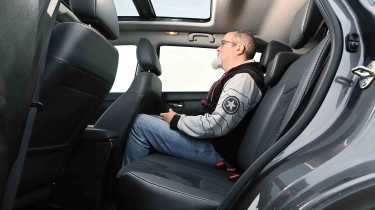
As well as the Vitara showing its age in terms of cabin quality, the space on offer isn’t as good as you might find in newer opposition. The upright shape means there’s no problem with headroom, but the narrow body limits shoulder space in the back, while narrow door bins and limited storage elsewhere mean the cabin isn’t as practical as it could be.
Dimensions and size
The Vitara is short and tall, whereas many of its rivals are longer and lower. As a result, it has a more traditional look than many small SUVs, with the boxy lines and large windows creating a squared-off shape, which is ironic, given that the Mk4 model was designed to be a smoother and less rugged machine than its predecessors.
| Dimensions comparison | |||
| Model | Suzuki Vitara | Mazda CX-30 | Ford Puma |
| Length | 4,185mm | 4,395mm | 4,226mm |
| Width | 1,775mm | 1,795mm | 1,805mm |
| Height | 1,600mm | 1,540mm | 1,550mm |
| Wheelbase | 2,500mm | 2,660mm | 2,590mm |
| Boot space | 362 to 642 litres | 430 to 1,406 litres | 456 to 1,216 litres |
Seats & passenger space
There’s a decent range of seat adjustment up front, while the large windows and tall driving position give a clear view of your surroundings.
Storage up front isn’t exactly generous, because while there are a couple of cup-holders, a trinket tray behind the gearlever and a larger one ahead with a shelf to place your smartphone, all of these areas are a little tight. The door bins are narrow, too, but the glovebox is a reasonable size.
The high roof means headroom is fine in the back, even in the Ultra model with its standard-fit panoramic glass. However, legroom is at a premium, especially if you’re sitting behind a tall driver, while shoulder space will be tight if there are three in the back. The upright backrest and short seat squabs mean that passengers might become uncomfortable on longer journeys.
Storage is also in short supply, with only shallow pockets on the seats back and bottle holders in the doors, while there aren’t any air vents or even a fold-down central armrest. There are two sets of Isofix points on the back seats, which are easily accessible courtesy of sturdy plastic surrounds.
Boot space
The Vitara’s 362-litre boot feels a bit stingy considering that several other small SUVs offer more than 400 litres. There is a false floor in the back of the Suzuki that gives a level load area, but the storage underneath is only a few centimetres deep. There is room for a space-saver spare wheel beneath this, though.
The back seats fold in a 60:40 split with the press of a button on the shoulders of the seatbacks, and there’s a slight rise in the floor when they are collapsed. Other highlights in the boot include a 12-volt socket, while there are a couple of recesses behind the wheelarches for smaller items.
Towing
Every 1.4-litre Suzuki Vitara is rated to tow up to 1,200kg braked. This is an exact match with the Renault Captur, but falls slightly short of the Mazda CX-30’s 1,300kg limit. The Vitara is still one of the stronger small SUVs, though, as the Ford Puma only manages 1,100kg.
“A low load lip helps with lifting heavy items into the boot, but I found that the tailgate didn’t rise high enough, so I kept catching my head on the boot latch when it was fully open.” - Dean Gibson, senior test editor.
Reliability & safety
Pros |
|
Cons |
|
While the Suzuki Vitara has earned a five-star Euro NCAP rating, it was tested in 2015, and this classification expired after six years. However, if the car were tested again, the latest round of safety additions could well see it earn a high score.
As well as adding driver-attention assist, lane assist and adaptive cruise control, the Vitara now features Suzuki’s Dual Sensor Brake Support. This is an upgraded radar and camera-based set-up for the autonomous emergency braking system, which is claimed to be more sensitive to other road users, so it can better pick out cyclists and pedestrians, as well as being more effective at detecting hazards at night and at junctions.
Suzuki owners are a loyal bunch, and while the company sells in relatively low volumes in the UK, there are enough fans of the marque out there to sing its praises. The most recent Driver Power survey saw the company finish ninth place out of 31 marques, beating plenty of much bigger names in the process.
The Vitara comes with a three-year/60,000-mile warranty. However, Suzuki also offers a ‘service activated’ warranty that can cover the car for up to seven years or a total of 100,000 miles. Simply book a service at a Suzuki franchise, and 12 months of extra cover is added to the warranty. Those service intervals are scheduled for every 12,500 miles or 12 months, whichever comes first.
| Euro NCAP safety ratings | |
| Euro NCAP safety rating | Five stars (2015/expired) |
| Adult occupant protection | 89% |
| Child occupant protection | 85% |
| Vulnerable road user protection | 76% |
| Safety assist | 75% |
Buying and owning
- Best buy: Suzuki Vitara 1.4 Boosterjet MHEV Ultra
The Vitara is cheap enough that forking out for the better-equipped Ultra trim won’t break the bank. We’d save a bit of money by sticking with two-wheel drive, though, unless you plan on doing a lot of off-roading. We also wouldn’t bother with that sizable £1,600 premium for an automatic transmission unless you simply cannot do without it.
Suzuki Vitara alternatives
When the Suzuki Vitara Mk4 first arrived, there were a handful of rivals to choose from, but since then we’ve seen an explosion of choice in the small SUV market. Our favourites in the class include the Renault Captur (a great-value all-rounder), Ford Puma (fun to drive), Mazda CX-30 (good to drive and premium-feeling) and the Toyota Yaris Cross (efficient hybrid powertrains).
Elsewhere, the SEAT Arona, Volkswagen T-Cross, and Volkswagen Taigo share tech, while the Skoda Kamiq straddles a line between SUV and crossover, but is a very practical vehicle. Other options include the Citroen C3 Aircross, Vauxhall Mokka, Peugeot 2008 and Fiat 600, all of which use the same platform and powertrains, and offer electric power.
There are also a number of exclusively-electric small SUVs to choose from, such as the Kia EV3, Skoda Elroq, Renault 4 and, of course, the Suzuki e Vitara.
Frequently Asked Questions
The Suzuki Vitara is an okay choice, but there are plenty of alternatives that offer a better range of abilities. It has never been a class leader, but it offers a dependable and reliable driving experience, and its relatively light weight and sprightly engine mean it’s one of the better cars to drive in the class.
Deals on the Vitara and alternatives