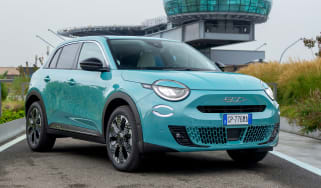
Fiat 600 review
The Fiat 600 looks the part, has a comfortable ride, and provides plenty of equipment for a reasonable price

Our opinion on the Fiat 600
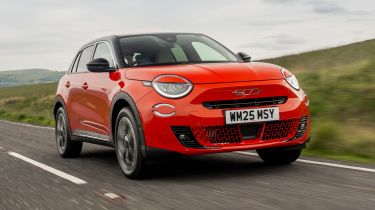
Fancy a small SUV with Italian flair? Try the Fiat 600. It’s a solid return to the class from Fiat, marrying a handsome exterior inspired by the smaller 500 but providing a good level of extra practicality. Add in a decent equipment list, and you have a compelling package.
The cynical might think of this as just another spin on the Stellantis group small SUV platform, but there’s enough differentiation between the Fiat 600 and the group's other offerings to give the car an identity of its own. The 600 doesn’t have the same sense of fun as the 500, but then this is intended as a more mature offering with greater family-friendly practicality than that car.
About the Fiat 600
Sometimes, things are sweeter the second time around. Take the Fiat 600, for example. It's the spiritual successor to the controversial Fiat 500X, a car that sold well enough, but caused some upset by using the famous 500 name that was once the reserve of the brand's smallest city car.
But the world has moved on considerably since then, to the point where buyers will accept that the MINI badge can reside on a sizeable family SUV like the MINI Countryman, a car longer than a Nissan Qashqai and taller than a Range Rover Evoque, and not have to denote something small. So why shouldn’t Fiat give the 500 brand a healthy stretch?
Used - available now


That’s not to say the 600 is getting anywhere near the dimensions of the aforementioned Countryman, for this is a car positioned squarely between superminis and family SUVs. Buyers have a wider choice when it comes to fueling the 600, too, as it’s available with either a mild-hybrid powertrain or as the fully electric Fiat 600e.
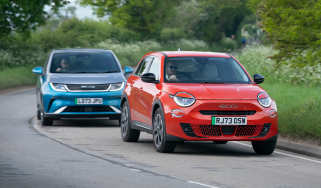
We’ve driven both the combustion-powered 600 and the fully electric 600e, and have even evaluated the latter against a BYD Dolphin in a real-world twin test. The BYD’s superior value for money, performance and standard kit helped in taking victory over the Fiat, although we did find that the 600e was more engaging to drive and just that bit more refined.
Performance & driving experience
Pros |
|
Cons |
|
We’ve driven both the 600 and 600e, and there actually aren’t that many differences between the two when it comes to the driving experience.
Although it’s officially named Fiat 600 Hybrid, this model is technically just a mild-hybrid. There are two power outputs, either 108bhp or 143bhp, with the latter using the same Hybrid 145 powertrain that’s shared with a range of Stellantis stablemates including the Citroen C4, Vauxhall Mokka, Peugeot 2008 and Alfa Romeo Junior. Both setups consist of a 1.2-litre petrol engine and a six-speed automatic dual-clutch transmission. The electric aspect comes courtesy of a single, rear-mounted motor.
There’s also the choice of a non-electrified model. This is also powered by a 1.2-litre engine, but power output is reduced to only 99bhp. This variant is exclusively available with a manual gearbox, so if you want fewer pedals, you’ll have to buy the hybrid or 600e.
If you’d rather go down the fully electric route, every variant of the Fiat 600e is powered by a single, front-mounted motor producing 154bhp. By default, or in Normal mode, the Fiat 600e doesn’t deliver its claimed power output, but rather a reduced figure of 107bhp. There’s good throttle-pedal modulation, and enough instant EV punch for the 600e to feel pretty comfortable with life without the need to flick the switch into Sport mode to access the motor’s full potential.
While it’s not as softly sprung as the Citroen C3 Aircross, every version of the Fiat 600 does a respectable job of dealing with the worst of the UK’s road surfaces. If you want to tackle particularly tough terrain, though, we’d steer you towards the closely-related Jeep Avenger instead.
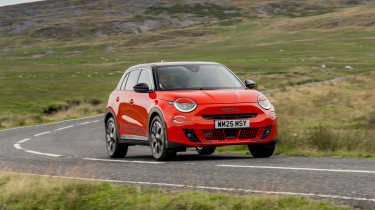
As is usually the case, the trade-off for ride comfort is excitement. With its generally light controls and leisurely performance, the Fiat 600’s general theme is easiness rather than exhilaration. Although the Fiat 600 Sport may sound like a bit of a thrill machine, the changes with this trim level are purely cosmetic. Worry not, though, because the Abarth 600e acts as the bonkers (and much firmer) relation to the sensible Fiat.
| Model | Power | 0-62mph | Top speed |
| 600 1.2 Hybrid 110 Icon | 108bhp | 10.9 seconds | 114mph |
| 600 1.2 Hybrid 145 Icon | 143bhp | 8.5 seconds | 124mph |
| 600e Icon 54kWh | 154bhp | 9 seconds | 93mph |
Performance, 0-60mph acceleration and top speed
If you misbehave with the Fiat 600e’s accelerator, the car will spin its front tyres. Instead, tame your lead foot antics, be a little more measured in how you deploy the full 156bhp available, and the 600e can get from 0-62mph in nine seconds. That’s a respectable enough time for a family-orientated runabout, but there are much swifter rivals out there, such as the Smart #1, which completes the same sprint in a mere 6.7 seconds even in its entry-level form.
Oddly, though, the 145bhp Fiat 600 Hybrid is actually slightly quicker than its more powerful electric twin. Due to its lower kerbweight, this model covers the 0-62mph sprint in 8.5 seconds, although the 110bhp car is inevitably slower at 10.5 seconds. This time is matched by the petrol model.
Town driving, visibility and parking
The Fiat 600 feels most at home in and around town, and travelling at typically urban speeds. While the ride is geared towards comfort, it still feels controlled enough to not feel wayward. The super-light steering makes awkward manoeuvres that little bit easier, but it’s still quite accurate. There are quite a few turns from lock-to-lock, though, which was a bit frustrating at times, but the high driving position does at least make for good all-round visibility.
As with many EVs, the 600e has a particularly responsive throttle, making it easy to thread through traffic. However, the brake pedal in our test car had an annoyingly vague zone between the friction and regenerative braking that made it hard to stop smoothly.
Country road driving and handling
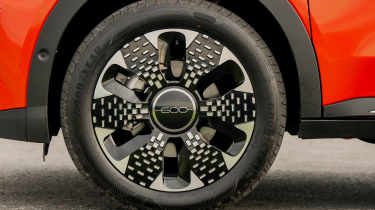
The extra weight of the electric 600e (some 250kg, depending upon the spec) means it doesn’t feel as settled on undulating country roads as the lighter 600 does. Neither version is the last word in comfort, but of the two, the 600 does a better job of dealing with big potholes than its electric sibling - especially on the smaller 17-inch wheels of our test car.
From a chassis perspective, the 600e is decent to drive. The ride is a little fidgety at low speeds but not intrusively so, and there’s enough give to make it a perfectly relaxing place to be at higher speeds.
The amount of body roll is well judged, giving the driver enough information to feel the tyres loading up – and that’s a good thing, given that the steering offers little in the way of feedback. Grip is also fine, and the balance feels neutral as you approach the limit of the tyres.
The 600e’s regenerative braking system works well, but we’d have liked some more adjustment rather than just an on or off option.
Motorway driving and long-distance comfort
Refinement is fine at motorway speeds. Aside from a bit of wind noise around the wing mirrors, road noise is kept at low levels for the class. The ride is smooth, and that more relaxed steering response helps it to feel stable and reassuring at speed. It comes across as a larger car than it really is.
“You get the sense the 600 is actually making use of its jacked-up profile to dispatch larger potholes and speedbumps with relative ease.” - Alastair Crooks, senior news reporter.
MPG & running costs
Pros |
|
Cons |
|
While the 600 Hybrid can technically travel on electric power alone, it’s only capable of covering less than a mile on battery power, and even then, at speeds of up to 18mph. Instead of reducing the need for the engine, the 600’s electric motor is intended to assist it and ultimately boost fuel economy instead.
The result is an official WLTP combined figure of 58.8mpg, which is an impressive number, but it falls slightly short of the Nissan Juke Hybrid’s 60.1mpg. The Renault Captur E-Tech is even more frugal still (at least on paper) at 64.2mpg.
Naturally, the pure-petrol 600 is thirstier but not by a ridiculous amount. At up to 50.4mpg on the WLTP combined cycle, it’s a little bit more efficient than the petrol-powered Juke, as that only manages up to 48.7mpg.
| Model | MPG | CO2 | Insurance group |
| 600 1.2 Icon | 49.6mpg | 130g/km | 21 |
| 600 1.2 Hybrid 110 Icon | 58.9mpg | 109g/km | 21 |
| 600 1.2 Hybrid 145 Sport | 57.6mpg | 109g/km | 27 |
Electric range, battery life and charge time
Every variant of the Fiat 600e uses a 54kWh battery pack (50.8kWh usable), with the Icon version getting a range of 254 miles, and the La Prima getting 252 miles of range. Fiat says that using the car solely around town could boost that to 370 miles, which sounds more optimistic than even the combined figures.
We saw an average efficiency of 3.7mi/kWh from our long-term Fiat 600e La Prima, which equates to around 187 miles of battery range. This was achieved after a mixture of urban and motorway driving, but it’s disappointingly short of Fiat’s claim of 252 miles.
All versions of 600e have a heat pump as standard, and because that’s a more efficient way of heating the interior, it means the range shouldn’t change drastically in colder weather. This is a very useful feature that’s optional on a number of rivals, and you won’t even find one in some models like the Vauxhall Frontera Electric, Ford Puma Gen-E or MGS5 EV.
Charging speeds of up to 100kW are supported, making it possible to take the battery from 20 to 80 per cent in just under half an hour. An overnight charge using a 7.4kW home wallbox charger should take a little over eight hours.
| Model | Battery size | Range | Insurance group |
| 600e Icon | 54kWh (50.8kWh usable) | 254 miles | 26 |
| 600e La Prima | 54kWh (50.8kWh usable) | 252 miles | 26 |
| 600e Sport | 54kWh (50.8kWh usable) | 252 miles | 25 |
Insurance groups
Insuring the Fiat 600 shouldn’t prove too strenuous on the bank account, as both the hybrid and EV sit in insurance groups 21 to 27 (out of 50). The Jeep Avenger commands similar premiums in groups 23 to 25, while the hotter Abarth 600e is predictably far more expensive in groups 35 and 36.
If you want the biggest savings on insurance, the Ford Puma is in groups 12 to 21, while the Renault Captur ranges from group 11 to 16.
Tax
Every 600 qualifies for the standard rate of VED road tax, but the luxury car tax isn’t a concern here due to the car’s relatively low price. However, the upcoming eVED pay-per-mile tax might impact the Fiat 600e if it arrives in 2028 as planned.
Business buyers will benefit from the lowest Benefit-in-Kind (BiK) company car tax rating if they stick with the fully electric 600e, as its zero-emission status results in far bigger savings.
Depreciation
Our market data indicates that the combustion-powered Fiat 600 will retain between 45 and 48 per cent of its original value after three years or 36,000 miles. These are stronger numbers than those achieved by the Jeep Avenger, as that only manages 34 to 42 per cent.
The Fiat 600e puts up firmer resistance than its sibling, at 47 to 50 per cent. Once again, this outshines the electric Avenger at 36 to 38 per cent.
Interior, design & technology
Pros |
|
Cons |
|
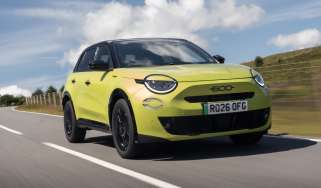
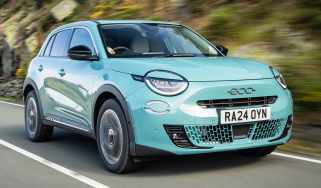
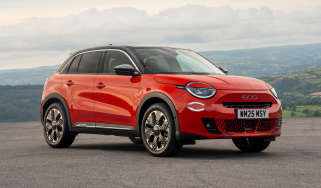
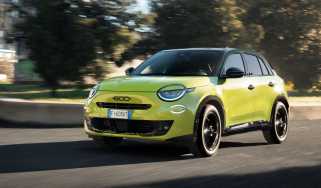
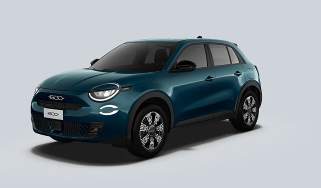
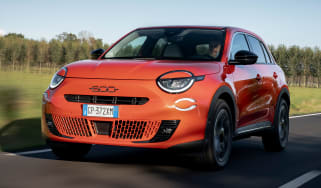
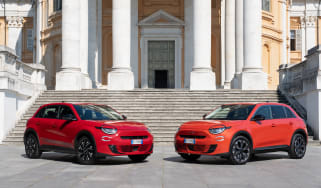
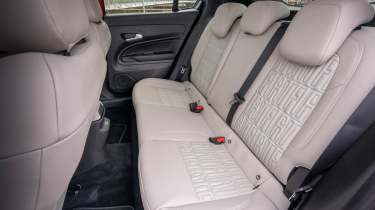
Fiat is said to be on a mission to banish dull colours. There are a number of eye-catching paint colours to choose from, some of which cost more than others. The monogrammed seats are also rather unique, if a bit unsubtle.
The 600’s in-car tech, meanwhile, is standard Stellantis fare, with a Fiat skin over the top of the same system that features in the Jeep Avenger.
Interior and dashboard design
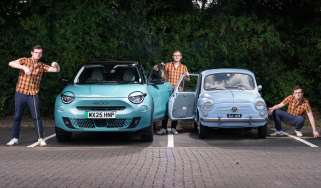
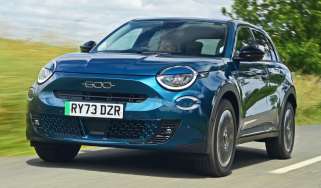
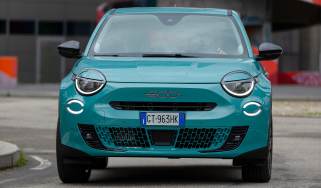
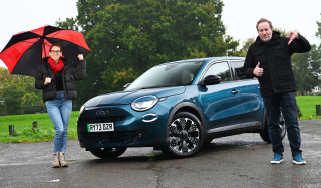
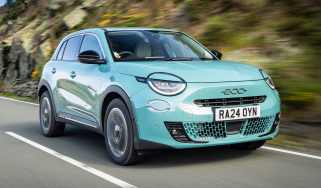
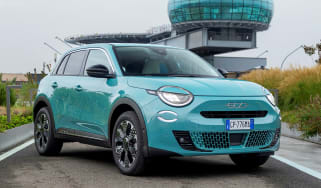
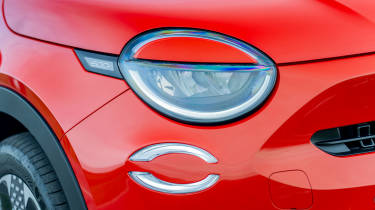
Anyone upgrading from the smaller Fiat 500 electric city car will feel right at home with the exterior styling of the Fiat 600e. Like the 500, the clamshell bonnet bisects the LED headlights, while the rear lights are a dead ringer for those of its smaller sibling. The extra rear doors and black plastic cladding around the wheel arches indicate this car’s additional SUV-style utility.
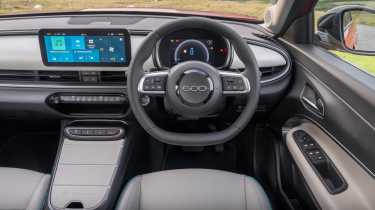
There’s more than a whiff of Avenger in the cabin, with the same basic layout of screen and hotkeys beneath it, not to mention the foldable cover for the central storage area between the front seats. It’s neat enough, and a bold strip of gloss-red material brightens the fascia. But there’s no doubt this feels a bit more mature and a little less fun than a 500.
Materials and build quality
While the 600’s interior is pleasant enough, we had one or two concerns about the quality of the test cars we’ve tried. We experienced loose plastic fittings and rattling windows during our six months with a 600e in La Prima spec. Given that this car was less than a year old and had under 5,000 miles on the clock at the time, it does raise the question of how it’ll fare as the years go on.
Infotainment, sat-nav and stereo
All versions of the 600 and 600e come with the larger 10.25-inch central touchscreen that’s denied to lesser versions of the Jeep Avenger, and has been used to great effect on the smaller 500. It’s not as large as the 12.8-inch screen fitted to the Smart #1, but the 600 has a snappier interface, with clear graphics, big on-screen buttons to press, and a crisp display. It’s positioned high up on the dash, so it’s easy to access without looking away from the road.
The 600 and 600e also come with Apple CarPlay and Android Auto smartphone capability to allow you to use apps from your phone for all your navigation and audio streaming needs. The top-of-the-range La Prima adds an in-built TomTom navigation system that includes vehicle charging locations, a wireless phone charging pad, and a couple of extra speakers.
“I do agree that the car looks good, but I am less impressed with the interior. The white seats are already showing signs of wear and tear, despite the car having covered fewer than 5,000 miles from new. In addition, the dye from my jeans has stained the material in places.” - Pete Baiden, web producer.
Boot space & practicality
Pros |
|
Cons |
|
The Fiat is smaller in all directions than the Smart #1, which is noticeable if you compare the two for interior passenger space.
Dimensions and size
The 600 is slightly longer than the Jeep Avenger, and it offers more luggage space as a result. It’s still one of the smaller models in the compact SUV market, though.
| Dimensions comparison | |||
| Model | Fiat 600 | Smart #1 | Jeep Avenger |
| Length | 4,171mm | 4,300mm | 4,088mm |
| Width | 1,781mm | 1,822mm | 1,797mm |
| Height | 1,536mm | 1,636mm | 1,541mm |
| Wheelbase | 2,560mm | 2,750mm | 2,560mm |
| Boot space |
385 litres (Hybrid) 360 litres (EV) | 323 litres |
321 litres 282 litres (EV) 262 litres (4xe) |
Seats & passenger space
There’s decent room for two adults up front in the 600, but the slight stretch compared with the Avenger’s overall length hasn’t translated into a big gain in wheelbase, because the Fiat’s is longer by only two millimetres. So the same constraints apply in the rear seats as they do in the Jeep’s; younger kids will be fine, but only the shortest adults will be able to get truly comfortable, with everyone else forced to squish their knees into the front seatbacks. It also doesn’t feature the neat sliding rear seat of the Smart #1 in order to increase leg room.
An Isofix child seat mounting point is provided on the front passenger seat (you’ll need to ensure the passenger airbag is disabled when a rear-facing child seat is fitted), and two further points are provided on the outer positions of the sliding rear bench.
Boot space
The Fiat 600 has a slightly larger boot than you’ll find in the 600e. 385 litres with the rear seats in place is pretty reasonable, but it’s short of the Renault Captur’s 422 litres, and a long way off the Ford Puma’s 456 litres.
The electric 600e’s boot capacity, meanwhile, stands at 360 litres, although this is more than you’ll find in a Smart #1 (323 litres). The Fiat also has a variable-height floor that you can use to store the charging cables. That’s useful, but it would have been even better if there was some storage under the bonnet, like there is in the #1, so you don’t have to remove items from the boot to access the cables in the underfloor storage area.
Towing
Both hybrid variants of the 600 are rated to tow a braked trailer of up to 1,100kg, but the petrol model and the 600e are not rated to tow at all. If you need an electric SUV to take on towing duties, you’ll be better off with a Volvo EX30 Extended Range, as this can handle a maximum of 1,600kg.
“Comfort is not helped by the shortage of rear legroom, because it means my children’s legs are usually touching the backs of the front seats. The odd unintentional kick in the back as they switch positions is unwelcome.” - Pete Baiden, web producer.
Reliability & safety
Pros |
|
Cons |
|
The safety experts at Euro NCAP haven’t rated the Fiat 600e yet, but we hope some additional development work has been carried out in order for it to improve upon the disappointing four-star rating of the Citroen e-C4, Peugeot E-2008, and Vauxhall Mokka Electric.
All the expected safety assistance technology is fitted to the Fiat, including autonomous emergency braking, which should avoid or mitigate low-speed collisions with other vehicles and vulnerable road users, such as cyclists and pedestrians. You also get traffic sign recognition to flag the speed limit on the road you’re driving and a lane keep assistance system to warn you if you’re about to stray out of your lane on the motorway.
Neither the Fiat 600 or 600e appeared in the most recent Driver Power survey, but the Fiat brand scored a middling 18th place out of 30 in the best manufacturer rankings. Owners have enjoyed their cars’ styling as well as affordable running costs, but practicality and quality were sources of disappointment.
Buying and owning
- Best buy: Fiat 600e Pop
In its entry-level petrol form, the Fiat 600 starts from £24,000, rising to £26,000 for the hybrid. However, thanks to it qualifying for band 2 of the Government’s Electric Car Grant (a discount of £1,500), the fully electric Fiat 600e also starts from around £26,000, so this is the one we’d go for. Running cost savings will soon make up for the initial cost difference compared to the petrol car, too.
While the posher La Prima and Sport trims add their own respective goodies, the entry-level Pop remains pretty well equipped while keeping the price well in check, so we’d stick with this.
Whether you want to go for combustion or electric power, you can build your new Fiat 600 through the Auto Express Buy A Car service, and save on the list price. We also have Fiat 600 leasing deals to choose from, along with used 600 models in stock right now.
Fiat 600 alternatives
The small SUV market is enormous, so both the 600 and 600e have an armada of competitors to face. In fact, there are already plenty of rivals to consider without even moving away from Fiat’s parent company, Stellantis. The Jeep Avenger, Peugeot 2008, Citroen C3 Aircross and Vauxhall Frontera are all stablemates to the 600, and each brings its own unique touches along with several identical underpinnings. If you’d prefer to look elsewhere, the Renault Captur, Ford Puma, Hyundai Kona and Skoda Kamiq are just a handful of cars that are worthy of your consideration.
If you’re considering an electric car, all of the aforementioned Stellantis SUVs have an EV variant to choose from, as do the Ford Puma and Hyundai Kona. There are also bespoke electric models like the Smart #1 and Renault 4 to take a look at.
Key updates of the Fiat 600 review
- 10 September 2026: Details about the petrol-powered Fiat 600.
- 28 January 2026: Fiat 600 Hybrid impressions.
Frequently Asked Questions
All new Fiat cars have a three-year, unlimited mileage manufacturer’s warranty. The latter puts the brand above most other manufacturers, even if it can’t quite match the five-year/unlimited mileage Hyundai warranty, or the seven-year/100,000-mile warranty from Kia. None quite offers the 10-year/100,000-mile warranty of Toyota, although the stipulation there is you must have it serviced annually at a Toyota dealership to maintain it for that length of time.
Deals on the 600 and alternatives