New electric BMW M3 caught testing on the Nurburgring with aggressive styling
The electric model will be the most powerful to wear the M3 badge
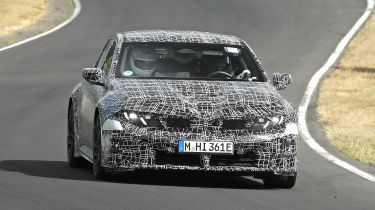
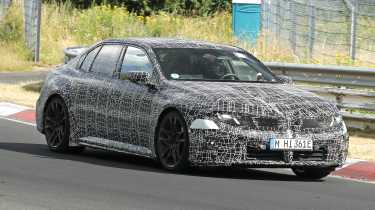
We’ve caught the new electric BMW M3 testing once again and it appears the next generation of the super-saloon will retain plenty of the performance-related design tweaks that helped immortalise its predecessors.
Frank Van Meel, CEO of BMW’s M division, recently confirmed that the electric version of the car would use the M3 badge – and these latest spy shots show it should be recognisable to M enthusiasts too.
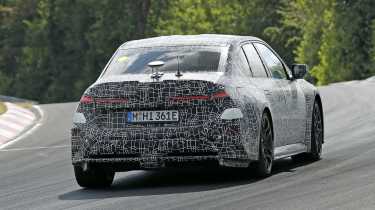
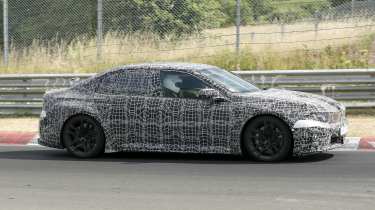
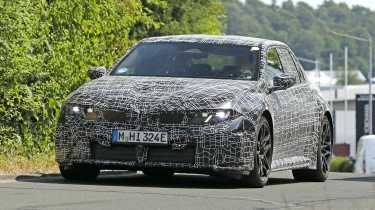
Spotted testing on the Nurburgring, this electric M3 prototype still wears full camouflage, although we can see the covering for the front intake has been removed, revealing a central spline not dissimilar to the one on the current M5. Without an engine to cool, the upper grille is blanked off, although the petrol-powered M3 will likely need to open up this space to channel air to the engine.
Bulkier wheelarches can be seen down the side, along with larger wheels and beefier brakes. The front wing air vent – a design staple on the M3 since the E46 generation – isn’t visible, though it might not be needed, given the pure-EV powertrain. The bonnet does feature an air vent, though, which we assume will be for aerodynamic purposes rather than cooling. On the roof, the familiar double-bubble carbon-fibre roof has also been carried over as well.
To the rear we can see for the first time a rather aggressive diffuser protruding from the underside of the bumper. There’s also a tiny spoiler on the bootlid and below that we can just make out the production-ready rear lights, which look unchanged from the standard i3.
BMW M Concept Neue Klasse inspiration
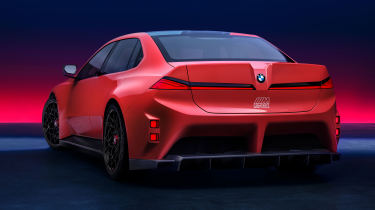
The design of the electric M3 will be toned down from the M Concept Neue Klasse that was revealed at this year’s 24 Hours of Le Mans endurance race. The concept was influenced by both the history of BMW M and its motorsport exploits and Oliver Heilmer, head of design for BMW’s new-era ‘Neue Klasse’ and M division, explained: “At BMW M, form consistently follows function. Every detail serves performance.”
Speaking about the M Concept Neue Klasse, he added: “This project is truly special to me because it carries the BMW M character into a new era.” That character comes from bold proportions, precise lines and muscularity from wide wheelarches, which as you can see are all present and correct.
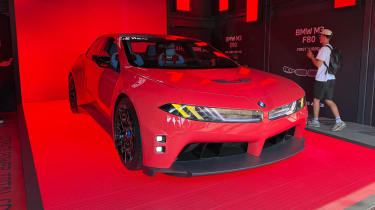
The concept’s razor-sharp shark nose sports the striking new interpretation of the famous kidney grilles, which we saw on the new 3 Series revealed earlier this year. It’s certainly a lot sleeker than the bucktooth arrangement on the current M3 and M4.
The M Concept Neue Klasse’s unique lighting signature includes bright yellow elements that are supposed to give a better view of the road in poor weather and are set to become a feature of future BMW M road cars. That will also be the case with the square track lights at the front and rear, which are a nod to the BMW M Hybrid V8 hypercar that competes at Le Mans.
Elsewhere, the heavily sculpted V-shaped bonnet features a large air outlet that helps to cool the electric drivetrain, and the special ‘trimaran-style’ bumper uses a three-part design, supposedly inspired by high-speed sailing boats, and structural support for the massive front splitter.
But perhaps the piece de resistance of the M Concept Neue Klasse is its twin-fin ducktail spoiler that’s been beautifully sculpted into the clean and rather simple design of the rear. Of course, it’s functional, too.
The ‘carbon-fibre’ roof is actually made of a natural-fibre composite, as are the front splitter, bonnet duct and the diffuser. This is supposed to be a more sustainable replacement that BMW will be using on its production cars.
BMW M3 power and technology revealed
The next-generation BMW M3 is guaranteed to be the most powerful ever, because there will be a pure-electric version with quad motors capable of delivering up to 1,341bhp. However, bosses have reassured us that the legendary super-saloon will not become some unhinged, power-mad monster. It’ll still feel like an M3 should.
Auto Express recently had the opportunity to chat with Christian Karg. He’s currently the head of vehicle dynamics for the whole BMW Group, and previously spent nearly 10 years moulding BMW’s M cars, including the current M3 and M4, plus all the extra-special CS and CSL models.
The softly spoken engineer is also the grandfather of the BMW M3 Touring, because he wanted to create one after owning a V10 E61 M5 Touring that he used as the family car for his three kids. Karg led the small, extremely passionate team that built the first prototype, so suffice to say, he knows a thing or two about making cars astonishing to drive.
We quizzed him on the biggest challenges facing BMW M and its first electric product, the zero-emissions M3, and he very quickly replied: “It’s not about the horsepower. That’s a part of the game, but the preciseness of M cars, that’s what’s unique.” This supports our suspicions that while the first-ever electric M3 could theoretically deliver hypercar levels of power, it almost certainly won’t. Around 650bhp to 750bhp seems likely.
That’s not that much in the world of high-performance EVs. However, BMW’s quad-motor set-up allows for incredibly precise control over the distribution of power to each wheel, for true torque-vectoring that should help make the electric M3 feel much lighter than it actually is.
Karg continued: “The Chinese competitors come up with really fancy stuff – a lot of technical novelties and milestones. We can’t cover everything, so we focus on our heritage. So what is important? What BMW stands for and our promise to customers.”
Returning to the subject of challenges for the electric M3, Karg said: “We test every car on the Nürgurbring, and you know there are challenges for BEVs in terms of long-term, high-peak power output. Also how to manage that in the proper way, how to manage the weight, how to make the car feel still light-footed and like a BMW M car should.”
One particular problem the BMW M boffins are facing is to maintain a high power output even when the car starts to run low on charge. Rival Mercedes-AMG managed to achieve a kind of ‘relentless’ performance with its new GT 4-Door, in part due to a specially designed battery pack derived from Formula One technology.
Karg didn’t give anything away about what the new M3 will be like to drive – not surprising given that the M division’s activities are kept separate. But he did promise “it will be quite amazing,” although we think he was just being modest.
Of course, there is also going to be a petrol version of the next M3, featuring a straight-six engine with new ‘BMW M Ignite’ combustion technology (originally developed for the marque’s race cars) and some level of hybrid assistance to ensure it meets the latest emission standards. Auto Express has even confirmed that, as with the current model, there’s going to be a Touring estate version, too. There may even be an electric M3 Touring - given that the standard i3 is getting a Touring variant.
Luckily, Karg told us, BMW still feels like a company run by petrolheads and driving enthusiasts. “It’s a wonderful thing that, in such a big company, there are a lot of opportunities to make things happen like that [M Neue Klasse Concept]. It’s not easy, but when you have the right people beside you, you can do a lot of good things.”
BMW’s M Neue Klasse Concept is not the first time the brand has previewed the petrol-free future of its legendary super-saloon. It’s shown us quad-motor prototypes of an i4 countless times, and there was the insane Vision Driving Experience: a ‘rolling laboratory’, again with four motors that produced an ungodly amount of power, plus wheelarches so big they would make a Group B rally car feel inadequate and fans that literally sucked the car into the tarmac for unparalleled levels of downforce.
Camouflaged prototypes of the electric BMW M3 haven’t been shying away from the cameras either. They've been spotted testing everywhere, from the Arctic Circle to the Green Hell of the Nürburgring Nordschleife. At least the brand is giving petrolheads the time to come around to the idea of an electric M3 and/or sharpen their pitchforks ahead of its arrival next year.
What will the new M3 be like inside?
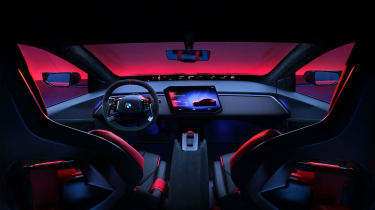
The interior of the M Concept Neue Klasse is designed to be restrained, simple and fully focused on the driving experience. Of course, it uses the Panoramic iDrive layout from the new 3 Series, which replaces the traditional instrument cluster with a customisable display stretching across the base of the windscreen.
It’s designed to keep the driver’s eyes on the road as much as possible while giving them all the vital information they need, which in an M3 will include lap times, temperatures and G-forces.
There’s no smattering of buttons on the centre console as on the current M3, just the alluring red gear selector. The same bright hue is also used on the shift paddles – the electric car is set to feature a virtual gearbox like the new AMG GT 4-Door and Hyundai Ioniq 6 N – and M mode buttons on the steering wheel, alongside plenty of other places.
All of that should make it into the new M3, and so could the floating dashboard finished in black knit material with unique backlit M graphics. However, the production car probably won’t be a four-seater like this concept, which gets proper bucket seats with five-point race belts in the front and back.
The seats won’t be the only detail that has to be changed for the next-generation M3, but we don’t expect there will be much difference between this concept and the road-going version. In fact, slap a number plate on it and we can see it hunting down the new Audi RS 5 tomorrow.
What’s the latest on BMW M’s revolutionary new four-motor layout?
The electric M3 will use a lot of the same technology as the new iX3, i3 and iX5, but they only get one or two e-motors. The super-saloon, on the other hand, will use four independent motors – one for each wheel – kept in check by the BMW M Dynamic Performance Control software in the car’s Heart of Joy supercomputer brain.
The motors in the ‘M eDrive’ set-up are supposed to be very power dense and in the past we’ve been told this quad-motor drivetrain can produce up to 1,341bhp, which is a megawatt of power. However, we don’t expect the electric M3 will produce anywhere near that much.
Considering that the Ferrari Luce and AMG GT 4-Door both produce more than 1,000bhp, we wouldn’t be surprised if this does too. But even with ‘just’ 650bhp it would be the most powerful M3 of all-time, and giving it 750bhp would make this zero-emissions saloon the most powerful road car the BMW M division has ever made.
Each axle will have an identical set-up: two motors mounted symmetrically with their own integrated gearboxes. These will be single-speed items, because a two-speed system – as used on the Porsche Taycan – was deemed not necessary, given the incredible scope of performance from the e-motors themselves.
As well as enormous grunt, a quad-motor drivetrain like BMW’s allows for incredibly precise control over power distribution to each wheel, for true torque-vectoring that will enhance the driving dynamics for both road and track. This should also help make the electric M3 feel lighter on its feet. But the front axle can also be decoupled to create a rear-wheel-drive tyre-blazer, or help boost efficiency on longer journeys, depending on what kind of mood you’re in.
No range estimates have been released yet, but the electric M3 will feature a 100kWh-plus battery with a special version of BMW’s sixth-generation cylindrical cells that have been optimised for the high output of this car’s quad motors.
What will the electric BMW M3 sound like?
Sound has long been a controversial element of high-performance EVs. Do these models need a sound at all, let alone one that mimics a petrol engine? This is a question that BMW M has just emphatically answered, previewing the virtual engine noise that’ll be used in future all-electric models including the M3.
Revealed in a video that’s following the development of BMW’s future M3, the company showed how it’s creating a unique engine note from some of its most iconic past models. The video showed an E92 M3 and an F82 M4 GTS – cars that respectively featured sonorous V8 and straight-six engines – but the main model being worked on to record and synthesise an engine noise was an E63-generation M6 convertible, with its iconic V10 engine.
Like lots of manufacturers, BMW will use the speakers to broadcast a synthesised engine noise inside the cabin, helping boost the sense of connection between the driver and the car's electric powertrain. The video even went so far as to reveal what the system could sound like in an early prototype, and the other cars in the room suggest drivers could be given different soundtrack options depending on their preferences.
Where does this leave the petrol-powered BMW M3?
Given the difference in the two cars’ powertrains, we can expect their performance to be noticeably different. However, a senior official told us that the EV and petrol models should have similar styling – based on the Neue Klasse Sedan concept that BMW brought along to the Munich Motor Show in 2023.
As previously stated, the next-generation BMW M3 will be available with a six-cylinder petrol engine, although we haven’t confirmed whether it’ll be the brand’s existing S58 or B58 unit, or an entirely new one.
It will certainly have some level of hybrid assistance, however, rather than a plug-in hybrid system as on the latest M5, because mild-hybrid tech will play a key part in meeting the M3’s emissions targets.
BMW has also recently introduced what it calls “BMW M Ignite” technology on its S58 six-cylinder to help it meet the latest emissions standards. It’s a new pre-chamber combustion process, patented by the company, which significantly reduces fuel consumption under high loads and will help its high-performance cars meet the incoming Euro 7 emissions standards.
The technology has come from BMW’s racing cars and is being added to all the straight-six engines in M cars this year. The company says customers who take their cars on track will be particularly appreciative, because it means they can do more laps with the same amount of fuel.
With no substantial electric assistance, we expect the petrol-powered M3 to be only slightly more potent than the current M3 Competition, which develops 523bhp and 650Nm of torque.
When will the new BMW M3 arrive?
Following the launch of the standard Neue Klasse 3 Series later this year, we’re expecting the petrol and electric versions of the next-generation BMW M3 to be revealed in 2027, before going on sale in 2028.
If you don’t want to wait that long for the new BMW M3, right now you can save nearly £20,000 on the current model with the help of the Auto Express Buy A Car service. Deals are available on both the standard saloon and M3 Touring.
Did you know you can sell your car through Auto Express? We’ll help you get a great price and find a great deal on a new car, too.