Cupra Formentor review
Cupra Formentor is a sporty crossover SUV that combines practicality with driving fun

Our opinion on the Cupra Formentor
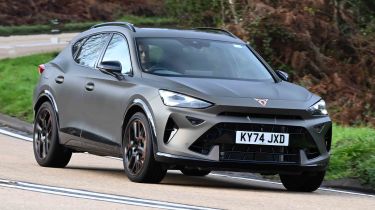
The Cupra Formentor has been a real success for the sporty Spanish brand. Its athletic styling and unique copper detailing have helped it stand out in a crowded small SUV marketplace; plus, it's good to drive, and there’s a range of engines to choose from. A mid-life facelift has brought welcome refinements to the infotainment system, while the plug-in hybrid models offer greater efficiency. If there's one criticism, it's that some cabin materials aren’t quite up to the standard you might expect given the Formentor is priced to match the similarly sized Audi Q3. But if you’re after a practical family car that prioritises driving fun and offers something a bit different to the SUV norm, then the Formentor is a solid choice.
About the Cupra Formentor
The Formentor was the first car to be launched exclusively as a Cupra model, because other models like the Cupra Leon also wore a SEAT badge. We’d argue that the Formentor’s sleek look is better suited to a Cupra badge than a SEAT one, although this does come at the cost of some headroom and boot space. That being said, it’s still a practical car with a decent amount of space in the back of petrol variants.
Used - available now

2024 Cupra
Formentor
21,512 milesAutomaticPetrol2.0L
Cash £27,368
2024 Cupra
Formentor
36,702 milesAutomaticPetrol1.5L
Cash £20,352
2024 Cupra
Formentor
154,000 milesAutomaticPetrol1.5L
Cash £22,360
2024 Cupra
Formentor
39,975 milesAutomaticPetrol1.4L
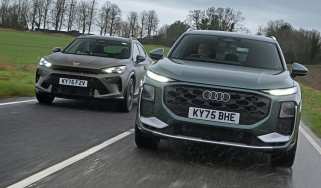
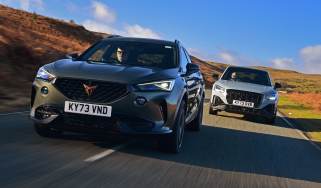
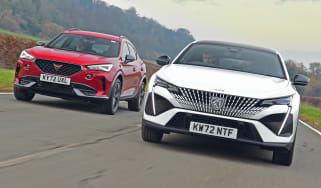
Cash £19,760We’ve put the Cupra Formentor through its paces numerous times since it made its UK debut, including pitting the latest e-Hybrid Cupra Formentor against an Audi Q3. We also spent six months with a Cupra VZN as part of our long-term test fleet.
Cupra Formentor prices and latest deals
The Cupra Formentor line-up starts from a little under £35,500 for the entry-level V1 variant, while a V2 comes in at a little over £37,500. The highest non-performance trim for the Formentor is the Tribe Edition, which commands a little under £39,500.
The more powerful 'VZ' models start in VZ1 form at around £44,000, followed by VZ2 at around £47,000, and VZ3 at just over £50,000. A special-edition VZ5 is available in very limited numbers and costs nearly £64,500.
If you’d like to save money on a Formentor, you can configure your ideal Cupra Formentor right now through the Auto Express Buy a Car service. You can also find the latest Cupra Formentor leasing deals or look for great prices on used Cupra Formentors. If you need to sell your existing car, be sure to visit the Auto Express Sell my Car service.
Performance & driving experience

Pros |
|
Cons |
|
The Formentor engine line-up offers a wide range of options, although there are no diesels in the mix. Most versions are front-wheel drive, but the more powerful 2.0-litre and limited-run 2.5-litre models have four-wheel drive.
The 148bhp 1.5 TSI petrol and the 201bhp 1.5-litre plug-in e-Hybrid are offered in V1, V2, and Tribe Edition models. Elsewhere, the sportier VZ1, VZ2 and VZ3 trim levels can be had in 262bhp 2.0 TSI petrol, a more potent 268bhp 1.5-litre e-Hybrid, and four-wheel-drive equipped 328bhp 2.0 TSI petrol forms. The limited-run VZ5 uses a 385bhp 2.5-litre, five-cylinder engine that’s related to the engine you’ll find in the Audi RS 3.
All e-Hybrid PHEV versions use a six-speed automatic, while petrol-only versions use a seven-speed automatic, although the least powerful 1.5-litre petrol is still one of the few new cars that can be specified with a manual gearbox.
| Model | Power | 0-62mph | Top speed |
| Formentor 1.5 TSI 150 V1 | 148bhp | 9 seconds | 127mph |
| Formentor 1.5 e-Hybrid 204 V1 | 201bhp | 7.9 seconds | 130mph |
| Formentor 2.0 TSI 333 VZ3 4Drive | 328bhp | 4.8 seconds | 155mph |
Performance, 0-60mph acceleration and top speed
The Formentor has a range of petrol engines sourced from the VW Group. A 1.5-litre petrol with 148bhp kicks off proceedings, and its 0-62mph time of 9.0 seconds is the same whether you choose the six-speed manual or seven-speed automatic gearboxes.
Performance fans will be pleased to find that the facelifted Formentor range includes a 328bhp 2.0-litre petrol model. Thanks to standard-fit four-wheel drive and 420Nm of torque, the 0-62mph dash is dispatched in less than five seconds, and there’s a top speed of 155mph. If you’re happy to sacrifice some performance to boost economy, the 261bhp 2.0-litre petrol model sprints from 0-62mph in 6.5 seconds.
The limited-run Formentor VZ5 is the most powerful variant produced so far, with 0-62mph dealt with in only 4.2 seconds, and it’ll continue to a top speed of 173mph. It's best experienced in its Cupra driving mode, which helps make the engine a bit more responsive, whereas the accelerator response in its Eco and Normal modes is a bit soft
Town driving, visibility and parking
Whichever Cupra Formentor model you choose, you’ll find it pretty straightforward to drive in and around town. If urban routes are where most of your driving takes place, then it’d probably make most sense to opt for the 148bhp petrol, or the lower-powered e-Hybrid - simply based on cost and overall efficiency.
The e-Hybrid models are a bit underwhelming when driven with any vigour; neither can shrug off the weight penalty of a heavy battery pack, making these versions feel slightly less agile in corners, plus the suspension has been stiffened to compensate for the extra weight, so they don’t ride as well. Nor do they sound particularly inspiring when pushed, so a more sedate driving style in town, making the most of its all-electric range, suits this version best.
Due to its hunkered-down stature, the Formentor doesn't provide the same high driving position as many of its rivals. Large C-pillars limit rear visibility, so we did find parking a little tricky at times. Thankfully, front and rear sensors are standard, although you’ll need to fork out for a V2 or higher if you want a reversing camera.
Country road driving and handling
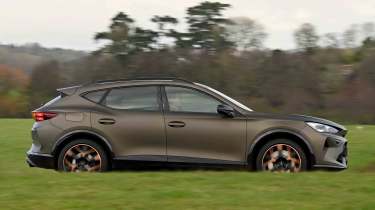
The Formentor is, on the whole, comfortable. The conventional suspension set-up on V1, V2 and Tribe Edition models doesn’t feel like a bad compromise; it’s a little busy, perhaps, but you’ll have to be driving over some pretty poor surfaces to get badly upset by the ride. We suspect that sticking with the smallest 18-inch wheels fitted to the entry-level V1 trim is the way to go when speccing a non-performance Formentor.
Adaptive dampers are standard on VZ1 trims and above, which allow the Formentor to ride very well, although the firmest Cupra mode feels extremely firm and is best left at the track. The Normal drive mode is just right, with very little body roll and lots of grip, so you’ll feel confident in carrying your speed on a twisty country road. Even in versions without adaptive suspension, you'll find that all driving modes (Comfort, Performance, Cupra, and Individual) provide a genuinely different experience through the steering weight and drivetrain responses. The steering gets heavier but doesn’t have any more feel, so it actually becomes slightly less enjoyable to drive.
The quickest Formentor models come with four-wheel drive as standard, which doesn’t turn it into an off-road champion, but does add a sense of security with additional traction in wintry driving conditions. Perhaps the version that takes advantage of the four-wheel drive system the most is the Formentor VZ5, which also gets a 10mm reduction in ride height over the regular Formentor for sharper handling, larger brakes with six-piston Akebono front brake calipers, plus the more powerful five-cylinder engine.
Motorway driving and long-distance comfort
In Comfort mode, you’ll find the Formentor is a perfectly pleasant car to rack up motorway miles. Road noise and wind noise are audible, although the SUV's naturally longer suspension travel (compared with a Cupra Leon) is happy to absorb bumps and ruts in the road – even on the larger 19-inch wheels the V2 and Tribe Edition models come with.
"The Formentor’s crossover-style body helps to keep the car’s centre of gravity low, so it behaves more like a hatchback than an SUV on twisting roads. If you enjoy driving, then we’d recommend choosing one of the VZ models with adaptive dampers, because they deliver a wide range of ability." - Dean Gibson, senior test editor.
MPG & running costs
Pros |
|
Cons |
|
Picking the 328bhp 2.0-litre petrol engine will bring fairly chunky running costs; it’s a high-performance petrol with four-wheel drive and an automatic gearbox, so 32.1mpg and 198g/km are hardly surprising. The front-wheel-drive 261bhp 2.0-litre TSI is better at 36.2mpg and 177g/km, but the most efficient petrol is the entry-level 1.5-litre TSI engine.
When we tested a 328bhp Cupra Formentor VZ3 in a variety of driving scenarios, this high-speed model returned an average of 30.6mpg. This isn’t too horrendous by performance car standards, but it’s still a little short of the official claim of 32.1mpg.
The plug-in hybrid has better efficiency than its petrol-powered counterparts, on paper at least. The 201bhp version has WLTP figures of 176.6mpg and 32g/km emissions, while the 268bhp gets 156.9mpg and 37g/km. As with any other plug-in hybrids, the fuel economy you achieve will depend entirely on how often the battery is charged. From our experience of the 201bhp powertrain in other VW Group models, a full tank of fuel and a fully charged battery should help you see a return of anything up to 70mpg. However, if you only use the petrol engine and never charge the battery, that figure will be closer to 35-40mpg, depending on where you do most of your driving.
| Model | MPG | CO2 | Insurance group |
| Formentor 1.5 TSI 150 V1 | 46.3mpg | 138g/km | 21 |
| Formentor 1.5 eTSI 150 V1 DSG | 47.9mpg | 133g/km | 21 |
| Formentor 2.0 TSI 333 VZ1 DSG 4Drive | 32.1mpg | 198g/km | 35 |
Electric range, battery life and charge time
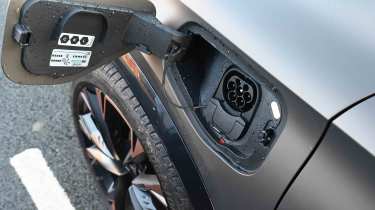
Both the 201bhp and 268bhp plug-in hybrid Formentors use a 25.8kWh battery that’s similar in size to other plug-in hybrid cars from the VW Group, such as the Volkswagen Passat. This gives the Cupra Formentor e-Hybrid a range of up to 77 miles in 201bhp form or 72 miles in 268bhp guise.
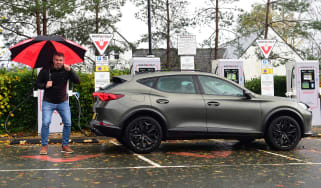
The Formentor’s maximum charging speed has increased dramatically compared with the pre-facelift car, from a relatively slow 3.6kW AC charging speed up to a maximum of 50kW using DC charging. This enables a 10-80 per cent top-up of just 26 minutes from a rapid charger. The latter is an expensive way of recharging the Formentor, so we expect most owners to use a typical 7.4kW home wallbox charger, which will take around four hours to fully recharge a Formentor plug-in hybrid from empty.
| Model | Battery size | Range | Insurance group |
| Formentor 1.5 e-Hybrid 204 V1 | 25.8kWh | 77 miles | 26 |
| Formentor 1.5 e-Hybrid 272 VZ1 | 25.8kWh | 72 miles | 29 |
Insurance groups
Cupra Formentor insurance premiums shouldn’t be too horrendous, with the line-up sitting as low as group 21 (out of 50). However, the fiery 328bhp four-wheel drive will push up the cost as this sits in group 35. In comparison, the BMW X2 resides in groups 22 to 40.
Tax
While the standard and Tribe Edition models fall short of the £40,000 threshold, every high-performance Formentor VZ model is subject to the luxury car tax. This means that on top of the standard annual rate of vehicle excise duty (VED), you’ll be faced with an additional surcharge, which applies from the second time the vehicle is taxed until it is six years old.
For business users, e-Hybrid power will bring slightly more attractive Benefit-in-Kind (BiK) tax rates. However, fully electric cars bring far bigger discounts here than anything with an engine. EV alternatives to the Formentor include the Cupra Tavascan, Peugeot E-408 and Smart #3.
Depreciation
Our market data indicates that the Cupra Formentor should retain between 43 and 50 per cent of its initial value after three years or 36,000 miles, with the PHEVs being towards the lower end of this bracket. For comparison, the BMW X2 holds on to around 50 per cent over the same period, while the Peugeot 408 suffers to a far greater degree, only retaining between 37 and 41 per cent.
Interior, design & technology
Pros |
|
Cons |
|
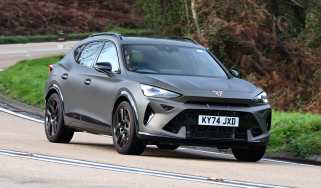
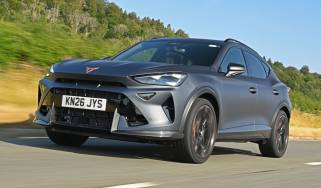
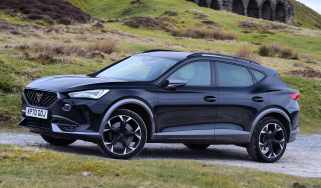
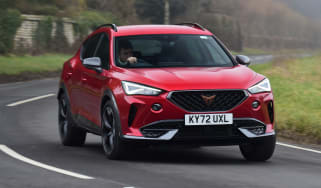
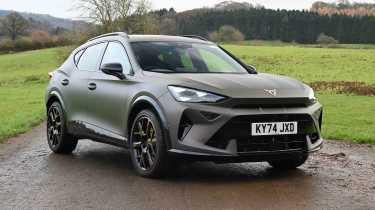
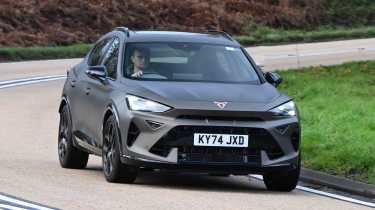
Updates to the Formentor introduced the ‘shark nose’ front end previously seen on Cupra’s electric models, along with triangular headlights, a neater grille and a completely revised bumper. A full-width light bar brightens the rear of the car, highlighting an illuminated central Cupra badge.
Our recommendation is the entry-level V1, which comes with all the basics, including:
- 18-inch alloys
- LED headlights with high-beam assistance
- 12.9-inch infotainment system with sat-nav and wireless Apple CarPlay and Android Auto
- Wireless phone charger
- Front and rear parking sensors
- Adaptive cruise control
- Three-zone climate control
Take a step up from the entry V1 specification to V2, and you’ll benefit from heated front seats with electric adjustment and driver's side memory settings, a power tailgate and a rear view camera. The Tribe Edition adds a few unique interior trim details and a 10-speaker Sennheiser audio system.
The high-performance VZ cars start with VZ1 trim, which adds matrix LED headlights and adaptive suspension. VZ2 has some model-specific 19-inch alloy wheels and interior upholstery, along with a top-view surround view camera system and a blind spot monitoring system. The high-end VZ3 gets its own set of 19-inch alloys, some more supportive Cup bucket seats, an upgraded Sennheiser audio system, and high-performance brakes (Brembo for the e-Hybrid and TSI 265 versions, and Akebono for the 4Drive). The range-topping VZ5 is the limited-run model and the only way to get the most powerful engine choice. To match its extra performance, it has unique chassis tuning.
Interior and dashboard design
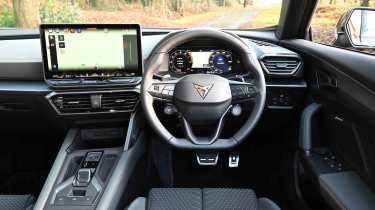
The Formentor has a more modern and stylish interior than its Cupra Ateca sibling. A huge 12.9-inch central touchscreen is perched on top of the dashboard, and most of the climate controls have migrated to the screen to give a cleaner look, much to the detriment of usability on the move.
There’s also a digital instrument cluster that comes as standard, plus a steering wheel with copper detailing and a carbon fibre-effect centre.
Materials and build quality
Cupra’s first bespoke model certainly feels far more unique inside than a SEAT – especially the versions that get a leather-covered dashboard and suede-effect upholstery in places. Look down, and you’ll see a lot of familiar switchgear and the stubby gearlever from the latest Volkswagen Golf, but overall, the interior feels special.
You’ll still find some cheaper plastics on the doors and lower centre console that don’t quite cut the mustard in a car that has prices on a par with an Audi Q3, and we also think that the plastic paddleshifters behind the steering wheel don’t feel sporty enough.
Infotainment, sat-nav and stereo
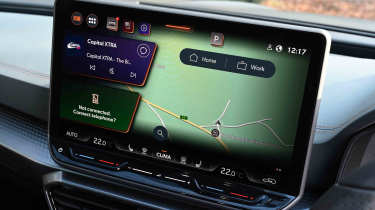
Every Formentor version now features a new 12.9-inch touchscreen. In terms of functionality, it’s not a massive step forward, but it’s more intuitive than before, while some bespoke graphics make it feel distinct from other VW Group models. The divisive climate control touch sliders are thankfully now illuminated, too.
There are some useful shortcuts on the climate control page, such as a setting to warm your feet, and another to cool the cabin, but we still prefer physical buttons to make things easier to find while you’re driving.
Wireless Apple CarPlay and wired Android Auto smartphone connectivity are both standard, so you can bypass Cupra’s software for the most part. You get four USB-C ports (two for the front seat occupants and two for those in the rear) to keep your devices topped up, plus standard wireless phone charging.
A seven-speaker audio system with Bluetooth and DAB radio is standard across the range, while Tribe Edition, VZ3, and VZ5 models have an upgraded ten-speaker arrangement courtesy of Sennheiser.
Boot space & practicality
Pros |
|
Cons |
|
If you want to prioritise overall practicality, then you might find that the Formentor is a little compromised – particularly in terms of boot space. But Cupra has ensured its sporty SUV comes laden with useful touches to make life on the road a bit easier.
Dimensions and size
The Formentor isn’t quite as long or wide as a Peugeot 408, but it is slightly taller. This car is also a tad longer than the Cupra Ateca.
| Dimensions comparison | |||
| Model | Cupra Formentor | BMW X2 | Peugeot 408 |
| Length | 4,451mm | 4,567mm | 4,690mm |
| Width | 1,839mm | 1,845mm | 1,859mm |
| Height | 1,537mm | 1,590mm | 1,478mm |
| Wheelbase | 2,680mm | 2,690mm | 2,790mm |
| Boot space | 345-450 litres | 515-560 litres | 471-536 litres |
Seats & passenger space
The Formentor measures a little longer than the Ateca SUV, and it offers reasonable practicality despite its low, coupe-style roofline. There’s plenty of space up front, which should be fine for most people, and you feel well cosseted. The front sports seats allow you to lower the driving position more than you might think, while the raised centre console adds to the sporty feel.
One minor irritation is that the circular button on the centre console ahead of the drive selector looks like it should be the starter, but it’s not; it deactivates the electronic stability control. The engine start is the circular button on the lower right steering wheel spoke.
Even with chunky front seats, especially the clamshell, carbon-effect items in the top-spec VZ models, it doesn’t feel too claustrophobic in the back. Should you want the interior to feel even more airy, a panoramic sunroof costs around £1,500 – although this has a slight impact on headroom. Those buying the Formentor as a family car will find three Isofix child seat anchor points – two in the rear, one on the front passenger seat – with the rear anchors located behind some easily removable plastic tabs.

Boot space
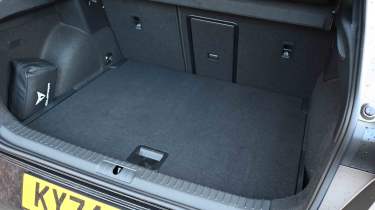
Boot capacity is a mixed bag with the Formentor. Two-wheel drive petrol models feature a generous 450-litre capacity, which is 86 litres less than you get in a Peugeot 408, but adding four-wheel drive reduces the Cupra’s boot by another 30 litres.
Four-wheel-drive models still have a bigger boot than the Cupra Leon or Volkswagen Golf GTI, though. The plug-in hybrid Formentors, meanwhile, have just 345 litres of boot space, which isn’t particularly impressive for a car of this size, and again, it’s less than you get in a Peugeot 408 PHEV.
Towing
On a 12 per cent gradient, the Formentor e-Hybrid can tow a braked trailer weighing up to 1,700kg, a figure which applies to both power outputs and also applies to the most powerful 2.0 TSI petrol model. The 2.0 TSI 265 can tow 1,600kg, and the 1.5 TSI version manages to pull 1,500kg. Having a towbar installed costs around £850.
"The Formentor was a worthy family car for my family of three. We squeezed in all we needed for a weekend away, and with one of the rear seats down, we managed to slot in a small armchair my in-laws had gifted us." - Richard Ingram, deputy editor.
Reliability & safety
Pros |
|
Cons |
|
We don’t have any data from the Driver Power ownership satisfaction survey on what the Formentor is like to live with, but Cupra needs to work on improving its rather disappointing 28th place out of 31 in the list of best car manufacturers in the most recent survey.
Safety shouldn’t be a concern, though, because the facelifted Formentor received a full five-star crash safety rating from Euro NCAP in 2025.
Standard equipment includes auto high-beam assist, collision warning and autonomous emergency braking, a driver alert system and lane-keeping assist. To gain the full suite of active safety systems you need to upgrade to either V2, VZ2 or VZ3 specifications, which add advanced lane assist, side-assist and pre-crash tech (including automatic front and rear seat belt tensioners, window closure and hazard light operation).
| Euro NCAP safety ratings | |
| Euro NCAP safety rating | Five stars (2025) |
| Adult occupant protection | 91% |
| Child occupant protection | 86% |
| Vulnerable road user protection | 79% |
| Safety assist | 77% |
Buying and owning
Best buy: Cupra Formentor 1.5 TSI 150 DSG V1
The entry-level Cupra Formentor is good to drive, comfortable and reasonably practical, so we don’t see much reason to fork out on a fancier model unless you’re tempted by extra goodies or better performance. In that instance, we’d recommend the 2.0 TSI 265 VZ1, which has similar power to a Volkswagen Golf GTI and comes with those effective adaptive dampers.
While the 1.5 TSI doesn’t offer the tax savings or outright efficiency of the PHEVs, it can still achieve up to 47.9mpg on the WLTP combined cycle, which is pretty good for a sporty pure-petrol SUV.
While V1 trim is the Formentor at its most basic, you’ll still get a 12.9-inch touchscreen infotainment system, with Apple CarPlay and Android Auto, LED headlights, 18-inch alloy wheels, tri-zone climate control, sports seats and a heated steering wheel, so it doesn’t exactly feel spartan inside.
Cupra Formentor alternatives
Price rises mean that the Formentor now rivals premium small SUVs such as the Audi Q3 and BMW X2, as well as some other coupe-SUVs like the Peugeot 408. All trade heavily on their individual kerb appeal, so the Formentor continues to have its work cut out, luring customers away from these established marques. Fully electric models such as the Cupra Tavascan, Citroen e-C4 and Smart #3 offer even lower running costs and company car tax savings.
Cupra Formentor pictures
Key updates of the Cupra Formentor review
16 June 2026: General update to include more information about the VZ5 version.
30 March 2026: Inclusion of information about the Tribe Edition trim, along with the latest depreciation and tax data.
Frequently Asked Questions
Different from the usual (and rather stingy) three-year/60,000-mile cover offered by VW Group subsidiaries, Cupra offers a five-year/90,000-mile warranty.
Deals on the Formentor and alternatives