Mazda CX-6e review
Far more than a 6e on stilts, it’s amazing how little is carried over from saloon to SUV…


Our opinion on the Mazda CX-6e
Yet again, Mazda strikes a brilliant balance between quality and value for money with the CX-6e. It costs less than a Tesla Model Y, but feels infinitely more premium – and it isn’t lacking in the tech stakes, either. It’s a shame, therefore, that the user interface feels so fiddly, and that so much of the driver-assistance tech needs to be switched off to experience the car at its best.
About the Mazda CX-6e
Early in 2026, Mazda launched the first of two cars built as part of a joint venture with Chinese automotive powerhouse Changan. The Mazda 6e saloon-cum-hatchback was a Tesla Model 3 rival with smart looks, a minimalist cabin and up to 348 miles of range.
Then came the CX-6e, ostensibly an SUV version of its saloon sibling, and the model Mazda will be pinning its electric car hopes on. It’s shorter but taller than the 6e, but features the same drivetrain and 78kWh battery, plus identical charging hardware. It sits in the heart of the mid-size SUV segment, going up against cars such as the Skoda Enyaq and Hyundai Ioniq 5, as well as the industry-defining Tesla Model Y.
Bizarrely, despite sharing much of its tech with the saloon, the CX-6e gets a bespoke cabin architecture – with a huge 26-inch central touchscreen and no conventional instrument cluster. The changes don’t stop there, either; it has bespoke switchgear, a totally different centre console layout, and different materials. Even the doors feature an electric release mechanism, compared with the saloon’s mechanical set-up. For a project designed to save Mazda time and money, these seem like odd decisions.
Used - available now

2022 MINI
5-Door Hatch
9,200 milesAutomaticPetrol1.5L
Cash £22,990
2022 MG
HS
24,500 milesAutomaticPetrol1.5L
Cash £12,402
2023 Vauxhall
Mokka
22,883 milesManualPetrol1.2L
Cash £12,197
2019 Nissan
X-Trail
85,667 milesManualDiesel1.8L
Cash £11,697Two trims are offered at launch: Takumi and Takumi Plus. Understandably, the base car offers better value, with standard kit including 19-inch wheels, LED lighting, heated and ventilated seats, a full-length panoramic roof and that massive touchscreen. Takumi Plus brings 21-inch wheels which harm the ride, plus digital door mirrors, different upholstery and heating/ventilation for the rear seats.
It’s not clear at this stage whether there is more to come from the Mazda-Changan joint venture, but Mazda UK’s managing director told us that the maker needs to focus on “volume segments” – suggesting smaller electric models could be on the way.
Performance & driving experience
Pros |
|
Cons |
|
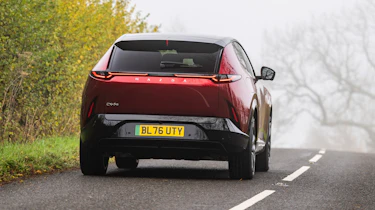
Drive the Mazda CX-6e in isolation and you’re unlikely to come away disappointed. It offers a mature ride and handling balance, and while it might not feel as sharp as a petrol-powered Mazda CX-5, most will find it perfectly pleasant.
Only if you turn off the nannying safety aids, that is. This is where the CX-6e’s Chinese roots are made most apparent; it’ll tug the steering on winding roads and chime constantly if you stray over the white lines. Turning it all off is no mean feat, either – the complicated infotainment menus make seemingly simple tasks a chore.
Overall though, there are few situations where the CX-6e feels out of its depth. It’s quiet, refined and reasonably comfortable, while the just-right power output feels well suited to congested UK roads. Its taller but shorter body makes it easier to drive than its 6e sibling, too.
| Model | Power | 0-62mph | Top speed |
| Mazda CX-6e | 254bhp | 7.9 seconds | 115mph |
Performance, 0-60mph acceleration and top speed
For now, only one powertrain is offered. Most of the time, the performance feels adequate: 0-62mph in 7.9 seconds would have been considered hot-hatch fast only a decade ago. The traction control can rein things in and cause the car to bog down away from slippery junctions, but in normal driving, the CX-6e feels plenty fast enough. Top speed is restricted to 115mph.
Town driving, visibility and parking
Measuring 71mm shorter than the 6e saloon, the CX-6e does feel more compact – especially when parking. Visibility from the car’s myriad cameras helps; you can pick and choose your perfect angle via the massive central touchscreen, which not only helps when nestling up against the kerb, but also when pulling out of blind junctions or side roads.
The ride is occasionally jittery at low speeds, especially on the larger 21-inch wheels. But it’s never crashy; the damping actually feels particularly mature, softening off bumps, ridges and potholes to cocoon the driver and passengers in what is overall a very grown-up driving experience.
Country road driving and handling
This is a Mazda, but not as we know it. Developed in partnership with Chinese automotive giant, Changan, the two companies have combined their expertise and, in the process, lost some of Mazda’s traditional magic.
That’s not to say the CX-6e is a dynamic basket case. It still handles relatively neatly, it just doesn’t have that last degree of sparkle that’s been present in every Mazda model since the first-generation MX-5 launch in 1989.
Being rear-driven, you do get that sense of being pushed rather than pulled, but the over-sensitive traction control system feels quite restrictive when pulling out of junctions or slower corners. To stop the wheels spinning, the car cuts power completely, which could be cause for concern if you ever find yourself trying to exploit a particularly narrow gap in traffic.
Otherwise, though, the CX-6e feels predictable and relatively nimble. It’s sprightly rather than genuinely quick, but there’s enough power and torque for everyday driving. The steering is fine, but not brimming with feedback, even if the front end doesn’t feel quite as pointy or direct as it does in the lower, sleeker 6e saloon.
The brakes are strong, although we’d like a bit more adjustability for the regenerative braking system. Each drive mode (Normal, Sport) has its own standardised strength, and it’s only adjustable – via the central screen, no less – if you select the Individual mode. It’s unnecessarily fiddly.
Motorway driving and long-distance comfort
If it wasn’t for the comparatively small battery, the CX-6e would be an enviable motorway car. It’s not as stable as the 6e saloon – an inherent issue with the taller, SUV body – but additions such as double-glazed side glass ensure it’s particularly refined at speed.
“Most people won’t mind that the CX-6e trades that last degree of handling finesse for a comfortable, grown-up driving experience. Overall, it’s a perfectly likeable and surprisingly premium family SUV.” - Richard Ingram, deputy editor.
Range, charging & running costs
Pros |
|
Cons |
|
Priced from a whisker under £43,000, the Mazda CX-6e commands a premium of around £4k over the equivalent 6e saloon. For that, you get a shorter but more practical SUV body, plus a completely new interior layout with plenty of kit and high-end features.
It’s a little bit more expensive to buy than rivals such as the Skoda Enyaq, but you’ll be stepping up to at least a SportLine before you get anything like the kerb appeal of the sleek and stylish Mazda. Pretty much everything is thrown in as standard, too – opting for the top-spec Takumi Plus doesn’t seem worth the £2,360 extra, unless you really want digital door mirrors and the bigger 21-inch wheels.
Electric range, battery life and charge time
At launch, just one version of the Mazda CX-6e will be offered: a single-motor, rear-wheel-drive model with a 78kWh (77kWh usable) battery good for up to 300 miles of range.
Reading that, you’d be forgiven for thinking this car had been around for a few years, such is the rate of progress in this area of the market. Yet launching in late 2026, it instantly feels off the pace – rivals such as the Tesla Model Y and Skoda Enyaq offer more than 370 miles of range, while the more mainstream Citroen e-C5 Aircross can breach the magic 400-mile marker when fitted with the biggest available battery.
During our drive, in cool ambient temperatures of around seven or eight degrees, we managed to average just over three miles per kilowatt-hour. That might not sound great – indeed, neither does the associated 230-odd-mile range – but it’s worth noting that our unsympathetic driving style that day should chalk this up as a worst-case scenario. We’ve been seeing closer to 3.7-3.8mi/kWh out of the 6e saloon during our long-term test, taking the CX-6e’s mechanically similar sibling closer to 290 miles on a single charge.
At least the CX-6e makes up for things with a solid 200kW maximum charge speed – good for a 10 to 80 per cent top-up in as little as 24 minutes. That’s five minutes faster than the aforementioned Skoda, and wholly competitive in the mid-size SUV class.
| Model | Battery size | Range | Insurance group |
| Mazda CX-6e Takumi | 78kWh | 300 miles | 44 |
| Mazda CX-6e Takumi Plus | 78kWh | 290 miles | 44 |
Insurance groups
Insurance groups for the Mazda CX-6e are high. Even the basic Takumi car falls into group 44; 10 groups higher than the cheapest Tesla Model Y. Thankfully, there’s no added premium for the top-spec Mazda, despite its flashier 21-inch wheels.
Tax
Both versions of the Mazda CX-6e cost less than £50,000, and therefore escape the luxury car tax surcharge. That means a flat rate of £200 per year, while company car drivers will enjoy the very lowest Benefit-in-Kind tax rates applicable to all EVs.
Depreciation
The Mazda CX-6e’s residual values are pretty good given what an unknown quantity it is. Early predictions suggest it’ll hold on to between 53 and 54 per cent of its original value after three years and 36,000 miles. Surprisingly, that’s not as good as the 6e saloon (59-60 per cent), but far better than its Enyaq rival, which manages between 45 and 50 per cent depending on model.
Interior, design & technology
Pros |
|
Cons |
|
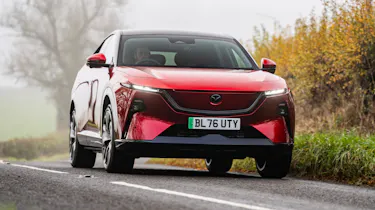
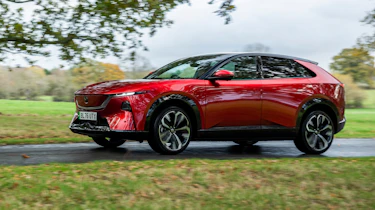
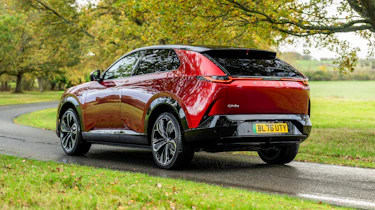
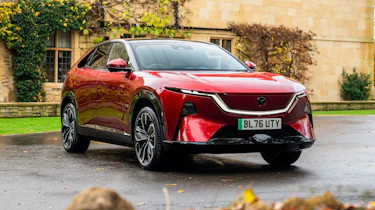
At first glance, the CX-6e cuts quite a dash. While moving away slightly from the traditional styling cues found on models like the CX-30, CX-5 and CX-60, it looks cleaner and more modern. The lighting signature – particularly at the front – is smart, and thanks to some striking optional paint colours, it has the ability to really stand out in a sea of monotone SUVs.
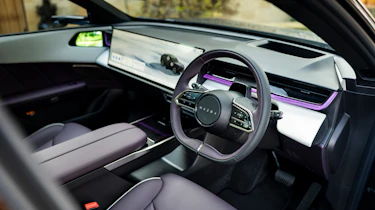
It’s a similar story inside. The cabin uses a minimalist layout, but looks smart. The large digital interface is filled with features, and the materials are sufficiently high quality to challenge this car’s premium German rivals. But that button-free dashboard has some usability issues, which we’ll come to in a moment.
Ergonomically, the CX-6e isn’t quite as comfortable as we’d like, either. The window line is high, and difficult to rest your elbow on – especially at a cruise. The long, soft centre console is better thought out here than it is in the 6e saloon, though; that car has an area of hard plastic exactly where your left arm falls, making it difficult to get comfortable.
Interior and dashboard design
If you’ve sat in a Mazda 6e and think the CX-6e SUV will feel familiar, you’re sadly mistaken. Strangely, despite both being built as part of a joint venture with Chinese powerhouse Changan, the cabins are quite different.
Both shun physical buttons for large digital displays, but while the 6e gets a central screen and separate instrument cluster, the CX-6e gets a much wider 26-inch panel that stretches from the middle of the dashboard to the passenger side of the car. There are no traditional instruments; instead, the speed and key info is shown on the top right of the main screen – complemented by a standard-fit head-up display.
Sure, it looks clean, but many key functions are hidden in that big central touchscreen, making simple tasks much fiddlier than they need to be. You can at least assign shortcuts via two buttons on the steering wheel, meaning you don’t have to delve into the menus every time you want to turn on the lights or adjust the wiper sensitivity.
Materials and build quality
For a car that starts from just over £40,000, the Mazda CX-6e feels incredibly premium and well built. The materials used throughout are of high quality, and the fit and finish is very impressive. The seats are plush, and the fabrics and leather alternatives on the dashboard and doors are remarkably high-end.
Combined, the CX-6e punches well above its weight, almost feeling like a match for cars such as the Volvo EX60 and Mercedes GLC Electric – both models in the class above. Anyone coming from a premium-badged rival will be quite content.
Infotainment, sat-nav and stereo
The general layout of the CX-6e’s infotainment system is lifted from the 6e saloon, with some unique quirks due to the size of the screen and the way it spans almost the entire dash.
First up are our frustrations surrounding the lack of traditional instruments. With no dial cluster, the speed readout is forced on to the top-right corner of that central screen. Yes, you can get the same information in the head-up display, but its resolution, brightness, positioning and colour meant that at times we briefly mistook the bright white numerals for approaching cars – especially when cresting a hill or turning a corner.
Then there are the myriad menus that you’ll be forced to battle with every time you want to change even minor things, such as the lights or ADAS systems. You can swipe down from the top edge of the screen for a series of shortcuts, but even then it’s a baffling chequered tablecloth of icons – finding one before the attention monitor accuses you of not concentrating is almost impossible.
It’s a shame the systems aren’t more intuitive really, because the hardware itself is slick and responsive. The screen reacts instantly to your inputs, and the graphics are sharp. We’re still not sure any car needs a passenger display though; it’s as pointless here as it is in any BMW and Mercedes, and unless you turn the brightness right down, it’s going to prove quite the annoyance after dark.
In our experience, the voice control is buggy and limited in what it can do, too. It’ll burst into life when you least expect it, and giving even simple instructions – like changing the radio station – isn’t yet possible. Rival systems use AI to a greater degree, and are more useful as a result.
“As is increasingly the case in the automotive world, the CX-6e’s cabin centres around one massive screen that controls everything from the nav and media, to the climate control and ADAS functions. We’d not resent it so much if it was a little more intuitive, but the endless menus make even the simplest tasks a chore.” - Richard Ingram, deputy editor.
Boot space & practicality
Pros |
|
Cons |
|
The Mazda CX-6e is a more practical car than it appears on paper. It sits at the upper end of its segment in terms of outright size, but the long wheelbase provides plenty of space for adult occupants, and the boot is a good shape and size for most use cases. There’s a deep frunk capable of swallowing a carry-on suitcase, plus various areas for oddment storage inside the cabin, too.
Dimensions and size
Despite being significantly shorter than the 6e saloon, the CX-6e still sits at the top end of the class in terms of outright size. Measuring 4,850mm, it is 56mm longer than the ever-popular Tesla Model Y and a massive 192mm longer than a Skoda Enyaq. You’ll not necessarily notice that on the road, but it’ll restrict where you can park on tight city streets – even if the excellent 360-degree cameras do help mitigate the car’s added length.
| Dimensions comparison | |||
| Model | Mazda CX-6e | Tesla Model Y | Skoda Enyaq |
| Length | 4,850mm | 4,794mm | 4,658mm |
| Width | 1,935mm | 1,920mm | 1,879mm |
| Height | 1,620mm | 1,624mm | 1,623mm |
| Wheelbase | 2,902mm | 2,890mm | 2,766mm |
| Boot space | 468 litres | 854 litres | 585 litres |
Seats & passenger space
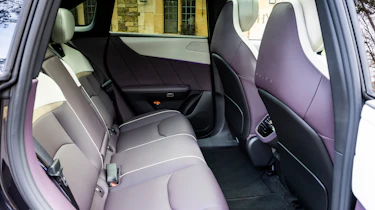
We were genuinely surprised by how much space there was in the second row of our CX-6e test car. With the driver’s seat set for a six-foot-tall adult, there was enough room behind – with space to spare – for a person of similar stature.
Even with the standard-fit panoramic roof, there is loads of headroom, and kneeroom is generous, too. All cars come with a separate climate control panel for rear-seat occupants so they can set the temperature just so.
We found there was plenty of adjustment in the heated and ventilated front seats, too. The materials used are luxurious, even if the seat bases are a little harder than we might like. The steering wheel is also heated, and can be operated from the car’s smartphone app on cold days.
Boot space
The 468-litre boot might not sound that big, but neither does the 337-litre load bay in the 6e saloon – and having lived with that car for an extended period as part of our long-term test fleet, we’ve not found it lacking in day-to-day versatility.
In short, we reckon Mazda’s measuring system might be slightly different to the industry standard. Visually, the CX-6e’s luggage space looks plenty big enough for everything a modern family might throw at it. The seats fold in a 60:40 formation.
There’s no underfloor storage, but a decent-sized frunk more than makes up for it – giving you somewhere to store the charge cables, or an area to throw muddy boots after a winter walk.
Towing
The Mazda CX-6e is rated to tow a 1,500kg braked trailer, or 750kg if it’s unbraked. That’s reasonable for a car in this class, though the limited torque might make the car feel quite lethargic versus rivals.
“The CX-6e’s long body and lengthy wheelbase open up to reveal a practical and usable cabin, plus there’s a handy space in the nose for storing the charging cables.” - Richard Ingram, deputy editor.
Reliability & safety
Pros |
|
Cons |
|
Mazda has a good reputation amongst its customers, generally speaking. It finished 11th out of 30 in the 2026 Driver Power owner satisfaction survey; its ability to offer value and quality meant it only just missed out on a top 10 finish.
That said, while Mazda has been working with automotive giant Changan for over 20 years, the joint venture is unproven on this latest line-up of European-ready electric vehicles. It’ll take some time for data to start filtering through, even if at first glance the cars appear to be well built, and admirably efficient.
The CX-6e hasn’t been tested by Euro NCAP yet, although we expect it to be assessed in early 2027. The similar 6e was awarded the full five stars, however, with impressive scores across the board.
What this doesn’t take into account is the nannying, overactive safety systems, which beep and bong incessantly – trying their darndest to keep you within the speed limit or between the white lines. We found most of them so annoying – especially on rural roads – that we ended up switching them off.
At least the warranty offer is solid. Every Mazda registered after September 2025 now comes with a six-year, 100,000-mile guarantee, with the high-voltage battery protected separately for the industry-standard eight years.
Buying, prices and deals
Best buy: Mazda CX-6e Takumi
The best buy is the entry-level CX-6e Takumi which starts from around £43,000. Unless you really want the bigger 21-inch wheels – which, incidentally, harm the car’s ride – there’s little reason to spend any extra money. Options are limited to those aforementioned alloy wheels, plus a series of striking colours; Soul Red crystal is the most expensive at £1,000.
You can save on the list price by building your new Mazda CX-6e with the Auto Express Buy A Car service. We also have selection of CX-6e leasing deals, and can help you to sell your car.
Mazda CX-6e alternatives
This is an incredibly competitive part of the market, and rivals stretch far and wide. The most obvious one is the Tesla Model Y, which thanks to recent price rises is now £2k more expensive than the Mazda. It’s more efficient and arguably easier to live with, but it won’t feel as premium, or as nice to drive.
Other rivals include the excellent Skoda Enyaq and the related Volkswagen ID.4 (soon to be ID. Tiguan), plus the Hyundai Ioniq 5 and Kia EV6. Premium alternatives – worth mentioning purely due to the CX-6e’s tech-laden, high-quality cabin – include the Volvo EX40, BMW iX1 and Mercedes GLA Electric.
Mazda CX-6e pictures
Frequently Asked Questions
The Mazda CX-6e is covered for six years or 100,000 miles, whichever comes first. That can't quite match Toyota’s service-activated 10-year warranty, but is competitive in this class.
Deals on the CX-6e and alternatives