MG ZS review
The MG ZS is one of the most affordable new SUVs on sale, making it a compelling bargain

Our opinion on the MG ZS
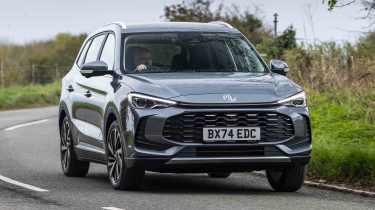
The small SUV segment is an enormously popular one, so the fact that the MG ZS is one of the cheapest cars in the class already puts it in a strong position. While it isn’t perfect, this car does a respectable job of hiding its budget focus and providing enough appeal to put it firmly in the running against its pricier rivals.
About the MG ZS
The second-generation MG ZS has jettisoned its electric powertrain completely, with the MGS5 EV taking on small electric SUV duties instead. Now, the ZS is only available with petrol or full-hybrid power. This latter suits this car particularly well and sets it apart from a number of competitors, in what is a rather overcrowded market.
The ZS line-up is an easy one to understand. Buyers have the choice of petrol of hybrid power, with both cars coming in entry-level SE trim as standard. The Hybrid+ is also available in the fancier Trophy trim.
We've tested the MG ZS in both its petrol and hybrid forms. During our 2024 twin test against the Dacia Duster, the MG couldn’t quite manage an outright win, but we found it did at least offer superior performance and a very generous amount of standard kit.
Performance & driving experience
Pros |
|
Cons |
|
The MG ZS range starts with a regular 1.5-litre petrol engine to keep things ultra affordable, but we recommend the more potent hybrid powertrain. The hybrid set-up is shared with the smaller MG3 hatchback, and operates in a similar way, with the electric motor powering the front wheels most of the time, with the engine acting as a generator of electricity for the 1.83kWh hybrid battery pack. The engine takes over powering the front wheels at higher speeds.
Used - available now


While that sounds high-tech, the three-speed automatic gearbox used by the hybrid system sounds like a throwback to MGs of the ‘70s. However, it’s all that is really needed as a result of that electric motor. The engine is a development of the 1.5-litre petrol used in earlier MG models; while we’ve found it pretty unpleasant in the past, here it’s very much taking a back seat, and as a result, it’s easier to live with because the electric motor is strong enough to do the majority of the heavy lifting.
The cheaper petrol model is also powered by a 1.5-litre engine, but there’s no electrical assistance to be found here. If you prefer automatic cars, you’ll have to go for the hybrid because the petrol is only available with a five-speed manual.
| Model | Power | 0-62mph | Top speed |
| ZS petrol | 113bhp | 12.5 seconds | 111mph |
| ZS Hybrid+ | 193bhp | 8.7 seconds | 104mph |
Performance, 0-60mph acceleration and top speed
The larger body of the ZS Hybrid+ means that it doesn’t quite deliver the same brilliant performance as the MG3 supermini. However, a combined system output of 193bhp and a hefty 343Nm of torque is still plenty for a family SUV, and a 0-62mph time of 8.7 seconds is more than enough for most drivers. The top speed of the hybrid is 104mph.
Cutting out electric power does result in a significant power reduction, though, as the 113bhp petrol model takes a lethargic 12.5 seconds to reach 62mph from a standstill. When you eventually get there, this model’s top speed is slightly higher at 111mph. While we’re doubtful that ZS drivers are intending to floor their right foot at every opportune moment, the hybrid is still the superior performer for getting up to motorway speeds.
Town driving, visibility and parking
With its electric motor generating significantly more power than other hybrids, the MG ZS feels more like an EV around town. From 0-30mph, performance is genuinely excellent, with a keen yet smooth power delivery that makes it a great car for nipping through city traffic.
We haven't driven the petrol model yet, but the figures on paper aren’t making us optimistic about reaching our destination as quickly as we would in the hybrid.
At 10.5 metres, the ZS’s turning circle is quite tight, which means that backing into spaces and squeezing through small gaps is fairly easy. The ride is a little busier than in the Dacia Duster, but not as firm as the Ford Puma.
Country road driving and handling
At higher speeds, the hybrid’s power delivery throws up some quirks. Ask for more performance than the electric motors can offer – for example, when accelerating along a motorway slip road – and while the acceleration never lets up, there’s a long wait as the petrol engine wakes, selects the right gear ratio and eventually gives you its all.
When it does, it’s very quick, but the end result isn’t very linear. Drawn as a graph, the acceleration would look like a two-humped camel as opposed to the gentle, consistent curve that most cars deliver.
The ZS is more than capable enough when you’re negotiating a twisty B-road. It won’t elicit a smile in the way a Ford Puma will – it all feels a bit too numb to be called fun to drive – but the MG’s body is reasonably well controlled, and a decent ride quality is maintained throughout.
The steering is precise enough, but the weighting can feel a little unnatural beside some rivals. While not outstanding in any one area, the MG ZS is certainly more sophisticated to drive than its predecessor.
Motorway driving and long-distance comfort
One area in which the ZS doesn’t quite feel so honed is the road noise at the legal limit. Tyre roar is quite audible, which means that it isn’t quite as refined as you’d hope on longer journeys. Some testers found that the driver’s seat isn’t the most comfortable either, due to a headrest that protrudes too far from the backrest.
MPG & running costs
Pros |
|
Cons |
|
Based on official WLTP figures, the MG ZS Hybrid+ is capable of 55.4mpg. In the real world, that figure doesn’t seem like an impossible task, with our fairly typical use across a variety of roads throwing up a reasonable figure of 48.7mpg.
The petrol model doesn’t perform too badly in isolation with its claimed combined figure of 43.5mpg. However, considering that the Hybrid+ offers superior efficiency, which holds up in day-to-day driving, we’d recommend opting for this model instead.
| Model | MPG | CO2 | Insurance group |
| ZS SE | 43.5mpg | 145g/km | 16 |
| ZS Hybrid+ SE | 55.4mpg | 115g/km | 22 |
| ZS Hybrid+ Trophy | 55.4mpg | 115g/km | 22 |
Insurance groups
The latest MG ZS sits in a slightly higher insurance group than its predecessor, potentially due to the fact that its older incarnation (ignoring the all-electric version) was petrol only, whereas the latest car also offers a more powerful and complex hybrid system.
Both the SE and Trophy trims are in group 22, which is a little lower than the hybrid version of the Dacia Duster in group 24.
It’s here where the petrol car has an advantage because it sits in group 16, although this is the same as the hybrid-powered Renault Captur E-Tech.
Tax
Every MG ZS attracts the standard rate of VED road tax from the second year onwards. Low pricing also means that the £40,000 luxury car threshold for road tax is avoided.
Company car drivers seeking Benefit-in-Kind tax savings might actually wish to avoid the ZS altogether, because it simply cannot match the low rates offered by electric cars. MG does offer an alternative, though, in the form of the MGS5 EV.
Depreciation
Our used car market data shows that the MG ZS should hold on to between roughly 43 and 47 per cent of its value after three years or 36,000 miles. This is a long way off from the Dacia Duster’s residual values of between 56 and 60 per cent after the same period. The top-selling (and more expensive) Ford Puma sits in between the two at 44 to 52 per cent.
To get an accurate valuation for a specific model, check out our free car valuation tool...
Interior, design & technology
Pros |
|
Cons |
|
MG has tried to make the interior of the ZS feel premium, but there are one or two telltale signs that it isn’t as well put together as some other rivals.
The trim range kicks off with SE, although the level of equipment you get differs depending on whether you go for your ZS in petrol or hybrid form.
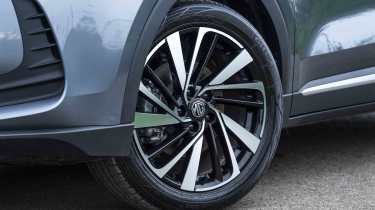
Go for the Hybrid+ SE trim, and you'll get 17-inch alloys, a 12.3-inch central touchscreen with sat-nav and full smartphone capability, rear parking sensors and a reversing camera, cloth trim with manual front seat adjustment, and adaptive cruise control. The petrol SE misses out on adaptive cruise control due to its manual gearbox, but gains artificial leather with electric driver's seat adjustment, heated front seats, a 360-degree camera system, and front parking sensors.
Due to the affordable pricing of the ZS, we recommend going for the range-topping Trophy trim, which is only available in hybrid form. It includes over and above the petrol SE:
- 18-inch alloys
- Privacy glass
- Electric folding door mirrors
- A heated steering wheel
Interior and dashboard design
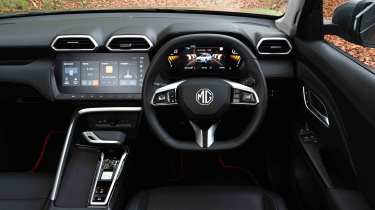
Up front, the cabin looks fairly smart. There’s even some inspiration that seems to be borrowed from the most exotic of places; those individual air vents sitting at the top of the dashboard have more than a hint of Lamborghini Huracan about them.
That’s as far as the Italian supercar comparisons go, because the remainder of the cabin appears conventional in an inoffensive way. Beneath the large, 12.3-inch central touchscreen sits a row of physical keys, but these don’t include a full set of climate controls; with the exception of buttons for the front and rear heated windows. The rest of the functions must be adjusted on the touchscreen itself.
The steering wheel is slightly flattened on both its upper and lower edges and feels great to hold, while the gear selector takes the form of a wide, flat lever that’s reminiscent of the throttle on a large aircraft. Ahead of it is a space to hold a smartphone, and the glovebox is generously sized.
Parts of the cabin design don’t feel all that well thought out. The silver trim on the leading edge of the centre console and steering wheel can be distractingly reflective, and on one occasion, we caught our finger between the gearlever and the recess it sits within when selecting reverse. Be assured, though, you’re only likely to do this once given how much it hurts.
Materials and build quality
At first glance, the ZS’s cabin has a slightly premium feel to it, with leather-effect stitching and soft plastics covering the top of the dashboard. However, it doesn’t take long to discover that the impression is created by a fairly thin coating on top of a budget car.
The lid for the centre armrest feels as though it’s barely held in place, and the hinge is loose and somewhat floppy. One of our test cars also had a glovebox that didn’t fit properly, while the fake leather upholstery doesn’t feel very convincing.
Infotainment, sat-nav and stereo
All versions of the ZS come with a digital driver’s display as standard. A portion of the display shows a digital image of the car in graphics reminiscent of a PlayStation 3 driving game, but it also presents a wealth of information, including speed, efficiency, the drive mode you’re in, and other trip details.
While some rival models feature physical climate controls, the ZS is immediately limited by a system that forces the driver to make adjustments to the heat and fan speed using the 12.3-inch touchscreen. This forces you away from whatever page was previously loaded just to achieve a comfortable temperature, which is particularly irritating if the page in question is a map screen that’s being used for navigation.
It’s a shame, because the screen has a high resolution (as does the feed from the parking cameras) and the layout is neat and logical. The Apple CarPlay and Android Auto smartphone connections are both wired rather than wireless, but the hook-up is easy and it fills the whole screen – a positive and a negative, because you’ll need to hit the home button on the physical shortcut control bar to access things such as the climate control.
“If you want to add a few hundred more pounds to the mix, you’ll get the rather lovely Dynamic Red paint which gives a certain fashionable quality to the fairly subdued styling.” - Shane Wilkinson, senior content editor.
Boot space & practicality
Pros |
|
Cons |
|
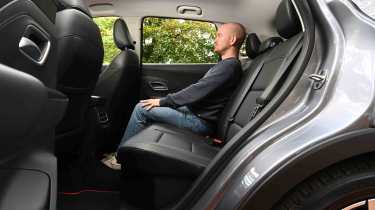
While it’s not the class leader in terms of practicality and interior space, the MG ZS still offers plenty of room for a family of five. In fact, it’s one of the most spacious cars for this sort of price, which will ultimately be good news for families who need to carefully watch the pennies.
Dimensions and size
The MG ZS is roughly the same size as the Dacia Duster, while the high driving position helps with positioning the car on the road. At around 1.8 metres wide, there shouldn’t be any issues when it comes to dealing with width restrictions.
| Dimensions comparison | |||
| Model | MG ZS | Dacia Duster | Ford Puma |
| Length | 4,430mm | 4,343mm | 4,186mm |
| Width | 1,818mm | 1,813mm | 1,805mm |
| Height | 1,635mm | 1,621mm | 1,536mm |
| Wheelbase | 2,610mm | 2,660mm | 2,590mm |
| Boot space | 443-1,457 litres | 474-1,609 litres | 456-1,216 litres |
Seats & passenger space
Knee room is certainly a strong suit for the MG ZS, as we found out in our twin test of the ZS against the equivalent Dacia Duster. The ZS has more knee room than the Duster (645 - 882mm for the ZS versus 605 - 735mm for the Duster), but the latter is a little better for head room (954mm for the ZS versus 974mm for the Duster). The ZS has plenty of foot space under the front seats - good news for those wearing boots in the back. The rear Isofix points are a little buried between the upper and lower seat cushions, so they’re not as easy to access as in some alternatives, but they are better than the Duster’s zipped points.
Taller drivers may find the driver’s seat to be a little too high. For some odd reason, SE petrol and Trophy Hybrid+ trims come with a six-way electrically adjustable driver's seat with lumbar adjustment for the driver, while SE Hybrid+ gets manual adjustment and no lumbar adjustment.
One criticism we had of early test versions of the ZS has been fixed: the steering wheel of all post-January 2025 UK cars has both rake and reach adjustment, whereas those before only had rake adjustment.
Boot space
At 443 litres, the MG ZS’s boot volume is reasonable for a car in this class, but not outstanding. The load area has a fairly low lip compared with the Dacia Duster (704mm for the ZS versus 805mm for the Duster) and minimal wheel arch intrusion, so it’s easy to make the most of the volume on offer, while some items can be hidden below a false floor. The seats drop almost flat, increasing the overall volume to 1,457 litres. Once again, this isn’t a class-leading figure; for example, the Dacia Duster Hybrid offers 1,545 litres in the same two-seat configuration.
Towing
If you have a trailer or caravan to hook up, you may find yourself in a bit of bother because both powertrains are only rated to tow a braked trailer of up to 500kg. This figure is comparatively tiny compared to the Nissan Qashqai’s 1,400kg limit.
Reliability & safety
Pros |
|
Cons |
|
There’s more disappointing news from the safety testers at Euro NCAP, because the MG ZS fell short of a five-star rating, with criticism of the fact that there was no countermeasure to prevent front-seat occupants from hitting each other in a side impact. It certainly is not the only small SUV with a four-star score, because the Renault Captur also received four stars when it was tested in 2024. In order to get a small SUV with the maximum five star rating, you’ll need to look towards a Volkswagen T-Roc.
| Euro NCAP safety ratings | |
| Euro NCAP safety rating | Four stars (2024) |
| Adult occupant protection | 75% |
| Child occupant protection | 82% |
| Vulnerable road user protection | 73% |
| Safety assist | 76% |
The MG ZS came last of the 50 cars in the 2026 Driver Power customer satisfaction survey. Some owners have been left reeling by troublesome tech and one too many repairs, which means there’s still plenty of work that needs to be done to improve the brand’s reputation.
| MG ZS | Position | Score |
| Overall | 50 | 78.54% |
| Powertrain | 50 | 73.71% |
| Exterior | 29 | 87.43% |
| Interior | 35 | 81.71% |
| Practicality & Bootspace | 34 | 81.43% |
| Ride & Handling | 49 | 81.37% |
| Safety Features | 50 | 74.10% |
| Economy & Running Costs | 50 | 69.52% |
| Quality & Reliability | 50 | 76.29% |
| Infotainment | 49 | 78.45% |
| Value | 47 | 78.86% |
What owners said
- “Fantastic car, reliable good size good engine runs well good mileage, but maybe a little slow”
- “Good fuel economy, in car entertainment and digital screen features, comfort and load capacity”
- “I like the interior, I dislike how loud the car revs”
- “I like the comfort and features but I dislike the reliability and cost of repairs”
- “Looks smart, nice interior, like the gadgets, however no temperature which I would like”
- “The Trophy ZS is sleek, superb inside and for the money has all the extras. The only drawback which I knew about on reviews is the engine noise uphill”
If you own a MG ZS or any other car, let us know what you think of it: Take the Driver Power survey today...
Buying, prices and deals
- Best buy: MG ZS Hybrid+ Trophy
The MG ZS’s price is so reasonable that the range-topping model is still very cost-effective. Trophy trim adds some useful goodies to the ZS, making it feel like a slightly more premium affair.
The hybrid powertrain is by far the best choice thanks to its genuinely strong performance and real-world efficiency. It can be had in SE form for around £23,000, but we recommend the fancier Trophy trim for around £25,500. The base petrol SE starts at around £20,500.
You can build your perfect MG ZS through the Auto Express Buy A Car service, and we also have a wide selection of ZS leasing deals and used ZS models to choose from.
Alternatives
There are numerous options in the small SUV segment, with models offered by nearly every mainstream car maker that cater to a wide range of needs.
One of the big hitters is the Ford Puma, which is a consistently strong seller, and for good reason. It’s the best car in this class to drive, and while the engine range is limited, Ford’s petrol EcoBoost units suit the car well. Practical features such as the hidden Megabox in the boot mean it’s well suited to family life, too.
Another favourite small SUV of ours is the Renault Captur. Again, clever features such as the sliding rear bench make it a great choice for those with kids, while the option of various hybrid powertrains allows you to keep running costs in check.
Other options include the Toyota Yaris Cross and Nissan Juke – the latter of which is built in the UK and sells in huge numbers. Cars such as the Vauxhall Mokka, Peugeot 2008 and Hyundai Kona offer plenty of powertrain choices, including zero-emission electric options, if they’re of interest.
Key updates of the MG ZS review
- 22 June 2026: Latest Driver Power data.
- 24 December 2025: Model facelift information.
Frequently Asked Questions
MG provides a seven-year/80,000 miles standard warranty with its cars, whichever comes first. That's longer than many rivals, although Kia provides a longer seven-year or 100,000-mile policy.
Latest deals on the ZS and rivals