Best superminis to buy 2026
It's a hard-fought class, but these are the 10 best superminis on sale right now

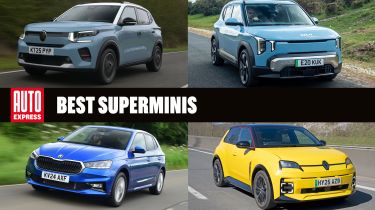
The best superminis in 2026 are small cars that make you wonder if you really need anything bigger. There are so many excellent ones to choose from, knowing which you should put your money into can be hard. We've put together our top 10 superminis based on our extensive testing of every model on the market to help you choose which supermini is right for you.
With choices in the smaller city car segment having dwindled in recent years, superminis are the go-to choice for most buyers prioritising compact size and low costs. The best superminis are much more than urban runabouts, however, showing levels of sophistication and practicality that mean they can fill a varied role. Today’s small SUVs offer similar qualities but tend to cost a little more to buy than their supermini equivalents.
The top supermini choices tick that crucial low-cost box, with good efficiency and low insurance premiums. They are also adept in various kinds of driving, manoeuvrable in town but quiet and powerful enough for longer journeys and fun on the right B-road. We also look for decent practicality with room in the back for kids and a good-sized boot. Scroll down for our pick of the best new superminis on sale…
Compare the best superminis to buy
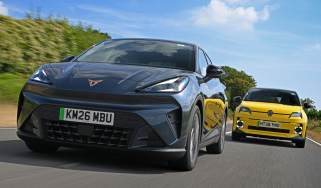
Our expert road testers have deemed the Cupra Raval the best supermini to buy right now. This is due to its overall value for money, eye-catching design and enjoyable driving experience. The low-cost Fiat Grande Panda comes in at a very close second place, while the efficient Kia EV2 finishes in third place.
| Rank | Car | Prices from |
| 1 | Cupra Raval | £23,800 |
| 2 | Fiat Grande Panda | £19,000 |
| 3 | Kia EV2 | £24,300 |
| 4 | Renault 5 | £21,500 |
| 5 | Citroen C3 | £19,900 |
| 6 | Nissan Micra | £21,500 |
| 7 | MG3 | £17,500 |
| 8 | MINI Cooper | £25,300 |
| 9 | Dacia Sandero | £14,800 |
| 10 | Skoda Fabia | £21,100 |
For even more information on each model in our best superminis list, simply click the jump links in the table above or continue scrolling down
1. Cupra Raval
- Prices from £23,800
- Supermini of the Year 2026
Pros |
|
Cons |
|
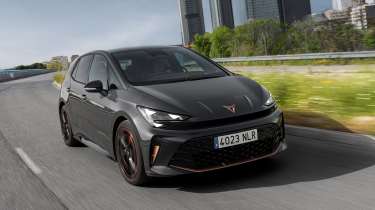
Very few people are immune to the charms of a pocket rocket, and the Cupra Raval has indeed won over our road testers by updating the sporty supermini formula for the EV age.
There are plenty of sporty small cars out there already, but the Raval follows a slightly different path to its EV rivals. A lower kerbweight is combined with a lively dose of power, rather than a ridiculous one. The result is a thoroughly enjoyable driving experience but, more importantly, low costs as well.
The official battery ranges are best described as modest, but they should still be plentiful for most needs. In its base spec, the Raval covers up to 186 miles on the WLTP combined cycle, rising to 279 miles depending on specification. When we tested the fieriest VZ version of the Raval, we saw an average of four miles per kWh, which equates to a real-world range of over 200 miles. We definitely weren’t driving gently during this test, either.
Inside, the Raval is filled with Cupra’s usual copper-coloured details. In fact, it’s quite a busy design overall with lots of contrasts and textures going on, so it definitely can’t be described as boring. Everything feels very well screwed together, too, and there’s plenty of proper buttons for key functions.
While you can have a lot of fun in the Raval (and we did), it settles down well enough for longer motorway trips or hopping about in town. Yes, the ride is firm, but it’s very well damped and supple over the bumps.
“The steering is accurate and well weighted, but it’s the way the Raval turns in that impresses most. You just pivot the wheel and the car reacts; seemingly relentless grip carries you through the bends and slingshots you out the other side.” - Richard Ingram, deputy editor.
As zesty electric superminis go, there are some tempting alternative options to be found. The Alpine A290 is essentially the popular Renault 5 but with a big injection of power and poshness. Alternatively, the MINI JCW Electric is another little firecracker with plenty of retro charm
2. Fiat Grande Panda
- Prices from £19,000
Pros |
|
Cons |
|
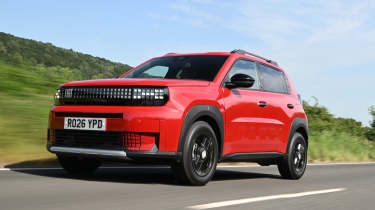
As its name suggests, the Fiat Grande Panda is bigger than its predecessor, but it’s also a much more sophisticated machine.
Ever since its initial debut over 40 years ago, the different generations of Fiat’s Panda have always offered the same core characteristics; simplicity, durability and affordability. We’re pleased to report that Fiat hasn’t lost sight of this heritage with the Grande Panda, as this is one of the cheapest electric cars on sale in the UK at around £21,000. Alternatively, if you’re not keen on EVs, you can have an even cheaper hybrid variant from just £19,000.
Whichever version you go for, you’ll be greeted with cost-effective efficiency. The Grande Pande hybrid can return an official 52.3mpg on the WLTP combined cycle, while the EV can cover up to 199 miles. It’s worth noting that our test car’s range did start to suffer slightly during motorway driving in colder weather, but urban driving is where this car is designed to thrive, just like every Panda before it.
Along with its more sophisticated powertrains, the Grande Panda has taken a considerable step upwards in regards to interior quality. While it’d be unfair to expect truly premium materials in such a low-cost car, some clever design trickery makes the cabin a perfectly pleasant place to be. There’s some carefully thought-out splashes of colour, too, because many people would consider a humdrum Italian car to be pure sacrilege.
Accompanying the stylish interior is a twin-screen dashboard, and a 10.25-inch touchscreen takes centre stage. Admittedly the tech isn’t class-leading, but it does the job well enough for this kind of price. The sight of proper buttons underneath for the climate controls is always a welcome one, too.
The one-off Panda 100hp aside, Fiat’s supermini has always been better described as straightforward rather than exciting to drive. This is indeed the case with the Grande Panda in both electric and hybrid forms as neither version will complete the 0-62mph in under 10 seconds. However, for simply getting on with the task of getting you from point A to point B, the little Fiat is a breeze to live with. The handling is composed enough to keep you feeling firmly in control, and the suspension copes remarkably well with the worst of Britain’s road surfaces.
“On the road, even in somewhat dreary weather, the exterior looks fresh and vibrant. Its sleek face hides the headlights, daytime running lights and even a clever retractable charging cable.” - Jordan Katsianis, news editor.
The Fiat Grande Panda isn’t the only low-cost supermini to come with the choice of hybrid or electric power. In fact, it’s closely related to the Citroen C3 and Citroen e-C3, which are also very tempting little cars for the money. If it’s the retro charm that floats your boat, the fully electric Renault 5 has this in spades, along with a WLTP Combined range of up to 249 miles
Latest Fiat Grande Panda deals
3. Kia EV2
- Prices from £24,300
Pros |
|
Cons |
|
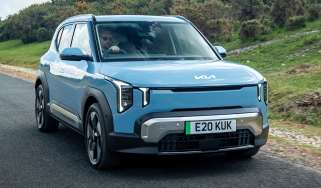
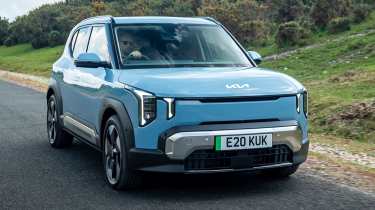
The Kia EV2 takes the styling and technology of the huge Kia EV9 and packs them into a far more compact package.
There’s no shortage of Kia electric cars but the EV2 is the cheapest, and the savings are boosted further by the Electric Car Grant. The ‘Standard Range’ model is also good for 194 miles on the WLTP combined cycle, which should be more than enough for the daily driving needs of most owners.
Naturally, the biggest advantage of the EV2 over the behemoth that is the Kia EV9 is that it’s effortless to drive. All-round visibility is excellent, and the blocky shape means this car is easy to place in tighter spaces. The brake regeneration system is also highly adjustable and smooth in its operation.
The EV2’s interior is pretty typical Kia fare, by which we mean it’s functional if a tad lacking in character. A pair of 12.3-inch screens are the centrepiece, but the climate controls are obscured by the steering wheel. This is a frustration that we’ve found in a number of Kia’s latest models.
“Kia will admit that it didn’t set out to make a pure driver’s car with the EV2.. The focus is very much on comfort, which is pretty refreshing compared with so many overpowered electric cars.” - Pete Baiden, web producer.
If you’re tempted by a small-scale, blocky electric car, you may wish to also look towards the spacious and retro Renault 4. The MINI Aceman is also one of the funkier offerings in this area of the market
4. Renault 5
- Prices from £21,500
Pros |
|
Cons |
|
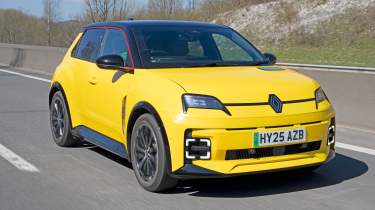
It oozes retro charm, but the fully-electric Renault 5 is so much more than a mere nostalgia trip.
While the Renault 5’s design is indeed an attractive one, it’s the starting price that could ultimately be key in tempting buyers into the world of EVs. At under £22,000, the 5 certainly feels like a bona fide bargain. There’s more good financial news, too, as you could also save a small fortune on running costs compared to a combustion-powered supermini, especially if you have access to home charging.
If you’re something of a cautious individual, you may now be thinking that we’re about to drop a bombshell regarding painfully obvious cost-cutting or catastrophic build quality. No need to fret, though, as the 5 feels pretty solidly put together and is generally a nice place to be.
We’ve been big fans of Renault’s on-board tech in recent years, and the 5’s twin-screen dashboard is no exception. The displays are easy to read, and the appearance of physical climate control buttons is always a welcome sight.
Bright colours and jazzy styling aside, the Renault 5 actually feels rather grown-up from behind the wheel. Everything stays refined at higher speeds, there’s enough acceleration for a quick departure from a standstill and you can have a decent amount of fun in the corners. If the driving experience is your number one priority, you may wish to look towards the Alpine A290 that’s based on this car, but the standard Renault 5 is genuinely enjoyable in most day-to-day scenarios. Opting for the larger 52kWh battery means a WLTP combined range of 249 miles, although the smaller 40kWh unit’s 193 miles should still prove to be plenty for most needs.
“In a mix of driving environments, with temperatures around 17 degrees Celsius, we achieved 4.1 miles per kilowatt-hour in the 52kWh comfort range version, but that included motorway driving that uses more energy.” - Jordan Katsianis, news editor.
For those who desire a big dose of old-school charm from their electric supermini, there is an obvious competitor to the Renault 5; the MINI Cooper Electric. While both cars offer plenty of similar characteristics, the 5 does have the Cooper pipped on price. The Fiat 500e is another retro EV, but this is a far smaller model as it falls firmly into the city car class
5. Citroen C3
- Prices from £19,900
- Best for ride comfort
Pros |
|
Cons |
|
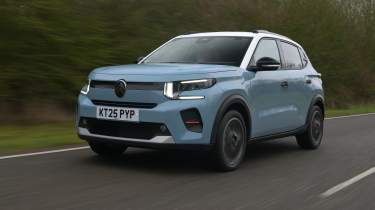
A lot of people go for smaller cars because they come with a smaller price tag, and very few brand-new cars are cheaper than the Citroen C3.
The C3 isn’t really a trendsetter, but that’s not what this car is about. Rather than being a showy, shouty car, it focuses on nailing the essentials at a sensible price point. That being said, this is a Citroen so it does still stand out a bit in the comfort stakes.
If you’re considering going electric, the Citroen e-C3 offers the same straightforward qualities as the petrol model, only with even cheaper running costs. You will initially pay a premium over the regular C3, but the e-C3 is still a lot cheaper than the majority of the competition.
The theme of simplicity is most evident when sitting inside the C3, but the cabin is neatly finished and inoffensive to the eye. There are plenty of hard plastics and an overall lack of pizazz, but the controls are logically laid out.
One gripe during testing was the steering wheel. Its unusual oblong shape means it takes a bit of time to get used to. This design is inspired by Peugeot’s i-Cockpit setup, so we recommend trying before buying. Regardless of the C3’s price, Citroen hasn’t been too stingy with the standard kit, as even entry-level cars get air-conditioning, rear parking sensors and cruise control.
This is a no-frills car with a no-nonsense price so you won’t be surprised to hear that the C3 is very uneventful to drive. Both the petrol–powered model and electric e-C3 offer adequate performance to keep up with the flow of traffic. Great visibility and a small size make these models very easy to drive. Citroen e-C3 drivers have a respectable WLTP combined range of 199 miles at their disposal, so longer trips aren’t out of the question.
“The C3 has a very upright driving position that’s almost SUV in style, and the square edges of the bonnet make it easy to judge where the corners of the car are.” - Dean Gibson, senior test editor.
Being based on Stellantis’s STLA Smart Car platform means the C3 has some closely-related siblings, including the Fiat Grande Panda. The Peugeot 208 and Vauxhall Corsa also share some DNA with this budget supermini, as do their fully-electric Peugeot E-208 and Vauxhall Corsa Electric counterparts
6. Nissan Micra
- Prices from £21,500
Pros |
|
Cons |
|
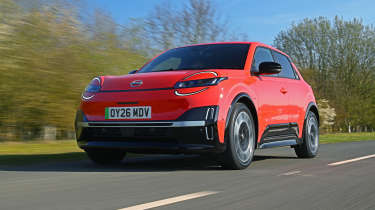
The Nissan Micra has plenty in common with the Renault 5, like its underpinnings and even the starting price. For the most part, the choice between these two supermini siblings will boil down to personal taste and whichever finance or leasing deals you can find.
WLTP combined battery ranges for the Nissan Micra sit at 198 or 260 miles, depending on spec. However this car sits in slightly higher insurance groups than the R5, so your premiums may very well creep upwards. An advantage with the Nissan over the Renault, though, is that it’s fitted with adjustable regenerative braking which will help to boost efficiency. This includes a one-pedal driving mode.
Don’t act too surprised, but the Nissan Micra’s interior is also pretty much identical to the Renault’s. However, given that the R5’s infotainment system is one of the very best on the market, this is good news. We’d advise upgrading to the Advance trim, though, as this adds systems like integrated Google Maps.
“There’s strong performance on offer, and the chassis delivers a decent mix of big-car refinement and reassuring handling.” - Dean Gibson, senior test editor.
We bet you can’t guess which car is the most direct competitor to the Nissan Micra. Only joking, it is of course the Renault 5. If you’re in the market, be sure to compare the deals that apply to both cars, as one could very well undercut the other by quite some way. Our Buy A Car service can help with this task. Don’t forget that there’s also a third member of this family of cars, the Alpine A290
7. MG3
- Prices from £17,500
Pros |
|
Cons |
|
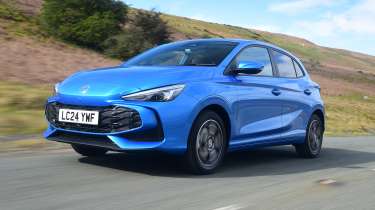
The previous MG3 wasn’t really a car to shout about, but the latest model is a much more talented and efficient machine.
The revamped MG brand has become synonymous with low-cost motoring, and the MG3 is the cheapest car in the current line-up. The petrol model starts from around £17,500, while the hybrid model isn’t too far behind at around £19,500. We’re particular fans of the latter as it offers impressive real-world efficiency — we managed a steady 55.4mpg during testing, and we reckon it’s possible to get even closer to the official 64.2mpg figure.
MG’s money-saving efforts do show in some areas within the interior but, for the most part, quality has taken a step in the right direction, even if the overall design is rather bland. The MG3’s 10.25-inch touchscreen infotainment system is responsive and easy enough to fathom, and Apple CarPlay and Android Auto are also thrown in. Music fans may be a little disappointed by the rather weak speakers, though.
One area where the MG3 defies its humble roots is how it feels to drive. Its low 1,300kg kerbweight means there’s genuine fun to be had on a B-road. Opt for the hybrid and the EV-like acceleration means surprisingly eager performance, too. When things settle down, the small 16-inch wheels help to absorb any battle-damaged tarmac.
“What sets the hybrid system in MG3 apart from those in its rivals, such as the Renault Clio and Toyota Yaris, is how much more involved the electric motor is. The result is that the MG3 Hybrid+ behaves more like an electric car.” - Shane Wilkinson, senior content editor.
The MG3 still faces two long-serving supermini rivals. The Renault Clio and Vauxhall Corsa are both household names for UK buyers, and the latter has the advantage of optional electric power
8. MINI Cooper
- Prices from £25,300
Pros |
|
Cons |
|
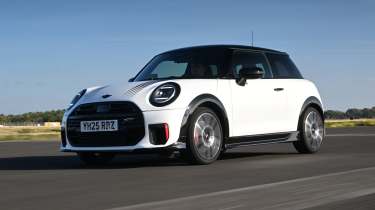
The latest MINI Cooper really is a super…MINI, and it’s a rather posh one at that.
While it isn’t the most affordable car on this list, the MINI Cooper has evolved into a model that genuinely feels like a premium product. Slightly higher starting price aside, though, the Cooper still offers running costs that are befitting of its money-saving heritage. Even the thirstiest models can return over 45mpg on the WLTP combined cycle or, alternatively, you can choose the Cooper Electric and completely eliminate the need to buy petrol.
One of the MINI’s biggest boasts is the overall level of fit and finish. Everything feels superbly well screwed together and the materials are befitting of a car with a much higher price tag (such as those from its parent brand, BMW).
The rest of the interior is a mixture of dark, woven materials, the centrepiece is a big and bright circular OLED display. This is the heart of the MINI’s functions and readouts, and the system is easy to use once you’re familiar with the seemingly endless list of on-screen icons.
As well as a reimagining of the MINI’s iconic look on the outside, the latest Cooper has also been drastically updated under the skin. New engines in the combustion models have upped efficiency and performance, while the EV model can now return up to 249 miles of range on the WLTP combined cycle. Due to additional safety tech and structural upgrades, the latest MINI Cooper is heavier than its ancestors, but it still retains that crucial element of driving fun. In fact, there’s even a ‘go kart’ driving mode for maximum mischief.
“There’s nothing quite like it on the road, with the sharp chassis delivering an entertaining drive, whichever model you choose.” - Dean Gibson, senior test editor.
As we’ve mentioned, the MINI Cooper’s most direct retro rival is the Renault 5. However, this car is exclusively available as an EV, so petrol and hybrid buyers may wish to look towards a non-nostalgic supermini such as the Renault Clio or Peugeot 208
9. Dacia Sandero
- Prices from £14,800
- Lowest starting price
Pros |
|
Cons |
|
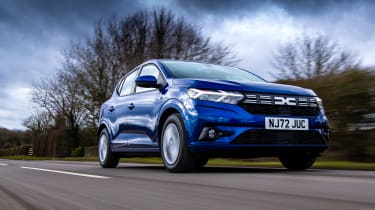
The Dacia Sandero continues to defy the laws of economic inflation, yet it also manages to be genuinely appealing.
While the general rule of thumb is ‘low cost equals low quality’, the Dacia Sandero is based on the current Renault Clio, and that’s a pretty strong foundation to build on. The result is a generous amount of head- and legroom for all passengers, along with a 328 litre boot which gives a number of pricier rivals a good run for their money. Renault Group’s TCe 90 engine is a frugal one, too, and we managed 49.3mpg when we pitted the Sandero against a Citroen C3. There’s also the option of a bi-fuel model, but you’ll need to make sure there’s a forecourt with an LPG pump nearby.
The entry level Essential trim is perhaps a bit too no-frills when it comes to kit. Upgrade to the Extreme variant, though, and you’ll get rear parking sensors, an eight inch touchscreen, Apple CarPlay, Android Auto, keyless entry, auto lights, and auto wipers. This is a fairly large additional cost, but we think it’s a worthwhile investment. Features aside, the latest Sandero feels like a much more solidly-engineered car than the one it replaced, so it should stand up well to family car duties.
As well as space, the Sandero’s Clio underpinnings mean it’s also a very pleasant car to drive. While it’s not about to be classed as a hot hatchback, the engines don’t need to be worked hard to quickly build up momentum on the slip roads. The steering feels very light, but this makes it incredibly easy to chuck the Dacia around tight city streets and into awkward parking spaces.
"The Dacia Sandero continues to offer great practicality for cost-conscious buyers. It even makes sense for those choosing the higher specification versions, because its low running costs shouldn’t leave them out of pocket." - Ellis Hyde, news reporter
As is the case in several market sectors, the Dacia’s closest rival in terms of price comes from MG. The MG3 is still a few thousand pounds more expensive than the Sandero, but few other superminis come anywhere close. While it’s more expensive, there’s also the car on which the Sandero is based; the Renault Clio. Two of the biggest upside of the Renault’s higher cost are a stylish design and the option of full-hybrid power
10. Skoda Fabia
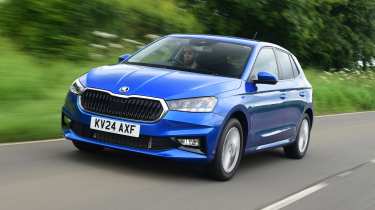
- Prices from £21,100
- Best for cabin and boot space
Pros |
|
Cons |
|
While some superminis place a focus on fashion and fun, the Skoda Fabia is one of the more grown-up options.
The Fabia lineage is decades long, and the latest iteration is the most practical one yet. Anyone in the market for a supermini as a family car will be pleased to hear that the Skoda has a stonking 380 litres of boot space, which is pretty much the same capacity as you’ll find in a Volkswagen Golf hatchback. Passengers will also enjoy ample room, with six footers being able to sit comfortably behind two tall adults. Sitting three in the rear is also possible without too much of a squeeze.
In typical Skoda fashion, the Fabia’s interior places a welcome focus on ergonomics. In short, everything is logically placed and well put together. The 8.25 touchscreen is shared with other VW Group cars, and it’s a sharp system to look at if just a tad sluggish to load. Choose one of the higher trim levels and the cabin is upgraded with Skoda’s Virtual Cockpit setup, and we think this is one of the very best technological set-ups on the current market.
There isn’t a hybrid option here, but over a 9,000-mile long-term test we averaged more than 55mpg - no small number. The Fabia is as sensible to drive as it is to look at, being geared more towards comfort than speed. With responsive steering and low weight, the Fabia does handle well, and it’s nimble in town.
“More practical than ever, with greater passenger space and modern onboard tech, the Fabia has fine-tuned what was already a pretty compelling package into one of the best superminis you can buy.” - Ellis Hyde, news reporter.
The Fabia has two stablemates; the Volkswagen Polo and SEAT Ibiza. While the former has an element of badge appeal, the latter is arguably a bit more stylish to behold. We feel that the Skoda offers the best all-round value for money, but all three of these cars should prove to be solid buys.
How we choose the best superminis
We go to great lengths to bring you the definitive verdicts on every supermini. Here’s how we test them and what we’re looking for…
Intensive testing
Our road test teams have tested every supermini currently on sale in the UK and the majority of the available models have also been group tested against their key rivals in a back-to-back assessment. Some have also been on the Auto Express long-term test fleet where we live with cars for a period of around six-months to really understand how it fits in with everyday life.
Focus on what supermini buyers really want
Cost is crucial in the supermini market as these are some of the most affordable cars to buy and run. We look at efficiency, both on the official tests and in the real world, as well as insurance costs and general running costs in order to build a complete picture for what a supermini is likely to cost you to run.
Maneuverability and ease of driving is also very important for buyers who typically use these cars in urban areas, on the school run and for shopping trips. A good supermini feels nimble and engaging on the road, and it should combine these qualities with good visibility for parking. Finally, the best superminis can’t just be good small cars, they need big car qualities to really stand out. Interior space, boot space, technology and safety are never going to match larger, more expensive options from the classes above, but top superminis can still deliver surprisingly well on these counts.
How to choose the best supermini for you
With so many superminis out there, it’s hard — but not impossible — to find the right one for you. If you go about choosing the right way, the process can even be quite fun.
The first thing you need is a clear idea of what you want before visiting a dealership. How many miles are you going to do? How often do you carry passengers? How much luggage do you have? What are your must haves in terms of driver assistance features, smartphone integration, infotainment and cruise control? Make sure you’ve got your budget in mind, too - not just for fuel, insurance and the cost of the car, but for service and maintenance as well.
Should you choose a petrol, hybrid or electric supermini?
Petrol and hybrid superminis are the norm these days. They’re quick and efficient, which means it’s harder to recommend diesel superminis to most — and fewer manufacturers are offering diesel anyway. Small diesel cars only really excelled on motorways, and if that’s what you’re after then you’re probably best off looking at something more refined from the class above.
When it comes to power, modern turbocharged petrol or hybrid cars are designed to blend performance with strong economy. An engine with 100bhp or a little more will probably offer the best compromise between the two.
Electric power is increasingly popular, although you do have to balance the superior running costs with the upfront price, which tends to be on the high side. If you don’t do enough mileage, you might struggle to make your money back in fuel savings. However, small electric cars are fantastic around town.
How to take a supermini test drive
Never underestimate the power of a test drive. Driving position, clutch weight, seat comfort, visibility, ease of using the controls are just some of the factors that can transform the perfect car on paper into a nightmare in the real world. Trying a car before you buy it is essential.
On your test drive, tailor your experience to the sort of things you usually do. If you’re a town driver make sure the car can handle tighter spots - try parallel parking, a three point turn, reversing into a bay, and anything else you do regularly. If you’re a countryside commuter, find the sort of road you’re used to and see how the car feels.
How to spec your supermini
Most entry level superminis come with generous standard equipment, but keep an eye on how the costs stack up as you move up the range. Work out what you don’t want (or need) to make sure you don’t end up paying extra for unnecessary gear. A fully-loaded supermini can end up costing more than a larger and more sophisticated car from the class above, and it’s unlikely that a high spec will be reflected in high residual values when the time comes to sell.
Think about safety when choosing a supermini
If safety is a concern, keep an eye on your chosen car’s Euro NCAP rating. Many models in this class come with good levels of active and passive safety tech, but not all. Some superminis have received low star ratings from Euro NCAP as a result of active safety aids not being included as standard, but that doesn’t necessarily mean that the adult and child occupant protection scores are low. It’s worth checking our reviews to get the full story.
Buy a car with Auto Express. Our nationwide dealer network has some fantastic cars on offer right now with new, used and leasing deals to choose from...