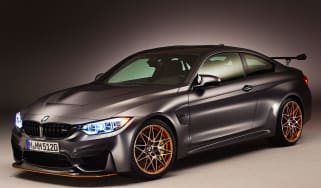
BMW M4 review
The M4 delivers outstanding performance, but it comes at quite a high price

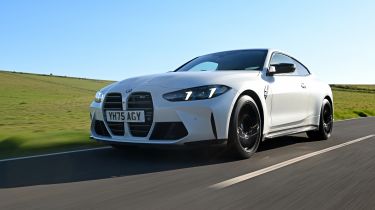

Our opinion on the BMW M4
There’s no doubt that the BMW M4 is a seriously capable performance machine that comes with a relatively practical edge, although it’s a car that feels big and heavy to hustle along narrow and twisty UK roads. It’s only cheaper than a Porsche 911 if you keep away from the options list, too, but if you want the ultimate driving experience, then the £15,000 M Race pack is an essential upgrade that puts the M4 toe-to-toe with its accomplished German rival.
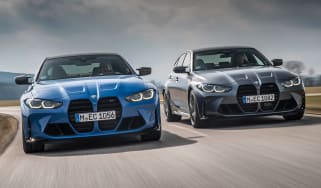
A bigger issue is that the M4 has competition from within the BMW line-up. The M3 uses the same powertrain as the M4 but offers even greater practicality, especially in Touring guise, while the M2 is arguably even more engaging (it’s also available with a manual gearbox) and offers a saving of £20,000.
About the BMW M4
While SUVs and electrification dominate the mainstream, models such as the BMW M4 remind us that a traditional performance car can’t go wrong as a two-door coupe with pure-petrol power. That undersells the M4 a little, because constant evolution by BMW’s Motorsport division has ensured that this medium-sized coupe has the kind of performance that was once the preserve of mid-engined supercars, while still offering a relatively practical four-seat body.
Used - available now


The second-generation M4 arrived in 2020, while the line followed a succession of highly rated BMW M3 coupes starting with the E30 M3 that earned legendary status in touring car racing in the late eighties. There has been some significant evolution since, with the M3 and then M4 growing in stature, resulting in the current car having far more power and a far higher price tag than the original M3.
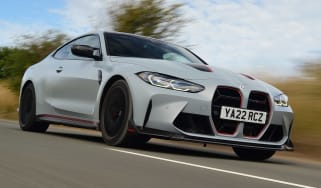
There have been different versions of the M4 offered since it was launched in 2020, including stripped-out M4 CSL and M4 CS variants. The current line-up consists of one model in the UK, the M4 Competition xDrive. It comes as either a two-door coupe or soft-top M4 Convertible, and the xDrive part of the name gives away that it comes with four-wheel drive, rather than the rear-drive set-up that has been a traditional feature of the M3/M4 in the past.
While the original M3 had a four-cylinder engine, and the last M3 Coupe had a V8, the current car features BMW’s traditional in-line six, albeit with twin turbos. It’s connected to an eight-speed automatic gearbox that offers manual shifts via steering wheel paddles.
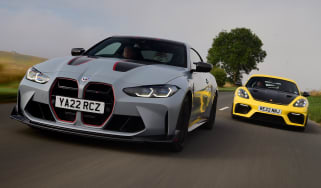
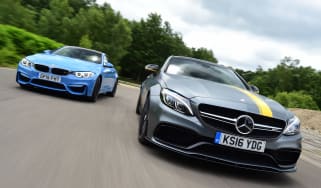
Our tests of the car have continuously confirmed that it remains a seriously impressive driving machine. We’ve tested the M4 numerous times in the UK and Europe over the years, including twin tests of the M4 Convertible against the Porsche 911 and the hardcore M4 CSL against the Porsche Cayman GT4 RS. The BMW isn’t as tactile and involving as it used to be, perhaps – old M3s set a very high bar there – but this is a practical four-seater that can still go toe-to-toe with dedicated sports cars and even supercars on a race track or testing section of road. It will be interesting to see how the future M4 might top it.
BMW M4 prices and latest deals
One stand-out feature of the M4 is a price tag in excess of £90,000. In basic guise the M4 Competition starts at £93,000, while the Convertible version adds around £4,000 to the price. Selecting options can easily send prices into Porsche 911 territory, north of £100,000. For reference, the sharper CS was priced at £122,000, while the short-lived CSL was even more, at nearly £130,000.
If the BMW M4 still feels like the car for you, then there are BMW M4 deals to be found courtesy of the Auto Express Buy A Car service. We can also help you to sell your car.
Performance & driving experience

Pros |
|
Cons |
|
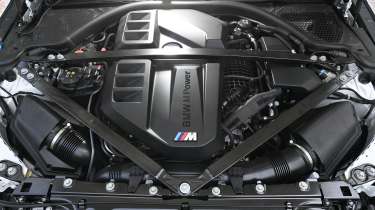
There’s just one version of the BMW M4 available to buy in the UK, and it’s the M4 Competition xDrive. It comes with a 3.0-litre turbocharged in-line six and an eight-speed automatic gearbox (a six-speed manual is available outside the UK) while four-wheel drive is fitted as standard.
In Competition form you get 523bhp at 6,250rpm and there’s 650Nm of torque between 2,750 and 5,730rpm. Those numbers certainly don’t fall short against rivals, but they’re also fighting against the M4’s kerbweight that now tops 1,850kg – that’s nearly 400kg more than an E46 M3 and not far off 700kg more than the original E30 M3. Perhaps more pertinently, it’s more than 100kg heavier than a Porsche 911 Targa 4 GTS, which is one of the heavier models in the 911 line-up. However, you’d be hard-pressed to feel the weight of the M4 on the road, which is a sign of how well BMW has tuned the coupe.
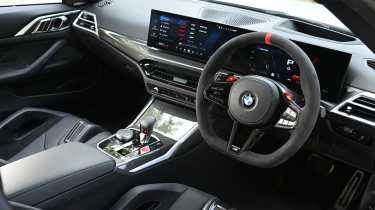
The xDrive all-wheel drive system gets an Active M Differential on the rear axle, but also the driver-selected ability to operate in standard AWD, rear-biased AWD Sport, and a full rear-wheel drive mode. Other tech includes a 10-stage traction control system, and brake-by wire tech means the feel of the pedal can be adjusted too, along with the usual driver selections such as steering weight and damper stiffness. When you have a preferred set-up, you can patch it to one of the bright red M1 or M2 buttons that sit on the top spokes of the steering wheel for quick access.
| Model | Power | 0-62mph | Top speed |
| M4 Competition xDrive Coupe | 523bhp | 3.5 seconds | 155mph (limited) |
| M4 Competition xDrive Convertible | 523bhp | 3.7 seconds | 155mph (limited) |
| M4 CS xDrive (2024-2025) | 543bhp | 3.4 seconds | 188mph |
Performance, 0-60mph acceleration and top speed
In the past, BMW’s M cars have tended to trade some straight-line performance in favour of handling finesse, but most buyers aren’t going to be complaining about the acceleration on offer in the M4. Four-wheel-drive traction helps it to go from 0-62mph in 3.5 seconds, while the heavier Convertible manages it in 3.7 seconds.
You can feel the transmission diverting power to the front wheels during hard launches, while the three-stage gearshift mode adjusts the changes from smooth to forceful depending on which level you’ve chosen, either via the touchscreen or the small toggle switch on the back of the shift lever. Whichever setting you choose, the M4 car cracks forwards as soon as you ask for more power, and at full throttle it feels relentless, all the way from idle to the limiter.
The car’s acceleration is a good distraction from the fact that the six-cylinder engine sounds more industrial and intense than it does musical, although the sports exhaust ensures that most of the sounds you hear are genuinely mechanical, rather than being artificially piped into the cabin.
A 155mph top speed is standard for the M4 Competition, but if you add the M Driver’s Pack (£2,175, or as part of the £15,275 M Race Track Pack) this is lifted to 180mph.
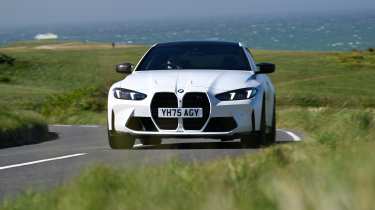
Town driving, visibility and parking
Despite its performance, the M4 is as easy to drive as any other BMW 4 Series. There’s enough steering assistance to make light work of manoeuvring at low speeds, and visibility is no worse than in the regular 4 Series.
The lower seating position of the optional bucket seats might make things trickier, despite there being plenty of adjustment, and the M4 can feel quite wide, too. It’s an easy car to drive smoothly, although the car’s ride is at its firmest around town – the springs and dampers are set up for high-speed driving.
Country road driving and handling
While the M4 feels like a large, heavy car at a canter, it suddenly wakes up when you push harder – the steering delivers more feedback, the nose responds instantly and refuses to deviate from your chosen line, and you begin to feel the rear tyres working a little harder. The M4 is four-wheel drive, but it behaves like a rear-drive car, albeit one reined in by some clever electronics, and with the extra traction benefits of all-wheel drive.
Add the M Race Pack and the M4 is even more exciting, with every dynamic quality feeling a little sharper. Some of the stiffness you feel at low speeds evaporates, although on the average bumpy UK road, it’s still undoubtedly firm.
All the M4 really lacks is that last element of fun and involvement that separates a good car from a great one. You’ll get out of a fast drive in an M4 with sweaty palms, but the experience is more impressive than memorable.
Motorway driving and long-distance comfort
The M4 behaves much like a regular 4 Series Coupe when you want to cover longer distances. There’s some extra road noise from the wide performance-focused tyres and a few more thumps creeping into the body through the firmer suspension, but the M4 settles down nicely at motorway speeds, and is never short of performance for quick overtaking.
Most of the M4’s settings can be adjusted, including the severity of the gearshifts, the weight of the steering and brakes, the firmness of the ride and how quickly the throttle responds. It can get a little bewildering, but it’s useful to be able to map your favoured settings to the red toggle switches on the steering wheel." - Dean Gibson, senior test editor.
MPG & running costs
Pros |
|
Cons |
|
Few people would buy a BMW M4 and expect low running costs, but it’s impressive how economical a modern car with well over 500bhp can be. Fuel consumption in the high 20s won’t win any awards, but our experience of the M4 says that you’re more likely to achieve them in the real world than some of the figures quoted for cars that are supposedly focused on economy.
Gentle driving on a motorway cruise saw the trip computer return as much as 27mpg during our most recent encounter with the M4, while even some spirited road driving failed to make a significant impact on that number, with overall fuel consumption of 25.2mpg recorded during our time with the car.
Add a 59-litre fuel tank to the mix, and you’re looking at an easy 300 miles between visits to the petrol station, even more if you want to play fuel-light bingo.
Of course, if you use the M4’s performance as intended, then fuel economy will tumble – our drives in the car suggest you’d be lucky to get 20mpg having fun on a twisty road.
If anything is likely to cost a few bob, it’s consumables, because the M4’s weight and performance will have an impact on brakes and tyres. The M4 gets staggered 19 and 20-inch wheels as standard, with 275/35 and 285/30 section rubber respectively – a set of Michelin Pilot Sport 4S tyres in those sizes comes in at about £300 a side at the front and £350 a side at the rear. If you’re feeling flush, then there are carbon-ceramic brakes available for nearly £9,000 - they’re a bit overkill for road use, but if you do track days then they should hold up to abuse better than the standard set-up.
| Model | MPG | CO2 | Insurance group |
| M4 Competition xDrive Coupe | 28.0mpg | 227g/km | 42 |
| M4 Competition xDrive Convertible | 27.4mpg | 232g/km | 45 |
| M4 CS xDrive (2024-2025) | 27.7mpg | 232g/km | 47 |
Insurance groups
While the M4 isn’t a cheap car to insure, the difference between it and some mainstream models isn’t as wide as you might imagine. A group 42 rating is high, but the Porsche 911 sits in group 50, irrespective of the version you choose. The AA gave us a quote just shy of £2,000 for 12 months of cover, which is around £500 a year more than some premium SUVs. You’re likely to benefit from a cheaper quote if you shop around at a specialist performance car broker.
Tax
First-year VED is hefty courtesy of the M4’s 227g/km emissions, and this contributes around £5,000 towards the car’s list price. In comparison, annual road tax of £640 in years two to six, courtesy of the luxury car tax surcharge, seems pretty reasonable, especially if you can afford an M4 in the first place.
You’d have to run a very successful business if you’re thinking of choosing an M4 as a company car, because its top 37 per cent Benefit-in-Kind rating means that even lower-band taxpayers will face bills in the thousands.
Depreciation
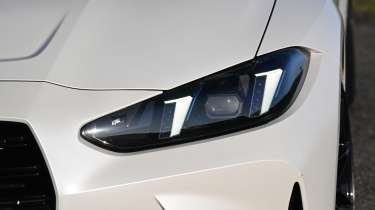
After three years and 36,000 miles, the M4 Competition is expected to retain around 43.7 per cent of its original value. Our experts also quote a residual value of 41.1 per cent for cars fitted with the £8,500 Ultimate Pack, which adds adaptive LED headlights, a powered tailgate, some carbon-fibre trim and a more advanced park assist system. This doesn’t really recoup its value when you sell, given that cars end up around the £40,000 mark with or without the pack. There are no depreciation figures for the M4 with the £15,275 M Race Track Package, although it might be more desirable courtesy of its track-focused add-ons.
Interior, design & technology
Pros |
|
Cons |
|
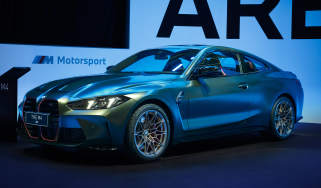
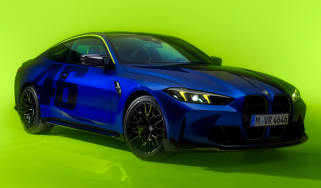
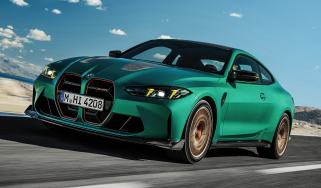
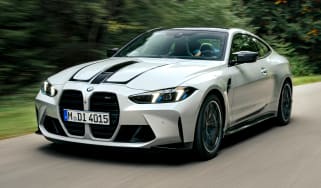
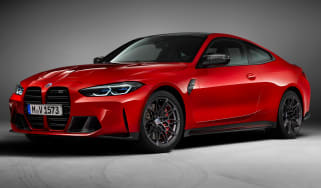
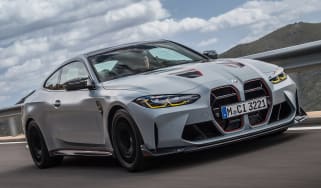
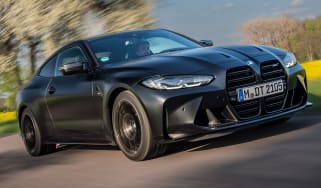
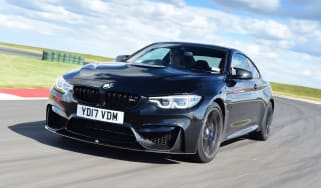
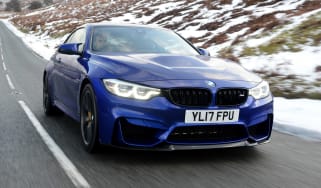
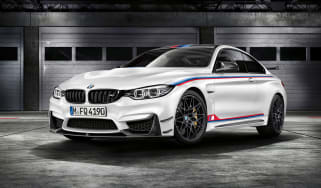
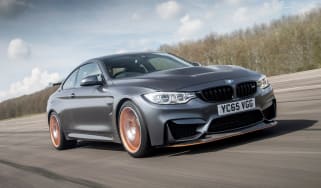
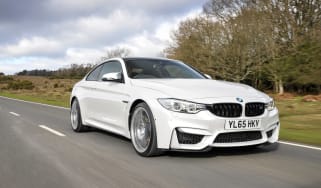
The M4 is based on the BMW 4 Series Coupe’s body, but pumped-up front and rear wings, deeper bumpers, quad exhaust tips, a carbon-fibre roof and arch-filling alloys help differentiate it from lesser versions.
While the M4’s grille is likely to forever split opinion, the car can be specced up to look as subtle or as in-your-face as you want. There are different wheel designs, and vivid colours for the exterior and the leather upholstery, too, while those with a spare four grand or so can delve into BMW’s Individual programme for even wilder hues.
The Kyalami Orange and Yas Marina Blue leather seat options are particularly bold, and there appears to be little stopping you choosing either in combination with some of the brighter exterior colours. For something with all the subtlety of a 1990s shell suit, try combining Sao Paulo yellow paintwork with Yas Marina leather to see what we mean. Aluminium cabin trim is standard but you can upgrade that to carbon fibre at extra cost.
Interior and dashboard design
If you’re familiar with recent BMWs, then the M4’s cabin will look and feel right at home. The dash isn’t heavily canted towards you as in BMWs of old – these days there’s more of a gentle curve for the dash and touchscreen.
One familiar BMW feature that persists is the overly padded steering wheel rim, but you’ll at least find physical buttons on its spokes. There are more shortcut keys surrounding the gear selector, with the start-stop button and various switches to adjust the damping, exhaust and other driver-controlled functions. It’s here you’ll find the traditional rotary iDrive control too.
We’re not particularly keen on BMW’s modern instruments. The digital screen is something to get used to, but the bar-graph-style speedometer and tachometer that flank the main display aren’t very easy to read at a glance. That’s a shame when BMW’s instruments used to be a model of clarity. At least there’s a head-up display as standard that puts vital information in the driver’s line of sight.
Materials and build quality
While some of BMW’s rivals seem to have dropped the ball in terms of quality, there are no such worries with the M4, which feels like a premium piece of kit that is ready to be driven as hard as you want.
All of the major touch-points and surfaces feel as if they’re made to a high standard, although BMW hasn’t been able to resist a splash of fingerprint-attracting piano black plastic around the drive selector.
BMW’s work to create a stiff structure has paid dividends, too. Even considering the M4’s firm ride, there’s no sense of rattling or squeaking in the cabin.
Infotainment, sat-nav and stereo
All M4s get a wide, curved-screen set-up with a 12.3-inch driver’s display and 14.9-inch infotainment screen. Since the M4 has been around for a little longer than some other BMW products, it uses the firm’s Operating System 8.5. This doesn’t mean much in isolation, but one of the benefits is that it still comes with a rotary iDrive controller; Operating System 9 that’s used in newer models such as the latest BMW iX3 removes this useful feature. Touchscreen and voice control functions are still included on OS 8.5 if you prefer.
The infotainment has plenty of features, and if you don’t want to use Apple CarPlay or Android Auto, then the native system is pretty comprehensive. The menus and functions are all quick to access, if a bit cluttered, while the large display reflects off the windscreen at night.
"Carbon-fibre options can give the M4 Coupe the look of a road-going touring car. The carbon-fibre bucket seats cost around £4,500, while you can add exterior carbon for £4,200 and carbon interior trim for £1,200. It won’t do much to save weight, but it looks the part." - Dean Gibson, senior test editor.
Boot space & practicality
Pros |
|
Cons |
|
As with the BMW 4 Series, the M4 comes in coupe and convertible forms with two doors and four seats. If you need more versatility, then the BMW M3 use the same powertrain and comes as either a five-seat saloon or estate. However, even in coupe form, the M4’s relatively conventional, meaning it’s among the more practical performance cars on sale, and is closer in utility to the likes of the Mercedes-AMG CLE 53 than a Porsche 911.
Dimensions and size
Not only does the BMW M4 weigh more than 1,800kg, it’s also 4.8 metres long – an increase of about 130mm over the first M4, and only about 120mm shorter than a BMW X5. It makes a Porsche 911, a car that itself has grown significantly over the years, almost look tiny.
Compared with the standard 4 Series Coupe, the M4 is 33mm longer, 35mm wider and (somehow) 6mm taller than the standard car, despite it having lower suspension.
| Dimensions comparison | |||
| Model | BMW M4 Coupe | Porsche 911 Carrera | Mercedes-AMG CLE Coupe |
| Length | 4,801mm | 4,542mm | 4,873mm |
| Width | 1,887mm | 1,852mm | 1,935mm |
| Height | 1,398mm | 1,302mm | 1,434mm |
| Wheelbase | 2,857mm | 2,450mm | 2,875mm |
| Boot space | 440 litres | 373 litres | 410 litres |
Seats & passenger space
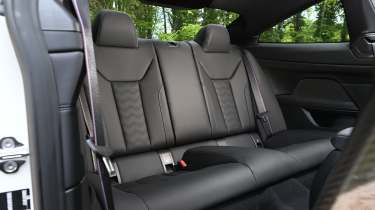
There’s a wide range of adjustment to both the seats and steering wheel in the M4, and you’d have to be a particularly unusual shape not to be able to get comfortable. One big caveat is whether you’re adding the £4,450 optional carbon-backed bucket seats. These figure-hugging seats feature a large lump at the front of the base to divide your legs in the style of a racing car-style bucket seat.
It’s a bit of a dubious reference, because the leg dividers used in actual racing seats aren’t as wide or obstructive, and a lot of drivers find it gets in the way of their legs in the M4. Long-distance comfort is excellent, though, and unlike a lot of bucket seats, they don’t require too much of a clamber over to access.
In the rear, anyone approaching six-feet tall will feel their head brush against the roof lining, while shoulder space is tight for the two back seats. Those carbon-fibre bucket seats do leave decent space beneath them for your feet – so it’s more comfortable for two adults back there than you might think.
Boot space
You get a 440-litre boot in the M4, which is unchanged from the regular 4 Series. While the traditional boot opening will limit the M4’s ultimate practicality, there’s enough capacity on offer for most needs. It can easily swallow a couple of suitcases, and you can fold the back seats, or drop the centre section to load through longer items while still carrying two passengers.
"If you need more practicality, then the BMW M3 saloon has easier access thanks to its four-door layout, while the boot measures 480 litres. Or there’s the M3 Touring estate, which has a 500-litre boot capacity." - Dean Gibson, senior test editor.
Reliability & safety
Pros |
|
Cons |
|
BMWs have achieved mixed results in reliability surveys in the past, but the latest 4 Series had an encouraging finish in the 2025 Driver Power survey, coming seventh overall. It didn’t trouble the top-scorers on build quality and reliability, but it wasn’t bad, coming in 21st place out of the 50 cars. It also placed second overall for the ease of deactivating systems such as lane-departure warning and speed-limit chimes.
While the 4 Series’ result was behind that of the Mercedes C-Class (in fifth), it was well ahead of the Audi A5 (22nd place) and Tesla Model 3 (25th), both cars of similar price and market positioning. The M4 itself wasn’t surveyed, but as a member of the 4 Series family, you can expect similar levels of quality and reliability.
The BMW M4 hasn’t been tested by Euro NCAP, but again, the 4 Series Coupe has, although its five-star rating from 2019 has expired because the test procedures have evolved over time. Still, the 4 Series had particularly good results in the adult occupant and vulnerable road user protection categories.
Buying and owning
- Best buy: BMW M4 Competition xDrive
There’s just one version of M4 Coupe to choose from now that the M4 CS is no longer offered. However, there are plenty of options that you can add to tailor the car to different tastes. If you’re looking for a track car, then there are track-biased tyres on offer, plus carbon-ceramic brakes for consistent stopping performance.
If you plan on keeping the M4 for a while, then BMW’s five-year Service Inclusive plan for around £1,700 is probably worth selecting, and the driver training and experience element of the M Driver’s Pack (for £2,200) is probably more worthwhile than the raised 180mph limiter.
For £15,275 you can add the M Race Track Package, with M carbon bucket seats, carbon-ceramic brakes, a head-up display, and the M Driver’s Pack included, making this the closest you can get to a new M4 CS now.
BMW M4 alternatives
The Porsche 911 is probably the closest car in spirit to the M4 Coupe. Given that it’s a dedicated sports car rather than a pumped-up four-seater, the two cars do occupy slightly different corners of the market, so that neither directly treads on the other’s toes, but for driver appeal they’re much closer.
The Porsche is a little more expensive out of the box (a basic Carrera now starts just shy of £104k) and despite token rear seats and a deep front boot, it can’t match the M4 for practicality. But it’s also smaller, lighter, lower-slung and a lot less brash than the BMW, which may appeal to some.
While Mercedes and Audi have offered high-performance coupes in the past, neither currently has an exact match for the M4. Audi has just launched a new RS 5 in saloon and Avant guises, with prices at the £90,000 mark, while the highest-spec Carbon versions easily break the £100,000 barrier. Power comes from a 630bhp/825Nm plug-in hybrid powertrain with quattro four-wheel drive, so as well as accelerating from 0-62mph in 3.6 seconds, the RS 5 has a claimed electric range of 52 miles.
As for Mercedes-AMG, it doesn’t produce a CLE 63 AMG at the moment, with flagship duties taken care of by the CLE 53 instead. It’s more of a cruiser than some AMG coupes of old – the 465bhp, hybrid-assisted in-line six delivers a less raw experience than the BMW, and the appealing but also slightly chintzy cabin is more about flash than focus.
Key updates of the BMW M4 review
12 May 2026: Latest driving impressions.
Frequently Asked Questions
The M4 is an appealing performance car that offers decent practicality and enough pace and ability to deliver thrills on the track as well as the road. It’s pretty large and expensive to buy, though, and a lot of potential buyers could get similar enjoyment from the slightly smaller and £20,000 cheaper BMW M2.
Deals on the 4 Series and alternatives
More reviews
Which Is Best
Most Economical
- NameM4 xDrive 530 Competition M 2dr Step Auto
- Gearbox typeSemi-auto
- RRP£91,395