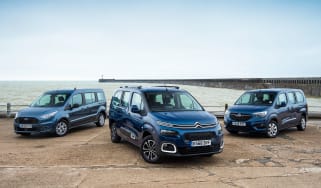
Citroen Berlingo review
This bargain MPV remains one of the best value ways to transport a growing family and everything that goes with it

Our opinion on the Citroen Berlingo
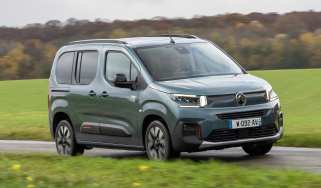
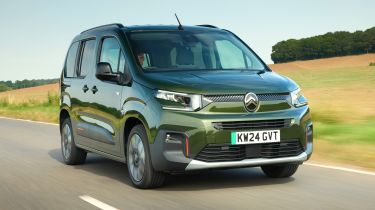
The Citroen Berlingo has always been a great MPV and an ideal family car thanks to its generous passenger and boot space, low running costs, and great value for money. The latest iteration improves on each of those areas, plus it’s much better to drive, reasonably comfortable, and certain versions, can seat seven. It’s also offered with a choice of petrol, diesel or pure-electric power, with the e-Berlingo one of the few EVs available with seven seats. Sure, the Berlingo doesn’t have the kerb appeal of a typical family SUV, but those with more sense than money should have it on their next family car shortlist.
About the Citroen Berlingo
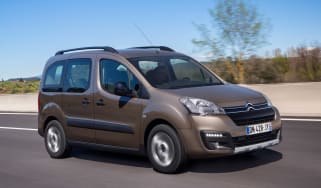
People used the phrase “a van with windows” as a pejorative towards MPVs in the 1980s and 1990s, but when the Citroen Berlingo debuted in 1996, it became a virtue. The first-generation Berlingo offered unmatched space and practicality for the money – and it wasn’t bad to drive either. The second-generation Berlingo that followed in 2008 provided greater sophistication, but it’s this third-gen Berlingo that arrived in 2018 which has made strides in quality, driver appeal, and practicality.
It’s also one of the first people-movers to get a fully electric variant. The e-Berlingo went on sale in 2021, and while the electric model was originally due to completely replace the combustion car, Citroen has since backtracked, and currently offers petrol, diesel and all-electric versions.
Used - available now

2021 Citroen
Berlingo
5,041 milesAutomaticPetrol1.2L
Cash £19,500
2024 Citroen
Berlingo
17,162 milesManualPetrol1.2L
Cash £13,990
2020 Citroen
Berlingo
25,818 milesManualDiesel1.5L
Cash £10,999
2024 Citroen
Berlingo
74,318 milesManualPetrol1.2L
Cash £10,250You can also get your Berlingo in M and XL variants, the latter 35cm longer and equipped for seven seats. A facelift in 2023 brightened up the exterior and improved the interior, while the simplified trim levels of Collection and Max arrived in 2026.
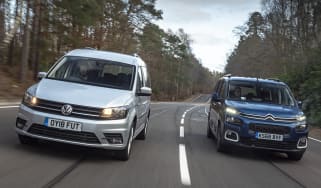
We’ve driven not just the Berlingo, but its Stellantis siblings the Peugeot Rifter and Vauxhall Combo Life. We have also conducted a triple with a pre-facelift Citroen Berlingo XL against the Ford Grand Tourneo and Vauxhall Combo Life XL. We’ve even run the electric Citroen e-Berlingo and the longer Citroen Berlingo XL as part of our long-term test fleet.
Performance & driving experience
Pros |
|
Cons |
|
The Berlingo’s underpinnings are a mish-mash of technologies. The rear half is largely unchanged from the previous model, allowing for a similarly huge load area, while the front is based on the EMP2 platform used by cars ranging from hatchbacks to family SUVs. Doing so allowed Citroen to install the latest suite of safety tech and chassis refinements, and the result is a car-like experience rather than that of an agricultural old van, whichever engine you end up choosing.
Driving the electric Citroen e-Berlingo has the benefit of near-silent running, no gearbox to deal with and a generous amount of torque available as soon as you tap the accelerator. The e-Berlingo is great when you’re pottering around town, especially when you engage the ‘B’ mode that increases the regenerative braking, though it’s not capable of one-pedal driving like some other family-friendly EVs.
Performance, 0-60mph acceleration and top speed
Under the bonnet, there’s a choice of a 1.2-litre petrol with 109bhp, a 1.5-litre diesel in one of two power outputs – 99bhp and 129bhp – and a single electric motor with 134bhp on tap.
The most powerful diesel delivers a useful 300Nm of torque – handy when carrying a full complement of passengers and their luggage.
The top-end diesel is auto-only and accelerates from 0-62mph in 11.7 seconds, on to a top speed of 114mph. The entry-level oil-burner is a little bit slower on paper, as Citroen says this version takes 12.6 seconds to reach 62mph, and it has a slightly lower 107mph top speed, though that shouldn’t concern UK drivers.
The 109bhp petrol model’s 11.6-second 0-62mph time translates into decent real-world performance, while the linear power delivery makes the Berlingo easy to control at low speeds. The petrol Berlingo also has a top speed of 111mph.
With a proviso, the e-Berlingo’s electric motor sends all its 134bhp and 270Nm of torque to the front wheels, and recent revisions have improved its acceleration, with a 9.9-second 0-62mph time. However, it’ll only deliver that performance in the car’s Power driving mode, which should be used when the car is chockablock with people and their stuff. The EV’s remaining driving modes – Eco and Normal – restrict power slightly to preserve your driving range.
| Model | Power | 0-62mph | Top speed |
| Berlingo petrol 110hp manual | 109bhp | 11.6 sec | 111mph |
| Berlingo diesel 130hp auto | 129bhp | 11.7 sec | 115mph |
| e-Berlingo 136hp | 134bhp | 9.9 sec | 82mph |
Town driving, visibility and parking
The Berlingo’s van-based architecture offers benefits for visibility. The big windows, tall side mirrors and slightly elevated driving position mean you get a decent view out, plus you get a standard reversing camera and reverse parking sensors.
The ride is smooth enough, though the harshest bumps vibrate around the cabin, possibly one downside of basing your car on a commercial vehicle.
Day to day around town, we’d recommend driving the e-Berlingo in Normal mode, and switching to Eco for when you have to get the most range out of the battery, because this setting not only limits power, but the climate control as well, which isn’t great in the blistering heat or freezing winters.
Country road driving and handling
For the most part, the Berlingo drives more like a tall car than a van out of town. The steering is light, the turning circle is tight and, while the high centre of gravity makes itself felt during hard cornering, body roll is controlled well enough. There's decent grip and the brakes feel strong and reassuring.
Motorway driving and long-distance comfort
Whichever fuel you go for, the Berlingo remains fairly smooth and refined, with the two diesels the better pick for regular longer trips or towing duties. There’s quite a lot of wind noise at motorway speeds, particularly around the bulky door mirrors, but that’s not particularly surprising considering this is a large box on wheels.
MPG & running costs
Pros |
|
Cons |
|
A good many people aren’t quite ready to make the switch to electric, or don’t have anywhere they could charge an EV. In that case, whether you pick a petrol or a diesel, the Berlingo’s engines sip fuel rather than guzzle it down, plus they all benefit from stop/start technology, which helps to save fuel in heavy traffic.
Most frugal of all is the lower-horsepower diesel equipped with a manual gearbox, returning up to 54.8mpg, but the more powerful automatic isn’t far behind at 51.8mpg, though you can expect to pay a little more to insure it.
Mid-40s economy from the petrol isn’t bad either considering the Berlingo’s boxy shape, and a larger 60-litre fuel tank in the petrol (diesels get 53 litres) means that even if it’s not as frugal, it still has a decent range on a tank. Match the official figures, and you can expect to cover over 500 miles in the petrol, and as much as 600 miles if you squeeze every last drop from the diesels.
| Model | MPG | CO2 | Insurance group |
| Berlingo petrol 110hp manual | 46.0 | 143g/km | 12 |
| Berlingo diesel 100hp manual | 54.8 | 139g/km | 11 |
| Berlingo diesel 130hp auto | 51.8 | 144g/km | 16 |
Electric range, battery and charging
Both the e-Berlingo M and XL use a 52kWh battery which allows for a maximum driving range of 212 and 206 miles, respectively. That’s a useful increase over the 177 and 168 miles when the car was launched.
Even so, those figures are not ideal if you frequently visit family over 300 miles away – as we learned when we ran an e-Berlingo Flair XTR M as a long-term test car, and a figure that’s now possible in plenty of EVs (albeit fewer with up to seven seats). However, we did find that driving around town in eco mode, and with the stronger regenerative braking setting activated, we could get close to the e-Berlingo’s claimed range.
The e-Berlingo has a maximum charging speed of 100kW, so if you decide to take the electric MPV on a longer journey, topping up from 0 to 80 per cent will take just 30 minutes at a suitably fast rapid charger. Day to day though, most people charge their cars at home or using slower public charging points nearby. A standard 7kW home wallbox needs seven and a half hours to fully replenish the e-Berlingo’s battery. A heat pump is a £720 option on the Max, and unavailable with Collection trim.
| Model | Battery size | Range | Insurance group |
| e-Berlingo 136hp | 52kWh | 212 miles | 19 |
Insurance
As the Berlingo offers little in the way of sporty intent, insurance costs should prove to be modest throughout the range. Insurance group ratings start from 11 for the 100hp diesel in Collection trim (the petrol is a little higher, in group 12), and climb to group 21 for the e-Berlingo in Collection XL or Max M form.
Tax
The e-Berlingo is naturally the road tax winner here. For private buyers its 0g/km CO2 figure means a first-year bill of just a tenner, though it’s then £200 a year thereafter, the same as the combustion models. 143g/km for the petrol Berlingo means a first-year rate of £560, a figure that also applies to both diesels, as they fall within the 131-150g/km range in the government’s system.
For company car drivers, the e-Berlingo’s the only real option if you want to cut your BIK bill; EVs are currently charged at 4 per cent, while the combustion versions are up above 30 per cent. An e-Berlingo Collection will cost a basic-rate taxpayer £259 for the 2026/2027 tax year, whereas the frugal 100hp diesel, despite having a lower P11d value, will set a basic-rate taxpayer back £1,669.
Depreciation
Due to their popularity, family SUVs and crossovers will retain more of their original value compared to MPVs like the Berlingo, though the depreciation shouldn’t be disastrous. Our latest expert data suggests the e-Berlingo should hold onto around 47 per cent of its list price after three years and 36,000 miles of ownership, and the petrol and diesels should retain 50 per cent come trade-in time.
That’s on par with the Dacia Jogger (49 per cent), and higher than the Peugeot e-Rifter (43 per cent) and Vauxhall Combo-e Life (38 to 40 per cent).
Interior, design & technology
Pros |
|
Cons |
|
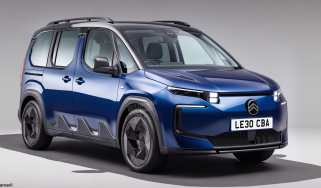
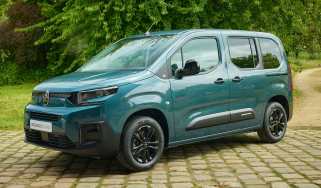
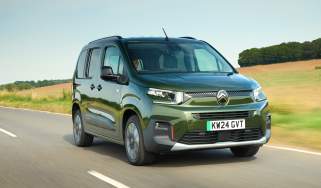
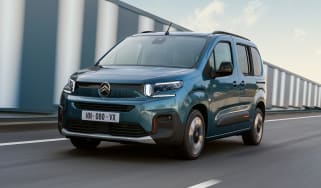
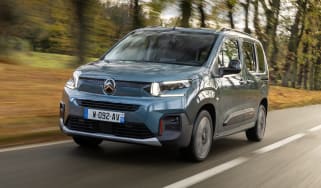
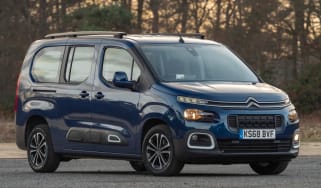
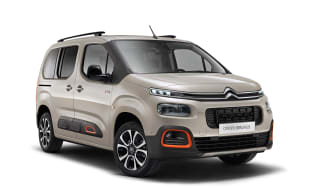
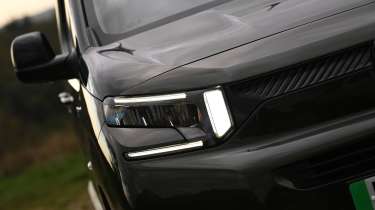
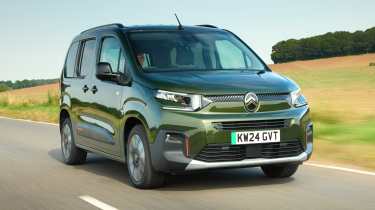
In typical Citroen fashion, the Berlingo takes a slightly quirky approach to its styling. The external ‘airbump’ panels not only break up the vast metal panels along the side, but bring the added bonus of protecting the paintwork from car park dings. Collection models are equipped with 16-inch alloy wheels, while higher-spec Max versions come with larger 17-inch alloys. The double-decker headlights keep faithful to the current Citroen family look and colourful highlights add character to the boxy body that the Peugeot Rifter and Vauxhall Combo Life arguably lack.
Interior and dashboard design
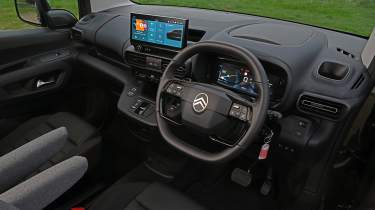
Like the outside, much of the trio’s cabins are shared with one another. That means there’s a large, raised dashboard which houses the gear lever (or gear selector in automatic and electric models), and a simple layout which prioritises ergonomics and storage space over style. The Berlingo gets traditional dials, unlike the Rifter, which uses Peugeot’s i-Cockpit setup that places the dials above a small-diameter steering wheel.
Materials and build quality
Design and build quality have taken a significant leap forward over the previous-generation Berlingo, though those used to the squidgy plastics and damped switches of more conventional cars might still find it a little agricultural. However, while the plastics are hard, they do feel sturdy and more than capable of withstanding anything life as a family car might throw at it.
Infotainment, sat-nav and stereo
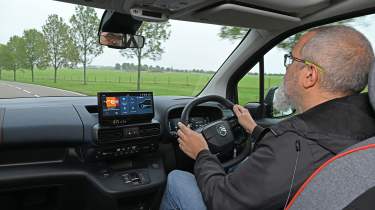
All models are equipped with a 10-inch touchscreen infotainment system, introduced to replace the old eight-inch unit from the model’s debut, and while it’s still not at the cutting edge of infotainment, it’s quicker and easier to use than it used to be. Built-in navigation is optional only on the Max, and then as part of the Comfort & Tech option pack (£520, including keyless entry and start). In reality, most people will just use the navigation apps from their phones via Apple CarPlay or Android Auto, both of which are standard across the range, as is a decade of over-the-air updates.
Sound quality from the six-speaker hi-fi is reasonable, but it won’t impress any music-mad MPV/SUV buyers. Many other Citroen models integrate heating and climate controls into a touchscreen, but the Berlingo keeps physical buttons and switches which, in our opinion, are much easier and less distracting to use on the move.
Boot space & practicality
Pros |
|
Cons |
|
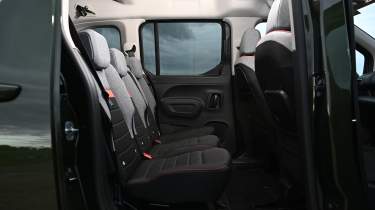
Most MPVs are designed with practicality at the forefront, but few others (Rifter and Combo Life relatives aside) execute this thinking as well as the Berlingo. In every interior dimension, the Berlingo is huge: head, leg and shoulder room are vast, and there’s enough width to the second row that three child seats can be fitted across its width. The large sliding rear doors make it easy to get in, too.
Then there’s the storage space. A total of 28 cubbies offer up a whopping 186 litres of volume, which is more storage than you get in the actual boot of a Fiat 500. They’re topped off (literally) by a clever roof storage system that Citroen calls the Modutop. It’s got an airline-style locker at the back, with a long, translucent shelf running ahead of it through the centre of the cabin. Paired with a panoramic glass roof, it’s available as a £750 option on both Collection and Max trims, though only in five-seat ‘M’ body form.
The front overhang and bumper are shorter than on the old Berlingo, which improves forward visibility. Combined with the high driving position it means that drivers get a great view of the road ahead. Kids will enjoy the back seats, too; the huge areas of glass mean that it’s easy to see out.
Dimensions and size
Both the five-seat Berlingo M and seven-seater Berlingo XL are 1,848mm wide with the mirrors folded and 2,107mm between the tips of the mirrors, but dimensions then differ between the two models. The most obvious difference is in overall length where the M is 4,403mm, and the XL extends to 4,753mm, while there’s an increase in wheelbase too from 2,785mm to 2,975mm. The XL is a tiny bit taller at 1,818mm.
The Berlingo M’s length makes it slightly shorter than a Citroen C5 Aircross while the XL’s length is just a little longer than that of a BMW 3 Series. Their height is more significant, with both being a little taller than a BMW X5 or Mercedes GLE.
| Dimensions comparison | |||
| Model | Citroen Berlingo | Dacia Jogger | Ford Tourneo Courier |
| Length | 4,403mm (M) | 4,550mm | 4,337mm |
| Width | 1,848mm | 1,853mm | 1,800mm |
| Height | 1,812mm (M) | 1,689mm | 1,817mm |
| Wheelbase | 2,785mm (M) | 2,898mm | 2,692mm |
| Boot space | 775 litres (M) | 820 litres (5 seat) | 570 litres |
Legroom, headroom & passenger space
It doesn’t matter which of the five seats you find yourself in, there will be little to complain about when it comes to space. The high roofline makes headroom acceptable for the tallest top-hat fanciers, and legroom is just as generous.
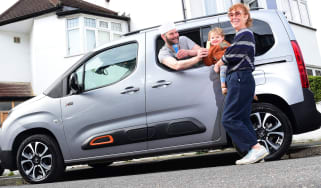
Young families will like the fact that each second row seat gets Isofix mounting points – hidden behind zipped covers – as standard. The cabin is wide enough to accommodate three child seats together, too. Access is easy, thanks to huge sliding doors and a flat interior floor.
XL models add a third row of seats. These aren’t quite as spacious, but passengers of average height or below will be happy enough. Access is possible from the second row, which can slide and fold forwards.
Boot space
That impressive cabin space is backed up by a vast load area. The M model’s 775-litre boot equates to 100 litres more than the old Berlingo Multispace in standard guise, and the XL gets a faintly ridiculous 1,050 litres. Folding the seats takes a simple flick of levers in the boot or on the seats themselves, and all three individual chairs drop into the floor for a near-level load area, via levers in the boot if necessary. If fitted, the sixth and seventh seats are removable altogether.
The front passenger seat folds flat and almost completely level with those behind, which, according to Citroen, means the Berlingo M can take objects up to 2.7 metres long, and the XL 3.05 metres – enough for a whitewater kayak. The boot door is huge, which is great for loading but a pain in tight spaces. In order to get around this, you’ll need to go for the range-topping Max trim, because the tailgate glass opens separately from the door. Collection trim models are denied this benefit.
Reliability & safety
Pros |
|
Cons |
|
Vans used to be simple machines, but the amount of safety and driver assistance tech you find on commercial vehicles these days is deeply impressive. That’s how the van-derived Berlingo features cruise control, lane-keeping assist, speed limit recognition, active emergency braking and driver attention monitoring as standard, while top-spec Max can be optioned with the £1,300 Drive Assist pack. It includes adaptive cruise control, lane positioning assistance, blind spot assistance, and front and lateral parking sensors.
The third-generation Berlingo received a four-star crash safety rating from industry experts Euro NCAP in 2018 based on how its sister car, the Peugeot Rifter, performed during its battery of tests. However, the testing criteria has changed significantly since then, and due to it not (nor its sibling cars) having been retested under this revised criteria, the Berlingo’s score has expired.
The Berlingo didn’t feature in the 2026 Driver Power customer satisfaction survey, but the Citroen brand posted much lower satisfaction scores than its Peugeot (7th) and Vauxhall (6th) siblings, with the double-chevron brand finishing 28th overall out of 30 manufacturers. Owners praised value for money, but had mixed views for the ride, handling, and exterior categories.
Buying, prices and deals
Best buy: E-Berlingo XL Collection
Pricing for the Berlingo starts at just under £25,500 for an M length five-seat 109bhp 1.2 petrol in Collection trim. The least expensive diesel comes in at around £26,000, while the longer XL seven-seat version with a 99bhp diesel is around £27,000.
Thanks to the £1,500 ‘Band 2’ electric car grant (ECG) discount from the Government, the electric E-Berlingo costs around £31,000 in M length in Collection trim, while the range-topping Max trim is around £32,500.
Our preferred XL length Collection E-Berlingo costs around £32,000. It’s our pick because that low price makes it one of the cheapest electric seven-seat cars you can buy – its nearly half the price of an equivalent seven-seat Volkswagen ID. Buzz. The electric drivetrain is a great fit for a family car, being very easy to drive doing daily errands, and if you can charge it up at home, you don’t need to worry about time-consuming trips to the pumps. The instant torque of its electric motor will be a better match for a car load of passengers than the petrol version.
The longer XL is only available in Collection trim, and aside from dual-zone climate control and some fancier trim, you’re not missing out compared with the Max trim. And besides, this is a family car, so you need something hard-wearing rather than plush.
If you’re interested in a Berlingo of your own, you can save money when you build you new Berlingo with our Buy A Car service. We also have a wide range of Citroen Berlingo leasing deals, as well as plenty of used Citroen Berlingo models to browse through. We can even help you to sell your car.
Citroen Berlingo alternatives
The Berlingo’s platform-sharing counterparts, the Peugeot Rifter and Vauxhall Combo Life, are the obvious alternatives to the Citroen. Unlike the Citroen, both are available only as EVs, with starting prices of £32,500 and £32,340 respectively before any discounts or grants, putting them around the same price as the Berlingo.
In terms of value and space-focused five- and seven-seaters, the Dacia Jogger (starting price £18,995) is a good place to start, with all models getting seven seats. It’s a proper car, this one, yet with the Jogger’s back pair of seats folded, the boot’s even larger than that of the five-seat Berlingo, though it can’t quite compete with the XL model’s more than 1,000 litres of space.
For something more compact, and once again van-based, the Ford Tourneo Courier is worth a look. Underpinnings similar to the Ford Puma make it surprisingly good to drive yet it still has the benefits of a high roof and sliding rear doors.
Citroen Berlingo pictures
Key updates of the Citroen Berlingo review
30 July 2026: Latest driving impressions and line-up information.
Frequently Asked Questions
All new Citroen vehicles come with a standard three-year/60,000-mile warranty, but with a warranty start date from 1 July 2026 are eligible for the ‘We Care’ service-activated extended warranty policy, which extends the standard policy up to eight years or 100,000 miles, whichever comes first. It applies to all versions (inc petrol and diesel) rather than just the electric ones, as per Peugeot’s Allure Care policy.
The e-Berlingo’s battery pack is covered by a separate eight-year/100,000-mile guarantee. Also included are a 12-year anti-perforation warranty and three years’ paint cover.
Deals on the Berlingo and alternatives