Kia XCeed review
It’s one of the oldest members of Kia’s line-up, but the XCeed is still a reasonably appealing crossover


Our opinion on the Kia XCeed
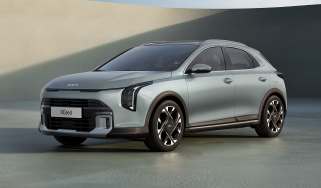
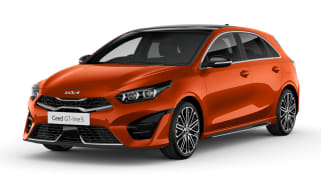
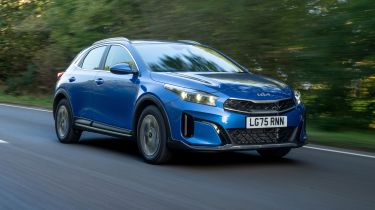
While the once mighty Kia Ceed family has gradually diminished, the Kia XCeed marches on as one of the remaining combustion-powered models in the South Korean manufacturer’s range. The XCeed is about the same size as its Niro stablemate, but this model provides just that bit more design flair and driver focus.
There’s no hiding the XCeed’s advancing age, because it’s starting to feel a bit old-school when compared to younger models like the Kia K4. That being said, the upsides of this maturity are a cabin that’s filled with plenty of proper buttons and mechanical underpinnings that have had the chance to prove their durability over time.
About the Make Kia Niro
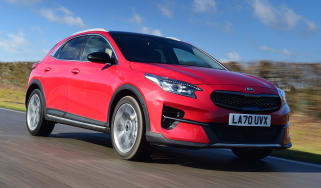
The XCeed fills the gap between the Stonic and Niro in the Kia range. It's positioned as a more stylish choice, with its sharp looks taking aim at more premium members of the crossover car market.
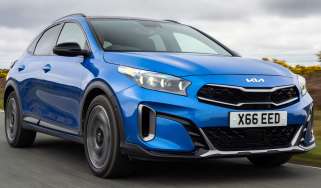
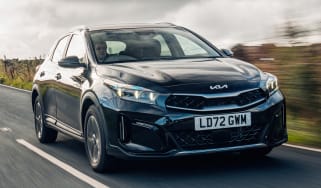
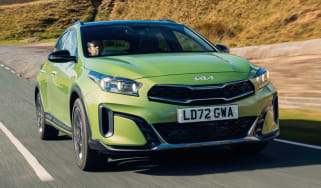
A facelift in 2022 brought in some exterior styling changes which give the XCeed a fresher feel. However, this model first went on sale in 2019, so it’s quite long in the tooth compared to the majority of Kia’s current line-up.
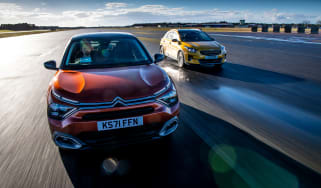
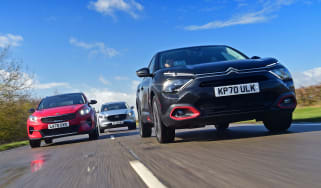
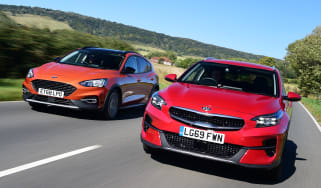
Given how long the XCeed has been on sale, we’ve had plenty of opportunities to test it against its rivals. When we pitted the XCeed against the pre-facelift Citroen C4 in a twin test, the Kia took the win thanks to its more attractive pricing, distinctive design, enjoyable driving experience, and spacious interior. This Kia was also victorious in the XCeed versus Ford Focus Active twin test, and narrowly missed out on top honours in the XCeed vs Mazda CX-30 vs Citroen C4 triple test.
Kia XCeed prices and latest deals
There are three Kia XCeed trim levels to choose from, and the majority are powered by the same 1.0-litre engine. This means the pricing structure is straightforward, starting off with the Pure trim from around £25,200. In the middle sits the GT-Line, which ups the price to at least £26,600. With both of these models, you’ll need to add around £1100 to the price if you want an automatic gearbox.
Used - available now

2022 KIA
Xceed
55,428 milesManualPetrol1.5L
Cash £13,000
2024 KIA
Xceed
20,198 milesManualPetrol1.5L
Cash £16,697
2024 KIA
Xceed
29,100 milesManualPetrol1.5L
Cash £17,210
2022 KIA
Xceed
41,166 milesManualPetrol1.0L
Cash £10,980The odd model out is the range-topping GT-Line S, because this is only available with an automatic. Another difference is that there’s the choice of the same 1.0-litre engine or a larger 1.6-litre petrol. For the less powerful model, you’ll be looking at at least £31,200, while the beefier variant pushes this over the £33,000 mark.
Don’t forget, you can save plenty when you build your perfect Kia XCeed with our Buy a Car service. We also have a wide range of XCeed leasing deals to choose from, as well as used XCeed models in stock and ready to go.
Performance & driving experience
Pros |
|
Cons |
|
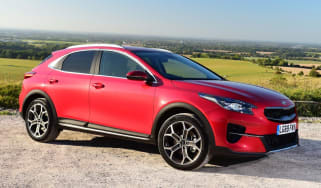
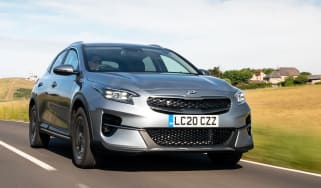
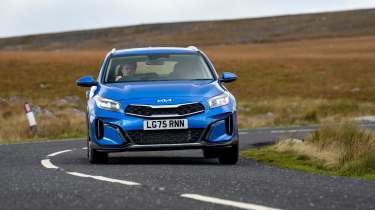
To achieve a rugged look, the Kia XCeed sits higher than the (now defunct) Ceed hatchback on which it’s based. This is thanks to a 20mm boost in ride height and larger-sidewalled tyres.
The Xceed is fitted with softer springs along with hydraulic bump stops, both of which help to provide a smoother, more pliant ride than its former sibling.
| Model | Power | 0-62mph | Top speed |
| XCeed 1.0T GDi Pure | 113bhp | 11.9 seconds | 113mph |
| XCeed 1.0T GDi GT-Line DCT | 113bhp | 12.2 seconds | 113mph |
| XCeed 1.6T GDi GT-Line S DCT | 177bhp | 8.5 seconds | 130mph |
Performance, 0-60mph acceleration and top speed
The XCeed’s engine line-up has been trimmed down over the years to just two petrol options, with the majority of the range being powered by a 1.0-litre unit connected to either a six-speed manual or a seven-speed dual-clutch automatic transmission. All XCeeds are front-wheel drive, and the 1.0-litre models produce 113bhp and 200Nm of torque. This returns a 0-62mph time of 11.9 seconds in the manual and 12.2 seconds in the automatic. Both are capable of a top speed of 113 mph.
The alternative engine option is a 1.6-litre petrol, but this is exclusively available with the fanciest GT-Line S model. This unit ups the power to 177bhp and 265Nm, which then shaves the 0-62mph sprint down to 8.5 seconds, and increases the top speed to 130mph. While crossovers are seldom regarded as performance machines, those in a particular hurry may want to look towards the electric Smart #3 instead, because this can reach 62mph in as little as 3.7 seconds if you choose the Brabus version.
Town driving, visibility and parking
Thanks to its hatchback underpinnings, the XCeed feels pretty nimble when darting around town. Narrower streets aren’t too much of a concern, and forward and sideways visibility are both fine. We did have the occasional issue seeing whatever was behind us because the rear windscreen is small. Every variant gets rear parking sensors and a reversing camera as standard, which does make slotting into a space easier. The camera’s resolution isn’t the clearest, though.
Country road driving and handling
While it’s set up to be calm and relaxing on the move, the XCeed is reasonably good to drive in the twister stuff. Few lumps and bumps are allowed to intrude into the cabin. There’s some body roll in the corners, but this means the XCeed is pretty easy to read when you’re getting close to the limit when driving quickly. The electric power steering system feels accurate and well-weighted.
Motorway driving and long-distance comfort
Thanks to its reasonably soft suspension setup, the XCeed settles down nicely on flowing roads and motorways, making it ideal for covering long distances.
When up to speed, there’s a bit of tyre and wind noise to be heard within the XCeed’s cabin, but it certainly isn’t enough to cause any headaches.
“Kia’s Six–speed manual shifts through the gate nicely enough, but the clutch pedal is light and the biting point is vague, so it’s hard to move away cleanly.” - Dean Gibson, senior test editor.
MPG & running costs
Pros |
|
Cons |
|
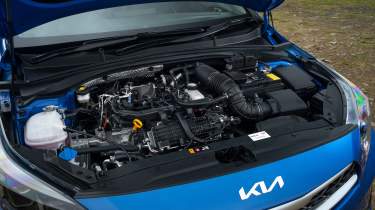
The XCeed’s mid-life facelift added more than just cosmetic exterior changes and upgraded on-board tech, because there were aerodynamic improvements to help reduce drag and reduce fuel consumption.
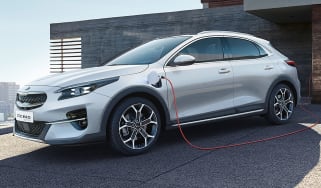
With the plug-in XCeed now a thing of the past, it’s the 1.0-litre models that offer the best efficiency. This engine can return up to 47mpg on the WLTP combined cycle, although this drops slightly to 46.3mpg if you opt for the automatic transmission. Emissions range from 135 to 140g/km depending on your chosen gearbox and trim level.
The 1.6-litre shouldn’t prove to be a massive drain on your finances, because this claims a pretty reasonable 42.1mpg. Emissions aren’t too much higher either, at 152g/km.
| Model | MPG | CO2 | Insurance group |
| XCeed 1.0T GDi Pure | 47mpg | 135g/km | 11 |
| XCeed 1.0T GDi GT-Line DCT | 50.4mpg | 139g/km | 11 |
| XCeed 1.6T GDi GT-Line S DCT | 44.8mpg | 144g/km | 12 |
Insurance groups
Regardless of its somewhat beefy appearance, the Kia XCeed sits in insurance groups that befit a small car. The entire line-up ranges between groups 11 and 12 (out of 50), which is a similar situation to the Toyota Yaris Cross (groups 11 to 14) and a little bit lower than the Skoda Kamiq (groups 12 to 20).
The electric Smart #3 is in a whole different (and more expensive) league, though, residing in groups 33 to 41.
Tax
A lack of electrification means no company car tax savings for XCeed drivers. However, while owners will have to pay the usual annual vehicle excise duty (VED), they’ll manage to avoid the luxury car tax because even the most expensive GT-Line S sits well below the £40,000 mark.
Depreciation
Our valuation data shows that the Kia XCeed puts on a pretty average performance in terms of its residual values. After three years or 36,000 miles, this crossover is expected to retain 42 per cent of its original value, regardless of spec. This means the Skoda Kamiq is a slightly stronger investment at 46 to 48 per cent after the same length of time. The Toyota Yaris Cross wipes the floor with both of its rivals here, though, at 48 to 53 per cent.
To get an accurate valuation on a specific model check out our free car valuation tool...
Interior, design & technology
Pros |
|
Cons |
|
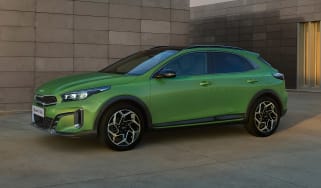
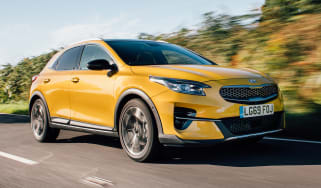
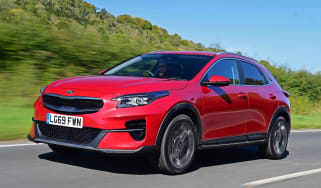
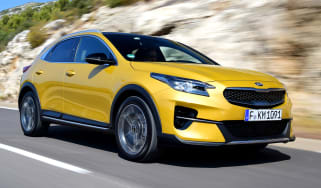
Kia has a good reputation for producing well-made cars with quality interiors, and their exterior designs have become a lot more eye-catching in recent years. The XCeed’s coupe-like lines and jacked-up suspension are still on-trend, even if the car has been with us for quite a while.
Interior and dashboard design
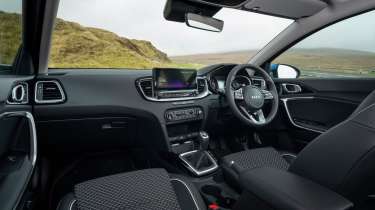
Inside, there’s a general feel of common sense about the cabin design, and that’s a good thing. The dashboard is clearly laid out, and the 10.25-inch infotainment screen sits high on the dash. This is also accompanied by a 12.25-inch digital driver’s display if you opt for the range-topping GT-Line S.
One of the biggest advantages of the XCeed’s advancing age, though, is a plethora of good old-fashioned buttons that can be operated without taking your eyes off the road.
Materials and build quality
While it’s not quite as plush inside as some of Kia’s EVs, the XCeed does at least feature good-quality plastics that are firmly screwed together. We think the interior generally feels like it’s up to the task of enduring plenty of miles and daily family use, but the Skoda Kamiq also does this while feeling just a tad more upmarket.
Infotainment, sat-nav and stereo
Kia’s tried-and-tested infotainment system features here and is still one of the better systems around; intuitive to use and packed with plenty of desirable features. Android Auto and Apple CarPlay connectivity come standard, and it’s all displayed on a 10.25-inch screen that's now standard in every car (it was originally an upgrade). Fancier features like wireless phone charging and an eight-speaker JBL Audio system are added as you move up through the trim levels.
“One area where the XCeed is streets ahead of many rivals is in terms of the infotainment tech. Kia hasn’t done anything radical here but you get a large, clear screen, a main menu page with two rows of icons, logical sub-menu structures and decent loading times.” - Dean Gibson, senior test editor.
Boot space & practicality
Pros |
|
Cons |
|
The XCeed is spacious enough for a car in the crossover class. The cabin has good-sized door bins, a mobile phone cubby ahead of the gear lever and two cupholders in the centre console. A larger cubby is located under the centre armrest. Other nods to increased practicality include luggage hooks in the boot, a roof-mounted sunglasses holder and – in top-spec GT-Line S cars – 40:20:40 split-folding rear seats.
Dimensions and size
The XCeed measures in at 1,495mm tall, 1,575mm wide (or 1,826mm including mirrors) and 4,395mm long. It’s about the same size as the Mercedes GLA and exactly the same length as the Mazda CX-30, though its Japanese rival is wider at 1,795mm, minus mirrors.
| Dimensions comparison | |||
| Model | Kia XCeed | Skoda Kamiq | Toyota Yaris Cross |
| Length | 4,395mm | 4,241mm | 4,180mm |
| Width | 1,826mm | 1,793mm | 1,765mm |
| Height | 1,495mm | 1,534mm | 1,595mm |
| Wheelbase | 2,650mm | 2,650mm | 2,560mm |
| Boot space | 426 litres | 400 litres | 350 litres |
Seats & passenger space
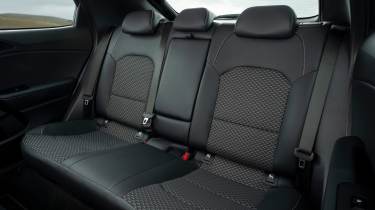
Despite the XCeed’s SUV-inspired looks, the difference in front and rear passenger space is much more like what you'll typically find in a hatchback. Space is still respectable, with enough room for four adults to sit in decent comfort, or five at a slight squeeze. Comfort in all seats is good, with plenty of support and adjustability, especially in higher-spec models. Isofix points feature on the outer rears, while these are also heated in top-spec GT-Line S cars.
Boot space
The XCeed’s boot stands at 426 litres with the rear seats in place. Fold them down (60:40 as standard, 40:20:40 on the GT-Line S), and this increases to a total of 1,378 litres. For comparison, the Mazda CX-30 has 430 litres with the seats up and 1,406 litres with them folded, although these figures include underfloor storage.
Towing
The axing of diesel and plug-in hybrid power has ultimately reduced the Kia XCeed’s towing ability. The 1.0-litre petrol models can tow up to 1,010kg braked, while the larger 1.6 can take on up to 1,410kg. This means the 1.6 is a better tow car than most crossovers, as the Toyota Yaris Cross and Skoda Kamiq are only able to take 1,100kg at most.
“The rising window line means the view out isn’t great, and that could be key for little ones. And if your little ones aren’t so little, they’ll find knee and foot space in the back okay, but not overly generous.” - Steve Fowler, former Auto Express editor.
Reliability & safety
Pros |
|
Cons |
|
The XCeed is packed with active safety kit, with lane-keeping assist, automatic emergency braking, hill-start assist, traffic-sign recognition and cruise control all fitted as standard. Top-spec GT-Line S models get the full complement of systems, including an Intelligent Speed Limit Warning function and a blind-spot collision warning.
Euro NCAP hasn’t tested the XCeed individually, but the closely related Ceed hatch scored a full five stars when fitted with its optional safety pack. It’s a pretty sure bet that the XCeed would perform just as well. However, due to the Ceed being tested back in 2019, its rating has now expired due to NCAP’s increasingly stringent testing criteria.
The Xceed hasn’t appeared in the Driver Power survey for quite a long time, but the Kia brand only managed an 18th-place finish on a list of 31 brands. This placed it behind a number of key rivals, including Skoda (12th), Nissan (15th), Suzuki (9th) and Vauxhall (4th). Kia did at least outshine its own sibling, Hyundai, as this brand only managed 20th place.
| Euro NCAP safety ratings | |
| Euro NCAP safety rating | Five stars (Kia Ceed - 2019, expired) |
| Adult occupant protection | 88% |
| Child occupant protection | 85% |
| Vulnerable road user protection | 52% |
| Safety assist | 68% |
Buying and owning
- Best buy: XCeed 1.0T GDi GT-Line
Opting for the mid-spec GT-Line will bag you some very useful extra kit without forking out a ridiculous amount of extra cash. You can only have the 1.0-litre engine with this spec, but we’d stick with the manual unless you’re only able to drive an automatic.
Kia XCeed alternatives
There’s a fine line between crossover cars and small SUVs, so the Kia XCeed essentially faces two sets of rivals. They’re both fierce sectors, too, with the Skoda Kamiq, Toyota Yaris Cross and Subaru Crosstrek representing the former camp, while the Ford Puma, Renault Captur, SEAT Arona and Hyundai Kona are just a handful of top-selling options from the latter.
Of course, there are also a growing number of electric XCeed competitors to look towards, too, including the Smart #3, Volvo EX30, Hyundai Kona Electric and even the Kia EV3.
Frequently Asked Questions
Kia offers an industry-leading warranty on all of its cars that provides seven years and 100,000 miles of coverage.
Deals on the XCeed and alternatives