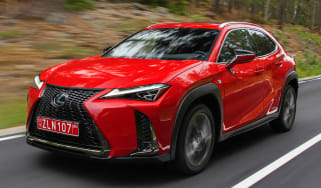
Lexus UX review
The Lexus UX hybrid is good to drive, economical and should be easy to live with, too

Our opinion on the Lexus UX
The Lexus UX is an interesting alternative to the best compact SUVs you can buy. The styling is daring and different, the interior is finished to the usual Lexus high standards, and it’s likely to be reliable and efficient enough to not cost loads to run.
But, the UX doesn't really stack up as an overall package. Rear cabin space isn't great, for example, which might be a concern for family buyers. Plus the hybrid models won't win over many business users, because their CO2 emissions aren't as competitive as those of plug-in rivals, and in some areas the car is starting to show its age.
The fully electric UX 300e is no longer an option either, although its range and charging speeds were a long way off the pace by the time it was removed from the line-up.
About the Lexus UX
Lexus practically invented the premium crossover when it launched the RX in 1998, but the luxury brand was a little late to the compact SUV party and slow to get an EV into its showrooms. The company launched its NX back in 2014, followed by the UX three years later, and three years after that, production of its first-ever electric car – the UX 300e – finally started.
Used - available now


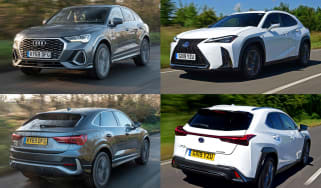
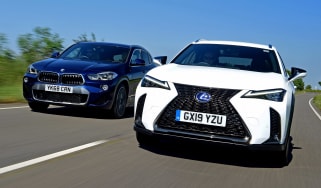
Sitting between the Lexus’ entry-level model, the LBX, and the NX, the UX goes head-to-head with the likes of the Mercedes GLA, BMW X1, Audi Q3, Alfa Romeo Tonale and Volvo XC40. But with a coupe-like profile and sporty driving characteristics, its closest rival is arguably the BMW X2 - which the Lexus beat in a twin test in the BMW’s previous generation.
Based on an adaptation of Toyota’s TNGA platform (called GA-C by Lexus), the UX shares its underpinnings with the Toyota Prius and Toyota C-HR. Powering the Lexus is Toyota’s venerable 2.0-litre petrol-electric hybrid system that sends power to the front wheels, and just one model is available. Badged 300h, it replaced the old 250h, bringing improvements in power and efficiency in 2024. There used to be a four-wheel-drive “E-Four” variant, but this has now been axed from the range, as has the all-electric UX 300e.
Lexus UX prices and latest deals
Compared with its rivals, the UX was pretty pricey in its now-discontinued all-electric UX 300e guise, costing up to £57,000 in its highest specification. But right now, the UX is a bit cheaper, thanks in part to only being offered as a hybrid.
You’ll pay £38,095 for the entry-level Premium model, with the £38,595 F Sport Design sitting above it. On top of these are the £40,195 F Sport Design Tech and £45,395 F Sport models, before you get to the range-topping £49,495 Takumi, which ditches the F Sport’s bodykit and reverts to the Premium’s exterior look while adding a fancy sound system and extra technology.
You can save when you spec your ideal Lexus UX through the Auto Express Buy a Car service. We also have a selection of UX leasing deals, as well as used Lexus UX models in stock and ready to go.
Performance & driving experience
Pros |
|
Cons |
|
The UX 300h features an Atkinson-cycle 2.0-litre four-cylinder petrol engine that’s mated to an electric motor. Power goes solely to the front wheels and a small battery, which is charged by both regenerative braking and the petrol engine, can provide electric-only driving for short distances and at speeds up to 71mph.
The all-wheel-drive E-Four version that used to be on sale had an additional electric motor, which in low grip situations could supply 7bhp and up to 55Nm of torque to the rear wheels.
| Model | Power | 0-62mph | Top speed |
| Lexus UX 300h | 196bhp | 8.1 seconds | 110mph |
Performance, 0-60mph acceleration and top speed
Rivals including the BMW X1 and Audi Q3 have the option of more powerful and faster plug-in hybrid variants, but the UX 300h is more than quick enough for a small SUV. The Lexus’ CVT automatic transmission – so often a party-pooper – keeps the usual surge in revs to a minimum and is actually a positive aspect of the UX. The changeover between the electric motor and petrol engine is seamless, while the power delivery is smooth.
Town driving, visibility and parking
A consistent brake feel, clear throttle response and decent visibility from its higher-riding crossover bodystyle, plus predictable steering, mean the UX 300h is a doddle to drive smoothly around town. No matter the specification, whether you go for the larger wheels or even the Takumi’s adaptive dampers, you won’t find yourself having to dodge potholes or drain covers. It’s surprisingly nimble too – its 10.4-metre turning circle is over a metre tighter than all of its German rivals.
Country road driving and handling
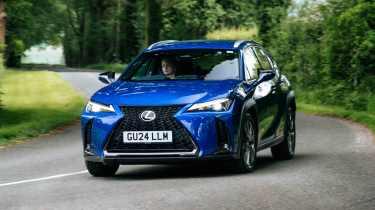
Choose the F Sport variants of the UX 300 and the ride is a little firmer than you’d expect from a Lexus. That’s because the F Sport gets stiffened suspension and partly as a result there’s a un-Lexus-like level of driver engagement with tight body control, and its 300h powertrain is punchy enough to play its part - even if it doesn’t make a terribly nice noise.
The steering is well weighted and direct thanks to the steering rack being mounted directly to the subframe, without the need for rubber bushes. This reduces vibrations and flex, delivering a level of steering sharpness largely absent from models in this segment.
Motorway driving and long-distance comfort
When the acceleration isn’t wanted, the way the UX settles down to a refined and comfortable cruise is equally impressive. The all-electric UX 300e was the go-to if you wanted excellent refinement, but the hybrid’s engine isn’t exactly vocal either.
There’s no ‘sound insulated glass’, but it doesn’t take long behind the wheel to notice Lexus has done a great job of sound proofing against wind and road noise. As a result, the UX certainly feels more substantial than its Lexus and Toyota siblings that sit on the same platform. One aspect that isn’t so good is the UX’s lane-keeping assist; it’s an old system and can bounce the car from one white line to the other on a narrow road.
“On the road, the latest fifth-generation parallel hybrid system feels exceptionally well calibrated, with the electric motor doing most of the grunt work at town speeds, which has the added benefit of keeping the powertrain smooth and silent. Ask for more performance and response from the overall powertrain is good, with the petrol motor coming on stream seamlessly.” - Jordan Katsianis, News Editor.
MPG & running costs

Pros |
|
Cons |
|
The Lexus UX 300h is called a self-charging hybrid, which means you never need to connect it to a charging point, with electricity for the battery being generated during regular driving. The flip side is that you shouldn’t expect the same high levels of fuel efficiency promised by a plug-in hybrid like the BMW X1 xDrive 30e; the realistic all-electric range of the 300h is limited to just a couple of miles.
As for emissions, Lexus claims that the UX will emit at least 113g/km, rising up to 119g/km for the range-topping Takumi.
| Model | MPG | CO2 | Insurance group |
| Lexus UX 300h | 56.4mpg | 113g/km | 25 |
Insurance groups
A long list of active and passive standard safety features helps contribute to the reasonable insurance rankings of the hybrid UX, which start in group 24 for the entry-level Premium version and rises to 30 for the priciest F Sport Takumi. That’s pretty much the same as the BMW X1, which starts in group 24, but rises much higher for plug-in hybrid and the all-electric iX1.
Tax
Despite having relatively good CO2 figures compared with a traditional petrol or diesel car, the hybrid 300h won't be overly attractive to company car drivers, due to the UX's 28-30 per cent Benefit-in-Kind (BiK) tax rate.
Only the Premium and F Sport Design versions of the UX 300h sit below £40,000 so if you opt for a higher-trimmed model, then you’ll have to pay the luxury car tax. This means the total road tax is £620, paid every year until the car is six years old.
Depreciation
The entry Premium UX 300h model is the strongest performer in terms of residual values, keeping around 50 per cent of its value over a typical three-year/36,000-mile ownership period; the priciest F Sport Takumi will only retain 39 per cent over the same time. For comparison, the BMW X1 retains its value better, maintaining between 49 - 55 per cent of its original value.
When it was on sale, the electric 300e had the combined issue of being both the most expensive UX, and the version that lost the most value. At the time, our expert data predicted the priciest Takumi trim will only hold on to 32 per cent of its value, which is especially painful when it costs over £57,000. Even the most affordable £47,500 base version will keep just 34 per cent of its value over the same period.
"On our course of mixed town and dual-carriageway driving, we managed to top the claimed MPG figures quite substantially, cracking nearly 60mpg in the standard ‘Comfort’ driving mode. Faster motorway driving isn’t this powertrain’s most efficient arena, but even so 50mpg+ will easily be on the cards." - Jordan Katsianis, news editor.
Interior, design & technology

Pros |
|
Cons |
|
When the UX was last updated in 2024 with the addition of the 300h powertrain, exterior styling revisions were largely absent, with only a few new colour options inside and out as well as painted arch surrounds on higher-grade models.
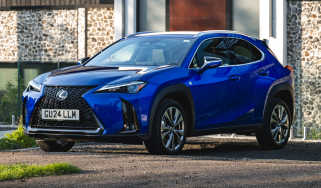
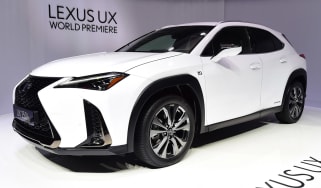
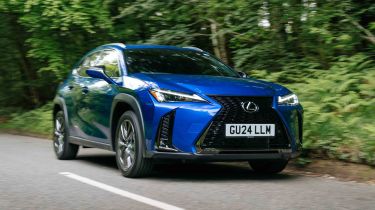
Despite this, the UX is still one of the more handsome crossovers on sale, with Lexus’ ‘spindle’ grille at the front, sporty creases in the body and a purposeful stance.
The standard-fit 17-inch alloy wheels feature an aerodynamic design to reduce wind resistance and increase airflow, although non-aero 18-inch alloys are available on higher-trim models. Ten paint colours are offered in the UK, including a couple developed exclusively for this country: Terrane Khaki and Celestial Blue. The car looks particularly striking in solid red or metallic blue, but we wonder how many buyers will take this bold approach. Five of the metallics are a £250 option.
Interior and dashboard design
The Lexus UX originally had a 10.3-inch screen on the dash controlled by a touchpad in the centre console. A touchscreen did away with this set up later on in its life, but it’s not as well integrated as the older display.
The seats are available trimmed in fabric, leather or a combination of the two. There are also five colours to choose from: black, grey, beige or ‘hazel’ with an eye-catching red and black colourway reserved for the F Sport.
In a first for Lexus, the instrument panel can be finished in a trim inspired by the grain of Japanese ‘washi’ paper. According to Lexus, this creates a ‘calm and warm’ feeling.
Materials and build quality
There’s a rich quality to the interior that helps the UX stand out in an overcrowded segment. Lexus has worked hard to give the car the feel of its larger saloons and SUVs, adding little touches to give the UX showroom appeal.
For example, the three-spoke steering wheel and analogue clock are lifted from the old Lexus LS luxury saloon, while the engineers used brainwave analysis to produce what they claim is the “perfect door-closing sound”. Lexus has even worked hard to reduce the noise and juddering of the electric windows.
Infotainment, sat-nav and stereo
The UX's infotainment is a similar design to that used in a variety of Lexus and even Toyota models. The central screen has a neat enough layout, but the driver’s display is cluttered and looks dated now.
There's an 8.0-inch screen in Premium models, while F Sport and above get the larger 12.3-inch display. Compared to rivals, the small screen looks especially dinky these days, so just to make reading the sat-nav easier, we’d recommend choosing the larger unit.
All versions of the UX come with wireless Apple CarPlay and Android Auto connectivity. Only the Takumi model gets the 13-speaker Mark Levinson sound system, but it’s a fantastic addition if you’re an audio fan.
The layout of buttons on the steering wheel is very easy to use while driving, as is the bank of controls in the middle of the dash for the climate; the LCD temperature displays are almost retro now.
Boot space & practicality

Pros |
|
Cons |
|
The Lexus UX doesn’t present an entirely convincing case as a serious family car, and it seems as though it was predominantly designed with front seat passengers in mind. It feels more like a raised hatchback because you sit down into it, instead of climbing up like you might in a high-riding SUV. A lower driving position may appeal to some, while others might prefer a higher perch that allows you to look down on other motorists.
Dimensions and size
At 4,495mm in length, 2,078mm wide with mirrors (but 1,840mm without them) and up to 1,540mm tall, the UX is slightly longer and taller than the BMW X2 but a touch narrower.
The UX is a little longer than a Volvo XC40, but it isn’t quite as wide or tall. This means that the XC40 is bigger inside for passengers and has a larger boot.
| Dimensions comparison | |||
| Model | Lexus UX 300h | BMW X1 | Audi Q3 |
| Length | 4,495mm | 4,500mm | 4,531mm |
| Width | 1,840mm | 1,845mm | 1,816mm |
| Height | 1,540mm | 1,642mm | 1,662mm |
| Wheelbase | 2,640mm | 2,692mm | 2,828mm |
| Boot space | 320 - 1,231 litres | 500 - 1,545 litres | 520 - 1473 litres |
Seats & passenger space
The footprint of the Lexus UX is very similar to rivals from BMW and Audi, but its profile is more of a coupe-SUV, meaning interior space is tighter.
The driver and front-seat passenger get the best deal in the UX, with loads of headroom and a pleasant feeling of being cocooned behind the wraparound dashboard.
In the back, headroom and legroom would be best described as adequate, with the low-set seats managing to offset the effects of the sloping roofline. Passengers should avoid the middle seat, because it sits higher than the outer rear seats and space for feet and knees is compromised by a centre console that encroaches into the rear. Two Isofix points are provided on the outer rear seating positions.
The main issue for those in the back of the UX is that it’s not as spacious and airy as a more conventionally styled SUV, with the narrow rear windows creating a claustrophobic feeling. Bizarrely, there are also no door bins in the back.
Boot space
Both front and four-wheel drive versions of the 300h have the smallest boot size at 320 litres, which is significantly less than its BMW and Audi rivals, which can take over 500 litres.
Surprisingly, the fully electric UX 300e has the largest boot with all seats in place – it is claimed to be able to swallow 367 litres of cargo.
There’s only a 60:40 folding rear bench too, so if you’re after a more flexible premium small SUV, the BMW X1’S 40:20:40 split-folding rear bench will be more appealing.
Towing
Hybrid Lexus UX models have a braked and unbraked towing capacity of 750kg – less than some versions of the Vauxhall Corsa. The UX might be fine for transporting garden rubbish to the tip, but this isn’t an SUV for towing a caravan or boat. As for 300e variants, it isn’t rated to tow anything, so you’ll be better off looking towards the Volvo EX30, which has a 1,600kg towing limit.
Reliability & safety

Pros |
|
Cons |
|
The Lexus UX received the maximum five-star rating from safety experts Euro NCAP in 2019. All models are equipped with eight airbags and the Lexus Safety System+, consisting of autonomous emergency braking with pedestrian protection, adaptive cruise control, lane-keep assist, lane-departure alert, and road-sign assist.
It’s an impressive package, with the UX offering a semi-autonomous mode in stop-go traffic at speeds of up to 18mph. You can also set the cruise control to obey the speed limits posted on road signs.
Reliability isn’t likely to be an issue, with Lexus still ranking highly according to the latest Driver Power customer satisfaction survey. The brand finished in third place out of 31 manufacturers, ahead of Audi in 19th and BMW in eighth, but below Mercedes in second place. The UX was in 38th place out of 75 cars in the 2023 Driver Power best cars to own survey, though it didn’t feature in the latest survey.
| Euro NCAP safety ratings | |
| Euro NCAP safety rating | Five stars (2019/expired) |
| Adult occupant protection | 96% |
| Child occupant protection | 85% |
| Vulnerable road user protection | 82% |
| Safety assist | 77% |
Buying and owning
The UX’s current infotainment system removes one of our biggest issues with the older version, but even that is looking old now. We’d still opt for the F Sport to ensure you get the larger screen, wireless smartphone charger and tinted windows, but the body kit is a nice extra too. Throw in the fact you won’t have to pay the luxury car tax of the slightly more expensive F Sport Design Tech and it seems like the sensible choice too.
Lexus UX 300h alternatives
Even before you get to the usual German options, there are loads of alternatives to the UX. Starting within the Lexus stable, the LBX comes with a classy cabin, efficient hybrid technology and costs far less than the UX with a similar amount of interior space. Then there’s the new second-generation Volkswagen T-Roc, which will soon get a new full-hybrid powertrain.
The BMW X1 and its coupe-SUV X2 sibling remain solid competitors though the latest batch don’t have the best build quality and aren't as superior to drive as they once were. The Audi Q3 was renewed in 2025 and comes with the firm’s latest style of interior and infotainment plus some impressive PHEV options.
Frequently Asked Questions
All Lexus UX models are covered by just a three-year/60,000-mile warranty. However, with the Lexus Relax warranty, every time you service your vehicle at a Lexus Centre, a 12-month warranty is included for up to 10 years or 100,000 miles, whichever comes first.
As standard, the hybrid system is covered by a separate warranty of up to five years/60,000 miles, but this can be extended to 10 years/100,000 miles. After that, you can get a one-year or 10,000-mile warranty as part of a Hybrid Health Check service every time you go in for annual franchised dealer servicing. You can continue to do this until the car reaches 15 years old.