Alfa Romeo Junior review
The Alfa Romeo Junior is the brand's smallest SUV, and it aims to woo buyers looking for some sporty fun

Our opinion on the Alfa Romeo Junior
The Alfa Romeo Junior is by far and away our favourite of the Stellantis collection of small SUVs based on the CMP platform. It possesses that familiar Italian flair, while the sporty-looking cabin features decent technology and some interesting design touches. It’s also got a decent-sized boot.
The electric versions can actually be engaging to drive, too, with steering, road-holding and a playful nature that will appeal to Alfa fans, even if the powertrain isn’t quite on-brand. However, while the hybrid Junior Ibrida is available at a fairly competitive price, it’s less impressive to drive. That would be OK for most other cars in this segment, but not one wearing an Alfa Romeo badge.
About the Alfa Romeo Junior
What’s in a name? Well, in the case of the Alfa Romeo Junior, quite a lot more than for most new cars. The very stylish and suitably dramatic-looking small SUV was meant to be called Milano and was unveiled with that name in April 2024, but the plan had to be hastily, and slightly awkwardly, changed when the Italian government’s ‘Made in Italy’ rules forced the brand to choose something slightly less patriotic.
This is because the car isn’t manufactured in Alfa’s home country, but in the same Polish factory that also produces the Fiat 600 and Jeep Avenger. So the decision was made to revive the Junior name previously used on the iconic Alfa GT Junior coupe in the sixties and seventies.
Used - available now

2024 Alfa Romeo
Junior
2,221 milesAutomaticPetrol1.2L
Cash £21,500The Junior is Alfa’s first EV, and when the covers were pulled back, it looked like the UK would only get the pure-electric versions. However, a hybrid powertrain was soon added to the line-up. This widened the baby SUV’s appeal and slashed its starting price.
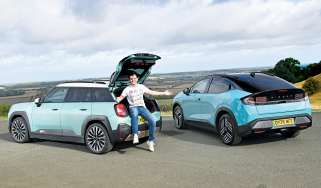
We tested the Junior against the MINI Aceman in a twin test to determine which distinctive SUV is the very best buy. The Italian option beat back its competitor and took the win thanks to its superior driving experience and unique personality.
Alfa Romeo Junior prices and latest deals
Prices for the Alfa Romeo Junior start from just under £28,000 for the hybrid version, officially called the Junior Ibrida, which, rather surprisingly, is more than £3,000 less than a like-for-like version of the Peugeot 2008. Although all that really does is highlight how overpriced its French cousin is.
The zero-emissions Junior Elettrica starts at nearly £34,000 and gets the same amount of kit as the Ibrida. Sitting pretty at the top of the EV range is the Junior Veloce, which swaps the standard 154bhp electric motor for a 276bhp unit with a limited-slip differential (LSD), upgraded front brakes, lowered suspension, and other chassis tweaks. All those changes raise the price to more than £42,000.
If you’d like to save on your next car, you can build your perfect Alfa Romeo Junior through the Auto Express Buy a Car service. Prefer to pay for a car in monthly instalments? We also have plenty of Junior leasing deals to choose from.
Performance & driving experience
Pros |
|
Cons |
|
Most small-SUV buyers want something that’s good to drive around town, is comfortable on the motorway and easy to live with. But of course, this is an Alfa Romeo, and while that might not mean much to some customers, certain individuals will have high expectations of the car on twisty B-roads or mountain passes.
| Model | Power | 0-62mph | Top speed |
| Junior Ibrida | 143bhp | 8.9s | 128mph |
| Junior Elettrica | 154bhp | 9.0s | 93mph |
| Junior Veloce | 276bhp | 5.9s | 124mph |
Performance, 0-60mph acceleration and top speed
The Junior Ibrida features the same 48-volt mild-hybrid system that’s available in various Jeep, Peugeot, and Vauxhall models. The 1.2-litre three-cylinder PureTech petrol engine works with a 28bhp electric motor that’s built into the car’s six-speed dual-clutch automatic gearbox. The e-motor provides a small power boost, and allows for pure-electric driving at low speeds, such as when you’re pottering around town.
Total output for the Ibrida is rated at 143bhp and 230Nm of torque; that’s enough for 0-62mph in 8.9 seconds, although it feels a lot slower in the real world. Put your foot down and there’s a delay in the throttle response while the hybrid system gets itself together. Once that happens, you get a good initial shove courtesy of the e-motor, and at low revs the engine delivers a deep and pleasant note. But that soon gives way to a dull drone as the revs rise.
You’re stuck listening to it for quite a while, because the Junior Ibrida slowly accelerates – and that’s when the road is flat. When trying to climb up into the hills outside Turin, we found the car felt underpowered; on more than one occasion, we had our foot to the floor, yet the Alfa didn’t gain any speed.
There’s no such issue in the Junior Elettrica, which uses a front-mounted motor producing 154bhp and 265Nm of torque. Some modern EVs have caused us to rein in our expectations of performance in this segment, and on paper, the nine seconds it takes the Junior to cover the 0-62mph dash is behind plenty of the competition. But in reality, it’s more than enough for the average compact SUV buyer.
If you want real excitement, the Junior Veloce is the model to go for. It features a 276bhp electric motor and a Torsen mechanical limited-slip differential (inspired by the one on the mid-2000s Alfa Romeo 147 Q2, no less) to help get power to the road. While rivals such as the Smart #3 and MG4 provide some rear-wheel-drive fun that feels like a happy accident, the Junior Veloce drives much more in the manner of a serious, traditional front-driven hot hatch.
The electric motor’s output in the Junior Veloce is pretty substantial, too, producing 276bhp and 345Nm of torque for a 0-62mph time of 5.9 seconds. Floor the throttle in Dynamic mode, and you'll feel some torque steer, but not so much that you have to wrestle with the wheel; the power still feels accessible, and the augmented engine sound enhances the experience. Alfa has done a great job here, making it not too intrusive yet familiar enough to keep you engaged.
Town driving, visibility and parking
Around town, there’s an underlying firmness to the Junior’s ride. Rather than being as unnecessarily harsh as the MINI Aceman, it’s just enough to feel appropriate for a car built by a sporting brand such as Alfa Romeo. The throttle pedal is fairly smooth and easy to modulate, but we’re not fans of the brakes. The left pedal’s action is soft and spongy; while the overall stopping power was fine, it still didn’t give us much confidence.
Driving the Junior Ibrida in town, we had to be very delicate with the throttle to continue getting around silently using only the electric motor. A touch too much throttle input, and the petrol engine comes to life, while slowing down to a complete stop feels jerky. To get the best out of the hybrid version, you have to adopt a smoother driving style and a gentle approach to the throttle.
Country road driving and handling
For the most part, the Junior can settle into a pleasing flow along a back road, rather than one that you’ll relish taking for a Sunday morning blast. The steering is a highlight of the baby Alfa. It’s precise and well weighted, if not quite as sharp as the set-ups in its bigger range mates, the Alfa Romeo Giulia and the Alfa Romeo Stelvio. But this seems appropriate for how the chassis responds.
The Junior is hefty for a small car, but it’s lighter than many other electric rivals, so although the Alfa Romeo doesn’t feel agile as such, it’s certainly not as flat-footed as some of the competition. The thick A and B-pillars restrict your view out, but the compact dimensions and bonnet cowls make it easy to place the Junior on the road.
The Junior Veloce takes things up several notches by adding not just the more powerful e-motor and limited-slip differential, but also a faster steering ratio, retuned dampers, four-piston brake calipers on the front, and very aggressive camber on the 20-inch wheels at both ends, which are wrapped in wider 225-section Michelin Pilot Sport EV tyres.
All these upgrades come together to create a very entertaining driving experience that is especially impressive when you’re pushing the limits. It’s almost hard to believe that this car is so closely related to the decidedly bland Vauxhall Mokka.
The Veloce feels incredibly grippy at the front, and you can feel the differential working as it drags the car out of tight corners without a hint of understeer. In Dynamic mode, the traction control stays out of your way for the most part and will allow you to have fun on the twisty stuff. The relatively low kerbweight of 1,560kg also means the Veloce can be chucked around with rapid steering inputs and still maintain composure.
As you’d expect, the ride is firm and can become very bouncy over uneven road surfaces, but the Veloce isn’t uncomfortable, nor does it feel like it's crashing into potholes. In fact, the car feels more lively as a result.
Once again, the Junior Ibrida proves to be the couch potato of this family. It moves around a lot over uneven surfaces, which makes the car feel nervous and unsettled through corners, and doesn’t instil confidence behind the wheel. Try to accelerate out of a corner, and the overly eager traction control attempts to halt proceedings.
However, we’re grateful the Junior Ibrida isn’t any faster, because of the poor brakes. There is no feel to the pedal until your foot is nearly in the firewall, and you need to apply a lot of force before the car actually starts to slow. Even after a brief session of spirited driving on Italian B-roads, we could hear the brakes squealing and smell how hot they were when we got out.
Motorway driving and long-distance comfort
At motorway speeds, the ride settles down nicely, and the Junior is a fairly composed and capable car on a long-distance cruise. We were very impressed by how quiet the cabin is at high speeds, with very little road or wind noise coming through. In the Junior Ibrida, specifically, the ride is also quite smooth at motorway speeds and does a good job of absorbing the bumps that pepper the Italian autostrada we tested it on.
“The car came into its own on the twisty B-road sections. This is what the Veloce version of the Junior is made for – it handles really well and feels so at home through the bends. And when we did encounter a slow-moving vehicle on the country roads, the Alfa’s quick acceleration made it easy to pass them.” - Dawn Grant, pictures editor.
MPG & running costs
Pros |
|
Cons |
|
We’re incredibly familiar with the Junior Ibrida’s mild-hybrid powertrain, because it’s found not just in the Vauxhall Mokka and Jeep Avenger based on the same platform, but also much larger cars, including the Vauxhall Grandland and seven-seat Peugeot 5008.
As we mentioned, the 1.2-litre petrol engine is assisted by a 28bhp e-motor that allows for short periods of pure-electric driving. It’s powered by a 0.9kWh 48-volt battery located underneath the driver’s seat and topped up by regenerative braking, meaning you never have to worry about plugging the car in anywhere.
Alfa Romeo claims the hybrid set-up can return up to 58.8mpg, but we averaged just over 37mpg during our own testing, which involved driving on the motorway and through towns, plus some sprinted bursts in the Italian countryside.
| Model | MPG | CO2 | Insurance group |
| Junior Ibrida | 58.8mpg | 110g/km | 26 |
Electric range, battery life and charge time
While the electric motor and battery in the Junior Elettrica have been used in other Stellantis products, Alfa Romeo has made its car lighter than competitors', at 1,560kg (1,545kg in Veloce form), resulting in impressive efficiency figures.
Our long-term Alfa Romeo Junior Veloce returned a steady 3.6 miles per kWh average during the cooler winter months after a mixture of driving conditions, including plenty of motorway journeys.
For comparison, we ran a mechanically similar Peugeot E-2008 on our long-term test fleet, and averaged 4.1mi/kWh in warmer and more urban conditions. Even so, that figure for the Peugeot throws up a real-world range of 209 miles, which still isn’t outstanding and is some way short of the official 255-mile claim.
For roughly £1,000 less than the base Junior Elettrica, the Kia EV3 offers a marginally better range, but for the price of this mid-spec Sport Speciale trim, the EV3’s range climbs to 372 miles – a number which, even in poor weather, gets close to 300 miles in the real world.
The Kia is quicker to charge, too. Although its 128kW maximum rate isn’t exactly outstanding, the figure still comfortably beats the Alfa (100kW). The Junior Elettrica is still slightly quicker than the MINI Aceman, which has a peak charging rate of only 95kW.
As standard, electric versions of the Junior come with an 11kW on-board charger, which will top up the car from zero to 100 per cent in just under six hours. Most UK houses don’t have access to three-phase electricity, so a more typical 7.4kW home wallbox charger should be able to manage the same task in under 8.5 hours.
A quicker charge is available, with 100kW DC charging able to replenish 20 to 100 per cent of the battery in 30 minutes. The battery is covered by a separate eight-year/100,000-mile warranty.
| Model | Battery size | Range | Insurance group |
| Elettrica | 54kWh | 255 miles | 23 |
| Veloce | 54kWh | 208 miles | 34 |
Insurance groups
The insurance rating for the entry-level Junior Ibrida is group 26, which is a little high considering the more powerful 153bhp Ford Puma in high-end ST-Line S trim comes in at group 17. At the even more affordable end of the spectrum is the Renault Captur, which starts in group 11.
The Junior Elettrica sits in group 23, which is better than rivals like the Kia EV3 in group 33, and is on par with the entry-level Skoda Elroq in group 22. The more expensive and considerably more potent Veloce lands in group 34, which is one group lower than the larger 81.4kWh battery version of the EV3.
Tax
You will have to pay the same standard rate of annual vehicle excise duty (VED) as you would do for the Ibrida model, because EVs like the Junior Elettrica are no longer exempt from this.
Fortunately, no version of the Junior Ibrida goes above the £40,000 luxury car tax for petrol, diesel, and hybrid cars, while the Junior Elettrica skirts the revised £50,000 threshold (it comes into effect from 1 April 2026, although it applies retrospectively to cars registered from 1 April 2025) for EVs, so you won’t have to par an additional surcharge on your road tax bill. EVs might end up being subject to an eVED pay-per-mile fee if that comes into force from April 2028 onwards, though.
Depreciation
According to our latest market data, over a typical three-year/36,000-mile ownership period, the Alfa Romeo Junior should maintain 49 to 51 per cent of its original value. That’s much better than the closely related Jeep Avenger that can hold onto 39 to 43 per cent of its sticker price over the same period, while the Vauxhall Mokka only manages 32 to 45 per cent.
To get an accurate valuation on a specific model check out our free car valuation tool...
Interior, design & technology
Pros |
|
Cons |
|
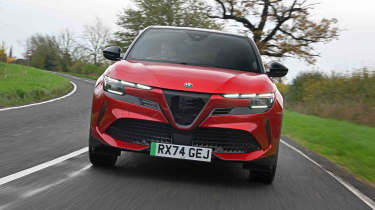
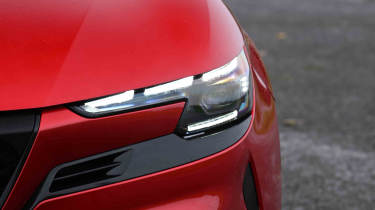
Underneath, the Junior shares the CMP/e-CMP platform with other Stellantis products such as the Vauxhall Mokka, Fiat 600, Peugeot 2008 and Jeep Avenger. However, the design of Alfa Romeo’s small SUV is very distinctive. There’s not much in the way of overhangs at either end, while the distinctive wheelarches and a ‘floating’ roof with a blacked-out rear pillar help to give it a sporty stance. A new form of Alfa’s ‘Scudetto’ shield appears on the grille, and the front end looks aggressive, with angular, bold matrix LED headlights. The rear invokes the iconic ‘Kamm tail,’ in a reference to the legendary Giulia TZ, according to Alfa. Whether or not it’s a successful interpretation is down to personal preference, but it’s certainly eye-catching.
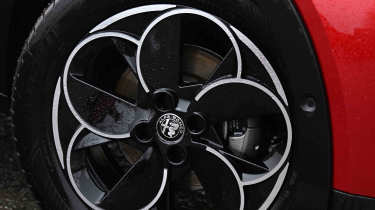
The Junior Ibrida and Elettrica come with an ‘Alfa Romeo’ script on the grille, while the Sport Speciale and Veloce get a more modern ‘Scudetto’ insert with the brand’s emblem. Wheel sizes start at 17 inches, but the Veloce gets a set of lighter 20-inch rims, red brake calipers, red exterior trim accents and a black roof.
Interior and dashboard design
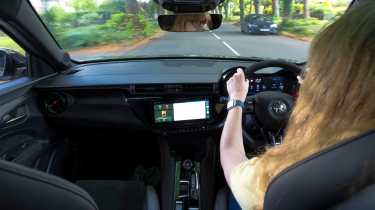
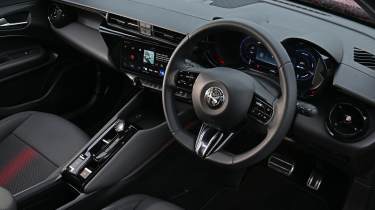
A sporty driving environment is exactly what we hoped for from the Junior, and it’s managed to deliver the goods. The red-and-black theme of the Junior’s cabin feels totally on-brand for Alfa Romeo, while the high centre console and driver-angled dashboard add a feeling of sportiness that few of its rivals can match. The steering wheel is as great to hold as it is to look at, and the subtly glowing Alfa Romeo logos in the round air vents are a neat touch.
One of the first things you notice inside is the Junior’s small steering wheel. It’s not quite as minuscule as the Peugeot i-Cockpit set-up, but it’s an immediate indication of the Junior’s sportier personality. It’s also easy to get comfortable, with a low-slung driving position.
Materials and build quality
It’s just a shame that there are so many parts that have been clearly lifted from other Stellantis products; the starter button, driving modes switch, and drive selector are easy to spot from any number of other Peugeots, Vauxhalls and Jeeps. Even the fonts haven’t changed; it’s something of a letdown in a cabin that otherwise feels fairly special.
You also can’t help but notice the amount of plastic everywhere, particularly the doors that are made of cheap-feeling and scratchy hard plastic, and have almost no padding for your elbows. Worse still, as we drove along in the Junior Ibrida, various pieces of trim inside our almost factory-fresh test car were rattling loudly; whenever one stopped, another would chime in, so we had to hit the dashboard like we were playing whack-a-mole.
Infotainment, sat-nav and stereo
The Junior breaks a long-time Alfa Romeo tradition of placing a pair of gorgeous, round analogue dials ahead of the driver by swapping them for a 10.25-inch digital driver’s display. It still sits beneath deep cowlings in the dash, though, and it’s even possible to set it to show a classic instrument panel arrangement for a more authentic feel.
In contrast to the glitz and glamour of a MINI Aceman’s touchscreen, the Junior’s set-up is more understated, but most of the basics are good enough without being outstanding in any one area. The central display is angled towards the driver, but has been embedded low down in the dashboard, which means you have to take your eyes off the road to read or interact with the screen.
The physical climate controls go some way to make up for that, and from a purely ergonomic point of view, they give the Alfa an advantage over some rivals such as the MINI Aceman, in which you control everything via the touchscreen. We also like the shortcut button to the driver-assistance menu, making it quick and easy to switch off the lane-keeping assist, for instance.
“The Sabelt bucket seats definitely improve the look of the cabin and we’ve found them very comfortable so far. But these – along with the Alcantara touches and sporty leather steering wheel – come as part of the Sport Pack option.” - Dawn Grant, pictures editor.
Boot space & practicality
Pros |
|
Cons |
|
Boot volume in the Junior is above average among its competitors, but the baby Alfa isn’t a class-leader when it comes to back-seat space, and the rear cabin is devoid of almost any creature comforts. Thankfully, if you need a more family-friendly SUV, there's also the mid-size Alfa Romeo Tonale and the even larger Alfa Romeo Stelvio.
Dimensions and size
The Alfa Romeo Junior is very similar in size to the Ford Puma and Renault Captur. If that’s still too big to fit in your parking space, the MINI Aceman is slightly smaller at 4,079mm long.
| Dimensions comparison | |||
| Model | Alfa Romeo Junior | Peugeot 2008 | Jeep Avenger |
| Length | 4,173mm | 4,304mm | 4,088mm |
| Width | 1,781mm | 1,770mm | 1,797mm |
| Height | 1,532mm | 1,550mm | 1,541mm |
| Wheelbase | 2,560mm | 2,610mm | 2,560mm |
| Boot space |
415-1,280 litres (hybrid) 400-1,265 litres (EV) | 434-1,467 litres |
321-1,277 litres 262-1,218 litres (4xe) |
Seats & passenger space
The standard ‘Icona’ front seats are comfortable, but they’re flatter than pancakes and offer no support through corners. Buyers can add some much more body-hugging Sabelt bucket seats, which definitely feel worth it after sliding around in the standard ones. However, they’re part of the optional Sport Pack, which costs £4,600 on certain models (£2,200 on Veloce 280), and doesn’t provide much else aside from some Alcantara trim, aluminium pedals and the more sophisticated grille design.
At least there’s a wide range of adjustment in the front seats, and the telescopic adjustment on the steering wheel lets the wheel come out a long way, so it’s not hard to find a comfortable driving position. Over-the-shoulder visibility is a little compromised by the small side rear windows and thick C-pillars, and the high base of the back window means that there’s not much to see when you look through the rear-view mirror, either.
When it comes to storage, there are some neat modular cup-holders in the large area between the front seats, while the door bins are a decent size. The position of the fuse box means that the glovebox is in effect halved in size with the transition from left to right-hand drive.
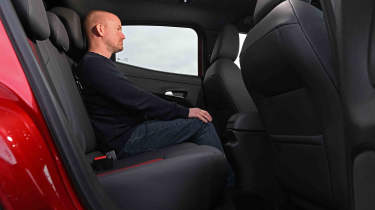
You’d never expect the Junior to offer a limo-like amount of space in the back, and it doesn’t. With anyone approaching six feet tall up front, there’s hardly any knee room left in the back. You could squeeze adults into the rear seats for very short journeys, but any longer and they’ll be complaining. Headroom isn’t as bad, but it’s still not great. If space for passengers is a priority in an EV of this size, then alternatives such as the Kia EV3, Smart #1, or Skoda Elroq are all better bets.
Whether it’s a cost-cutting measure or because Alfa never believed anyone would willingly sit in the back, there are no door bins, armrest, cup-holders or air vents there. The only amenity is a single USB-C charging port, plus two sets of Isofix child-seat mounting points.
Boot space
The Junior Ibrida has a 415-litre boot, while the EV offers a capacity of around 400 litres. Both of those figures are a little above the average for cars in this class, and more space than you get in a Volkswagen Golf hatch, but trails the likes of the Skoda Elroq, which has a far more generous 470 litres of capacity with the seats up.
You can drop the rear seats in the Junior to expand the space to just under 1,300 litres, but again, this trails the Elroq's 1,580-litre cavern. A height-adjustable floor in the Junior at least allows for greater flexibility of the space, with users able to create either one large storage area, or a smaller boot that has a floor level with the load bay opening, and space underneath to store the charging cables. There’s no ‘frunk’ or additional cable storage under the bonnet in the electric versions, though.
“While the Junior’s boot is actually a decent size for this class of vehicle, the sloping rear windscreen means room isn’t great in the back seats for adults. Yet it was comfortable for Isla, who was happy either sitting up – especially with her nose out of the back window – or curled up asleep.” - Dawn Grant, pictures editor.
Reliability & safety
Pros |
|
Cons |
|
Given that the Junior sits on the same platform as many other four-star rated EVs by Euro NCAP, we expect similar results when the Italian car undergoes its safety test. There’s some reassuring safety kit as standard, too, as you would likely expect of an EV in this area of the market. Adaptive cruise control, active lane assist and automatic emergency braking are all standard, while the Technology Pack – available as a £1,700 option on entry-level and Ti trims – adds level-two autonomous driving.
Buying and owning
- Best buy: Alfa Romeo Junior Elettrica Sport Speciale
The electric versions of the Alfa Romeo Junior offer a much more polished driving experience than the hybrid, so unless you have nowhere to charge an EV, we’d avoid the Junior Ibrida. That leaves three specifications to choose from, and of them we’d recommend the mid-range Sport Speciale. It’s well equipped and not much of a walk-up over the base car, but if you like your Italian electric SUVs to be properly sporty, then the Veloce should fit the bill to an extent.
The Junior comes with a three-year warranty from new, plus 12 months of breakdown cover. Alfa’s standard warranty is also backed up by an eight-year package for the electric vehicle’s battery.
EVs have far fewer moving parts that require maintenance than a typical petrol or diesel internal-combustion-engined car, and Alfa Romeo is passing this benefit onto its customers through its current service plan. At around £100 for three years of maintenance, it looks like a bit of a bargain.
Alfa Romeo alternatives
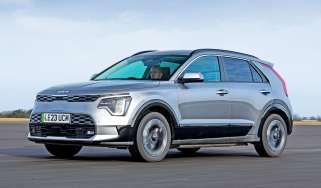
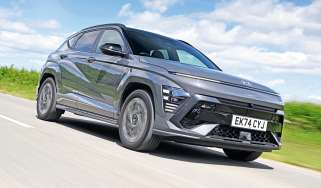
Because the Alfa Romeo Junior is available with hybrid and electric power, it competes with pretty much everything in the small SUV segment, not least the very popular Ford Puma, Dacia Duster and Renault Captur. Specific all-electric options include the Smart #1, Hyundai Kona Electric, Kia Niro EV, MINI Aceman and Volvo EX30.
The best of the small electric SUV sector is undoubtedly the Skoda Elroq. It may not be the most fun EV around, but it excels in every aspect while also being available with a wider range of battery sizes, thereby increasing its driving range, along with ample interior space, making it a highly practical family car.
The Junior also has to try and stand out from the other, more established models based on the same CMP platform, which includes the Vauxhall Mokka, Fiat 600, Peugeot 2008, Jeep Avenger and Citroen C4.
Pricing for the Alfa Romeo is cheaper than with some of its Stellantis cousins, which is surprising given the slightly more premium nature of the marque. We think the Junior is one of the best options in the Stellantis stable, as well as the wider EV crossover market.
Key updates of the Alfa Romeo Junior review
12 February 2026: Updated to include impressions from our long-term test of the Alfa Romeo Junior Veloce.
Frequently Asked Questions
The hybrid Ibrida is a bit underwhelming, whereas the Elettrica (the company’s first effort at an electric car) makes a decent case for itself. Alfa Romeo has been given a massive leg up courtesy of the Stellantis empire, because it’s been able to base the car on a proven platform, but has managed to sprinkle some flair into the mix, both in terms of style and driving.
Deals on the Junior and alternatives