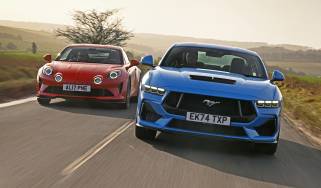
Ford Mustang review
Famous Ford Mustang nameplate gets a more aggressive look for its seventh generation

Our opinion on the Ford Mustang
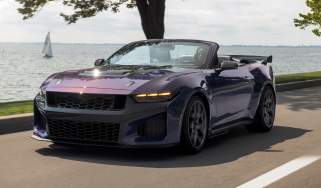
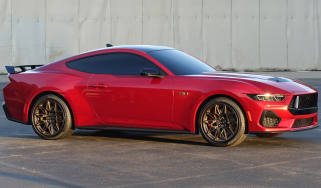
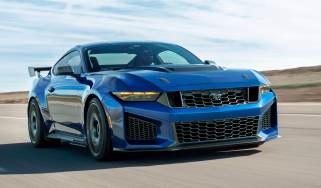
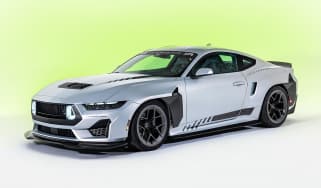
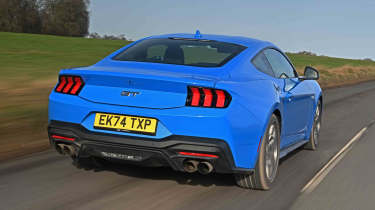
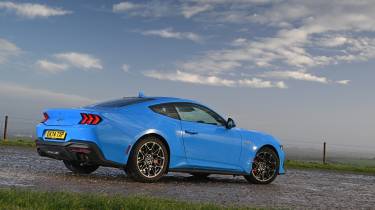
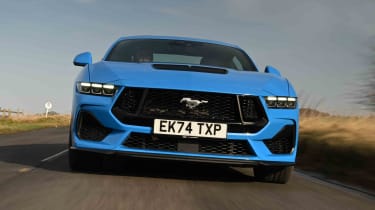
It’s always a tough task to reimagine an icon, but the Ford Mustang Mk7 does exactly that. With buyers easily falling for its predecessor’s looks, the aim was clearly to not tinker with the formula too drastically. The latest model is sharper, more menacing and more angular than the Mk6 generation, but it’s still instantly recognisable as a Mustang.
About the Ford Mustang
At a time when so many cars are using turbos or electrification to improve efficiency, the Mustang has stuck with a big, simple V8 engine, driving the rear wheels only. As before, it’s possible to buy a coupe model or – for a reasonable premium – a convertible. The Mustang was highly commended in Coupe of the Year category at our 2025 New Car Awards.
You have a choice of standard GT or Dark Horse trims – the latter trim is only available in the coupe. Every version is well equipped, but the Dark Horse trim comes with upgraded brakes, a Tremec manual gearbox (it’s the same gearbox that was used in the previous-generation Ford Mustang Mach 1), and a limited-slip rear differential for improved traction. The Dark Horse also gets the ‘higher-output’ 5.0-litre V8 with unique tuning, although that only actually equates to 7bhp extra over the standard GT.
Used - available now

2017 Ford
Mustang
55,598 milesManualPetrol5.0L
Cash £27,000
2022 Ford
Mustang
20,988 milesAutomaticPetrol5.0L
Cash £40,000
2019 Ford
Mustang
49,528 milesManualPetrol2.3L
Cash £27,590
2022 Ford
Mustang
55,291 milesAutomaticPetrol5.0L
Cash £33,500We’ve tested the latest Ford Mustang against the Alpine A110 as part of our real-world twin test, and the Mustang certainly charmed us with its charismatic V8 engine and distinctive soundtrack, but it also surprised us with a level of chassis sophistication that would have been unthinkable given some of the Mustang's predecessors. However, while the Mustang was the far more practical choice, the Alpine A110 is just sublime as a driver’s car. We've also tested the Mustang's SYNC 4 infotainment system in detail as part of our best car infotainment system group test.
Ford Mustang prices and latest deals
Prices start from around £58,500, which gets you behind the wheel of the 5.0-litre V8 GT coupé, while the Ford Mustang Convertible carries a £3,500 premium over the hard top, starting at close to £62,000.
At the top of the range (aside from the track-focused GTD) is the Ford Mustang Dark Horse, which is around £12,500 more than the GT and only comes as a coupé, starting at around £71,000.
Performance & driving experience
Pros |
|
Cons |
|
On the road, the Mustang gets a lot of things very right – and very little wrong. It’s composed yet comfortable, exciting yet refined: Ford has settled upon a really well-judged set-up.
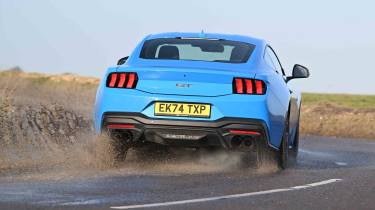
Use all of the power that the Ford has to offer, and it begins to roar as it nears the red line. Some previous Mustangs have a slightly harder edge to their tone than the latest model, but there’s still so much pleasure to be had from extracting everything that the V8 can offer. Upshifts need to be well considered during hard driving, because aggressive changes can cause the rear axle to spin up – especially in the damp. In a time of charmless turbo engines and electric powertrains, the Mustang never fails to put a smile on your face.
There is one very big exception to all of this, however, which is the automatic gearbox. The optionally available transmission has a baffling 10 speeds, and with so many ratios to choose from, the engine is never given the chance to extend itself. Each upshift is accompanied by a drop in revs so small that you’d be forgiven for thinking that there’s a CVT gearbox hiding in the car, making that V8 feel completely flat.
Even if you seize manual control, there are so many gears that it’s hard to keep up with which one you’ve chosen. Don’t be tempted by the fact that the auto accelerates slightly quicker than the manual – if you need an auto in your performance car, look elsewhere.
Performance, 0-60mph acceleration and top speed
The heart of any American muscle car is its engine, and the Mustang has a very big heart. The 5.0-litre naturally aspirated ‘Coyote’ V8 puts out a very healthy 440bhp in GT spec, or 7bhp more in the more focused Dark Horse. Of course, all that shove is backed up by plenty of torque, too, with both versions offering 540Nm. In GT form, that’s enough to reach 0-62mph in 5.4 seconds, with the Dark Horse arriving at the benchmark 0.1 seconds sooner.
That isn’t far shy of the 473bhp offered up by the BMW M2 – and that car costs nearly £12,000 more than the Ford; the BMW doesn’t sound as good, either. Even when you’re plodding along in traffic or gently cruising up to 3,000rpm before each upshift, there’s a growl from the Ford’s engine which constantly reminds you that you’re driving something very special. Rev matching is very easy when changing down, but there is a switchable automated system that can do this for you, too.
| Model | Power | 0-62mph | Top speed |
| Mustang 5.0 GT | 440bhp | 5.3 seconds | 155mph |
| Mustang 5.0 Convertible auto | 440bhp | 5.0 seconds | 155mph |
| Mustang 5.0 Dark Horse | 447bhp | 5.2 seconds | 155mph |
Town driving, visibility and parking
Prod the round starter button at the base of the dashboard, and the deep burble from the V8 could leave some Mustang newbies feeling slightly intimidated about how tricky it might be to drive such a burly coupé. The first few miles behind the wheel, however, will ease their minds completely. While the clutch pedal and gearshift require some positivity, they’re slick and precise to use. There’s enough heft to reassure you that it’s engineered to cope with the engine’s torque, but it’s significantly lighter than earlier Mustangs and its rivals from 10 to 15 years back
That engine has so much grunt from low down that low-speed manoeuvres and plenty of traffic jam crawls can be carried out on just the biting point of the clutch – often there’s no need to even tickle the throttle pedal.
Country road driving and handling
The Mustang surprises on a twisty road, where there’s a level of precision and delicacy to its chassis that gives some of the best European coupés a run for their money. The nose is keen to dive towards an apex, with steering that is well judged in terms of its response, weight and accuracy.
Body movement is fairly well contained, even on tricky roads. It’s only when it’s pushed very hard on the most challenging roads that the ultimate sharpness fails to live with a BMW M2, and its fairly substantial mass starts to reveal itself. Grip and traction are impressive in the dry, but this is still a powerful rear-wheel drive car and can be a bit more of a handful in the wet.
The overall balance is neutral, almost too much so for a V8-powered coupé, the torque feels pegged back at the lower reaches of the rev range, so it means that trying to adjust the mid-corner balance on the throttle has less effect than we’d like. The brakes are more than up to the task of hauling the car to a stop.
Motorway driving and long-distance comfort
For all its ability as a driver’s car, the Mustang’s credentials as a long-distance cruiser manage to exceed even those high standards – this is a model that really lives up to its GT billing. Regardless of whether you’re driving around town or at motorway speeds, the ride is impressively soothing, which, combined with the car’s big, soft seats, makes it a very comfortable place to complete lengthy journeys. The gearing in sixth is very long, which means at 70mph the engine is pulling less than 2,000rpm.
“The Mustang looks like it has a manual handbrake, but it’s actually electric. Using the Electronic Drift Brake mode in the infotainment screen, rear brake pressure is preloaded so that a tug on the lever locks the back axle to initiate a handbrake turn. I obviously couldn’t test this on public roads, but I wasn’t keen on the way the lever is sprung. Rather than gradually building resistance like a regular handbrake, it feels initially heavy with little effort needed after.” – Alex Ingram, former chief reviewer
MPG, emissions & running costs
Pros |
|
Cons |
|
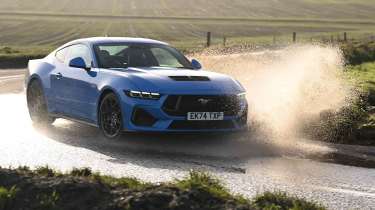
People don’t buy a V8 American muscle car expecting it to sip fuel like a Toyota Prius. In certain situations, the Mustang works its way through unleaded as keenly as you’d expect, and in even fairly free-moving urban traffic, expect low-twenties mpg at best.
But on more open roads, things improve. That torquey engine that makes motorway trips feel so effortless – and the long sixth gear that means it’s barely ticking over at 70mph – ensures that it will achieve more than 30mpg.
Cruising range is harmed by its average-sized 61-litre fuel tank, and while 300-ish miles will be fine at a cruise, work the car harder and you’ll be making regular fill-ups.
| Model | MPG | CO2 | Insurance group |
| Mustang 5.0 GT | 28.0mpg | 230g/km | 44 |
| Mustang 5.0 Convertible auto | 27.4mpg | 235g/km | 48 |
| Mustang 5.0 Dark Horse | 27.2mpg | 238g/km | 46 |
Insurance groups
Depending on which model you choose, the Ford Mustang line-up sits between insurance groups 43 and 46.
Tax
Whether you’re a company car user or a private buyer, road duty for the Mustang is about as high as it’s possible for it to be. From April 2025, VED rates are set to double across almost every band; with the Mustang’s CO2 emissions of 275g/km already putting it in the highest Band K, that will see its first year cost rising from £2,745 to £5,490. After that, the cost will be £600 a year.
Depreciation
Residual values are fairly strong across the Mustang range. The GT coupé is expected to retain roughly 55 per cent of its value after three years or 36,000 miles, while the Convertible will hold on to 51 per cent. The Dark Horse version looks set to resist depreciation the best, keeping 57 per cent of its original asking price.
Interior, design & technology
Pros |
|
Cons |
|
Blending retro design and modern tech is a tough challenge, and in some areas the Mustang succeeds in this better than others.
Interior and dashboard design
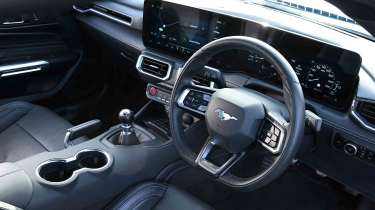
In some ways, Ford has done a great job of bringing the Mustang’s cabin into the 21st Century while leaving subtle references to its past. For example, the digital gauges can be customised to show the driving information in many ways, with track mode offering a huge, horizontally scrolling rev counter.
Ever-growing digital displays make the Ford short of the clear retro feel in some of its predecessors, but a chunky-looking steering wheel and lots of Mustang logos add some sense of occasion. The shoulder line of the windows is fairly high as you sink into the large, supportive seats, so you still feel snugly cocooned within something clearly sporty.
Materials and build quality
Ford Mustang buyers have always had to concede some build quality in order to get a keenly priced coupé with a big engine, and while the new car feels reasonably well finished, there are still a few too many hard, cheap-feeling plastics dotted around to make it feel truly luxurious.
Infotainment, sat-nav and stereo
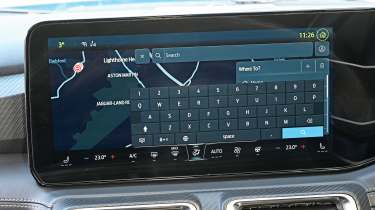
A huge 13.2-inch screen dominates the Mustang’s dashboard, and it uses the latest version of Ford’s SYNC software, with some Mustang-specific content thrown in. Squeezing the bespoke features into the standard interface has added confusion, though; the My Mustang menu lets you customise colours and graphics for the dials, yet some other display settings are where they are in other Fords, which puts them in a completely different sub-menu.
During our best infotainment system group test, we found the system slow to respond, and programming the sat-nav on the move proved tricky because the on-screen keyboard is small and hard to interact with givin the car's firm ride. Some testers had difficulty finding the safety assistance menu to turn off lane keeping (fortunately, that's a dedicated button on the steering wheel). One positive is that it’s amazingly quick and easy to pair a Bluetooth device.
While much of the infotainment mirrors that of other Fords, the Mustang has a few unique menus. You can display auxiliary gauges on the touchscreen, to give real-time readouts for oil pressure, lateral G and battery voltage. Find a private road or track, and you can record your own 0-62mph attempts via the built-in acceleration timer.
The GT comes with a 10-speaker B&O sound system. Even though it’s having to fight with the bass from the V8 engine, it sounds punchy and clear – better than the premium systems you’ll get in a BMW M2.
Boot space & practicality
Pros |
|
Cons |
|
While practicality will never be at the forefront of a coupé buyer’s checklist, those looking for a desirable two-door performance car that has space for a young family of four would struggle to do better than the Mustang.
Dimensions and size
American cars tend to be bigger than their European counterparts, and this certainly is the case for the Ford Mustang. It is longer, wider, and taller than either the BMW 2 Series coupe or Alpine A110. While that will make it harder to park and navigate your way around town, it does at least mean you’ll benefit from a decent dose of practicality.
| Dimensions comparison | |||
| Model | Ford Mustang | BMW 2 Series coupe | Alpine A110 |
| Length | 4,810mm | 4,548mm (4,580mm M2) | 4,181mm |
| Width | 1,916mm (2,097mm inc mirrors) | 1,838mm (2,068mm inc mirrors) | 1,798mm (1,980mm inc mirrors) |
| Height | 1,414mm | 1,404mm (1,403mm M2) | 1,248mm |
| Wheelbase | 2,719mm | 2,741mm | 2,420mm |
| Boot space | 408 litres | 390 litres | 196 litres |
Seats & passenger space
The high dashboard line and long bonnet add a sense of occasion to the Mustang’s cabin, but the upshot is that judging the car’s extremities needs careful consideration in tight spots. It’s easy to get comfortable, though, because the seats are supportive. They also have plenty of adjustment, and so does the steering wheel.
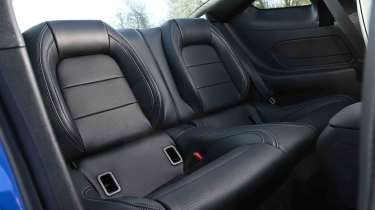
The Mustang’s rear seats can be genuinely usable. Against the tape measure, while headroom is a little tight, the cut-out in the roof line at the leading edge of the rear windscreen means that it offers roughly the same space as the BMW iX2 coupé-SUV.
Predictably, it’s knee space which is most at a premium, because if the driver’s seat is set all the way back, it’s touching the rear seat squab. But with an average-sized driver (or shorter), there’s enough space to carry adults. The seats are very sculpted and supportive.
Boot space
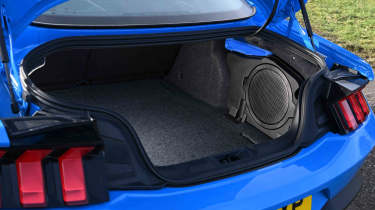
At 408 litres, the boot capacity is very reasonable for a performance car. The opening isn’t huge, but the space is more than a metre long and almost one metre wide, so there’s room for golf clubs, or even suitcases. You do have to be wary of the bass speaker that lives in a recess on the driver’s side of the car, in order to make sure it doesn’t get damaged by what you’ve put in the boot, though.
“For around £2,000, it’s possible to upgrade to a set of Recaro sports seats. They’re a lightweight alternative to the standard items, trading a little bit of squishy comfort and the standard heating and ventilation functions for more lateral support – handy for making the most of that chassis.” – Alex Ingram, former chief reviewer
Safety & reliability
Pros |
|
Cons |
|
The latest Mustang hasn’t been tested by Euro NCAP yet, but the Mk7 gets much more safety tech than its predecessor. A lane-keep assist system can be switched off easily via a button on the steering wheel, but the speed-limit warning system needs to be disabled via an infotainment sub-menu. The Mustang also has a system that alerts the driver if they’re not holding the steering wheel. Our test car often failed to register that we had both hands on the wheel, and only a vice-like grip would satisfy it.
Owners ranked Ford 23rd out of 31 brands in our 2025 Driver Power owner satisfaction survey. That’s a welcome improvement over its 30th-place finish out of 32 brands in 2024, but there are still improvements to be made.
Buying and owning
Best buy: Ford Mustang 5.0 V8 GT manual
If you’re going for a Mustang, it has to have a V8, so it's fitting that UK Mustangs are now only fitted with eight cylinders. Avoid the terrible automatic gearbox; enthusiasts will always prefer a manual.
We’d stick with the regular V8 GT rather than the Dark Horse version since the standard item is wild enough as it is. Besides, that near £12,500 difference in price buys an awful lot of petrol to burn in that lovely 5.0-litre engine.
Ford Mustang alternatives
The number of new V8-powered front-engined, rear-wheel drive coupés for sale in the UK amounts to one, and the Mustang is it. However, change the number of cylinders to six, or even four, and there are options to be found. The BMW M2 is pricier and more engaging to drive, or there are the four-cylinder versions of the BMW 2 Series that could be considered, plus the BMW Z4 roadster.
Another rear-drive coupé that’s available, albeit hard to come by new, is the Toyota GR86, which is lighter and more agile, but lacks the soundtrack a Mustang delivers. A left-field option is the B road scalpel that is the Alpine A110. If you’re looking for an open-top cruiser, then the Mercedes CLE Cabriolet can fill that brief, although like the M2, it’s pricey when compared with the Mustang.
Ford Mustang history
A few cars can be identified by a single name – Beetle, Golf, Model T – and Mustang is definitely one of them. Originally designed to tap into a market of young drivers looking for a sporty car, the Mustang has evolved over seven generations to become a staple of the new-car market.
The original Mustang was based on existing parts from Ford models, such as the Falcon and Fairlane, which helped keep costs down and made the car affordable. That helped sell a million cars in the first 18 months it was available – pretty impressive when Ford projected sales of 100,000 for the first full year it was on sale in 1965.
Over the years, the Mustang has grown in size and power, with models such as the Mach One, Cobra, Boss 302 and Boss 429, not to mention the Shelby variants, all adding performance to the basic package.
There was a failed attempt to sell the Mustang in the UK back in the eighties, although it faced internal competition from the Ford Capri that it could never match, but the Mustang finally officially arrived in right-hand drive guise in 2016.
Key updates of the Ford Mustang review
5 February 2026: Updated the Ford Mustang review with the latest pricing and depreciation figures, along with our findings regarding the infotainment system from our best infotainment systems group test.
Ford Mustang pictures
Deals on the Ford Mustang and alternatives
Frequently Asked Questions
The current Mustang is an evolution of the sixth generation, so there should be good reliability from the proven parts under the skin. Ford’s ‘Coyote’ 5.0-litre V8 is a fairly common unit that can even be bought direct from Ford in the US for customisers wanting to modify their own cars.