MINI Cooper review
The petrol-powered MINI Cooper combines the EV’s looks with existing combustion engined-tech


Our opinion on the MINI Cooper
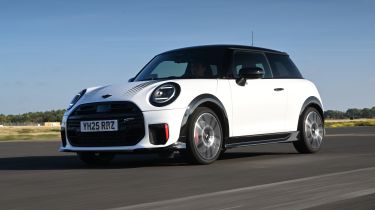
The combustion-engined MINI Cooper follows a template that has served the company well for many years, by offering a compact car with sporty handling in a premium package with plenty of tech. There’s nothing quite like it on the road, with the sharp chassis delivering an entertaining drive, whichever model you choose, and a cabin layout that combines modern connectivity with retro looks that are starting to only offer a cursory reference to the classic Mini. The car’s firm ride won’t be to all tastes, while practicality is still a bugbear, even in the five-door version, but the MINI Cooper delivers plenty of charm if it suits your lifestyle.
About the MINI Cooper
For nearly 25 years, the MINI hatchback has offered premium quality in a compact package, but for 2024 it was all-change in the line-up. For this generation, there are two distinct models, both called MINI Cooper (rather than MINI hatch), but one has a dedicated all-electric platform, while the other uses an evolution of the previous generation’s combustion-engined layout. They are known internally by the model codes J01 (electric) and F65 and F66 (five and three-door combustion engined versions), while the F67 is the latest MINI Cooper Convertible.
We’re focusing on the three and five-door combustion-engined models in this review. We also have separate dedicated reviews if you want to read up on the MINI Cooper Electric or MINI Cooper Convertible.
Three versions of the supermini are available, badged Cooper C, Cooper S and John Cooper Works. These mark the three engine options available in the MINI Cooper, with the C featuring a 1.5-litre turbo three-cylinder petrol, and the Cooper S and JCW using a 2.0-litre turbo four-cylinder in two states of tune. All cars are front-wheel drive and use a seven-speed twin-clutch gearbox.
On top of that, there are three trim grades to choose from on the Cooper C and Cooper S, branded Classic, Exclusive and Sport. These introduce different themes and additional equipment, with Exclusive providing more premium materials and tech, and the Sport adding more of a hot hatchback theme to the car without the JCW’s extra power.
On top of this, and unlike the electric model, the MINI Cooper comes with three or five doors, with the latter featuring a slightly longer wheelbase to boost practicality.
MINI Cooper prices and latest deals
The MINI Cooper range starts from around £25,500 for a Cooper C, while the Cooper S kicks off at broadly £29,000. If you want the added versatility of the five-door body, that’s another £1,000 extra, and the John Cooper Works starts in the region of £34,000, but it only comes as a three-door.
The Coopers come in Classic trim as standard, while upgrading to Exclusive spec adds £2,200 to the base price, and the Sport model costs £3,500 more than Classic. On top of that, there are packs labelled Levels 1-3 that offer more kit bundles, although what you can add depends on which trim level you’ve picked. The John Cooper Works is simpler to spec up, with just one trim and two Levels to choose from.
You can save plenty when you build a brand-new MINI Cooper via the Auto Express Buy a Car service, and we also have plenty of Cooper lease deals from our network of providers. Our Sell your Car service can also help you to get the best price for your old car.
Performance & driving experience
Pros |
|
Cons |
|
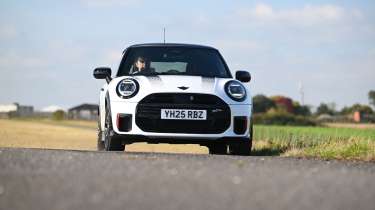
Ever since MINI was created by parent firm BMW, the brand has traded on its ability to produce cars with go-kart handling. While its bigger SUVs can’t quite live up to that reputation, the Cooper models maintain tradition with fun handling and responsive engines.
| Model | Power | 0-62mph | Top speed |
| Cooper C | 154bhp | 7.7 seconds | 140mph |
| Cooper S | 201bhp | 6.8 seconds | 150mph |
| John Cooper Works | 228bhp | 6.1 seconds | 155mph |
Performance, 0-60mph acceleration and top speed
Even the Cooper C has a sub-eight second 0-62mph time, so no version of MINI’s smallest car is going to feel slow. The car’s chassis is set up well, too, so the more powerful versions cope with the extra power and you have to be really heavy with the throttle to cause the front wheels to break traction in the dry.
Acceleration is strong through the rev range, and the engine note sounds particularly sporty. The Cooper C has a rorty 1.5-litre three-cylinder engine that revs with a growl, while the Cooper S and JCW both use a 2.0-litre four cylinder that sounds purposeful, with a bassy exhaust note.
The smooth shifts of the twin-clutch automatic gearbox mean you hardly miss the fact that the Cooper models don’t give you the option of changing gears yourself – only the JCW has paddleshifters.
Town driving, visibility and parking
The MINI Cooper has plenty of acceleration for the traffic light sprint, while the relatively small dimensions and fast steering rack mean that this is a car that’s built with urban driving in mind. Big side mirrors and short overhangs front and rear help you to position it accurately, while the narrow body means it’ll slip through gaps that urban SUVs will need to take with caution.
The main downside of the MINI Cooper is the firm ride. The car has a stiff chassis, so it tightly follows the contours of the road, which is fine on smooth surfaces, where the damping proves to be comfortable over sharper bumps. But this kind of surface is a rarity in the UK. You’ll soon get into the habit of steering away from cracks and holes in the road, which is easily done thanks to the car’s quick steering.
There are plenty of assistance systems on board, including front and rear parking sensors and automatic emergency braking, but we’d like to see better positioning of the indicator lights on the dashboard. At the moment, they flash up on either side of the large circular central screen and can be hard to spot, but if they were integrated into the head-up display in front of the driver, there wouldn’t be any doubt that they are on.
Country road driving and handling
On faster roads, the Cooper’s firm suspension becomes less of an issue as you revel in the entertaining handling. There’s a good balance, with the chassis and tyres providing plenty of grip to make the most of the performance on offer. It’s easy to carry your speed and only small steering inputs are needed to get the car’s darty front end pointing in the right direction. The chunky steering wheel rim feels substantial in your hands, although this might not be appealing to some people.
Performance is strong in the Cooper S, with a surge of mid-range acceleration delivering good pace for cross-country driving. The gearbox is quick to respond to requests for acceleration, kicking down smoothly in the process, and it doesn’t really leave you hanging as you make the most of the car’s performance.
The lack of manual control for the gearbox is most felt on country roads, but on the whole the transmission doesn’t get flustered when you ask for more acceleration. To help mitigate things, you can flick the drive selector toggle down to engage ‘L’ mode, which sharpens the throttle and sees the transmission hold on to gears for longer. This can be useful if you’re attacking a series of tight corners.
Motorway driving and long-distance comfort
The MINI’s sporty character is to its detriment on dual carriageways. The stiff chassis maintains its habit of following the undulations of the road, and although the damping is actually quite good at soaking up bumps, the stiff overall set-up means the Cooper isn’t a natural for long-distance drives. Add in tyre noise and a droning engine note, and we’d only recommend short motorway trips in this supermini.
"MINI has linked the different drive modes to the Experiences switch on the dashboard, so if you want sharper dynamics or more eco-friendly driving, you have to accept changes to the digital displays and cabin lighting, too. It’s largely fine, although some of the transition animations and sounds might irritate." - Dean Gibson, senior road test editor.
MPG & running costs
Pros |
|
Cons |
|
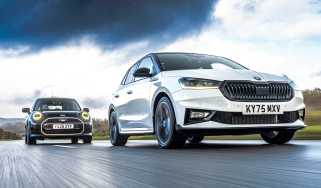
The first obstacle to MINI ownership is the relatively high list prices that the company asks for its premium supermini. The entry-level Cooper C starts at a price point that’s closer to mid and high-range mainstream models such as the Skoda Fabia and Renault Clio, while Cooper S matches the highest-spec variants of those cars. Add options, and you’ll be looking at a price tag north of £35,000.
Fuel economy in the 43-48mpg range is pretty reasonable, though, and the Cooper has plenty of the tweaks that BMW applies to all of its modes to help boost fuel efficiency. There’s no hybrid system, but stop-start and an eco mode are available to help deliver better fuel economy than you might expect from a sporty car.
The Cooper 5-door is slightly heavier than the standard model, so its official fuel consumption figures are slightly poorer, but by less than 1mpg, so you’re unlikely to see much difference in everyday driving.
When we tested the Cooper S 5-door, we saw fuel efficiency of around 36mpg on a route that took in a number of miles on the motorway and fast A-roads. That’s around 10mpg poorer than the official figures, while a 44-litre fuel tank means a range of around 350 miles if you can match that figure.
| Model | MPG | CO2 | Insurance group |
| Cooper C | 47.9mpg | 134g/km | 21 |
| Cooper S | 45.6mpg | 140g/km | 25 |
| John Cooper Works | 42.8mpg | 149g/km | 27 |
Insurance groups
Groups start from 21 for the Cooper C and 25 for the Cooper S, with the John Cooper Works slotting into Group 27. There’s no change in rating if you pick the 5-door model, while the electric Cooper has slightly lower insurance ratings overall.
Tax
No version of the MINI Cooper is subject to the luxury car tax surcharge, but if you’re looking at this supermini as a company car option, you will be better served by the Cooper Electric, which has far lower Benefit-in-Kind rates. It doesn’t come as a five-door like the petrol models, though.
Depreciation
The range of residual values for the MINI Cooper varies according to body style and powertrain. The poorest performer is the Cooper C, which sits in the 35-40 per cent range after three years and 36,000 miles, while the Cooper S is in the 36-41 per cent field. The John Cooper Works will be worth around 38-40 per cent of its new value, depending on which Level packs are included (the higher-spec ones having a negative impact on residuals).
These figures are for the three-door petrol Cooper, but the five-door version fares better. There’s a spread between 49 and 55 per cent here, so clearly the extra versatility is a desirable extra to have on the used market.
The electric MINI Cooper fares even better than the petrol three-door, ranging between 47-54 per cent.
Interior, design & technology
Pros |
|
Cons |
|
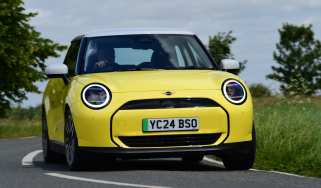
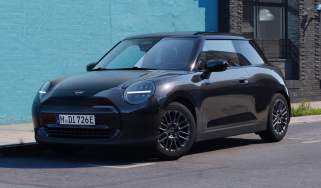
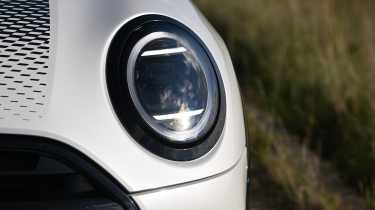
While the current F65 and F66 petrol Coopers are based on the same running gear as the previous F55 and F56 models, MINI has ported over the minimalist exterior design and hi-tech-yet-retro interior from the all-electric Cooper. The result is pretty successful, with a unique look that harks back to the current MINI’s heritage more than Austin’s original, while the cabin has a layout that’s unlike anything else in the small-car market.
Interior and dashboard design
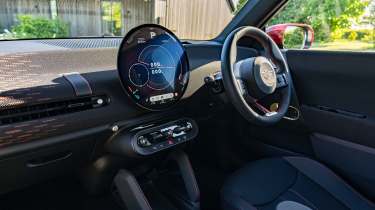
Pride of place inside goes to the large circular organic-LED touchscreen mounted centrally on the dashboard. It’s inspired by the central speedometer of the classic MINI, but this 24cm (18-inch) display, called the MINI Interaction Unit, is feature-packed and quick to respond to inputs.
There are other nods to classic MINIs with the bank of switches below. They’re simpler than the row of toggles seen in past generations, and include the starter – which is designed like a key in an ignition which you turn clockwise to start the car – a volume knob and handbrake button. There are toggle switches for the drive selector and ‘Experiences’, which adjust the cabin lighting, screen themes and driving experience.
The minimalist theme continues with the rest of the interior, although it doesn’t look basic, courtesy of the brightly coloured fabrics and upholstery used throughout.
Materials and build quality
MINI makes its use of recycled materials a highlight of the cabin, but there is no sign of sub-par plastics or cheap feeling fabrics anywhere inside the car. The dashboard is covered in fabric that varies according to which trim you choose, while the seats are trimmed in cloth and a material called Vescin, which is MINI’s name for its leather alternative.
Overall build quality feels good, with no rattles in the cabin. What physical controls there are have a solid feeling and work positively.
Infotainment, sat-nav and stereo
You won’t find any physical climate controls beyond the heated windscreen and rear window buttons, with everything else controlled via the touchscreen. The set-up works reasonably well, though, and this leaves space on the dashboard for an upright wireless phone charging pad with a clip that holds your phone in place.
The different Experiences that are selected via the toggle switch below the main screen change the cabin lighting and offer different displays on the dashboard. The text and graphics are super sharp and easy to read, too.
The outer edge of the touchscreen features temperature controls in its lower quarters, while in the top quarters there are power and fuel gauges. There’s a shortcut bar across the bottom of the display to help you navigate to the core functions, while swiping left and right on the main screen offers up different menus. This all works quickly, while the different displays have been designed to take up as much space as possible on the circular screen.
While the native sat-nav allows you to display the map across the entirety of the screen, smartphone integration isn’t quite as successful. If you’re using your phone software, then it appears in a square box in the middle of the display, and it seems relatively small when compared with rival set-ups that can use the whole of a rectangular display to show information.
If you’re put off by having to turn your head to see the speedometer at the top of the main screen, don’t worry, because all MINIs come with a head-up display that puts this information directly ahead of you. We’d like to see another update to make life easier, though. At the moment, when you use the indicators, green arrows flash up on either side of the main display, which are difficult to see." - Dean Gibson, senior road test editor.
Boot space & practicality

Pros |
|
Cons |
|
The biggest compromises with MINI ownership come in the form of practicality. While the BMW-built model is far larger than the original, there’s still not as much space here as you’ll find in other superminis.
Dimensions and size
As has always been the case, the MINI has larger overall dimensions than that other popular retro-inspired supermini, the Fiat 500, while the Audi A1 Sportback is a similar size, but has a five-door configuration that’s more accessible than the MINI 5-door’s. Most mainstream superminis are larger overall than the MINI.
| Dimensions comparison | |||
| Model | MINI Cooper 3dr | MINI Cooper 5dr | Audi A1 Sportback |
| Length | 3,876mm | 4,036mm | 4,029mm |
| Width | 1,744mm | 1,744mm | 1,740mm |
| Height | 1,452mm | 1,464mm | 1,409mm |
| Wheelbase | 2,495mm | 2,567mm | 2,550mm |
| Boot space | 210-725 litres | 275-925 litres | 335-1,090 litres |
Seats & passenger space
While the MINI Cooper is a low-slung supermini, cabin access is pretty easy, and once there you have a wide range of wheel and seat adjustment to help you get comfortable. So even the tallest drivers have sufficient room, although this will have a direct impact on rear-seat space.
Headroom is fine, even with panoramic glass fitted, although the narrow centre console does make you feel closer to your passenger than you might in other superminis. That console features a fixed armrest with no storage beneath, and you have a pair of USB sockets and a 12-volt connection in the open tray ahead of it. MINI does offer hidden storage in the shape of a fabric topped bin that sits in this central tray, with twin cup-holders and an upright wireless phone charger in front of them. The glovebox is bigger than the console box, but the door bins are very small.
In the rear, the three-door Cooper is a strict four-seater with no central belt, while access is tricky thanks to a narrow opening when the front seats are slid forward. Legroom is the critical factor here, because head and shoulder space are fine, but if tall occupants are sitting up front, there’s going to be limited room in the back.
The MINI 5-door has a slightly longer wheelbase than the three-door version, while the doors themselves swap the frameless configuration for more conventional framed doors front and rear. The back-door opening is narrow, but the car’s extra length means there’s a better chance of tall passengers feeling comfortable, with more legroom on offer.
Rather optimistically, MINI fits a third seatbelt and central headrest in the back of the Cooper 5-door, but the middle seat is extremely narrow and there will be a real fight for elbow and legroom if all three seats are in use. The limited space in the back means there are few luxuries, with a single cup-shaped tray and tiny door bins on offer.
Boot space
The small boot will be fine for a weekly shop and maybe even a weekend away, but there are far more versatile superminis out there. The MINI is more about style than practicality, though, so buyers are likely to be happy with the amount of space on offer.
There’s a total of 210 litres in the three-door car, but the slightly longer 5-door model has 275 litres. Both cars feature offset folding back seats to create more space, while a variable boot floor allows you to have either a level load lip or a deeper storage compartment.
"For an extra £1,000 the MINI 5-door adds some much-needed practicality to the mix. Unfortunately it comes with slightly awkward looks when compared with the cleaner lines of the three-door model, but the extra doors and larger boot are worth paying for if you’re looking to boost the MINI’s versatility." - Dean Gibson, senior road test editor.
Reliability & safety
Pros |
|
Cons |
|
Since this generation of MINI Cooper is based on the last generation, there should be fewer worries about reliability than if this was an all-new model. The engines and gearboxes are the same as before, while the infotainment tech comes with over-the-air updates to add features and keep things running smoothly.
Safety kit is comprehensive, with all of the standard features you would expect from a new car. This includes speed limit warning, although if you want to deactivate this, it’s easily done via a physical shortcut button on the control panel below the main display.
A basic three-year warranty is made slightly better by the fact there’s no mileage limit to go with it, while roadside assistance is offered for the same period of time.
All new MINIs come with three years of servicing included, which will help with running costs, while this can be extended to five years at additional cost.
| Euro NCAP safety ratings | |
| Euro NCAP safety rating | Five stars (2025) |
| Adult occupant protection | 83% |
| Child occupant protection | 82% |
| Vulnerable road user protection | 81% |
| Safety assist | 77% |
Buying and owning
- Best buy: MINI Cooper S Classic 5-door
It’s not the best looking version, but the Cooper S in five-door guise offers the best performance and practicality in a single package. You don’t need to upgrade beyond Classic trim to get an upmarket feeling supermini, but the Exclusive model is plush and the Level 2 and Level 3 packs add some features that boost the ownership experience.
MINI Cooper alternatives
While the MINI Cooper had some direct rivals for a while, it’s largely the only car in the premium supermini class now. Yes, the Audi A1 Sportback is still available, but it’s older than the MINI and unlikely to be replaced once production stops. Elsewhere, the DS 3 has turned into a crossover, while the Fiat 500 is still offered, but it’s even smaller than the MINI, although if you’re after style more than practicality, it could suit your needs.
In terms of performance models, the John Cooper Works is a fun hot hatch that could be on a shortlist with the likes of the pricier Honda Civic Type R or electric Alpine A290, because again, there are very few direct rivals.
Frequently Asked Questions
Overall, we like the MINI Cooper. It continues to deliver on modern MINI’s mix of style and fun, with a unique look inside and out that helps it stand out from the pack. Yes prices are high when compared with more conventional superminis, but the premium finish inside and hi-tech touchscreen go a long way to justifying this.
Deals on the Cooper and alternatives
More reviews
Car group tests
Long-term tests
Road tests
Which Is Best