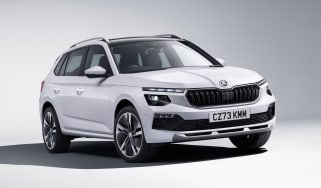
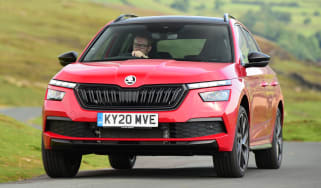
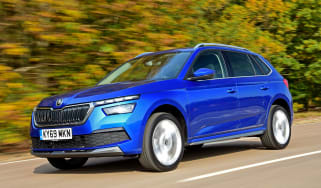
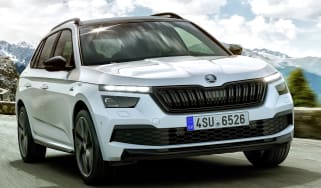
Skoda Kamiq review
The Skoda Kamiq offers an impressive blend of practicality, quality and comfort, further enhanced by midlife updates


Our opinion on the Skoda Kamiq
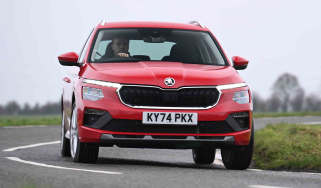
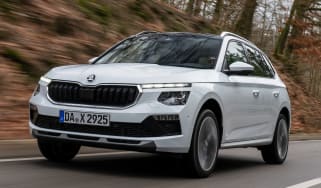
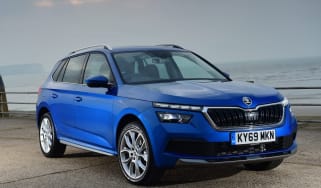
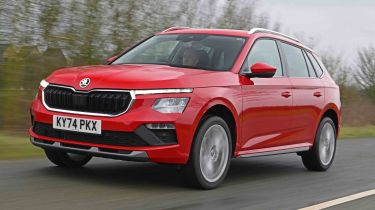
The Skoda Kamiq is the most affordable way into the brand’s tried and trusted range of SUV models. True to form for the Czech brand, it’s comfortable and well-built with a reassuringly simple design and smart technology.
Our testing of all the engine options confirms there’s not a bad one amongst them. However, the automatic gearbox isn’t the smoothest, and the Kamiq lacks the fuel-saving hybrid tech that some rivals employ. Overall, the Kamiq is a solid, user-friendly small SUV that only really lacks a bit of sparkle in the design department.
About the Skoda Kamiq
Underneath the skin, the compact Skoda Kamiq sits on an enlarged version of the MQB-A0 platform that also underpins superminis such as the Volkswagen Polo and the brand's own Skoda Fabia.
There’s just one five-door body style available with this small (B-segment) SUV, and all versions of the Kamiq are front-wheel drive - there’s no four-wheel drive option available. A 2025 update brought in to tweak the trim level range and upgrade the infotainment technology.
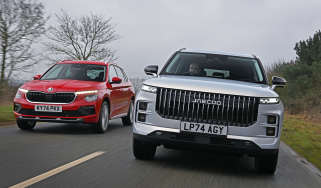
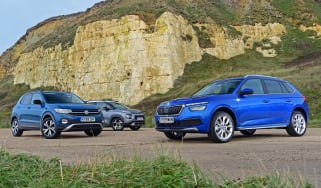
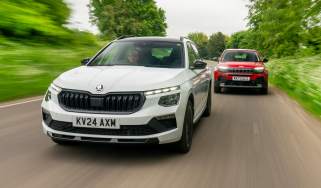
In our most recent testing, we’ve evaluated the Skoda Kamiq alongside a Jaecoo 7 in a twin test, but we’ve also pitted a Monte Carlo edition Skoda Kamiq against the Jeep Avenger.
Skoda Kamiq prices and latest deals
How much does the Skoda Kamiq cost? Well, official ‘on the road’ prices range from £25,300 to £33,290 but you can currently save an average of £6,511 through the Auto Express Find A Car service, where prices start at £19,920. You can lease a Skoda Kamiq from £243 per month or buy a used model at prices starting from £9,979.
Check out our latest new car deals, leasing deals and used car deals for the top offers available now on Auto Express. And don't forget we can help you sell your car, too.
The revised trim structure and improved levels of standard kit throughout the Kamiq range have helped keep this small SUV competitive with its rivals, with prices ranging from:
Used - available now

2023 Skoda
Kamiq
13,231 milesManualPetrol1.0L
Cash £14,550
2023 Skoda
Kamiq
14,205 milesAutomaticPetrol1.0L
Cash £15,300
2023 Skoda
Kamiq
62,924 milesManualPetrol1.5L
Cash £11,697
2020 Skoda
Kamiq
39,699 milesManualPetrol1.0L
Cash £11,849- SE Edition (from £25,500)
- Design Edition (just over £26,500)
- SE L Edition (just under £29,000)
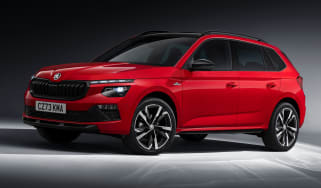
- Monte Carlo Edition (around £31,000)
Our Buy A Car service lets you spec your ideal Skoda Kamiq and choose the best offer from top dealers around the UK. Alternatively, you can lease a Kamiq or buy a used model. We can help you sell your old car, too.
Performance & driving experience
Pros |
|
Cons |
|
Access to the VW Group’s technology has enabled Skoda to offer a range of three tried-and-tested petrol engine options in the Kamiq, although hybrid and diesel fans will have to look elsewhere.
The six-speed manual gearbox on more powerful engines has a light and slick shifting action, while the dual-clutch automatic is responsive when on the move, but it can be a little hesitant and jerky when moving off from rest. This makes precise, low-speed manoeuvres in the automatic, such as parking, a little trickier than they should be.
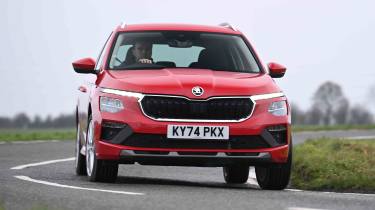
The Kamiq is not a car that will set hearts racing, but our testing has shown that the road manners tick all of the main boxes required of a small SUV.
Performance, 0-60mph acceleration and top speed
The 1.0 TSI in 94bhp guise is capable of 0-62mph in 11 seconds, while the torque spread from low revs is useful for keeping pace with urban traffic. We prefer the 114bhp version because it’s a lot more flexible, and it can sprint from 0-62mph in 9.7 seconds (adding the DSG auto sees that time grow to 10.2 seconds). Auto or manual, there’s a 121mph top speed compared to 113mph in the 94bhp car.
Above the 1.0-litre options sits a more potent 148bhp 1.5-litre unit. Its extra performance cuts the 0-62mph time to 8.3 seconds, whether you go for the manual or automatic, while the car’s top speed is 132mph. Most buyers in the small SUV class probably don’t need the extra power, but if you do a lot of miles or regularly carry a full complement of passengers or luggage, the upgrade could be worthwhile.
| Model | Power | 0-62mph | Top speed |
| Kamiq 1.0 TSI 95PS | 94bhp | 11.0 seconds | 113mph |
| Kamiq 1.0 TSI 116PS | 114bhp | 9.7 seconds | 121mph |
| Kamiq 1.0 TSI 116PS DSG | 114bhp | 10.2 seconds | 121mph |
| Kamiq 1.5 TSI 150PS | 148bhp | 8.3 seconds | 132mph |
Town driving, visibility and parking
The Kamiq’s steering is light yet precise. Combined with dimensions that aren’t much larger than a supermini’s, this helps make it very easy to drive around town. We found that the brakes take a little time to acclimatise to, because they are quite sharp at the top of their travel. They feel reassuringly strong, though.
Ride comfort at low speeds is, in general, among the best in the class. Aside from larger potholes, which can cause bigger thuds in the cabin than in rivals such as the Jeep Avenger, the Kamiq remains a comfortable way of getting around town.
Country road driving and handling
There are very few cars in the small SUV segment – the Ford Puma being one of the exceptions – that are actually fun to drive. But the accuracy of all the Kamiq’s major controls – plus the strong performance of its most potent petrol option – mean that it’s better than most in that regard.
The car has a very subtle, nose-heavy bias, grip levels are strong, and it feels reasonably light on its feet when you need it to change direction quickly. The car’s suspension helps keep the car on course well, and isn’t ruffled when it hits a sudden mid-corner lump.
Motorway driving and long-distance comfort
Despite it being a relatively small car, the Kamiq’s ride is at its best on the more settled surface of a motorway. During our testing, the overall softness managed to soak up longer compressions with ease and fade expansion joints into the background. Stability is great at speed, while road and wind noise are fairly well isolated compared with other cars in the class.
MPG & running costs
Pros |
|
Cons |
|
Officially, the Kamiq’s 1.0-litre petrol achieves up to 52mpg in WLTP tests. If you upgrade to our recommended 114bhp version, you actually gain 0.4mpg, while the larger 1.5 can return up to 49.1mpg. During our last encounter with the 114bhp 1.0-litre in manual form, we achieved 45.3mpg, while the 1.5 TSI managed 43.8mpg.
The Kamiq’s 1.0-litre engine tends to be more frugal with that manual gearbox, with the auto struggling to get into the mid-thirties for mpg around town.
There’s no hybrid powertrain in the current line-up. However, to increase the Kamiq’s lifespan, Skoda has previously stated that it’s likely to introduce this option in the near future.
| Model | MPG | CO2 | Insurance group |
| Kamiq 1.0 TSI 95PS | 52.0mpg | 123g/km | 12 |
| Kamiq 1.0 TSI 116PS | 52.4mpg | 122g/km | 15 |
| Kamiq 1.0 TSI 116PS DSG | 50.7mpg | 126g/km | 14 |
| Kamiq 1.5 TSI 150PS | 48.3mpg | 132g/km | 14 |
| Kamiq 1.5 TSI 150PS DSG | 49.1mpg | 130g/km | 20 |
Insurance groups
The Skoda Kamiq ranges from group 12 for the least powerful 94bhp 1.0 TSI, up to group 20 for the 148bhp 1.5-litre. That’s on a par with the Volkswagen T-Cross (groups 11-20), but is generally higher than the Ford Puma (groups 12-17), Renault Captur (groups 8 to 19) and Toyota Yaris Cross (groups 11-14).
Tax
For drivers paying Benefit-in-Kind (BiK) company car tax, the combustion-powered Kamiq will command far higher rates than its fully electric competitors. If you still want a Skoda SUV but want to save some extra pennies, we recommend taking a look at the Skoda Elroq, our 2025 Car of the Year.
Along with the Elroq, there are a number of other models such as the Kia EV3, Jeep Avenger, Peugeot E-2008 and Vauxhall Mokka Electric to consider.
Depreciation
Depending on your chosen trim and engine, our market data shows that the Kamiq is predicted to hold on to between 45 and 47 per cent of its original price after three years or 36,000 miles.
The closely related Volkswagen T-Cross fares a little bit better at 48 to 51 per cent, which could be partly due to its increased badge appeal.
The Renault Captur is also a stronger performer, and is predicted to cling on to between 48 and 53 per cent of its original value. A Jeep Avenger loses more money than the Skoda, maintaining around 36 to 42 per cent of its original purchase cost.
To get an accurate valuation for a specific model, check out our free car valuation tool...
Interior, design & technology
Pros |
|
Cons |
|
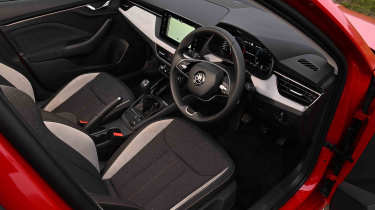
As part of an update in 2025, the Skoda Kamiq received new infotainment tech and a dual-screen dashboard to help keep things feeling up to date inside. Aside from this, though, the Skoda’s cabin feels pleasingly simple and straightforward, with a focus placed on usability rather than flashy design.
The Kamiq’s interior is starting to feel a tad dated compared to some of its younger small SUV rivals. On the flip side, an abundance of traditional switchgear will be a huge relief for more buyers who, like us, get annoyed with basic controls being buried in touchscreen menus.
All Kamiq models are well-equipped, with the entry-level SE Edition featuring LED headlights, a rear-view camera, a 10.25-inch Virtual Cockpit driver’s display and satellite navigation in the 9.2-inch touchscreen display.
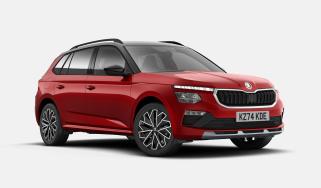
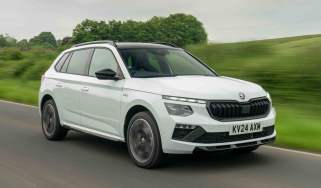
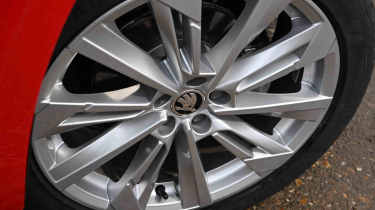
The Design Edition adds sports seats, a sports steering wheel and black details on the outside. Our recommended SE L Edition piles on more tech with keyless entry and start, parking sensors all round, heated seats and larger 18-inch wheels. The Monte Carlo Edition is semi-sporty with matrix LED headlights, a panoramic roof, adaptive cruise control, and wireless phone charging.
Interior and dashboard design
The first thing that strikes you about the Kamiq’s cabin is that it has actual physical controls. The climate functions are operated using dials and chunky buttons; the light switch is a big dial beside the steering wheel, which rotates with a satisfying clunk. There’s even a manual handbrake, too. With so many rivals putting controls like these into their touchscreens, we find driving the Kamiq a refreshingly old-school experience in comparison. Despite this now-rare use of buttons, the overall look is clean and understated.
Materials and build quality
Soft-touch plastics are not exactly commonplace in supermini-based SUVs, so it’s understandable that there’s lots of hard plastic in the Kamiq. At least it feels sturdy enough, helped by the fact that the main touchpoints, such as the door handles and steering wheel, feel expensive and high-class.
Infotainment, sat-nav and stereo
All Kamiqs are fitted with Skoda’s digital cockpit technology. It’s a digital driver information display on a 10.25-inch screen that offers plenty of scope for customisation. You can set different display layouts to prioritise mapping, speed, driver assist functions, or you can go for a more minimal look.
Whichever display is selected, the white-on-black graphics with green highlights are sharp, and the information is presented clearly. The combination of buttons and thumb wheels on the steering wheel makes changing between modes easy and intuitive.
The Kamiq’s infotainment system is a prime example of how not to overcomplicate simple things. Keeping the climate controls separate helps massively, but so does a logical menu structure. Screen resolution is sharp, the graphics are consistent through the menus and with the digital driver’s display, while the panel responds quickly to touch inputs. The volume can be adjusted by a wheel on the steering wheel.
One minus point is Skoda’s smartphone connectivity. Compared with the slick Ford Bluetooth system, connecting a device wirelessly to the Kamiq’s set-up always seems like a struggle, with the system usually taking a few attempts to connect successfully.
Even then, Android Auto can take minutes to pair automatically, although you can speed things up by manually selecting the option yourself. Wireless smartphone charging is part of the £360 Charging package on most trims, or comes as standard with the range-topping Monte Carlo Edition.
We particularly like the addition of the fabric on the dashboard to help create more of a living-room aesthetic.” - Ellis Hyde, news reporter.
Boot space & practicality
Pros |
|
Cons |
|
For a car barely larger than a supermini, Skoda’s designers have managed to unearth an awful lot of space inside the Kamiq’s cabin.
Skoda’s Simply Clever Plus pack (£345) adds extras that make life easier throughout the Kamiq. Rear-seat passengers each get a tablet PC mount on the back of the front seats, while loading the kids in and out of tight spots becomes a little less stressful thanks to pop-out door edge protectors.
Further forward, the pack adds a small waste bin in the driver’s door pocket and drawers under the front seats. The boot gets a net on the underside of the parcel shelf and a double-sided floor; one side is rubber, and the other is carpet.
Dimensions and size
The Kamiq isn’t a particularly big car, but it’s marginally larger in both directions than a Volkswagen T-Cross, and slightly longer than a Nissan Juke. It’s more like a high-riding medium/small hatch, almost as if the Skoda Scala family hatchback has had its suspension jacked up.
| Dimensions comparison | |||
| Model | Skoda Kamiq | Volkswagen T-Cross | Nissan Juke |
| Length | 4,241mm | 4,127mm | 4,210mm |
| Width | 1,793mm (1,988mm inc mirrors) | 1,760mm (1,993mm inc mirrors | 1,800mm (1,983mm inc mirrors) |
| Height | 1,531mm (1,559mm inc roof rails) | 1,573mm (1,584mm inc roof rails) | 1,593mm |
| Wheelbase | 2,651mm | 2,551mm | 2,636mm |
| Boot space | 400 litres | 455 litres | 422 litres |
Seats & passenger space
Much as with every other Volkswagen Group product, it’s easy to find a comfortable driving position in the Kamiq, thanks to the driver’s seat and steering wheel offering a huge range of adjustment.
A large tray at the base of the dashboard has plenty of space to hold a smartphone, while a modular storage item slots into one of the two cup-holders in the centre console, which is ideal for taking care of the key on the move. The large door bins are useful, too.
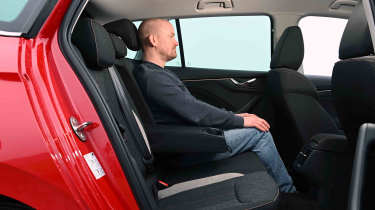
There’s loads of space in the back, with the Kamiq easily beating rivals such as the Peugeot 2008, Jeep Avenger and Ford Puma. Headroom, in particular, is excellent for a car in this class, but kneeroom is also among the best the segment has to offer.
The seats themselves are fairly soft and supportive – even in the centre seat, which can often be a little overlooked – and large plastic openings make it easy to access theIsofix points when installing a child seat.
Boot space
For a car of this size, the 400-litre boot is decent. It’s not quite the largest in its class – the Nissan Juke, for example, has 422 litres of space – but the Skoda’s wide opening, square shape and high roofline make it a useful area. Drop down the rear seats, and that volume grows to an impressive 1,395 litres.
A variable boot floor is a £210 option that’s well worth the investment. Without it, there’s quite a drop beyond the opening, which makes it a little trickier to lift heavy items into position, and once the seats are folded, it creates a useful flat load-through area. If you’re willing to sacrifice just a little more storage capacity, then a space-saver spare wheel is offered as an option.
“Rear passengers have room to spare, particularly when it comes to headroom, plus space under the front seats for their feet. Two adults would be very comfortable back there.“ - Ellis Hyde, news reporter.
Reliability & safety
Pros |
|
Cons |
|
The Skoda brand finished midway in the 2025 Driver Power survey, finishing 13th out of 31 car manufacturers. This is rather disappointing, given that the brand regularly placed within the top five only a few years ago.
The Kamiq was awarded a full five-star rating from Euro NCAP when it was originally evaluated in 2019, however this has since expired due to the testing criteria becoming much more stringent.
It’s a shame that Skoda charges extra for a driver’s knee airbag and rear side airbags.
Buying and owning
- Best buy: Skoda Kamiq SE L Edition 1.0 TSI 116 PS
If you’re prepared to fork out a few extra pounds, we think the SE L Edition trim adds the necessary extra kit to make this small SUV into a more premium and convenient offering. Keyless entry and start, heated seats and all-round parking sensors are useful touches.
The more powerful 1.0-litre TSI engine offers ample power and respectable refinement without guzzling fuel. So running costs won’t be too alarming.
Skoda Kamiq alternatives
Since the Kamiq is based on the Volkswagen Group’s tried-and-tested MQB platform, it’s obvious that its main rivals are going to be the platform-sharing Volkswagen T-Cross and Volkswagen Taigo, plus the SEAT Arona. It’s positioned a little higher than those models on price, but it’s also slightly larger, so you’re getting more car for the money.
The small SUV market has a lot of contenders. There’s the funky Citroen C3 Aircross, quirky Nissan Juke, fun-to-drive Ford Puma and the well-rounded Renault Captur. These all have varying levels of hybrid assistance (as well as all-electric options). Other models offered with hybrid drive include the Hyundai Kona and Toyota Yaris Cross, while cars such as the Jeep Avenger, Peugeot 2008 and Vauxhall Mokka have petrol, hybrid and fully electric variants.
Key updates of the Skoda Kamiq review
5 June 2026: Latest driving impressions and pricing data.
Frequently Asked Questions
You can deactivate it by pressing a button on the steering wheel. Simply select the one with the car icon surrounded by a circle, then scroll to the speed limit detection option and turn it off. You’ll have to do this before every drive, though.
Deals on the Skoda Kamiq and alternatives
Skoda Kamiq
Nissan Juke
Volkswagen T-Cross