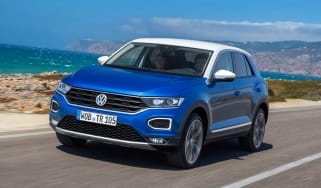
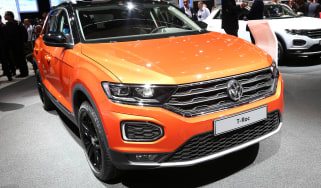
Volkswagen T-Roc review
The key strengths of the original T-Roc have been enhanced with improved quality and tech for the second generation

Our opinion on the Volkswagen T-Roc
Thanks to its size and shape, the Volkswagen T-Roc has very much fitted its brief of being a Volkswagen Golf-sized SUV, and this second-generation model makes more sense than the original, having been improved in every area. There’s a great new interior, much improved tech, efficient powertrains and a responsive driving experience, so VW has created a mature new T-Roc that’s a worthy addition to the range.
About the Volkswagen T-Roc
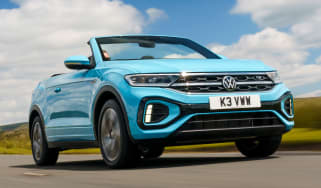
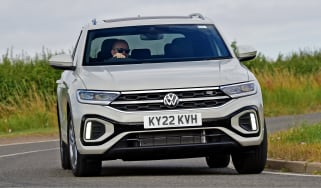
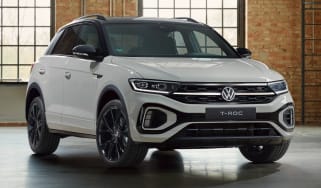
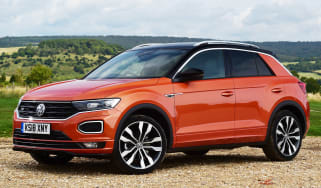
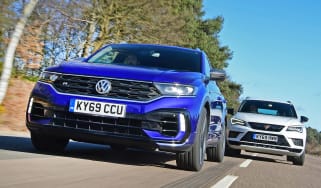
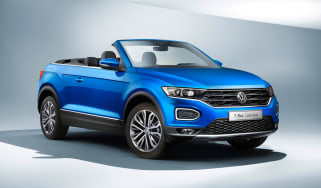
The Volkswagen T-Roc is a style-led SUV that sits between the T-Cross and Tiguan in the VW range. It doesn’t just fill a handily sized gap, though, because it’s also one of the firm’s more eccentrically designed SUVs, with bright colours, large wheels and even a high-performance range-topper on the way.
It has resonated with buyers, because the first-generation T-Roc was a huge success, with more than two million sold since 2017. Not wanting to isolate customers, VW says the new model enhances the original’s key traits with better quality, slicker powertrains and similar sleek styling.
We've tested the T-Roc abroad on the international launch, and conducted a twin-test on home soil of a Volkswagen T-Roc R-Line against a Toyota C-HR GR Sport. We've also tested a T-Roc 1.5 R-Line as part of our 2026 Towcar of the Year awards.
Performance & driving experience
Pros |
|
Cons |
|
At launch, the Volkswagen T-Roc has one 1.5-litre eTSI mild-hybrid turbo petrol engine on offer in two states of tune, and is available in all manner of VW Group models, and it offers a good mix of refinement, efficiency and performance. However, this is just the start of a wave of powertrain options.
Used - available now

2024 Volkswagen
T-Roc
20,505 milesManualPetrol1.0L
Cash £15,237
2025 Volkswagen
T-Roc
27,698 milesManualPetrol1.5L
Cash £17,244
2019 Volkswagen
T-Roc
64,341 milesManualDiesel1.6L
Cash £12,677
2024 Volkswagen
T-Roc
22,064 milesManualPetrol1.0L
Cash £15,317VW has already announced that a new T-Roc hybrid model will join the ranks later in the year, and it, too, will be available in two states of tune: 134bhp or 167bhp. Both versions will, like the existing eTSI, power the front wheels through a seven-speed dual-clutch transmission.
A bigger 2.0 eTSI with around 200bhp will arrive later. This will run a similar mild-hybrid system to the 1.5 eTSI but feature 4Motion all-wheel drive and 200bhp. A top-spec T-Roc R will arrive with a 328bhp power figure and standard 4Motion all-wheel drive to complete the line-up.
Performance, 0-60mph acceleration and top speed
The 1.5 eTSI comes with either 115bhp or 148bhp, although the lower-powered engine can’t be had with sporty R-Line trim. This entry-level engine is rather meek, and takes 10.5 seconds to get from 0-62mph. But the more powerful variant is quicker; with 250Nm, it does 0-62mph in 8.9 seconds.
These don’t sound like impressive figures, but thanks to a combination of turbocharging and the boost from a mild-hybrid system, acceleration feels effortless from idle. There’s very little noise or vibration, and the powertrain makes good progress without feeling strained. It’s not the most engaging car to drive, but more charismatic options are coming later.
| Model | Power | 0-62mph | Top speed |
| T-Roc 1.5 TSI 116 DSG | 114bhp | 8.9 seconds | 132mph |
| T-Roc 1.5 TSI 150 DSG | 148bhp | 8.9 seconds | 132mph |
Town driving, visibility and parking
The T-Roc’s crossover body sits you higher than in a Golf, but compact external dimensions and a low bonnet mean it doesn’t feel too big or unwieldy. Visibility is excellent, and the bonnet’s slightly raised edges can be seen from the driver’s seat, making the car easy to place on the road.
Rear visibility is also good, despite the big C-pillars, and a reversing camera makes parking easy. If there was one caution, it would be that bigger wheels will be easy to catch on kerbs and rough sections of road.
Low-speed manoeuvrability is as good as in any hatchback, and the relatively fast and light steering makes slipping through traffic easy. The steering is accurate, too, making for an unintimidating drive no matter your skill.
Country road driving and handling
This is where the T-Roc does very well in comparison with its rivals. It’s always largely driven like a slightly higher-riding Golf, and there’s an innate polish to the T-Roc’s driving experience. Even with bigger wheel options, it seems to shrug off road bumps and cambers without issue.
There’s a fundamental stability to the VW in corners, which is helped by steering that is accurate and connected, and the whole feeling behind the wheel creates confidence in a class where this is often set aside in favour of more cabin space or easier low-speed manoeuvrability.
Motorway driving and long-distance comfort
This inherent ease is apparent at motorway speeds, too, where the responsive powertrain makes it easy to keep up with traffic. It’s also impressively refined inside the cabin, although road noise in cars on larger wheel sizes will be slightly louder.
A tall seventh gear, and the engine’s overall refinement also help, making this an easy cruiser, and the adaptive cruise control that’s standard across the range is well calibrated. The T-Roc delivers a grown-up and multi-faceted driving experience. This initial range of engines only scratches the surface of what this chassis is capable of delivering. We look forward to seeing what the future hybrid, and hot R models deliver.
"If you’re constantly on and off the throttle, the seven-speed dual-clutch transmission can be indecisive when selecting between ratios, but if you train yourself to make smooth inputs, this greatly improves. It’s a familiar trait from the last T-Roc, but overall the mild-hybrid system does broadly help to deliver a relaxed driving experience." - Dean Gibson, senior test editor
MPG & running costs
Pros |
|
Cons |
|
For now, Volkswagen continues to segregate its electric and combustion-engined models, so the T-Roc isn’t available with an electric option, although all current T-Rocs will feature some level of hybrid system. The 1.5 eTSI mild-hybrid gets relatively good economy figures, with up to 50.7mpg and emissions of 127g/km for the 115bhp variant, and 50.4mpg and 128g/km for the 148bhp model.
Our experience in a high-spec 148bhp R-Line model with 19-inch wheels driving a route mostly on dual-carriageways saw a return of 41.9mpg, which is fairly decent when you consider that the mild-hybrid system is designed to work best at lower speeds. The mild-hybrid system feels very easy to get along with; the stop-start setup is seamless, and the car is happy to disengage the gearbox or shut down the engine completely when cruising to help reduce fuel consumption.
VW hasn’t announced efficiency numbers for the full-hybrid T-Roc just yet, but has said it will offer a 15 per cent improvement over an equivalent mild-hybrid. That suggests CO2 emissions close to the 100g/km mark and potentially returns of around 60mpg, based on the numbers we saw during our test of the 148bhp R-Line.
| Model | MPG | CO2 | Insurance group |
| T-Roc 1.5 TSI 116 DSG | 50.7mpg | 127g/km | 14 |
| T-Roc 1.5 TSI 150 DSG | 50.4mpg | 128g/km | 18 |
Insurance groups
The VW T-Roc kicks off in group 14 for the less powerful 1.5 eTSI Life, while the 148bhp version sits four groups higher. Style trim bumps the insurance rating up to 15, while R-Line starts in group 20 because it only comes with the more powerful 1.5 eTSI.
Tax
Currently the T-Roc slips under the £40,000 luxury car tax threshold, so it only costs £200 per year in Vehicle Excise Duty (VED) road tax. However, it’s easy to break that mark by adding options, while later versions are likely to start above that figure, and road tax rises significantly for the first five years it’s paid. For business users, Benefit-in-Kind (BiK) company car tax rates are steep, but they should improve when the hybrid version arrives.
Depreciation
VW’s generally have impressive residuals, and this new-generation T-Roc falls in the 47 to 50 per cent range, which is competitive with its main rivals, but isn't quite as strong as the 48 to 53 per cent range of the Citroen C3 Aircross.
Interior, design & technology
Pros |
|
Cons |
|
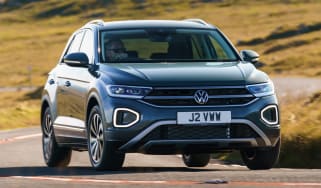
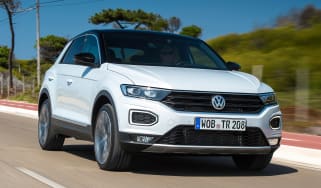
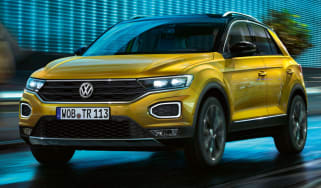
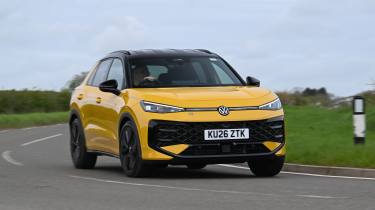
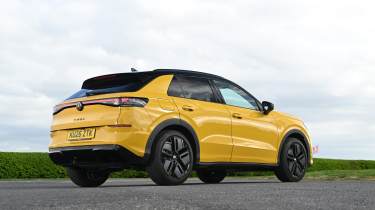
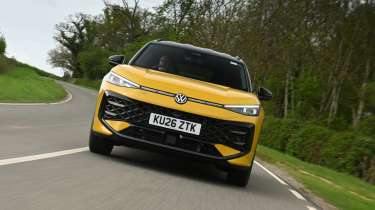
The T-Roc is designed to be one of VW’s more eccentric models, defined by one or two key design elements, such as the ‘hockey stick’ trims above the windows, which have been reimagined for the second generation. While it means there’s less of a stylistic leap than some customers might hope for the second generation, actually study the design and you’ll see it’s quite different.
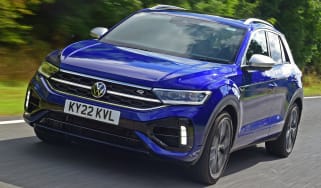
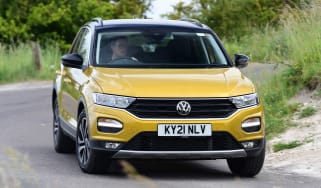
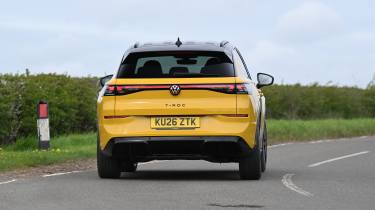
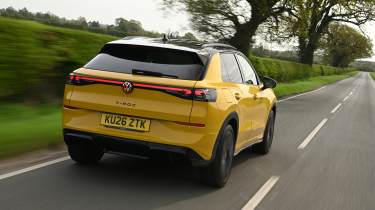
New to this generation is a much sleeker set of lights front and rear, including light bars and illuminated badges. The body itself is also now more aggressively proportioned, with bigger wheelarches and more pronounced flares above them. VW offers wheel sizes of up to 20 inches, while colour schemes offer brighter options, with three primary colours, including a canary yellow, giving the palette some life.
Standard equipment for the Life model includes 17-inch alloy wheels, an eight-inch digital driver’s display, a 12.9-inch central touchscreen, wireless Apple CarPlay and Android Auto, LED headlights, a rear-view camera and adaptive cruise control.
Our preferred Match trim includes:
- 18-inch alloys
- Rear privacy glass
- Digital cockpit pro
- Sat-nav
- IDA voice assistant
- Heated front seats
- A heated steering wheel
Upgrading to Style trim adds a significant amount to the T-Roc’s price, and includes 18-inch rims, upgraded headlights, ambient lighting, a heated leather steering wheel and heated front seats. The R-Line features different exterior styling, stainless steel pedals, sports seats in the front and sports suspension that lowers the ride height by 15mm.
Interior and dashboard design
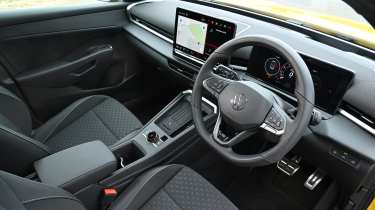
One area where Volkswagen has fundamentally changed the T-Roc is its interior. In previous generations, this almost felt like an afterthought, with a noticeable reduction in quality when compared with the Golf. For this generation, that notion has been turned on its head, because the latest T-Roc’s cabin isn’t just a vast improvement, but also proof that VW is listening to its customers.
The core design is simple, with a straightforward driver’s display and main touchscreen mounted on a clean dash. There aren’t many eccentric design features, but what is here is great, including the upholstered dash-top, soft-touch materials around the key parts, a nicely shaped centre console and a few key physical controls.
Materials and build quality
The first thing you notice about the cabin is its much higher-quality elements that you can see and touch. The new fabric panel across the main part of the dashboard isn’t just padded; it features a running-shoe-like texture that replaces a typically hard and unsightly slab of plastic. This is surrounded by higher-quality material elements, including the section where you'd generally rest your hand when using the touchscreen.
There are more soft-touch materials on the door cards, and while there isn’t the same sense of colour as the previous generation, you can specify a light grey-coloured seat and dash option to lift the overall ambience. And when the sun goes down, the extensive ambient lighting elements begin to glow and give a very upmarket feel.
The good news is that unlike some cars which feature soft plastics but don’t back it up with actual build quality, the T-Roc feels like VW at its best. The dash and centre console are completely solid, the controls around the steering wheel are nicely damped and high-end, while there’s a satisfying thunk when you close the doors.
Infotainment, sat-nav and stereo
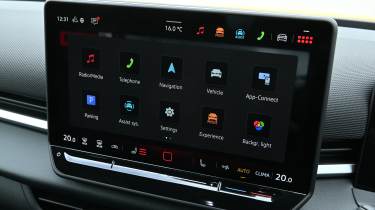
Matching the upscale materials and build quality are the T-Roc’s digital interfaces. All models have a dual-screen set-up with a 10-inch driver’s display and either a 10.3 or 12.9-inch touchscreen.
The main touchscreen features the same controversial volume and temperature sliders as other VW products, but they work within an ecosystem that’s far better resolved. The key thing is that the main interface is now much more responsive and doesn’t require an IT degree to navigate.
The main screen has all your key functions, including a static section for the air-conditioning, while elements such as the active driver aids and drive modes are all instantly accessible at the top of the home screen. We’d still like some physical controls for the air-con, but there is no annoying digging through sub-menus for anything you’d use daily.
One physical control worth mentioning is the programmable volume knob in the middle of the centre console with the starter button next to it. As well as controlling the audio level, it can also operate other functions. One press and it’ll change the drive mode or the colour of the interior ambient lighting – it’s a very welcome addition to an already impressive cabin.
Connecting your phone is easy, and we found it to be completely reliable via wireless Apple CarPlay. When in CarPlay, it’s easy to switch back to the native system. The driver’s display is also excellent, with clear graphics and a good variety of layouts depending on your preferences. The screen’s ability to match its colour to the ambient lighting is also a nice touch.
VW has also reverted to physical controls on the steering wheel, which make operating the driver’s display far more intuitive than the previous touch-sensitive buttons. In fact, compared with many modern digital-dial packs, the T-Roc has a huge array of options that can be set up precisely.
"The new T-Roc is clear evidence that VW is listening to customers and giving its models the class-leading cabins they expect. Quality, tech and materials are all excellent." - Jordan Katsianis, news editor.
Boot space & practicality
Pros |
|
Cons |
|
The T-Roc’s style-led position in the VW range has its compromises when it comes to interior space. The cabin isn’t quite as roomy or versatile as in many rivals, although if you need more capacity, VW caters for you with the larger Tiguan.
Storage up front is generous, with a big central bin and a decent-sized glovebox. However, there are no outstandingly large storage spaces, and the semi-open nature of the centre console might not suit everyone. There are no plug-in hybrid variants, but it remains to be seen if the future hybrid models have to compromise in terms of boot space.
Dimensions and size
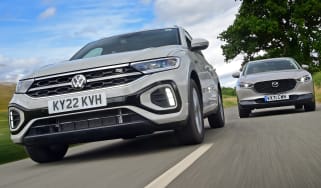
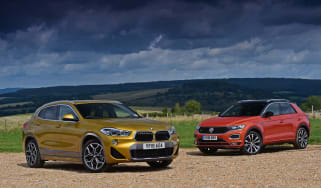
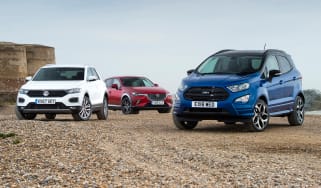
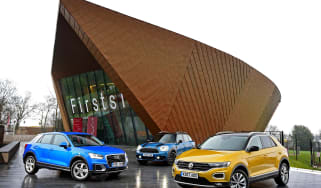
At 4,373mm the T-Roc falls between the small and medium SUV segments, so it’ll come across two general types of rivals. Closest in many respects is the Nissan Qashqai, which is slightly larger than the T-Roc in most dimensions, and it’s also close in size to the mechanically related Cupra Formentor. The Toyota C-HR is another segment-buster, and while it shares similar external dimensions to the T-Roc, it has a much smaller cargo area, courtesy of the battery that’s part of its hybrid powertrain.
The T-Roc is smaller than many medium-sized SUVs at a similar price, such as the Kia Sportage, Hyundai Tucson, Peugeot 3008, Toyota RAV4, Honda CR-V, Renault Austral and Ford Kuga. Look downwards in rival ranges and the VW is larger than many small supermini-based, models such as the Ford Puma, Peugeot 2008 or Nissan Juke, but it’s also considerably more expensive.
Dimensions comparison | |||
| Model | VW T-Roc | Toyota C-HR | VW Tiguan |
| Length | 4,372mm | 4,362mm | 4,539mm |
| Width | 1,828mm | 1,832mm | 1,859mm |
| Height | 1,573mm | 1,564mm | 1,658mm |
| Wheelbase | 2,629mm | 2,640mm | 2,677mm |
| Boot space | 475 litres | 447 litres | 652 litres |
Seats & passenger space
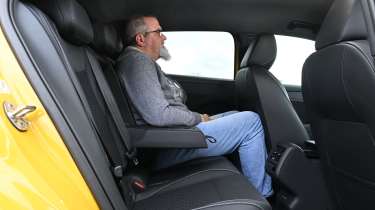
As with the larger Tiguan, the T-Roc’s new seats are superb. They offer excellent comfort and support for long-distance driving, and there’s lots of adjustment to the driving position. And despite the car’s compact exterior dimensions, it feels bigger inside than it looks from the outside.
The second row is a little more compromised. Width isn’t too bad, but the relatively small windows can make it feel more enclosed, although it’s not as claustrophobic as a Toyota C-HR inside. There’s a transmission tunnel for middle-seat passengers to contend with, so foot space is a little tight.
There are easy-to-access Isofix points on the front passenger seat and second row, and while the T-Roc’s roof slopes to the rear, the doors open wide for good access. It’s also at a decent height for loading kids. However, if you’re after more family-friendly space in the second row and a bigger boot, the Tiguan is a better option.
Boot space
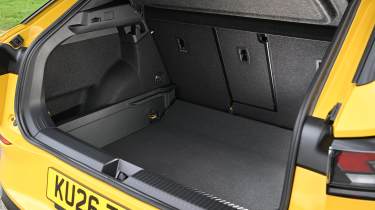
The T-Roc’s overall boot space is good on paper, with 475 litres matching most rivals, and bettering others such as the Toyota C-HR. However, the sloping rear glass makes the space less versatile.
While the loading lip is relatively high, the second-row seating does split into three sections. This is handy for carrying long items while still being four-up in the cabin. There aren't any remote seat latches, though, and the seat backs don’t fold completely flat. Total space is 1,350 litres with the rear seats folded.
While there’s plenty of space in the back for bulky items, and some handy under-floor storage, including a deep area under the floor that’s roomy enough to fit an optional space-saver spare wheel, we feel larger SUVs would suit being used as regular child-friendly transport.
Towing
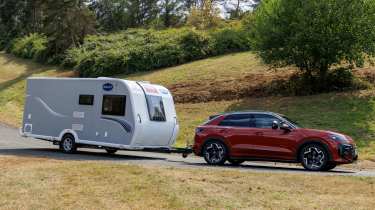
Volkswagen offers different towing capacities depending on the engine variant. As it stands, the entry-level 116bhp 1.5-litre variant is rated to haul a braked trailer or caravan of up to 1,500kg, while the 148bhp 1.5-litre variant can handle up to 1,700kg. The latter was awarded as the best tow car in the 1,100-1,400kg category, with the judges impressed by the traction and level of performance provided by this version, its cruising refinement, and the confidence-inspiring handling of the T-Roc.
Reliability & safety
Pros |
|
Cons |
|
Volkswagen has given the T-Roc a comprehensive active safety suite, and many key elements are fitted as standard on every model. This includes functions such as vehicle braking when the car senses another road user turning or swerving into your lane, a predictive speed limiter, front cross-traffic alert and emergency autonomous braking with pedestrian and cyclist monitoring. All these features helped it achieve a five-star Euro NCAP safety rating, which beats the now four-star-rated Nissan Qashqai.
It’s too early in this new T-Roc’s model cycle to get a solid idea of specific reliability, but the Volkswagen brand needs to do more according to the results of the 2026 Driver Power customer satisfaction survey, because the brand came in a rather disappointing 26th place out of 30 manufacturers. Owners weren't happy with their cars' running costs or the infotainment system's user-friendliness.
As ever, Volkswagen’s warranty coverage is only basic, with three years of cover for all its cars and a 60,000-mile distance cap, although you can extend the warranty at extra cost up to 100,000 miles. There’s a stingy 12 months of roadside assistance included, too.
| Euro NCAP safety ratings | |
| Euro NCAP safety rating | Five stars (2025) |
| Adult occupant protection | 91 per cent |
| Child occupant protection | 87 per cent |
| Vulnerable road user protection | 87 per cent |
| Safety assist | 77 per cent |
Buying and owning
Best buy: Volkswagen T-Roc 1.5 eTSI 150 Match
Prices for the new Volkswagen T-Roc start from just over £31,500, rising to a little over £32,000 for Match. The more premium Style trim commands a significant premium, costing over £36,000, and, due to R-Line only being available with the more potent 148bhp petrol engine, it costs an eye-watering £39,000.
The 1.5-litre MHEV petrol engine with 148bhp is our pick because it offers a brilliant combination of easy performance and efficiency. For the sort of car the T-Roc is, which is to say an effortless daily driver with some level of practicality, this makes a perfect pairing. The high levels of standard equipment provided by Match trim mean you don’t need to splash out on the top-spec car to get the right toys, and with our preferred engine, it comes in at a little over £34,000.
There are offers available on the new T-Roc via the Auto Express Buy a Car service, with savings of up to £3,000 off list prices, and monthly leases starting from around £220 a month.
Volkswagen T-Roc alternatives
The T-Roc has a laundry list of rivals, including the best-selling Nissan Qashqai, Hyundai Kona and Toyota CH-R, which can be smaller but also less expensive than the stylish VW. While the previous T-Roc never quite felt worth its price tag, the new one is a different story. It’s not as big as similarly priced competitors, and it won’t be able to match the equipment levels of its Chinese, Korean or Japanese rivals, but the T-Roc is among the best in class to drive, and is nicely efficient to boot.
Volkswagen T-Roc pictures
Key updates of the Volkswagen T-Roc review
22 September 2026: Mention of the T-Roc 1.5 150 eTSI winning the 1,100-1,400kg category of the 2026 Towcar of the Year awards.
11 August 2026: Updated to include the Match trim level
Frequently Asked Questions
The latest Volkswagen T-Roc requires servicing every 12 months or 9,300 miles, whichever comes first.
Deals on the Volkswagen T-Roc and rivals