BMW iX1 review
The BMW iX1 is a strong all-rounder that has premium and mainstream SUVs in its sights

Our opinion on the BMW iX1
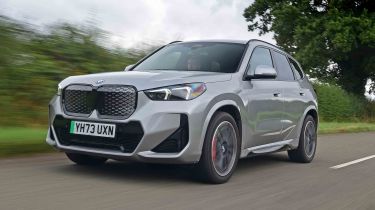
As it stands, the BMW iX1 is the smallest EV in the German firm’s range. That doesn’t mean it has much in common with the i3 that was previously the most compact model offered. While that was an innovative, smartly designed small car, the iX1 instead takes aim at the popular compact SUV crowd by utilising the well-proven BMW X1 as its basis.
About the BMW iX1
The BMW iX1 is an offshoot of the standard X1 line-up, with both front and four-wheel drive powertrains on offer. The trim levels also mirror those of the BMW X1, with Sport, xLine and M Sport to choose from.
There’s just one body style, a five-door, five-seat compact SUV, but if you want something a bit more distinctive, there’s the all-electric BMW iX2 which shares the same underpinnings but has a coupe-SUV body.
Our expert road testers have put the BMW iX1 through its paces since it first arrived in the UK. This electric SUV has faced both the pre-facelift Tesla Model Y and Volvo C40 (now updated and renamed EC40) in our real-world twin tests. We also experienced what it's like to live with the BMW iX1, because our news reporter, Ellis Hyde, spent six months with one as part of our long-term test fleet.
Performance & driving experience
Pros |
|
Cons |
|
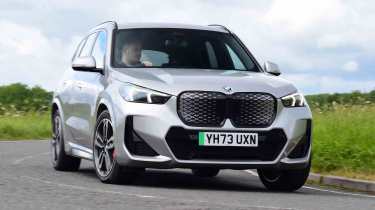
When choosing an iX1, it’s well worth considering just how much you desire the style of M Sport, because its large wheels and sports suspension can result in a very hard ride. It’s bordering on the sort of firmness that buyers would expect from a hot hatchback, so it can start to feel a little tiresome in a family car while you’re just trying to take a relaxed daily commute.
Used - available now


Choose xLine trim, or the lower Sport (only available with the eDrive20 powertrain) and the standard suspension setting and smaller wheel sizes help to take the edge off. Even so, if you value comfort, then the Audi Q4 e-tron is a much better option.
The iX1’s brakes offer a reassuring feel and a smooth transition between the motor regeneration and the mechanical system kicking in. There are three choices of regenerative braking to choose from, but they’re a little fiddly to adjust because they’re chosen via the infotainment system, as opposed to the more intuitive paddles that some rivals employ. There’s also an adaptive regen system, which uses navigation and traffic data to decide how much regen to use, but like all systems of this type, it’s inconsistent and unpredictable.
Performance, 0-60mph acceleration and top speed
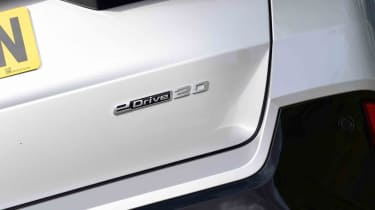
The entry-level eDrive20 uses a single front-mounted motor that produces 201bhp and 250Nm of torque, which is good for a 0-62mph time of 8.6 seconds. Above that sits the twin-motor, four-wheel-drive xDrive30. Output climbs to 309bhp and 494Nm, which is enough to slash three seconds from the eDrive20’s 0-62mph time. Both models use the same 66.4kWh (net) battery pack, which is smaller than the class average.
If you’d like, acceleration can be accompanied by a sci-fi-esque feedback noise provided by film composer Hans Zimmer, which works surprisingly well. Behind the steering wheel is a single, left-hand paddle, which engages the ‘boost’ mode, allowing the electric motors to deliver their full potential for 10 seconds.
| Model | Power | 0-62mph | Top speed |
| iX1 eDrive20 | 201bhp | 8.6 seconds | 106mph |
| iX1 xDrive30 | 309bhp | 5.6 seconds | 112mph |
Town driving, visibility and parking
The upright driving position of the iX1, along with its relatively long and flat bonnet, helps when navigating around town and in tight car parks. It also comes with front and rear parking sensors and a reversing camera as standard to lessen the chances of hitting obstacles, or you can get a 360-degree camera system as part of the Technology Plus Package, which will also record footage in the event of a collision (with the ignition on), the car is stolen, broken into, or towed.
You won’t find the steering to be the last word in feedback, but it is precise and light enough not to make low speed driving in town a chore. M Sport models come with a rather chunky steering wheel rim that some may initially find odd to hold.
The accelerator response is crisp and gives you the confidence to go for gaps in the traffic, but we would like it to be easier to adjust the regenerative braking so you can take full advantage of one-pedal driving when shuffling along in traffic. The larger 19- and 20-inch alloy wheel sizes exacerbate the iX1’s firm ride over speed bumps and drain covers, so we’d suggest sticking to the smaller 17- and 18-inch wheel sizes instead.
Country road driving and handling
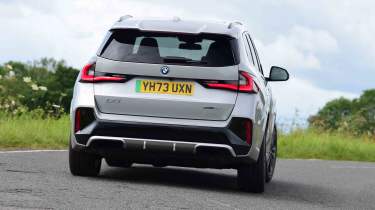
The flipside of the iX1’s firm ride is that it handles more sharply than most of the alternatives in this segment. This is all relative, though; as a heavy, electric SUV, it still doesn’t set pulses racing in the way that some of BMW’s other products can. Even the brand’s larger offerings, like the BMW iX, manage to deliver decent handling with class-leading comfort – something the iX1 doesn’t achieve.
The steering is very precise and offers a little feedback to the driver even if, more often than not, this is just to let the driver know that the front tyres are reaching the limits of their grip.
Motorway driving and long-distance comfort
Regardless of whether you go for the single or twin-motor model, the BMW iX1’s power delivery is very smooth, providing a sharp throttle response without overwhelming the traction of the tyres. A ‘Boost’ paddle to the left of the steering wheel gives you maximum power for 10 seconds, but in the eDrive20 we noticed little to no difference between pulling the paddle and simply pushing the accelerator pedal as far as it’ll go.
The iX1’s motors remain quiet at higher speeds, and wind noise is kept well under control. This means that road noise is the most conspicuous sound you’ll hear, but it’s not unnecessarily harsh, more of a distant bassy rumble. It’s only marginally louder than the likes of the Audi Q4 e-tron and quieter than the Mercedes EQA and Tesla Model Y.
“In my opinion, the only thing it really lacks is a sense of fun, although that’s probably not a top priority for the people looking to buy a premium electric SUV like the iX1. And if you are, the Beemer is well worth your attention.” - Ellis Hyde, news reporter.
Range, charging & running costs
Pros |
|
Cons |
|
When running an early BMW iX1 eDrive20 M Sport on our long-term fleet and over a wide mix of urban motorways, A-roads and town driving, it averaged 3.7 miles per kilowatt hour. With its net capacity of 66.4kWh, the iX1’s battery is a little smaller than most of its key rivals. Based on our test car’s efficiency, the iX1 would cover around 246 real-world miles between charges, which isn't quite as good as the official 288-mile range (294 miles in Sport trim with smaller wheels).
However, updates introduced in 2026 include a more efficient power electronics inverter using silicon carbide technology, which sounds quite fancy and increases the overall range to 318 miles for the eDrive20. Those same improvements are also coming to the four-wheel-drive xDrive30 version, increasing the range from 270 miles to 288 miles. Neither turns the iX1 into a long-distance EV champion, but they are all welcome improvements.
When it comes to topping up the battery in a hurry, a maximum charge rate of 130kW is a fair bit slower than rivals such as the Tesla Model Y (at 250kW), too. Due to that, it'll take 30 minutes to top up the battery from 10-80 per cent state of charge, whereas it'll take 28 minutes to do the same with the higher capacity 82kWh battery in the Model Y. Utilise a 7.4kW home wallbox charger, and it’ll take around 10 hours to fully recharge the battery of a BMW iX1.
| Model | Battery size | Range | Insurance group |
| eDrive20 Sport | 66.4kWh | 318 miles | 29 |
| xDrive30 xLine | 66.4kWh | 288 miles | 37 |
Insurance groups
Insurance groups start from 29 for the entry-level iX1 eDrive20 Sport and climb to 38 for the xDrive30 M Sport and Shadow Edition. This means that most variants of the BMW should be slightly cheaper to cover than the Tesla Model Y, which sits in groups 37 to 47. The Audi Q4 e-tron, meanwhile, resides in groups 32 to 40.
Tax
Electric cars are now liable for the standard rate of VED road tax, and the BMW iX1’s pricing structure and extensive list of options can push some variants over the £50,000 luxury car tax threshold. If you opt for one of these models, you’ll be liable for an additional £440 annual charge between years two and six after the car is first registered. EVs will also be subject to an eVED pay-per-mile fee if that comes into force from April 2028 onwards and is likely to ramp up in terms of cost from April 2029.
Company car drivers still benefit from the lowest applicable Benefit-in-Kind tax rates when they choose an electric car, so the iX1 is a prime candidate for business use.
Depreciation
Residual values for the BMW iX1 are on par with most rivals, but aren't anything particularly special. After three years or 36,000 miles, the iX1 is expected to retain between 40 and 43 per cent of its original value. The Audi Q4 e-tron performs marginally better over the same period (41 to 44 per cent), while the Volvo EX40 is expected to depreciate more (37 to 41 per cent). However, the Tesla Model Y holds on to its value better (48 to 59 per cent).
To get an accurate valuation for a specific model, check out our free car valuation tool…
Interior, design & technology
Pros |
|
Cons |
|
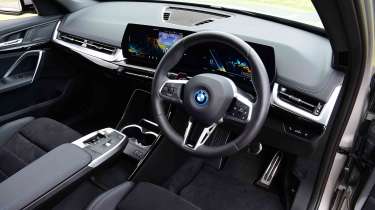
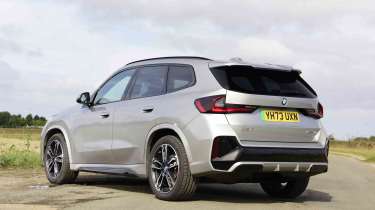
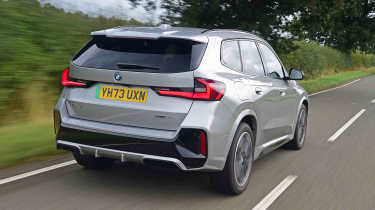
Many of BMW’s latest creations have divided opinion when it comes to looks, but the brand has played things slightly more safely with the iX1. Large grille aside, the general shape is sharply styled yet chunky enough to appeal to the SUV crowd. Wheel sizes range between 17 and 20 inches, with the latter being a £1,530 option on M Sport models. In terms of design, ergonomics and quality, the iX1’s cabin ranks close to the top of the class.
Interior and dashboard design
BMW’s interior designers have been on top form in recent years, and the iX1 is yet another hit for the brand. It offers a modern, clean interior design without completely sacrificing physical switchgear and controls. It’s a shame that the iDrive click wheel, still used on larger BMWs, is not present here, but for the most part the cabin controls are simple and intuitive to use.
There are other little touches that are well thought out: the wireless smartphone charging pad is positioned near vertical on the dash to avoid taking up too much space, and a small hinged bar secures the phone so it doesn’t move around while driving.
A pair of displays curve gently across the top of the dash, and both have a superbly sharp resolution. The colours change subtly among the driving modes, but we find that the angular layouts for the road speed and charge levels look a little fussy compared to the beautifully clear and simple analogue BMW dials of the past.
Materials and build quality
BMW’s interior quality still leads the way almost universally across the board, and the iX1 feels more sturdy than its rivals in this segment, too. The materials are top-notch and what little switchgear there is feels solid and expensive.
Infotainment, sat-nav and stereo
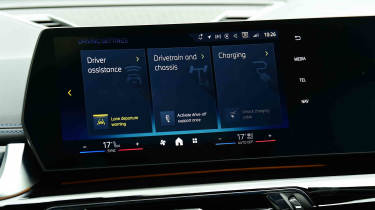
At 10.25 inches, the iX1’s main screen isn’t as large as a Tesla Model Y’s, but a second 10.7-inch display ahead of the driver caters for functions that are crammed onto the Tesla’s single screen, so they feel a little more spaced out, and the on-screen buttons are often larger. The resolution is at least as sharp as its rival’s display, too, and although it’s a shame that the climate controls are on-screen only, the arrangement isn’t as fiddly as many other rivals’ set-ups.
“I’ve been impressed by the interior quality, while the most handy storage space is the large area underneath the floating centre console. However, the tray covered by the armrest is pointlessly small, and the lid opens the wrong way, which is a personal bugbear.” - Ellis Hyde, news reporter.
Boot space & practicality
Pros |
|
Cons |
|
The front seats and steering wheel come with plenty of adjustment, although, as with most other BMWs, the wheel rim is a little thicker than in most rivals, which makes it feel slightly less precise than in most other competitors.
Storage is fairly impressive here, too, with large trays located beneath the floating centre console, and a couple of cup-holders mounted farther forward.
Our one small gripe is that the central armrest storage area is hinged away from the driver, as if it were designed for left-hand-drive markets and no one bothered to change it for right-hand-drive cars. BMW isn’t unique in doing this, however.
Dimensions and size
The BMW iX1 is shorter than both the Tesla Model Y and the Audi Q4 e-tron. The Tesla Model Y’s boot also looks much larger at 890 litres with the rear seats in place, but it’s important to remember that this figure is measured to the roof, rather than the window line.
| Dimensions comparison | |||
| Model | BMW iX1 | Tesla Model Y | Audi Q4 e-tron |
| Length | 4,500mm | 4,796mm | 4,588mm |
| Width | 1,845mm | 1,982mm | 1,865mm |
| Height | 1,616mm | 1,624mm | 1,639mm |
| Wheelbase | 2,690mm | 2,890mm | 2,764mm |
| Boot space | 490-1,495 litres | 890-2,138 litres (seats up measured to roof) | 520-1,490 litres |
Seats & passenger space
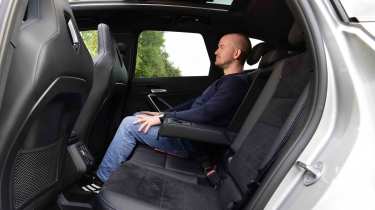
In terms of headroom and elbow room, the iX1 is as spacious as anything else in the segment, and the adjustable backrest can recline into a more relaxed position for longer trips.
The BMW lags ever so slightly behind the competition when it comes to kneeroom, where it’s not quite at SUV levels, and there is less space to stretch out than you’ll find in the back of a 3 Series. The floor has only a minimal hump in the centre, so there’s still plenty of foot room even if three people are sitting in the back. The base of the centre seat is soft, but the backrest, which doubles as a fold-out armrest, is a little firm.
Installing a child seat is straightforward, because the Isofix mounts are easy to reach behind hinged plastic clips. The rear door bins are huge, too – ideal for drinks bottles and mobile devices – so it’s great for storage.
Boot space
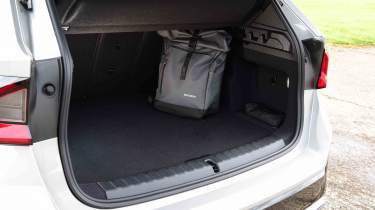
At 490 litres measured to the window line, the iX1’s boot is a generous size, if not quite class-leading. Fold the back seats down, and the volume grows to 1,495 litres when you fold down the 40:20:40-split rear seats.
Unlike the Tesla Model Y, there’s no separate storage under the bonnet for items such as cables or soft bags.
Towing
The BMW iX1 has a maximum braked towing capacity of 750kg in eDrive20 form, rising to 1,200kg for the xDrive30. An optional, electronically operated towbar is available for £875. The Tesla Model Y has the edge over the BMW, though, because all variants are able to tow up to 1,600kg. The more modestly-priced Renault Scenic also manages up to 1,100kg.
“I’m a little sad to see the car go. My parents won’t be too happy either, given that they’ve complimented the BMW for the amount of space in the cabin when I used the iX1 to take them to the airport. Despite how much luggage they had, the 490-litre boot could swallow the lot and have room to spare.” - Ellis Hyde, news reporter.
Reliability & safety
Pros |
|
Cons |
|
The petrol-powered X1 bagged a five-star rating when it was tested by Euro NCAP back in 2022, and the safety body confirmed this score applied to the all-electric iX1 when it was assessed separately in 2023. An impressive score of 92 per cent in the Safety Assist category was its strongest rating.
The iX1 didn’t appear in our 2026 Driver Power best cars to own scoreboard, but BMW’s performance in the best manufacturer league table has improved further still compared with last year, climbing from eighth to fifth place out of 30 brands, putting it just behind fourth-place Lexus. Owners told us that they liked the powertrains and acceleration of their cars, along with the interior and technology offered. High running costs were one of the few criticisms they had, although being able to refuel the iX1 overnight using a cheaper electricity tariff should help reduce the costs for iX1 owners.
| Euro NCAP safety ratings | |
| Euro NCAP safety rating | Five stars (2022) |
| Adult occupant protection | 86% |
| Child occupant protection | 89% |
| Vulnerable road user protection | 76% |
| Safety assist | 92% |
Buying, prices and deals
Best buy: BMW iX1 eDrive20 Sport
The great news is that eDrive20 versions of the BMW iX1 now qualify for the higher £3,750 electric car grant (ECG) discount from the Government. This means pricing for the eDrive20 Sport starts from just under £33,500, rising to a little under £35,500 for the x Line version. The sportier-looking M Sport is around £38,000.
Those interested in the quicker four-wheel drive xDrive30 will need to jump up to x Line trim (four-wheel drive isn't available in Sport trim) and spend around £43,000, while an xDrive30 M Sport will cost nearly £46,000.
Although this is a BMW, the less-powerful iX1 eDrive20 offers better driving range, so this is the powertrain we recommend, because we’re willing to bet that this is a bigger priority for small electric SUV buyers than outright performance. Meanwhile, Sport trim provides enough kit without adding too much to the price.
If you'd like to buy an iX1 of your own and get a healthy discount, you can configure your ideal iX1 now to get great offers from nearby dealerships, take a look at our top leasing deals or find top used models with our Buy A Car service. You can even sell your existing car for a great price with Auto Express Sell My Car.
BMW iX1 alternatives
The list of rivals for the iX1 is a veritable who’s who of the premium family EV segment, with some coming from within the BMW empire. The BMW iX2 adds more rakish styling to the same underpinnings, but you’ll ultimately be paying more money for a car with less space. A slightly more sensible BMW-sourced alternative is the MINI Countryman, which is arguably more versatile than the iX1.
Elsewhere, there’s the understated Volvo EX40 (formerly known as the XC40 Recharge), its coupe-esque EC40 sister car (formerly called C40), the Audi Q4 e-tron and Mercedes EQA - all of which come from traditional BMW rivals and offer a taste of somewhat affordable luxury. High-spec versions of the Hyundai Ioniq 5, Kia EV6, Nissan Ariya and Tesla Model Y fall into the same price range as the iX1, but they all offer more battery range. Most of these cars have more boot space, too.
BMW iX1 long-term test
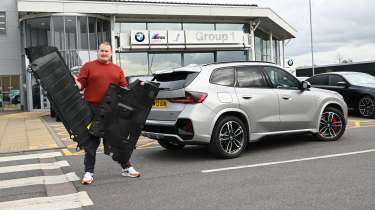
Our news reporter, Ellis Hyde, struggled to bond with the BMW iX1 during his six months with this electric SUV. While there are certainly plenty of qualities that day-to-day buyers will find desirable, Ellis couldn’t help but feel that things were noticeably lacking in the fun department. On the plus side, though, Ellis was left feeling highly impressed by BMW’s dealership customer service after a slight mishap involving some standing water. You can read the full long-term test here…
BMW iX1 pictures
Key updates of the BMW iX1 review
23 July 2026: Updated with the latest electric car grant (ECG) information and 2026 Driver Power findings
28 January 2026: Updated with news that the electric driving range will be improved for both the eDrive20 and xDrive30 models
5 January 2026: Updated to reflect the increased expensive car supplement threshold and mention the proposed pay-per-mile tax for EVs from 2028.
Frequently Asked Questions
During our time running an early iX1 eDrive20 over a variety of driving conditions, we saw a return of 3.7 miles per kWh, with an overall range of 246 miles possible based on the usable battery size. This version has since seen efficiency improvements for 2026, with the official range increasing to 318 miles between charges.
Deals on the BMW iX1 and alternatives