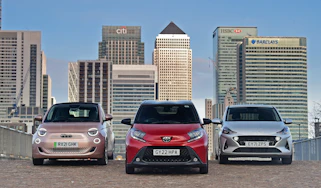
Toyota Aygo X review
The Toyota Aygo X is a compact, characterful city car with plenty to like
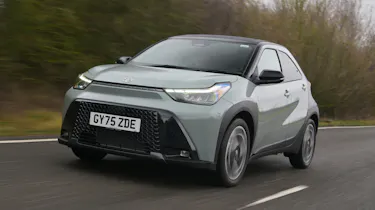

Our opinion on the Toyota Aygo X
While the Toyota Aygo can trace its lineage back more than 20 years, the current Aygo X model is a far cry from the original budget-minded city car. The arrival of hybrid drive means prices have risen way beyond inflation, but the Aygo X is far more upmarket than most other small city cars. It’s also surprisingly fun to drive, with the latest petrol-electric powertrain giving it an entertaining character that’s well suited to the cut and thrust of urban driving. If you look at it more as a two-seat runabout with a couple of chairs in the back for occasional use, it could be the perfect posh city car.
About the Toyota Aygo X
First things first, Aygo X is pronounced Aygo Cross, not Aygo-Ex. The Cross part of the name is significant because the third generation is distinctly different from the two that came before it. The original Aygo was based on a platform shared with the Citroen C1 and Peugeot 107/108 city cars, while Toyota supplied the advanced 1.0-litre three-cylinder engine.
This motor was carried over to the Aygo X, but in a new platform based on the larger Yaris supermini, after Toyota’s collaboration with its French partners ended. With it came SUV-like styling, hence the ‘X’ added to the name, while an update in 2025 saw the arrival of a new look inspired by the Toyota C-HR, as well as the introduction of the hybrid powertrain from the Yaris. This system replaces the 1.0-litre engine, rather than being sold alongside it.
Used - available now

2023 Mercedes
C-Class Coupe
43,831 milesAutomaticDiesel2.0L
Cash £20,449
2020 BMW
1 Series
27,631 milesManualPetrol1.5L
Cash £16,849
2020 Mercedes
GLB
42,742 milesAutomaticDiesel2.0L
Cash £22,349
2018 Kia
Stonic
38,419 milesManualPetrol1.0L
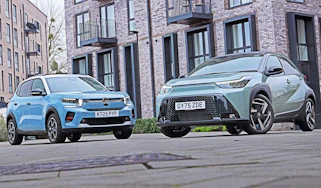
Cash £9,899We've conducted a thorough road test of the Toyota Aygo X against the Citroen C3 as part of a twin test.
Performance & driving experience
Pros |
|
Cons |
|
Adding hybrid drive to the Aygo X not only means there’s greater efficiency when compared with the old 1.0-litre model, but there’s an increase in performance, too. The powertrain has been carried over directly from the Yaris, so there’s a 1.5-litre three-cylinder petrol engine with a small electric motor and battery pack, while power is sent to the front wheels through a CVT transmission.
Given that the Aygo X is based on a shortened Yaris platform, the petrol engine, electric motor and gearbox fit relatively easily under the bonnet. Toyota did lengthen the car’s nose ever so slightly, but it doesn’t look unnatural or cobbled together.
A greater challenge was presented when considering the battery, though, because placing it under the back seats, as in the Yaris, was no longer an option. Instead, Toyota has split the 0.76kWh battery into two banks directly under the rear-seat cushions, which leaves a slightly odd seating position.
To achieve this, and to also leave enough space for a fuel tank, the floor was redesigned by Toyota’s European development team. All this work was worth it, though, because of the improvements in both power and efficiency.
Performance, 0-60mph acceleration and top speed
While the Aygo X is at the very low end of the spectrum when it comes to small cars fitted with big engines, the benefits on paper and at the wheel are blindingly obvious. Acceleration is considerably faster than in the previous generation, with the latest model being 5.7 seconds faster from 0-62mph. A sub-10-second sprint time is decent for any car, especially one designed for city driving.
Peak power of 114bhp is the same as in the entry-level Yaris, and 36bhp more than in the old Aygo X, and you can feel every one of those horses in action. Even better, the hybrid’s 141Nm of torque isn’t just 48Nm more than before, it’s also aided by an electric motor that delivers instant responses, so the Aygo X feels significantly faster in real-world conditions.
| Model | Power | 0-62mph | Top speed |
| Aygo X 1.5 Hybrid | 114bhp | 9.2 seconds | 106mph |
Town driving, visibility and parking
Thanks to the hybrid system’s added get-up-and-go, the Aygo X is about as good a town car as any ICE rival, thanks to zippy performance and a seamless transmission. Being a CVT, there are no traditional gears, so the car will hold the revs at the point when it’s generating peak power. These types of gearboxes can feel a little unnatural and droney, but Toyota has many years of experience with this set-up in its hybrid models, and the Aygo X’s gearbox is quick to calm down, letting the revs fall once you’re off the throttle. Suppression of noise and vibration is significantly improved over the previous generation, too.
The Aygo X has considerable electric-only performance, and will easily run for more than half the time on electricity alone - there’s a readout on the trip computer that can show you how much electric running it has done, too. A bit more information about how much throttle travel you have left before the engine kicks in would be a nice touch, but the powertrain is still great to use in urban settings.
Visibility up front is very good, but the small glass in the rear doors, thick C-pillars and dark roof make rearward vision a little difficult. The Aygo X is very easy to drive, though, and with an ever-so-slightly raised seating position compared with the average city car, it’s a cinch to park. The ride is very well controlled, and thanks to what feels like a low overall weight, it seems to skip over road imperfections, rather than crashing into them.
Country road driving and handling
Out of town is where city cars and hybrids can come unstuck, but the Aygo X impresses with its effortless acceleration. In the old Aygo X, pulling out of a side road into a national limit required some forward planning, but the hybrid is much more comfortable, and makes the process of driving down fast roads feel effortless.
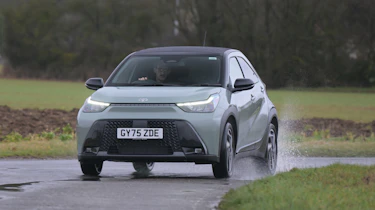
We also think the handling and ride quality are generally impressive, with the car showing an ability to handle bumps and ridges in the road that goes far beyond other city cars, and the Aygo X’s Yaris-derived chassis definitely helps here. However, while the Aygo X has large 18-inch wheels (or 17-inch items for the base model), they’re only fitted with narrow 175-section tyres. The rubber is also designed to offer low rolling resistance to help this hybrid model save fuel, so the limit of grip is lower than you might expect, especially in slippery winter conditions.
Motorway driving and long-distance comfort
The improvements made to the Aygo X are also evident on motorways, where the car is far more capable than not only the last Aygo X, but also most small-car rivals. The engine is quick to settle at a cruise, and the big wheels and secure suspension keep it from being blown off-course by crosswinds.
Every generation of Aygo and Aygo X has been able to handle high-speed motorways without too much drama in the past, but none have done it with anywhere near as much ease as this latest hybrid model.
One area the Aygo X doesn’t match larger superminis is refinement, because the lightweight body doesn’t quite have the same level of insulation from road noise as more sophisticated superminis, but it’s competitive for a city car.
"The nimble chassis and relatively relaxed stability control systems mean the Aygo X is quite enjoyable to drive quickly around town." - Dean Gibson, senior test editor.
MPG & running costs
Pros |
|
Cons |
|
Getting straight to the point, the Aygo X Hybrid is one of the most efficient non-plug-in hybrid cars on sale right now. Toyota claims an official fuel economy figure on the WLTP combined cycle of 74.3mpg, with CO2 emissions of 87g/km.
But the amazing thing about the Aygo X is that it’s not just possible to match the official figure, you can even pass it with relative ease. On our first encounter with the car on the European launch, we managed as much as 86mpg on a combination of motorways, trunk roads and urban driving, which is frankly incredible. Even when using the full performance from the powertrain, we still managed around 80mpg.
Back home in the UK in wintry conditions, we saw figures in the 55-60mpg range, but that included some additional motorway work that is unlikely to be the norm for most Aygo X users. Even so, that means the Aygo X has a range of around 370 miles despite it having a relatively small 30-litre fuel tank. Cover more miles in town, where the electric system does more of the work, and you should be able to squeeze even more miles out of a tank.
| Model | MPG | CO2 | Insurance group |
| Aygo X Hybrid Icon | 74.3mpg | 87g/km | 16 |
Insurance groups
Group ratings range from 16 to 19 according to trim level chosen, with both the Excel and GR Sport versions landing in that highest insurance group. This is a bit of an increase over the old 1.0-litre model, which was in groups 5-8.
Tax
VED road tax is charged at the standard rate, while company car buyers will be better served by a full EV such as the Citroen e-C3, Fiat Grande Panda Electric or Leapmotor T03. Although hybrid drive reduces the Aygo X’s emissions to 87g/km, that still gives it a Benefit-in-Kind liability of 23 per cent, so lower-rate taxpayers will face annual outgoings of at least £980 for even the entry-level model.
Depreciation
Residual values for the Toyota Aygo X range between 43 and 46 per cent after three years of 36,000 miles. That's a little behind the Kia Picanto, which is expected to retain around 50 per cent of its value over the same period.
To get an accurate valuation on a specific model check out our free car valuation tool...
Interior, design & technology
Pros |
|
Cons |
|
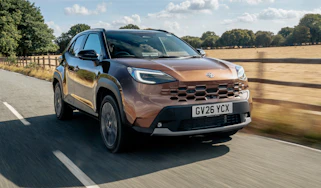
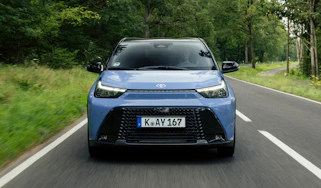
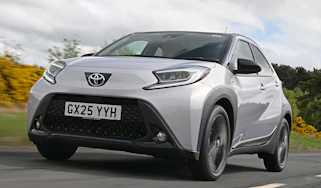
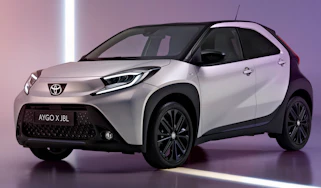
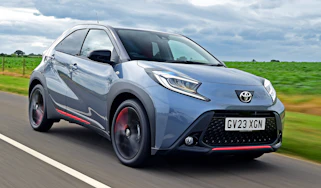
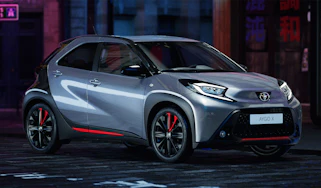
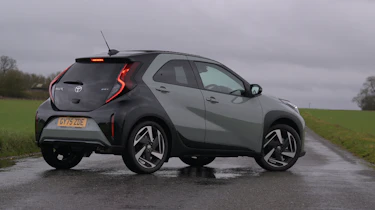
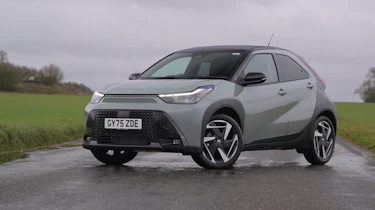
The Aygo X hybrid is easily recognisable on the outside because it features a new nose that makes room for the hybrid powertrain. The Toyota badge has migrated to the bonnet to leave a smoother front end with new light clusters and a large grille set below.
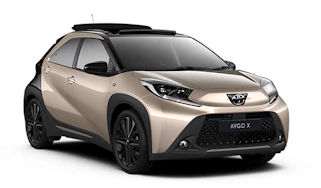
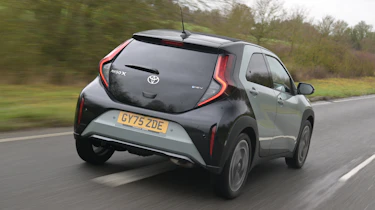
There are minimal changes elsewhere, so you get the same black plastic wheelarch cladding and two-tone paint on higher-spec cars, while the Aygo’s trademark black glass tailgate remains as a carryover from the original model. At the top of the range, the GR Sport version adds a chunky grille that gives a nod to the GR Yaris hot hatch.
Interior and dashboard design
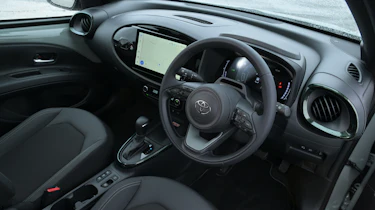
Changes to the cabin have been kept to a minimum, so you get the same large, oval centre console as before, but some elements feel a little too simple or pared back, considering the car’s price point. The design is quite funky, though, and there are some cool new fabrics and colour splashes on the dash. Excel models have air vents and centre console trim finished in glossy dark green plastic that has been given a swirling design reminiscent of a bowling ball - in some lights it looks like dirty marks, but gives the cabin a lift when caught by sunlight.
Materials and build quality
Cabin materials are fairly simple, with not much in the way of soft-touch plastics anywhere around the elements you touch. Key touchpoints, like the steering wheel, gear selector, and door pulls all have a relative Toyota-like heft, though, and the interior feels well screwed together.
Infotainment, sat-nav and stereo
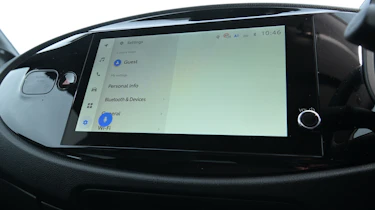
While the cabin hasn’t really changed compared with its predecessor, the tech very much has. The semi-digital instrument cluster of the last model has been replaced by a full-size colour display with a reasonable amount of layout variability.
Entry-level Icon and mid-range Design come with a nine-inch touchscreen infotainment system, while Excel and GR Sport trims feature a larger 10.5-inch display borrowed from other Toyota models. The latter dominates the dash and uses the brand's latest style of user interface. This screen size doesn’t sound like much on paper, but in the context of the tiny cabin, it feels huge – like mounting a 60-inch TV in a cupboard. The integrated system works well, but it’s best when hooked up to Apple CarPlay or Android Auto. High-end Excel and GR Sport trims gain wireless smartphone charging.
There is a set of separate climate controls that are super easy to use and well-placed.
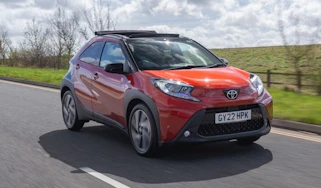
"The £1,350 electrically opening canvas roof (part of the Premium Pack with Excel trim) opens in two stages, while a pop-up wind deflector ensures airflow continues over the car, although in the fully open position there’s a bit of a breeze to be felt in the back seats. With UK weather as it is, it’s unlikely to be opened often, but it’s fairly quiet when closed, with very little wind noise heard." - Dean Gibson, senior test editor.
Boot space & practicality
Pros |
|
Cons |
|
Sprightly performance and high prices are two aspects of the Aygo X that aren’t very city car-like, but in terms of size and space, it very much fits the brief. The interior is small, to the point where the two back seats (there’s no middle belt for a third passenger) can be uncomfortable for anyone larger than a small child. This is only heightened by the oddly shaped rear seat bases, and the tiny pop-out rear windows.
Dimensions and size
The Aygo X is fairly standard in size compared to other city cars, except that its mini-SUV design makes it a little taller than the Kia Picanto. Toyota’s Yaris is one of the smaller superminis, but it’s still significantly larger than the Aygo X.
Aside from a slightly raised ride height, the Aygo X very much fits the dimensions of a city car, but it’s longer and wider than a Picanto. The Citroen C3 is a similar price, but offers more space and practicality.
| Dimensions comparison | |||
| Model | Toyota Aygo X | Kia Picanto | Citroen C3 |
| Length | 3,776mm | 3,605mm | 4,015mm |
| Width | 1,740mm | 1,595mm | 1,813mm |
| Height | 1,525mm | 1,485mm | 1,577mm |
| Wheelbase | 2,430mm | 2,400mm | 2,540mm |
| Boot space | 226-824 litres | 255-1,010 litres | 310-1,188 litres |
Seats & passenger space
The Aygo X’s compact dimensions do make it feel small inside, but there’s still plenty of seat adjustment so that taller drivers can get a comfortable position. More of an issue is that the steering wheel only adjusts for reach and not rake, which could be a problem for some.
As you might expect, cabin storage is limited, although the glovebox and front door bins are reasonably shaped. There’s no centre armrest or hidden storage, just a couple of cup-holders and a wireless charging tray ahead of the drive selector.
The rear seats are very tight, and thanks to small rear windows and a dark headlining, it can feel claustrophobic. The seat base is also tilted upwards towards the end of the cushion in order to fit the batteries underneath, making for a slightly awkward seating position that puts the rear passenger’s knees a little too high for comfort. The hip-point of rear-seat passengers isn’t any higher, though, so overall space in the rear isn’t massively compromised over the previous non-hybrid Aygo X.
The car is also a strict four-seater, with no central seat. The rear door openings are awkwardly shaped and rather small, making getting in and out a struggle. There are no mod cons, either, with only pop-out windows, a narrow tray between the seats for smaller items (it’s not even wide enough for a smartphone to sit in) and no door bins.

Boot space
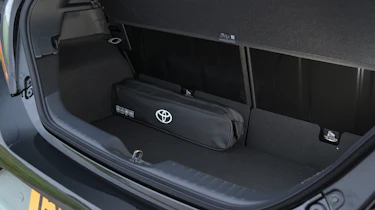
There’s a high load lip once you’ve opened the glass tailgate, but at least the floor is a uniform rectangular shape. With 226 litres of space on offer, there’s just about enough room for a weekly shop, but removing the flimsy fabric load cover doesn’t free up much more space.
The back seats have a central split and are easily unlatched via rubberised pulls on either side of the chairs. They leave a step in the floor, but the metal backs will make it easy to slide items in and out. The painted surface is likely to get scratched easily, though, and a total volume of 824 litres isn't huge.
"Practicality is where the Aygo X’s city-car nature bites back, with limited space and not much in the way of clever tricks to make the most of it." - Jordan Katsianis, news editor
Reliability & safety
Pros |
|
Cons |
|
Toyota’s strong reputation for reliability isn’t to be taken lightly with its models, and it’s backed up by an excellent warranty service. The basic coverage is three years or 60,000 miles, but if you continue to get the car serviced at a Toyota main dealer, the company will extend the warranty period for a further 12 months per service, all the way to 10 years, or 100,000 miles – whichever occurs first.
The latest hybrid-powered Aygo X ranked in 33rd place out of 50 models in our Driver Power Survey. It proved to be the most dependable car in our survey; it scored well for exterior styling, and it came second for fuel economy. Owners also liked the ride quality, braking performance, and value for money. However, low scores for acceleration, rear seat space, visibility and cabin trim all dragged down this car's overall score.
The Aygo X Hybrid received a four-star Euro NCAP rating after being tested in 2025. That's similar to other small car rivals like the Hyundai Inster, but behind the likes of the BYD Dolphin Surf, which earned the maximum five-star rating.
Every model is equipped with a Pre-Collision System with day and night Pedestrian detection, and daytime cyclist detection, intelligent adaptive cruise control (iACC), driver-attention alert, road-sign assist, reversing camera and six airbags. A Parking Pack, which includes front and rear parking sensors, is available as an option on Icon and Design trims, and standard on Excel and GR Sport trims.
| Euro NCAP safety ratings | |
| Euro NCAP safety rating | Four stars (2025) |
| Adult occupant protection | 73 per cent |
| Child occupant protection | 72 per cent |
| Vulnerable road user protection | 83 per cent |
| Safety assist | 68 per cent |
Buying and owning
Best buy: Toyota Aygo X Icon
The latest, hybrid-only Aygo X is pricier than its petrol-only predecessor, with the line-up now kicking off at just over £21,500 in Icon trim, followed by Design trim at a touch under £24,000. The posh Excel trim comes in at a little over £26,000, while the sportier-looking GR Sport is around £27,000.
There really is no bad spec, and with decent equipment across all models, we’d suggest that even a basic Icon model is the best version to go for, especially considering how much more expensive it is when compared with our favourite city car, the Kia Picanto.
While the Aygo X is still fairly new, you should be able to find some deals via the Auto Express Buy a Car service, with fresh Toyota Aygo X offers updated daily.
Toyota Aygo X alternatives
The city car class isn’t packed with options these days, and the closest rival in terms of size for the Aygo X is limited to just the Kia Picanto. While it isn't available in hybrid form and, therefore, doesn't come close to the Aygo X in terms of efficiency, it does feel more substantial.
For less than an Aygo X, you can get behind the wheel of Auto Express’ 2024 Car of the Year, the Citroen C3. This is a bigger car that offers more space than the Toyota, along with decent comfort and some funky design cues that don���t make it feel like a budget model. There’s also the platform-sharing Fiat Grande Panda, which has even more style-led details. Both of these models are available with hybrid power, or full electric powertrains.
Small EVs are scarce, but the Leapmotor T03 is one of the best value options. There are new models on the way, including a Volkswagen model based on the ID.1 concept – likely to be called ID. Lupo – and there’s a new-generation electric Renault Twingo on its way as well. Both of these European-designed models are expected to undercut the Toyota on price, too.
Toyota Aygo X picture
Key updates of the Toyota Aygo X review
10 August 2026: updated with the 2026 Driver Power customer satisfaction survey results.
11 December 2025: update to include pricing and the latest Euro NCAP safety rating.
Frequently Asked Questions
Servicing for the Toyota Aygo X is required annually or every 12,000 miles
Deals on the Toyota Aygo X and alternatives