Toyota RAV4 review
The RAV4 continues where the old RAV4 PHEV left off – it’s refined, practical and the latest plug-in hybrid system is impressive


Our opinion on the Toyota RAV4
A standout electric range figure isn’t enough to make the latest Toyota RAV4 truly shine. It honours RAV4 heritage by being competent off-road and having a decent amount of space inside, although cheap interior materials are a shame. On the road, the RAV4 feels smooth and unassuming, but ultimately a little dull.
About the Toyota RAV4
First launched in 1994, the Toyota RAV4 has become a staple of the family SUV class with more than 15 million examples having been sold – around two million in the UK. In 2025, the RAV4 was the world’s most popular car with more than a million sales. So the pressure’s on for this new, sixth-generation model.
Helping the RAV4 achieve that success over the years has been its typical Toyota build quality, genuine off-road capability and, in recent years, the hybrid efficiency that will continue with this latest model.
The Toyota is solely available as a plug-in hybrid in the UK (other markets get the option of a traditional hybrid). It’s no great surprise, however, given that 80 per cent of the previous fifth-generation RAV4 sales were of plug-in hybrids. Nevertheless, it’s still something of a shame that Brits won’t have a greater choice of powertrains.
Toyota’s newcomer has plenty of plug-in hybrid mid-size SUVs to contend with, though, such as the Hyundai Tucson, Volkswagen Tiguan and Ford Kuga. That’s before you get to the range of fresh PHEV SUVs coming out of China, such as the Chery Tiggo 8, Jaecoo 8 and BYD Seal U DM-i.
Used - available now


But the Japanese brand has given the new RAV4 a bold new look to stand out from the competition, along with a revised interior which clearly takes inspiration from the bigger, tougher Toyota Land Cruiser.
Toyota RAV4 prices and latest deals
The new Toyota RAV4 sees the return of the Icon trim, which kicks things off at £43,845. Design grade is likely to be the most popular choice with buyers, according to Toyota, and it starts at £45,745, which is only £350 more than before. There’s a bit of a step up to the £50,045 Excel model, while the top-spec GR Sport is £52,045. Toyota says first customer deliveries will begin from July 2026.
If that all seems a little steep, don’t forget you can check out used Toyota RAV4s on the Auto Express Buy a Car service with plug-in hybrid models starting from around £15,000.
Performance & driving experience
Pros |
|
Cons |
|
The sixth-generation RAV4 uses an updated ‘TNGA-K’ version of its predecessor’s TNGA platform and mostly the same body, too. The plug-in hybrid set-up has gained some tweaks to the battery and electric motors for extra range and power respectively.
As with the old RAV4, which lost the option of the ‘self-charging’ hybrid before it went off sale, the latest version is plug-in hybrid only. There’s a 2.5-litre four-cylinder engine with a CVT-style gearbox with no fixed ratios, although ‘steps’ in the transmission are designed to help make it feel like a conventional automatic.
| Model | Power | 0-62mph | Top speed |
| Toyota RAV4 Design FWD | 272bhp | 7.5 seconds | 111mph |
| Toyota RAV4 GR Sport AWD | 300bhp | 5.8 seconds | 111mph |
Performance, 0-60mph acceleration and top speed
There are two PHEVs to choose from. Previously you could only have the RAV4 PHEV with four-wheel drive, but a two-wheel drive model has been added. Dropping the electric motor on the rear axle sees the car’s total combined output reduced to 272bhp, compared with the AWD’s 300bhp. For comparison, the old front-wheel-drive RAV4 PHEV produced 215bhp, while the new 4WD’s power is unchanged from before.
Straight-line performance in the RAV4 will be more than enough for most, whichever version you go for. FWD versions go from 0-62mph in 7.5 seconds, with the AWD models completing the benchmark sprint in 5.8 seconds. Both powertrains have a 111mph top speed. The priority lies with electric running in the RAV4, so despite their differing outputs and gap in 0-62mph times, the two-wheel drive and AWD don’t feel that different in their power delivery – they also have the same amount of torque, at 227Nm. The RAV4 accelerates like an EV with responsive yet smooth power. Even when the battery is depleted and the 2.5-litre engine needs to kick in, it’s not terribly strained.
Town driving, visibility and parking
The RAV4 has always been an easygoing SUV to drive, complemented by its off-road ability, which has been part of its appeal for so long. There’s still light steering to aid low-speed manoeuvres and a high-set driving position, while a 40mm lower dashboard helps with front visibility, although the flat bonnet does stretch out a fair bit.
The old car’s parking camera was pretty average in terms of resolution and the new unit is a huge improvement, which is exactly what you want in a 4.6-metre SUV where the rear visibility is somewhat hindered by large C-pillars.
Country road driving and handling
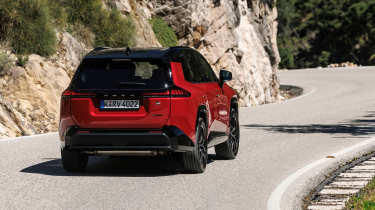
Developed in collaboration with Toyota’s Gazoo Racing wing, the new GR Sport model gets retuned steering, upgraded and strengthened suspension components, a 15mm-lower ride height with tuned front dampers, a reinforced rear brace and 20-inch wheels which provide a wider track.
The revised RAV4’s platform comes with 9.7 per cent more rigidity with up to 31 per cent stiffer mounting points in the suspension too, to improve ‘cornering performance’, according to Toyota.
When cruising, the GR Sport doesn’t feel all that different to the Design front-wheel-drive model, although we much prefer the sportier version’s figure-hugging seats. Push on and you’ll find the standard RAV4 leans in bends, especially over the front axle – but it’s all manageable and the steering never feels overly flustered. Switch to the GR Sport and things are a little more composed, yet we didn’t notice much difference either on or off road in terms of grip and power delivery, despite the all-wheel-drive layout.
Vehicle Braking Posture Control (VBPC) is another new feature of the RAV4, using braking inputs at each wheel to enhance turn-in response and agility, but overall there’s no getting away from the fact the centre of gravity feels high.
The RAV4 might have a CVT-style auto, but weirdly there are paddles on the back of the steering wheel that allow you to ‘shift’ gears. It even shows what ‘gear’ you’re in on the driver’s display, although the steps don’t really make much difference to the way the car performs, and the system will revert to auto mode if they’re not touched for a while when driving.
Motorway driving and long-distance comfort
Along with a stiffer bodyshell, the RAV4 has gained extra damping in the floor and wheelarches, plus softer suspension bushing to reduce road noise.
As the RAV4 sits in ‘EV mode’ as a default rather than engaging the four-cylinder in ‘HEV mode’, it’s very quiet most of the time. At motorway speeds, no matter if you go for the front-wheel-drive or GR Sport AWD, the RAV4 is a refined and competent cruiser that does a great job of suppressing imperfections in the road and outside noise.
MPG & running costs
Pros |
|
Cons |
|
With more than a quarter of a century of hybrid development under its belt, Toyota is a dab hand at the technology. It shows with the new sixth-generation RAV4, because while it only receives updates of the old car’s existing technology, it’s still near the top of the plug-in hybrid SUV class for electric range and eco-credentials. Toyota quotes 176mpg for the GR Sport and strangely less for the front-wheel drive (156mpg), which are both down on the old PHEV’s 282.4mpg. However, the new car has been tested under the newer, harder conditions for plug-in hybrids.
Electric range, battery life and charge time
Electric power in the plug-in hybrid RAV4 comes from a new 22.6kWh battery – up from 18.1kwh before. As well as the greater capacity, the battery gets improved thermal management for better efficiency and performance. There’s also a new geo-fencing function which automatically optimises electric-only running for the journey (as long as it’s set in the sat-nav).
For the old RAV4 PHEV, Toyota claimed an EV range of 46 miles on a full charge. The new one in Design trim offers 85 miles, only dropping to 82 miles in the all-wheel-drive model. Our drive saw a mix of hybrid and pure-EV running, although when the battery was around 75 per cent, the RAV4 had an estimated range of 50 miles, suggesting around a 70-mile range. For comparison, Volkswagen claims its Tiguan eHybrid has a range of up to 75 miles, the Ford Kuga PHEV can reach up to 45 miles and the new Jaecoo 8 SHS-P, with its massive 83.4kWh battery, is slightly below the Toyota at 83 miles.
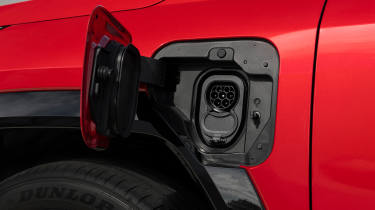
Charging has been upgraded for the latest RAV4 as well. The old car’s 6.6kW rate was agonisingly slow and really only suited to overnight top-ups, but the new model has a 50kW charge rate meaning it can be replenished from 10 to 80 per cent in 30 minutes. There’s also a new 11kW AC charger, which is twice as fast as the previous version, meaning the battery can be almost fully topped up in around three hours.
| Model | Battery size | Range |
| Toyota RAV4 PHEV AWD | 22.7kWh | 82 miles |
| Toyota RAV4 PHEV FWD | 22.7kWh | 85 miles |
Tax
Since the RAV4 Plug-in has a starting price in excess of £40,000, it faces the luxury car tax supplement for the first five years of ownership. However, that’s not uncommon in the world of PHEVs and most of its rivals incur the same cost.
Depreciation
Given how much of the new RAV4 is carried over from the fifth-generation model, we expect depreciation to be similar to before. The previous model’s residuals were in the mid-50 per cent range – pretty impressive and a match for newer rivals such as the Cupra Terramar.
Interior, design & technology
Pros |
|
Cons |
|
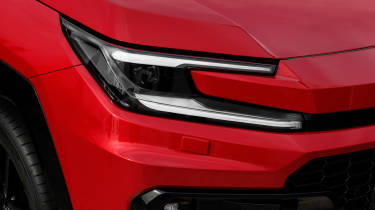
The styling of the new RAV4 has moved on quite a bit from the old car, although its proportions are almost identical. The front end features a set of C-shaped LED headlights – similar to the ones found on the new Toyota Prius and facelifted bZ4X – and there’s a honeycomb-shaped grille. The surfacing of the RAV4 is blocky, too, hinting at its rugged off-road appeal alongside the plastic wheelarch extensions. At the rear, we can see the RAV4’s new model logo sitting between its rear lights – themselves embedded in a black piece of trim on the bootlid. Other markets also get an ‘outdoor-inspired’ Woodland trim with a raised ride height, exclusive paints, all-terrain tyres and a reshaped grille and front bumper, although this isn’t destined for the UK.
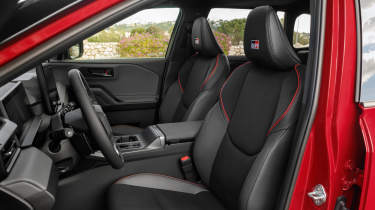
To set the GR Sport apart from the standard RAV4 visually, it also gets unique black 20-inch alloy wheels, an exclusive ‘functional matrix’ grille shape and plenty of GR badging. Inside, there’s a set of aluminium pedals, synthetic leather and suede sports seats, red stitching and red accents throughout.
Toyota even added some knee pads on the centre console in a nod to its World Rally Championship campaign, though we didn’t find the need to channel the firm’s WRC heroes Elfyn Evans or Kalle Rovanperä when we tested the RAV4 over some craggy, off-road section of our route.
Interior and dashboard design
The interior of the RAV4 has clearly been inspired by the Land Cruiser with squarer pieces of trim and chunky buttons. However, Toyota has stripped away the old RAV4’s metal-look inserts and available splashes of colour. The result is ugly and a bit depressing, even with the GR Sport’s token red stitching and logos. Carving a big hole in the dash for a double phone-holding bin doesn’t exactly improve the aesthetics, either, and worse, has relegated the climate controls to the touchscreen. While better than many in this regard (temperature is adjusted with physical buttons), they still draw too much attention away from the road.
Materials and build quality
While it might not be a premium car brand, Toyota’s interior build quality has usually been a plus point, but even the RAV4’s top-end trims are awash with hard black plastic. The worst offender is without a doubt the storage lid on the central front armrest – it opens either side, which is neat enough, but sounds horrendously clattery when it closes.
Infotainment, sat-nav and stereo
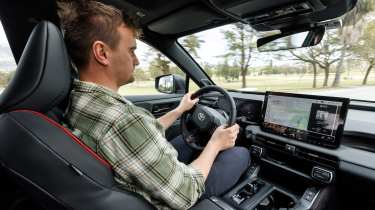
Inside the new RAV4 you’ll find a new 12.9-inch central touchscreen – apparently designed with European customers in mind – giving the driver key information in one view, along with customisable shortcuts and an overall “user-centric experience”, according to Toyota.
In front of the driver, there’s a 12.3-inch screen which can also integrate the car’s sat-nav and a revised head-up display on Excel and GR Sport versions. Functions such as the sat-nav, media, climate and vehicle control commands can also be managed via the RAV4’s new voice assistant and there’s Apple CarPlay and Android Auto wireless connectivity too. The physical buttons on the steering wheel to control the customisable driver’s display have a quality feel to them as well.
Boot space & practicality

Pros |
|
Cons |
|
The RAV4’s traditionally SUV, upright proportions on the outside equate to decent interior space, although versatility could be better. There remains no seven-seat version, either.
Dimensions and size
At just over 4.6 metres long, the new RAV4 is the same size as the previous iteration, and slightly larger than key rivals like the Hyundai Tucson or the Kia Sportage. The reduction of components for the new battery and moving it under the floor has meant that despite its larger size, it doesn’t encroach on cabin space.
| Dimensions comparison | |||
| Model | Toyota RAV4 | Ford Kuga PHEV | Volkswagen Tiguan |
| Length | 4,601mm | 4,604mm | 4,539mm |
| Width | 1,854mm | 1,882mm | 1,842mm |
| Height | 1,694mm | 1,679mm | 1,660mm |
| Wheelbase | 2,690mm | 2,710mm | 2,676mm |
| Boot space | 446 - 1,690 litres | 475 - 1,517 litres | 490-1,486 litres |
Seats & passenger space
We doubt anyone will complain about space inside the RAV4, whether they’re sitting up front or in the back. The seats in the GR Sport in particular are supportive and relaxing on a long journey, although the standard items aren’t exactly uncomfortable. The back bench has a concave shape on the bottom and backrest, so the seating there is pretty comfortable, too. Headroom, as with the old RAV4, is very good thanks to the tall roofline, while the panoramic sunroof doesn’t hinder headspace either.
Boot space
Compared to the non-UK hybrid model, the plug-in hybrid loses 68 litres of boot space, so there’s a capacity of only 446 litres back there. The boot opening is nice and wide however, and there’s no loading lip either.
Aside from a couple of hooks and hoops, there’s not a huge array of features to be found in the boot of the RAV4 and as with the older car, the rear bench also only folds in a 40:60 ratio.
Towing
If you’re interested in towing with the RAV4, the all-wheel-drive variant is the one to go for. It’s rated at 2,000kg, which is 500kg more than the old AWD PHEV. It’s also significantly more than the 800kg the front-wheel-drive PHEV model allows. The improved rear parking camera should come in handy for tow vehicles as well.
Reliability & safety
Pros |
|
Cons |
|
The fifth-generation RAV4 came a decent 31st (out of 50) in the 2025 Driver Power owner survey and given that many of the technical underpinnings remain on the new car, we’d expect a similar performance when owners start to report back on the latest model.
Aspects such as powertrain, interior, practicality and boot space, quality and reliability, and value scored well previously, with economy and running costs not far behind, painting a generally positive picture across the board.
Owners ranked the old car’s climate control, sat-nav and audio systems less favourably, though, which is interesting because the new model sees all of these tweaked in some way.
Euro NCAP hasn’t tested the sixth-generation RAV4 yet, although given that much of the structure and body is the same, we’d expect similar results to the fifth-generation car, which received great scores throughout.
New safety technology on the latest RAV4 includes the latest ‘Toyota T-Mate’ which comes with a wider detection capability for the exterior radar, an upgraded blind spot monitor with rear vehicle approach monitoring, front cross traffic alert, lane change assist with steering support, an updated pre-collision system to detect more objects, plus an improved panoramic monitor with 3D imagery. Toyota says frequent over-the-air updates will ensure the RAV4’s safety kit stays fresh. We found the lane keep assist system (which is pretty standard in most cars on sale now) wasn’t as intrusive as the one in the Volkswagen Tiguan, so you’re not tempted to turn it off every time you step inside.
One aspect of the RAV4’s suite of safety technology we encountered was the new Drive Recorder system. During our off-road section, the car detected an ‘incident’ and tried to record 10 seconds prior. Having no app connected to the car, it couldn’t record, although it attempted to retry several times over the next hour - annoyingly taking up most of the touchscreen with a warning message when doing so.
| Euro NCAP safety ratings | |
| Euro NCAP safety rating | Five stars (2019) |
| Adult occupant protection | 93% |
| Child occupant protection | 87% |
| Vulnerable road user protection | 85% |
| Safety assist | 77% |
Buying and owning
Best buy: Toyota RAV4 PHEV Design
Toyota says the Design front-wheel drive will be the most popular version of the RAV4 and it’s easy to see why. You get all the kit you could realistically want, it’s only slightly more expensive than the previous generation and the less-powerful powertrain will work just as well as the AWD on 99 per cent of journeys.
Toyota RAV4 alternatives
The GR Sport, at well over £50,000, almost encroaches on premium car territory that’s occupied by the likes of the BMW X3, Mercedes GLC and Audi Q5.
Rivals for the rest of the RAV4 range include the Ford Kuga and Volkswagen Tiguan, while outside of plug-in hybrid power there’s the Honda CR-V as well. If you’re looking to save some money, cheaper options such as the Hyundai Tucson, Kia Sportage, Nissan Qashqai, Renault Austral and Vauxhall Grandland are well worth a look.
Deals on the RAV4 and alternatives