Volvo XC90 review
Swedish Volvo XC90 SUV remains a strong contender thanks to an upgraded infotainment system and a luxurious yet practical interior

Our opinion on the Volvo XC90
You know what you’re going to get with a Volvo – a solid, practical, safe and confidently understated type of premium car. Sure enough, that sums up the XC90 very efficiently. Better yet for the Swedish brand, it also tallies very well with the typical customer requirements in the large premium SUV class where the Volvo XC90 plies its trade.
The big seven-seat SUV is showing its age in places after over a decade on sale, but its latest facelift freshened things up nicely. The infotainment system is now a real strength alongside the practical, high-class cabin and easy-going driving experience.
About the Volvo XC90
Volvo launched this second-generation XC90 in 2014, and the large SUV is still going strong. This is thanks in no small part to numerous updates delivered to the car's design, driving experience and infotainment system over the years.
The XC90 is no longer the pinnacle of Volvo’s SUV range and now rests in the shadow of the Volvo EX90 electric SUV. That car, which uses a special electric-only version of the same Scalable Product Architecture (SPA) platform found beneath the XC90, is the source of the 11.2-inch screen running Google-based software that was such a big part of the refresh.
Used - available now


With seven comfortable, adult-sized seats as standard plus a big boot, the XC90 has long been a strong candidate for family car buyers, but its interior quality makes it more of a luxury choice than a family utility vehicle.
We've tested many versions of the XC90 since it came out, and even ran both diesel and plug-in hybrid versions of the pre-facelift Volvo XC90 as part of our long-term test fleet. We've also tested the Volvo XC90 against the Genesis GV80 and put a plug-in hybrid T8 Volvo XC90 against a Kia EV9.
Performance & driving experience

Pros |
|
Cons |
|
There are now two petrol power options, the B5 mild-hybrid or plug-in hybrid T8. You can’t get a diesel XC90 these days, which is a shame because the fuel always suited the big Volvo well. The T8 powertrain is the flagship option, a plug-in hybrid arrangement that is widely used across the Volvo range. The B5 uses mild-hybrid tech to help boost efficiency so you don’t need to plug in to recharge the batteries.
All XC90 models are all-wheel drive and have an eight-speed automatic gearbox with a manual mode. Hill descent and hill-start control are also fitted, although the Volvo is definitely more suited to Tarmac use than hardcore off-roading. All cars have frequency adaptive dampers as standard, but Ultra and Ultra Pro versions come with air suspension that softens the ride and can lower the car for easier exits.
Generally, the car is easy to drive, hushed on the road and comfortable. No seven-seat SUV is particularly entertaining to drive, and that applies here too. What the XC90 does a bit better than an Audi Q7 or a Land Rover Discovery is disguise its bulk, so you don’t feel like you’re driving a vehicle quite as large as it is.
Performance, 0-60mph acceleration and top speed
It’s the least powerful B5 mild-hybrid petrol we’d go for: a 2.0-litre turbocharged petrol engine that’s backed up by a modest electric boost that recovers some waste energy when slowing down. This can then be deployed under acceleration to remove some load (and therefore fuel usage) from the four-cylinder unit. With 247bhp and 360Nm of torque sent to all four wheels, it delivers strong acceleration, the 0-62mph sprint being dispatched in 7.7 seconds.
Those in more of a hurry can turn to the T8 PHEV. It delivers a combined system output of 401bhp from a 2.0-litre petrol engine and an electric motor. That slashes the 0-62mph time to 5.4 seconds, but as with every new Volvo, the top speed is limited to 112mph.
Progress is fairly smooth in each car, but the B5 petrol engine can sound a little noisy when it’s worked hard. In the T8, the engine is virtually inaudible at normal speeds, even when the battery is empty. If you ask for full power, the transition between electric and petrol power can sometimes be a little abrupt.
The latter is due to be upgraded soon when the revised plug-in hybrid arrives towards the end of 2026, with a much higher capacity 41.2kWh (37.9kWh usable) battery and a more powerful electric motor that increases overall output to 456bhp and drops the 0-62mph time to a Volkswagen Golf GTI beating 5.2 seconds.
| Model | Power | 0-62mph | Top speed |
| XC90 B5 Core | 247bhp | 7.7 seconds | 112mph |
| XC90 T8 Plus | 401bhp | 5.4 seconds | 112mph |
Town driving, visibility and parking
The XC90’s low-speed ride is at its best in the range-topping models fitted with the air-suspension system. It can soak up normal road imperfections very efficiently, and only the occasional bigger bumps transmit crashes and shudders into the cabin. We crawled through a number of rural villages on our test route and the Volvo feels easier to thread around parked cars on narrow streets than the likes of a Land Rover Discovery, helped by good all-round visibility.
On the standard suspension set-up, which uses traditional coil springs up front and composite leaf springs at the back, and features adaptive dampers that adjust to the road surface, the Volvo still remains comfortable. Even then, the sound of suspension knocks (and road noise in general) is well isolated from the occupants. The steering is very light, which brings benefits when parking, at which point the surround-view cameras on the higher-spec cars come in handy for piloting an SUV almost five metres long.
Country road driving and handling
The light steering feels less positive as the speed increases and ultimately becomes a little too imprecise to inspire confidence in a car of this size, especially in conjunction with the floaty sensation created by the air springs. While this can be mitigated slightly by opting for a sportier steering mode, it doesn’t really improve things enough to encourage sporty driving in the XC90. Neither do the high centre of gravity and nose-heavy attitude. It’s best to just take a much more relaxed approach on B-roads, but that’s true of almost all seven-seat SUVs.
Motorway driving and long-distance comfort
That ride comfort is shown in its best light on a motorway, where the XC90 is a very relaxing place for seven people (and their belongings) to while away the miles.
Aside from a small rustle from the door mirrors, wind noise is well contained, and the engine note is considerably calmer than it is when under load. There was suspension noise over motorway expansion joints on our test route, but few actual jolts made their way past the air suspension into the cabin, even on the 21-inch wheels. Once again, a little more precision from the steering would make the Volvo feel more planted, but that’s only a minor criticism when at a cruise.
“The Volvo isn’t the last word in driving engagement – a BMW X5 is far more planted – but the XC90 doesn’t feel lost when it encounters a corner.” - Alastair Crooks, senior news reporter.
MPG & running costs
Pros |
|
Cons |
|
Officially, the XC90 B5 mild hybrid will achieve up to 33.6mpg on the combined cycle, but we found difficult to match in the real world, and suspect it’s a figure that will only get worse with a full complement of passengers on board.
That said, the petrol model is still where our money would go in the range. The plug-in hybrid offers financial benefits for company car users in terms of much lower Benefit-in-Kind (BiK) taxation, but it's harder to justify for everyone else if you're relying on fuel savings to balance out the extra investment needed to go from the mild- to plug-in hybrid T8 XC90.
The T8 has a claimed WLTP fuel economy figure of 235.4mpg, and even if the PHEV is charged religiously, you're unlikely to achieve that figure in the real world. In our testing, we were only able to get between 32 and 35mpg from the T8 with a flat battery, which underlines the importance of regular charging to keep the costs down. Perhaps the revised PHEV coming soon, with a claimed EV range of 99 miles, will be much more cost-effective to run because you'll be more inclined to run it on electricity alone and avoid using petrol.
Unlike a lot of PHEVs, the XC90 T8 still uses the same 71-litre fuel tank as the regular B5 petrol and not a smaller tank that frees up space for the batteries.
Electric range, battery life and charge time
The Volvo XC90 T8 plug-in hybrid (PHEV) uses an 18.8kWh battery pack, which officially should enable a range of roughly 44 miles in pure-electric mode. That’s not the best figure for the latest batch of plug-in hybrids, but there are few seven-seaters that offer the technology. The revised version will use a much higher capacity 41.2kWh battery and near 100 miles of electric range, which is much better than other luxury SUVs such as the Range Rover Sport.
With 6.4kW charging, the current T8 can recover its charge from a typical home wallbox in around five hours, and while Volvo hasn't revealed charging times for the revised PHEV, they have said they'll be similar to the present version. Unlike a number of its rivals, the updated XC90 T8 won't be capable of rapid charging.
| Model | Battery size | Range | Insurance group |
| XC90 B5 Core | 33.6mpg | 191g/km | 38 |
| XC90 T8 Plus | 235.4mpg | 27g/km | 42 |
Insurance groups
Volvo’s reputation for safety helps keep insurance groups lower than you might expect for a 60-grand-plus SUV. The Core mild-hybrid model kicks things off from group 38, while the top-spec T8 PHEV, despite its strong performance, only climbs four groups to 42.
Tax
As a big SUV that comfortably exceeds the £40,000 mark, the XC90 is subject to a £440 Vehicle excise duty (VED) luxury car tax surcharge. That means every model in the line-up costs £640 a year to tax from the second year until the sixth year. After that, it’s £200 per year.
Also, from April 2028 onwards, the T8 plug-in hybrid will be subject to a pay-per-mile eVED charge just like other plug-in and electric cars.
Depreciation
Depending on trim level and powertrain, the XC90 is predicted to hold onto between 42 and 49 per cent of its original value after three years or 36,000 miles.
While those residual values aren't far off the pricier BMW X7, they’re not as good as the Land Rover Discovery, which retains 54 to 58 per cent of its original value over the same period and mileage.
To get an accurate valuation for a Volvo XC90, check out our free car valuation tool...
Interior, design & technology
Pros |
|
Cons |
|
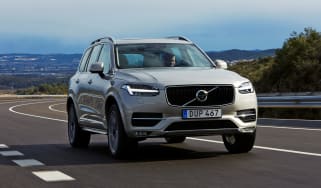
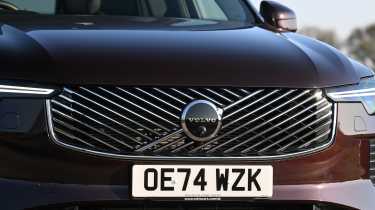
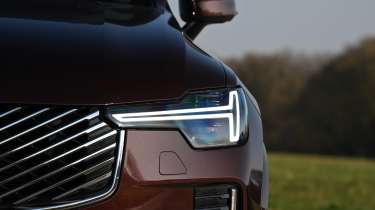
Volvo says there are Scandinavian influences everywhere in the XC90, such as the brand’s now signature T-shaped ‘Thor’s Hammer’ daytime running lights. The narrow light bars give the XC90 an aggressive glare, helped by its deep front bumper and bluff radiator grille that gained diagonal slats in the most recent facelift.
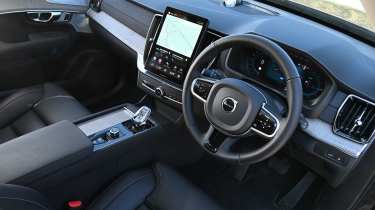
The Volvo’s interior design has aged extremely gracefully, and it manages to do a reasonable (if not perfect) job of mixing touch-sensitive controls and physical buttons. Few cars of the XC90’s age manage to feel as modern as it does next to the competition, and that’s tribute to the designers.
Entry-level Core gets an 11.2-inch touchscreen infotainment system, a wireless phone charging pad, matrix LED headlights, 20-inch alloys and heated front seats.
Our recommended Plus model gets a 360-degree camera system, a heated steering wheel and second-row seating, an air purifier, and four-way electric lumbar adjustment for the front seats.
Next up, Plus Pro adds a Harman Kardon sound system and 21” wheels, while Ultra adds adaptive air suspension, ventilated front seats with adjustable side bolsters, Nappa leather trim, a panoramic glass roof, and a head-up display (not compatible with the no-cost optional heated windscreen). Finally, Ultra Pro features an even fancier Bowers & Wilkins stereo and massaging front seats.
Both Ultra and Ultra Pro can be optioned in either a 'Bright' or the same 'Dark' exterior colour scheme as Plus and Plus Pro trims, which replaces all chrome exterior trim pieces with tasteful gloss black alternatives. Alternatively, you could get the Black Edition versions of Plus Pro and Ultra Pro trims, but we don't see the point because they offer fewer colour choices than non-Black Edition cars, and we're not fans of the compromised ride quality from the 21-inch wheels.
Interior and dashboard design
Even over 10 years on from its launch, the XC90 is still a wonderful place to sit. It’s at its best in top-spec Ultra form, where leather trim on the dashboard and the use of differing shades of materials and open-pore woods give a uniquely Swedish vibe that manages to feel hi-tech yet relaxing, and posh without being ostentatious.
You can get a one-litre water bottle or a large coffee cup in both of the central cup-holders and the bottle can be dropped into the wide door pockets as well. Under the central arm rest, the space isn’t particularly deep, but there are charging points for plugging your devices in as an alternative to the wireless charging pad under the central screen.
Materials and build quality
Everything feels solid and sturdy inside the XC90. The window switches and column stalks are suitably chunky, and most of the materials feel very high-end. We like the thick-rimmed steering wheel and the transparent drive mode selector that looks like a giant uncut diamond. When hard plastic does appear, it tends to be found lower down in the footwells, where it’s not really an issue anyway.
The materials get better as you ascend the trim level range, but the vibe is always quite cool and understated. The possible exception is the flashy metallic speaker covers for the Bowers and Wilkins stereo on the Ultra Pro models, but the sound they emit more than justifies this.
Infotainment, sat-nav and stereo
A digital instrument panel is standard throughout the range. It’s not particularly high-resolution compared with the class leaders, and there’s much less scope for rearranging the layout than you’ll find in an Audi Q7, for example. You either have a map in the centre of the display or a black space, but in typical Volvo style, the information is all displayed clearly and concisely with minimum fuss.
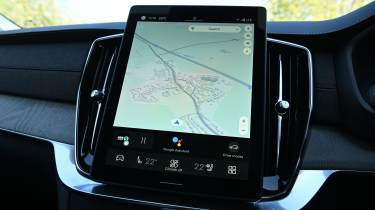
Infotainment is a hugely important part of the user experience in modern cars, and it’s fair to say that the XC90’s system was feeling a bit dated. That changed with the 2024 update, which introduced a larger 11.2-inch portrait touchscreen to the centre of the dash. It’s less well integrated than the old smaller unit, looking more like a glued-on tablet, but it’s far superior from a user’s perspective with its Android Automotive-based interface.
The crucial thing with the system is that Volvo has kept the on-screen buttons nice and large with fixed shortcuts to key vehicle controls and your most-used apps. There’s no doubt that Android phone users will find it more intuitive than those familiar with Apple but wireless Apple CarPlay is also there as a back-up option. You can switch to the car’s settings and configure the drivetrain (in the T8 PHEV) or turn off the safety aids with one press on a large icon – a simple thing but also a hurdle over which so many cars stumble.
Volvo also retains physical buttons outside the touchscreen for key functions. There’s a tactile knob for the volume that feels great to turn, and buttons to demist the front and rear screens. The climate control functions are all inside the touchscreen, however, unless you count the panel for back-seat passengers.
Those with Google accounts (which is probably most of us these days) can also log in and access previous destinations stored in other devices, as well as use the Google Play Store to download car-friendly Android apps, such as Spotify.
“I like the way the XC90 is a little less ostentatious than some of its large SUV rivals. It certainly doesn’t have the imposing road presence of big SUVs from Land Rover or BMW, and many people will prefer it that way.” - Steve Walker, head of digital content.
Boot space & practicality

Pros |
|
Cons |
|
The interior and boot space of the Volvo XC90 have always been strong points, and very few rivals that have arrived since this car was launched have managed to significantly improve on either.
Dimensions and size
The Volvo XC90 is a very big car, at 4,953mm from nose to tail. However, the Audi Q7 and Land Rover Discovery are even larger. The XC90's shape is essentially boxy and practical, unlike more overtly ‘rakish’ rivals such as the Audi Q7, and this shows when you get the tape measure out.
With a 1,776mm roof height, the Volvo XC90 stands tall against the 1,762mm BMW X5 (both without roof bars), and falls in-between the 1,737mm-high Audi Q7 and 1,796mm Mercedes GLE, both of which have standard-fit roof bars.
| Model | Volvo XC90 | Kia Sorento | Land Rover Discovery |
| Length | 4,953mm | 4,815mm | 4,956mm |
| Width | 2,008mm | 1,900mm | 2,073mm |
| Height | 1,776mm | 1,700mm | 1,888mm |
| Wheelbase | 2,984mm | 2,815mm | 2,932mm |
| Boot space (7/5/2 seat layouts) | 302/680/1,856 litres | 175/608/1,996 litres | 258/1,137/2,406 litres (measured to ceiling) |
Seats & passenger space
A typically high SUV driving position gives the XC90 driver a commanding view of the road ahead, and the large glass area all round means that visibility is reasonable for such a large car - although rear visibility is restricted when you have occupants in the third row. The front seats are very wide and comfortable, offering lots of adjustment to suit a wide range of body types, but there’s not a huge amount of side support.
Middle-row passengers get similarly comfortable seats to those sitting up front. Both knee room and headroom are decent, even when the seats in the middle row are moved forward to make more space for those sitting in the very back. There is space under all the seats in the XC90 to put your feet, which helps make the most of the space.
The middle chair in the second row is slightly narrower and firmer than those on the outside, but it’s more accommodating than many similar seats in rival SUVs. Manual sun blinds in the rear doors are standard on Ultra and Ultra Pro trims, but are an option on all other XC90s.
Move a row back, and things are still reasonably spacious. The middle row folds and slides forward to improve access, and the stadium-style seating places those right at the back a touch higher than the occupants ahead to give a slightly better view out. It’s good that all occupants get proper headrests, too.
There’s not a lot of floor space to put your feet when clambering into the rear, and we found it easier to go in backwards and plonk yourself in the chair. Just be careful not to clonk your backside on the protruding cup-holders. We managed to fit six-foot-tall adults in the middle and back rows behind a driver and passenger of a similar size. Space was a little tight, but it’s proof that this is a seven-seater that really can cope with seven adults.
Those back seats get air vents and a storage bin, but unlike rivals such as the Kia EV9, no USB ports. Also slightly disappointing for a car of this size is that the XC90 gets just two Isofix points; an EV9 has four, and an Audi Q7 has five.
Boot space
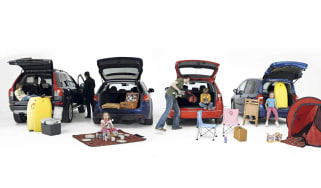
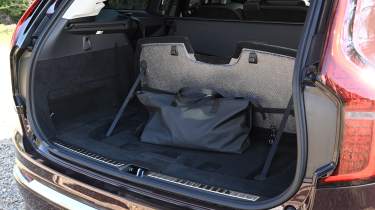
Even with all seven seats in place, the XC90 offers 302 litres of boot capacity. The third row of seats folds down easily and completely flat (albeit manually, unlike the electric seats of some alternative models) to expand that volume up to 680 litres at the window line. When configured in two-seat mode, the XC90 offers a vast 1,856 litres of load space to the roof.
On our test, we found that the seats can occasionally get jammed and require a bit of wiggling to get them to slide and fold. They do feel very sturdy, however. The XC90’s boot divider and tethering hooks prove to be very useful when securing slightly smaller items to prevent them from moving. You’ll also need the tether points to secure the little hold-all bag Volvo supplies to store the T8’s charging cable, because there’s no dedicated cable storage.

Towing
When it comes to hauling a trailer, the XC90 is a decent performer. The Volvo is rated to tow up to 2,400kg in T8 PHEV guise – this compares favourably against the wave of electric seven-seat SUVs, led by the Kia EV9, which only has a 900kg limit in rear-wheel-drive form (2,500kg with four-wheel drive). The mild-hybrid petrol XC90 B5 can tow 2,400kg.
The T8 version has been a regular winner with the Caravan and Motorhome Club. It won the best hybrid tow car category in 2025, and was awarded the best large family towcar in 2026. The judges liked the amount of space this SUV provided, the smoothness of its hybrid system while towing, and how it has more than enough power to haul around a heavy twin-axle caravan.
A retractable tow bar option is available for £1,600, and it includes a trailer stability assist system for the car's standard electronic stability program (ESP), and a self-check program for testing the lights of the caravan or trailer when the electrical connector is plugged in.
“The heated front and middle-row seats, along with the heated steering wheel, deserve a mention because they’re designed to work in the Arctic circle, and get up to temperature incredibly quickly” -Alastair Crooks, senior news reporter.
Reliability & safety
Pros |
|
Cons |
|
Euro NCAP assessed the Volvo XC90 in 2015. At the time, it was considered one of the safest cars the organisation had ever tested, with a 97 per cent score in the Adult Occupant Protection category, but because NCAP’s standards have grown ever more stringent, it no longer considers ratings this old valid.
That doesn’t make the XC90 an unsafe choice, because it still comes with all the passive and active safety-assistance technology you’d expect of a luxury SUV. Two pieces of tech made their debut in the XC90: a Run Off-Road system that senses if you veer off the tarmac – preparing the car for a crash – and special energy-absorbent seats that’ll reduce the impact of a big hit.
There’s also a clever autonomous emergency braking (AEB), which stops you from turning in front of an oncoming car. This is part of Volvo’s enhanced City Safety package, which also helps protect against collisions with motorcycles, swerving bicycles or errant pedestrians.
Our experience of the XC90’s safety aids was generally positive. The automatic braking systems didn’t seem to be too easily triggered by parked cars on the outside of bends or vehicles passing as you reverse out of driveways. The blind-spot monitoring tech spotted a decrepit Porsche Boxster accelerating fast up a motorway slip road’s outside lane behind us and steered the XC90 firmly away from danger. It wasn’t even a near miss, but the safety aids do seem to react in a more predictable and helpful way than in a lot of cars.
In our 2026 Driver Power customer satisfaction survey, Volvo ranked 14th out of 30 in our best car manufacturer rankings. Owners rated the safety features, ride quality, practicality and reliability of their cars, but told us that the running costs were expensive – particularly in terms of servicing, fuel economy, insurance and road tax. They also would like a better balance of physical and touch-sensitive controls.
| Euro NCAP safety ratings |
|
Buying, prices and deals
Our best buy: Volvo XC90 B5 Plus
Prices for the Volvo XC90 start from just under £66,500 and extend up to over £82,000 for the top-spec T8 plug-in hybrid. That just about overlaps with the cheapest version of the electric EX90 – although a fully loaded one of those easily tops £100,000.
The range of trim levels these days opens with Core before extending up to Plus just over £68,500, Plus Pro for £72,500, Ultra for £76,500, and Ultra Pro for nearly £80,000. The plug-in hybrid T8 starts at just under £69,000. All models are currently available on our Buy A Car service.
You can’t go wrong with the mid-range Plus trim because it has a few useful extras and doesn't cost all that much more than the entry-level Core trim. We'd add a set of rear sun blinds for a reasonable £195, but it's a bit mean that headlight washers are still a £245 option, given how necessary they are to keep the headlights clean. The B5 petrol might not be all that economical, but it gets the job done and is usefully cheaper than the T8, which we'd only recommend if you're a company car driver needing to save on BiK.
Volvo XC90 alternatives
As a luxury SUV that sits almost at the top of Volvo’s range, the XC90 naturally rivals cars such as the Audi Q7, BMW X5, BMW X7, Lexus RX, Genesis GV80, Porsche Cayenne and Range Rover Sport. However, the XC90 comes with seven full-size seats as standard, so it also competes with the more family-friendly cars such as the Land Rover Defender, Land Rover Discovery, Kia Sorento and Hyundai Santa Fe. If you’re willing to go electric, then the Kia EV9 is another rival.
Used and nearly new
Spacious, comfortable and classy, it isn't hard to see why the Volvo XC90 was such a big hit when it was launched in 2002. The Scandinavian seven-seater had all the qualities to fit in with family life, and excelled on longer journeys where its spacious interior and superb refinement made for a relaxing drive.
Older examples are showing their age now, while running costs might be an issue for some. Second-generation models offer a touch of premium luxury and excellent standard safety kit but, as ever, be sure to do your homework on the history of your potential purchase - taking extra time to ensure your used buy is rock solid could help prevent spending on repairs further down the line.
Volvo XC90 history
The XC90 arrived at the height of the premium SUV boom in the early noughties and provided genuine competition to the established, and mostly German, competition.
Volvo XC90 Mk2: 2014-date
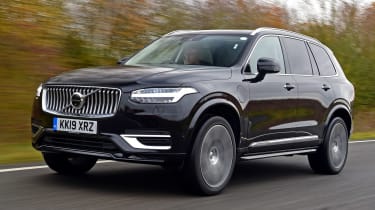
Volvo did a great job with its second-generation XC90, dialling up the luxury, refinement and safety credentials of its large SUV. Petrol, diesel and plug-in hybrid models are available, although you'll have to look out for a model from late 2015 onwards to secure a sporty R Design version - the Mk2 XC90 was initially launched with just Momentum and top-of-the-range Inscription trim levels. The 2024 facelift brought a new line-up of trim levels (Core, Plus and Ultra), a modest restyle and improved infotainment to match the system on Volvo’s EX90 electric model.
There have been numerous manufacturer recalls for the latest XC90, so be sure to check all the necessary maintenance work has been carried out before any purchase. Read our full Mk2 Volvo XC90 buyer’s guide here…
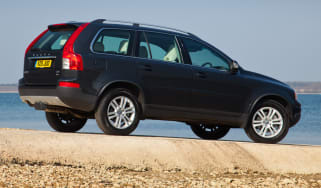
Volvo XC90 Mk1: 2002-2014
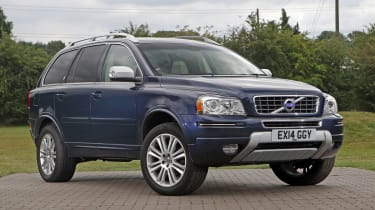
If you're after a big, comfortable, seven-seat SUV, then the Mk1 XC90 is hard to beat. Admittedly, time has caught up with Volvo's family 4x4, but despite dated styling and reasonably high running costs, it still offers good practicality and will easily accommodate a large family and luggage.
Facelifted models were introduced in 2006 and 2012, adding improved cabin materials, new engines and a revised infotainment system. Read our full Mk1 Volvo XC90 buyer’s guide here…
Key updates of the Volvo XC90 review
24 September 2026: Update to include its best large family car award at the 2026 Towcar of the Year award, along with news of the revised T8 plug-in hybrid.
Frequently Asked Questions
All Volvos come with a three-year, 60,000-mile warranty, plus three years of breakdown cover. That matches Audi’s package, while Land Rover provides three-year, unlimited-mileage coverage and three years of breakdown assistance. Leading the class is the Kia EV9, which has a seven-year, 100,000-mile warranty, but only a year’s breakdown cover.
Deals on the XC90 and rivals
More reviews
Car group tests
Used car tests
Which Is Best
Most Economical
- Name2.0 T8 PHEV Plus Dark 5dr AWD Geartronic
- Gearbox typeSemi-auto
- RRP£77,120