BMW 1 Series review
The BMW 1 Series is a well-built family hatchback that handles nicely, but practicality isn’t the best

Our opinion on the BMW 1 Series
The BMW 1 Series remains a solid entry in the premium hatchback class thanks to its dynamic driving experience, well-built cabin, strong efficiency, and keen pricing against premium rivals from Audi and Mercedes. While the 120 mild-hybrid and the BMW M135 hot hatch are equipped with impressive powertrains, we’d like a bit more choice when it comes to the 1 Series’ engine line-up, and it could do with a bit more rear passenger space and boot capacity in mild-hybrid form.
About the BMW 1 Series
The BMW 1 Series that was introduced back in 2004 gained a reputation for its fun driving dynamics thanks in part to being rear-wheel drive. The latest version may be front-wheel drive like its rivals, but the engineers at BMW have shown it’s still possible to make a hatchback that’s good to drive.
In 2024, the design of the 1 Series was overhauled, the cabin was refreshed, and the old-school six-speed manual gearbox was dropped, meaning every model now gets a seven-speed Steptronic automatic transmission as standard. The 1 Series is offered in a similar structure to most other BMWs: Sport, M Sport and M Sport Pro, plus there’s a range-topping M model, known as the BMW M135.
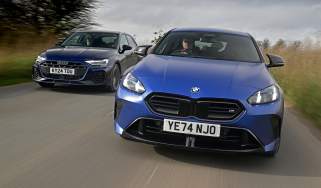
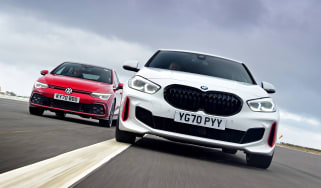
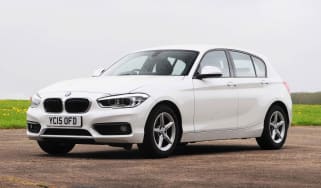
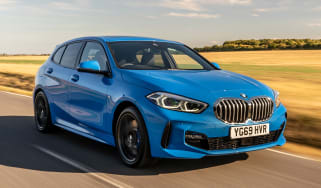
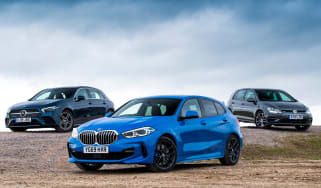
We’ve tested a number of BMW 1 Series iterations since the car first arrived on the UK’s shores. We’ve tested the pre-facelift version against its closest rivals, the Mercedes A-Class and VW Golf, in a group test.
Performance & driving experience
Pros |
|
Cons |
|
It’s a little disappointing that the 1 Series is available with only two petrol engines, when some rivals are offered with diesel, plug-in hybrid and even fully electric options, so customers can choose what meets their needs best. However, the lack of diesel is understandable given its declining popularity in recent years.
Used - available now

2014 BMW
1 Series
119,392 milesManualDiesel2.0L
Cash £2,995
2021 BMW
1 Series
13,633 milesAutomaticPetrol1.5L
Cash £19,890
2024 BMW
1 Series
11,588 milesManualPetrol1.5L
Cash £19,540
2021 BMW
1 Series
41,209 milesManualPetrol1.5L
Cash £16,360Nevertheless, the overall balance of the 1 Series remains excellent, with the lower-powered 120 feeling as agile as any of its rivals. The hot M135 delivers thrills, but perhaps not to the same extent as an Audi S3. Refinement is a strong suit of the 1 Series – no matter the wheel size or engine, there’s everyday usability thanks to the compliant chassis set-up and relaxing interior.
Performance, 0-60mph acceleration and top speed
The base 120 is a good engine, and despite being a turbocharged 1.5-litre three-pot, buyers won’t feel short-changed by it. It’s flexible enough, with 168bhp and a meaty 280Nm of torque available across a large portion of the rev range. And thanks to the smooth integration of a 48V mild-hybrid system, throttle response is snappy.
We’re yet to try the 123 xDrive, but its more powerful 2.0-litre engine and better traction off the line cut the 0-62mph dash down from 7.8 seconds to 6.3 seconds.
The M135 is the 1 Series that hot hatch fans will warm to, although its power has now dropped from 302bhp to 296bhp. This results in a 4.9-second 0-62mph time (0.1 seconds slower than before). It’s an excellent engine with a lovely, linear power delivery, rarely upsetting the M135’s all-wheel-drive ‘xDrive’ system.
We’d like a little more bias of power to the rear, and stiffer engine mounts would certainly help it feel more involved upon acceleration. The synthesised engine sound piped through the speakers isn’t particularly immersive.
| Model | Power | 0-62mph | Top speed |
| 120 | 168bhp | 7.8 seconds | 140mph |
| 123 xDrive | 215bhp | 6.3 seconds | 153mph |
| M135 xDrive | 294bhp | 4.9 seconds | 155mph |
Town driving, visibility and parking
Despite the 1 Series’ position as one of the sportier hatchbacks in its segment, BMW hasn’t gone overboard in making it too hard-edged on the road. Yes, there’s heavy steering, but it’s simple to pootle around town thanks to decent visibility and a responsive front end, plus a sensible suspension that can put up with the worst speed bumps and potholes at low speeds.
A turning circle of 11.7 metres isn’t amazing, and we found that making quick manoeuvres with the automatic-only 1 Series isn’t as easy as before, because it takes longer to go from drive to reverse compared with manual versions of the older model. The 1 Series is not a huge car, though – it’s narrower and shorter in length than a Mercedes A-Class, so navigating tight city streets isn’t a chore.
Whether you’re sitting in the standard seats or the sportier ones in the M135, the driving position is a little high in the 1 Series, which makes it a little bit easier to drive around town in terms of visibility. The two engines are equally adept at low speeds, thanks to the smooth-shifting seven-speed automatic gearbox. In ‘Comfort’ mode, it never seems to be in the wrong gear when cruising around.
Country road driving and handling
The 1 Series utilises the UKL2 platform that underpins the BMW 2 Series Active Tourer, the BMW X1 and the MINI Countryman. In the 1 Series, it delivers a slightly harsher driving feel, but it’s not what you would call uncomfortable. In the 120 M Sport, there’s a real tautness to the chassis, helped by the Adaptive M Suspension (standard on M Sport models). This adds quicker steering, frequency-selective dampers, which are designed to learn your driving style, an 8mm lower ride height, 50 per cent stiffer suspension bushings in the rear axle and extra bracing.
All this creates a nimble hatchback that’s as good to drive as any in the sector. On a winding road, you can build up a rapport with the 1 Series, although with a 1,500kg kerbweight, you have to be a little steadier with steering inputs than you’d expect. The brakes on the standard car are decent enough, although the M135 test car we drove had the uprated brake option, which features the same four-piston calipers and brake pads from the BMW M3, along with larger brake discs.
They’re surprisingly usable, with a relaxed pedal feel around town, but they deliver confidence-inspiring stopping power during sprightly driving. The M135 also receives unique damping, with stiffer suspension components and further bracing underneath.
Motorway driving and long-distance comfort
The 1 Series excels on a back road thanks to a decent amount of feedback, but once you’re on the motorway it doesn’t feel jittery or tiresome – it settles down and cruises at speed well.
Much of this is helped by the heavy steering, although the cabin does a good job of isolating wind and road noise, even on the largest wheels. We find the 1 Series seats to be ideal, providing enough support when you’re slinging the car into bends, but not feeling overly stiff on a long journey. Rear passengers might not feel the same because the back seats have a rather flat bench-like layout.
“There’s little body roll in corners, and chassis grip is strong. There’s a front-end bias to the four-wheel drive system of the M135, with the sharp steering and keen turn-in encouraging you to lean on the car’s nose when heading into bends, while a more neutral bias on corner exit sees the car fire down the next straight with the minimum of fuss.” - Dean Gibson, senior test editor
MPG & running costs
Pros |
|
Cons |
|
Thanks to its frugal mild-hybrid engine, the base 120 Sport can return up to 53.3mpg, meaning it’s more efficient than the equivalent (and lighter) Mercedes A 180 Sport that’s rated to do 47.1mpg. It even trumps the Audi A3 in 35 TFSI guise by a few mpg. The BMW’s 121g/km CO2 emissions figure is a little better than the Mercedes’, but the same as the Audi’s.
With its larger 2.0-litre engine and its four-wheel-drive system adding additional weight, the 123 xDrive 1 Series isn’t as economical as its front-wheel drive sibling, but 47.9mpg and emissions of 135g/km aren’t bad. They’re certainly far better than you'll find if you go for an SUV – the typical sort of vehicle you’d expect to find four-wheel drive fitted to.
Unsurprisingly, the M135 is the thirstiest 1 Series, but it shouldn’t ruin you at the pumps. BMW says it can return up to 37.2mpg, and we averaged 33.4mpg when we tested it against the Audi S3, which averaged 31.5mpg.
With no diesel in the range, those who want even better economy numbers will be forced to look at the A-Class, A3 or a Volkswagen Golf.
| Model | MPG | CO2 | Insurance group |
| 120 Sport | 52.3mpg | 121g/km | 21 |
| 123 xDrive M Sport | 47.9mpg | 135g/km | 26 |
| M135 xDrive | 36.7mpg | 174g/km | 29 |
Insurance groups
Insurance on the BMW 1 Series is roughly what you’d find on similarly equipped Mercedes, Audis and Volkswagens, at group 21 for the 120. The M135 sits in group 29, two below the Audi S3 and eight lower than the Mercedes-AMG A 35.
Tax
Most variants of the 1 Series sit below the £40,000 luxury car tax threshold for combustion cars, but being too keen on the options list can quickly trigger this additional charge. If you do, your combined annual road tax bill will be £625 between years two and six after the car is initially registered.
With no plug-in hybrid or fully electric models in the line-up, the BMW 1 Series is difficult to recommend for company car buyers due to a complete lack of Benefit-in-Kind (BiK) relief. We’d instead recommend you look towards electric hatchbacks like the Cupra Born.
Depreciation
Our market data indicates that the BMW 1 Series should retain 45 to 50 per cent of its initial value after three years or 36,000 miles. That's better than the Mercedes A-Class, which retains between 39 and 47 per cent over the same period of time, while an Audi A3 retains between 39 and 52 per cent.
To get an accurate valuation on a specific model check out our free car valuation tool...
Interior, design & technology
Pros |
|
Cons |
|
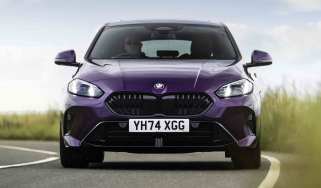
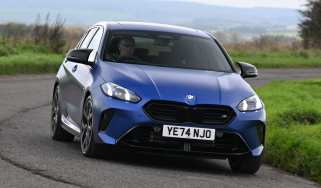
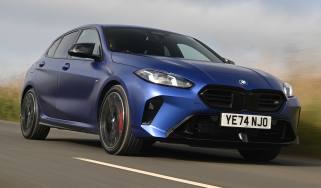
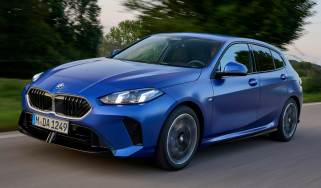
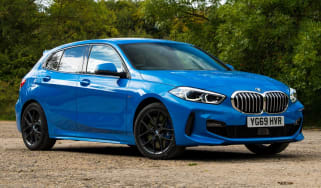
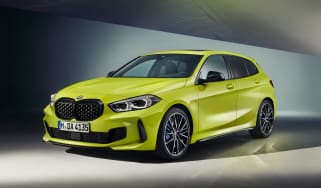
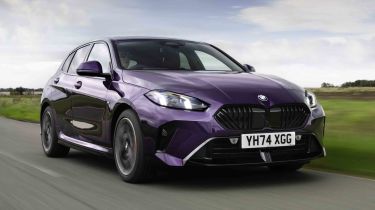
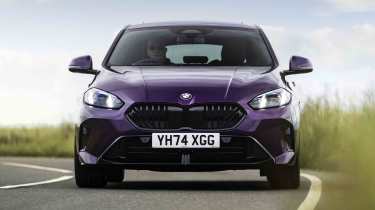
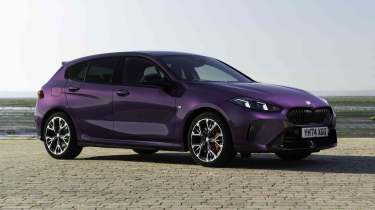
BMW has changed so much on the latest 1 Series that, rather than call it a facelift, it has given the car a new generation codename (F70), as opposed to the F40 that arrived in 2019. You can tell it’s the same body underneath, but BMW has added a completely revised front end with a new grille and slimmer headlights, while the rear has gained a reshaped bumper and new rear lights.
Entry-level Sport models offer a generous amount of kit and tech, including 17-inch alloy wheels, a 10.7-inch central touchscreen with wireless Apple CarPlay and Android Auto, a 10.25-inch driver’s display, heated front seats, a reversing camera, LED headlights, and Cruise control.
However, we think it’s worth upgrading to M Sport trim because it adds a much sportier look and racy interior touches. Changes include:
- M Sport front and rear bumpers
- M Sport side skirts
- 18-inch rims
- Front sport seats trimmed in Alcantara
- An M Sport steering wheel
- BMW M colour stitching on the dash
M Sport Pro trim adds a couple more styling tweaks, such as Shadow Line headlights, plus borrows the M Sport brakes, sports seats and spoiler from the M135.
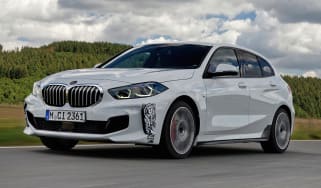
It’s a shame the M135 looks indistinguishable from the regular M Sport at the front, aside from an M badge in a grille with a bespoke horizontal slat design. There’s a quad-tip exhaust system to the rear, though – a staple of outright BMW M models – plus a rear spoiler and chunkier, M-style wing mirrors. The M135 comes with 18-inch wheels as standard, while two designs of 19-inch rims are available as options.
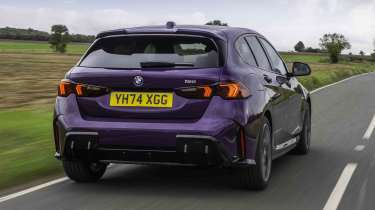
There are seven optional paints, with the Thundernight purple metallic particularly standing out – fans of BMW’s vibrant Techno Violet paint from the nineties will no doubt appreciate this shade. Of the seven, two are matt finishes from the BMW Individual catalogue: blue and grey.
Interior and dashboard design
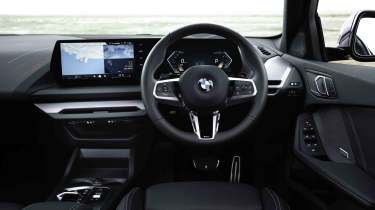
The BMW 1 Series received extensive changes to the interior as part of the latest updates. The dual-screen layout, steering wheel and dashboard design are all new to help bring it in line with the rest of BMW’s range, despite being the entry-level model. Jump inside, and it’ll immediately look and feel recognisable as a 1 Series, which is unquestionably a compliment.
The base Sport is a little drab inside, although there’s ambient lighting as standard, along with heated front seats upholstered in cloth and a new, very thick-rimmed sport steering wheel. The M Sport livens things up with M-coloured stitching on the dash, seats and centre console, and the Alcantara upholstery.
There’s not much difference inside the M135 compared with the M Sport, which is a little disappointing. In the M135, you’ll find a 12 o’clock marker on the steering wheel and an uprated Harman Kardon sound system.
Materials and build quality
As we’ve come to expect from the 1 Series, the interior quality is up there with the best in its class. On the whole, it feels built to last, bar a couple of small details like the air vent controls.
The standard of materials used is generally really impressive. From the base Sport to the M135, there’s an aluminium surround on the centre console switches and on the dash, plus the plastics don’t feel too cheap either (aside from the bottom spoke in the steering wheel, which looks a little flimsy, and the little joystick-style air vent controls that don't give a positive feel). Some might also feel that stitching in BMW’s M division colours looks a little tacky on a three-cylinder mild-hybrid.
Sat-nav, stereo and infotainment
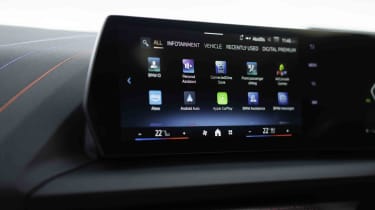
BMW is rolling out a twin-screen layout across its range, and while the standard-fit 10.7-inch central touchscreen and 10.25-inch driver’s display aren’t as big as the 14.9-inch touchscreen and 12.3-inch driver’s display you’ll find in BMW’s larger models, they’re the right sizes for the 1 Series.
The latest operating system appears far more premium than the previous generation, yet remains just as easy to navigate. We’ve found it to be a little delayed in its responses, especially when switching between menus. The touchscreen menu shortcuts (which larger BMWs don’t get) are a useful touch that helps mitigate the loss of the rotary iDrive controller from the centre console.
While this decision was made due to cost, it doesn’t significantly affect the touchscreen's use, which is easily within the driver's arm’s reach. The integration of the climate controls into the touchscreen is a step in the wrong direction ergonomically, even if they’re always visible at the bottom of the screen.
It’s also possible to add a head-up display to the ‘Technology Plus Pack’. We found the display easy to read on the move without being too distracting, and its configurability is pretty good, too.
Boot space & practicality
Pros |
|
Cons |
|
The 1 Series isn’t the most practical five-door hatchback on sale, with average boot space and rather tight rear-seat space. It’s bright and airy enough inside, although there’s a distinct lack of colour in the standard car. For £215, you can choose ‘Mocha’, ‘Oyster’, or ‘Coral Red’ leatherette upholstery to add some brightness to the cabin.
Cabin storage is pretty average for the class, with a small opening in the centre console and door bins designed for small bottles.
Dimensions and size
At 4,361mm, the latest BMW 1 Series is 42mm longer than before. It’s still shorter in length than a Mercedes A-Class, yet longer than an Audi A3. It also sits between its two German competitors in terms of height and wheelbase.
| Dimensions comparison | |||
| Model | BMW 1 Series | Audi A3 | Mercedes A-Class |
| Length | 4,361mm | 4,343mm | 4,428mm |
| Width | 1,800mm | 1,816mm | 1,796mm |
| Height | 1,459mm | 1,425mm | 1,423mm |
| Wheelbase | 2,670mm | 2,636mm | 2,729mm |
| Boot space | 300-380 litres | 380 litres | 355 litres |
Seats & passenger space
Six-foot-tall adults will struggle a little for headroom in the rear of the 1 Series and may find their legs touching the back of the seat in front of them. When we tried the sportier BMW M135, we found that its chunkier front sports seats reduced rear legroom compared to the regular car. The centre rear passenger will have to straddle a sizeable central hump in the floor, which accommodates the mechanical bits for the four-wheel-drive version.
And while on some cars, specifying a panoramic glass sunroof adds a bit of headroom, in the 1 Series, rear passengers won’t enjoy this option, as a crossbar further limits headroom.
A pair of Isofix child seat mounting points is provided for the back seats, and the mounts are found on the outer positions. An additional child seat mounting point is provided on the front passenger seat.
Boot space
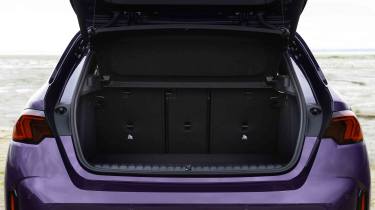
The 120 and 123 xDrive models have a mild-hybrid system that’s powered by a battery located under the boot floor, and as a result, the luggage capacity is a meagre 300 litres, or 1,135 litres with the seats folded flat. The M135 does without the hybrid assistance, so it boasts 380 litres of space, or 1,200 litres if you lower the seats.
The boot area is a decent shape, with a fairly low loading lip, although the boot is deep, so taking heavy items out might be a struggle. A luggage net and a split-folding 40/20/40 rear bench are both £175 options.
Reliability & safety
Pros |
|
Cons |
|
The current, F70-generation 1 Series that arrived in 2024 was so heavily revised over the F40-generation (which launched in 2019) that, despite sharing the same basic body and underpinnings, a new Euro NCAP test was required. It received a four-star safety rating (out of a possible five), which is lower than the Golf and A3, which were both awarded the maximum five stars.
Safety technology on the 1 Series is pretty comprehensive as standard. There is BMW’s ‘Active Guard’, which incorporates forward collision avoidance and lane keep assist, plus ‘Driving Assistant’, a radar-based driver assistance system consisting of rear crossing traffic warning and speed limit information.
A ‘Park Assistant’ can provide automatic parking in parallel and bay parking spaces, plus it helps with rear parking thanks to a reversing camera, and can automatically leave parallel parking spots.
As part of the £2,750 Technology Plus Pack, the 1 Series can have ‘Parking Assistant Plus’. This adds a panoramic view for the rear camera, a 360-degree exterior view, an anti-theft recorder and monitoring during parking manoeuvres.
| Euro NCAP safety ratings | |
| Euro NCAP safety rating | 4 out of 5 stars (tested 2025) |
| Adult occupant protection | 78% |
| Child occupant protection | 84% |
| Vulnerable road user protection | 85% |
| Safety assist | 80% |
The BMW 1 Series placed 6th overall in the 2026 Driver Power survey with a score of 86.64%. Its standout category was Quality & Reliability, where it finished 3rd, suggesting the solid build quality reputation of BMW is justified. Ride & Handling also impressed owners who ranked it 12th, and Infotainment came in 5th. The main weakness is Economy & Running Costs, where the 1 Series placed 34th. BMW ranked 5th out of 30 brands in the manufacturer standings with a score of 86.45%.
| BMW 1 Series | Position | Score |
| Overall | 6 | 86.64% |
| Powertrain | 13 | 88.70% |
| Exterior | 18 | 88.93% |
| Interior | 14 | 85.48% |
| Practicality & Bootspace | 30 | 82.41% |
| Ride & Handling | 12 | 89.79% |
| Safety Features | 11 | 85.12% |
| Economy & Running Costs | 34 | 77.35% |
| Quality & Reliability | 3 | 90.36% |
| Infotainment | 5 | 87.73% |
| Value | 16 | 85.00% |
What owners said
- “Smart, low emissions, comfortable, efficient, never goes wrong.”
- “It’s the perfect size for me. It’s easy to manoeuvre and park. It’s comfortable.”
- “Drivers car. Infotainment is good. Drive is a bit hard as it is an M series.”
- “The fuel efficiency is great the boot space is limited.”
- “We like the comfort and the mileage it does. Do not like all the technical stuff.”
- “It’s fast and hugs the road really well. It’s not big enough.”
- “Comfort. Dislike touchscreen controls; car wants me to upgrade with smartphone - try not to use apps.”
- “It’s lovely to drive and an amazing colour. The petrol consumption is better than my previous car.”
- “Best vehicle we have ever owned.”
| What they like | What they don't like |
| “The infotainment and shortcuts work really well, and the Harman Kardon upgrade sounds fantastic.” | “My biggest bugbear is the instrumentation. It doesn’t dim properly at night, so it’s very distracting.” |
| “I love the driving experience, but what gets me every time I climb aboard is the build quality. It’s so well made.” | “The front seats are really uncomfortable and should come with lumbar adjustment as standard.” |
| “The dashboard is every bit as user-friendly as you’d expect a BMW to be, and the same goes for the nav.” | “The wide tyres lead to tramlining over white lines, and the suspension is too firm for our potholed roads.” |
| “The physical climate controls are very handy, and crucially, nothing important is buried in the touchscreen.” | “Official dealers are far too costly for routine servicing. And my car hasn’t been very reliable at all so far.” |
| “You have to remember to use the drive modes. Driving smoothly and accurately gets the best out of the car.” | “It should be more refined, the engine doesn’t sound sporty enough, and the stop-start isn’t smooth enough.” |
| “On a decent twisty road it really is an enjoyable car to drive. The brakes are very strong, with excellent feel.” | |
| “I used to own a rear-wheel-drive 1 Series, but I find the handling better after BMW’s switch to front-wheel drive. With 17-inch wheels, the ride quality is very good on scarred roads.” | |
| “The front seats are very supportive and they’re comfortable on really long journeys too, with plenty of adjustability. The use of high-quality cabin materials is also very reassuring.” | |
| “There are plenty of cubbyholes in the cabin, and boot space is pretty good. It’s a practical shape that’s nice and wide, usefully boosted by folding the back seats flat. There’s reasonable rear-seat legroom, with just about enough space to fit four adults.” |
If you own a BMW 1 Series or any other car, let us know what you think of it: Take the Driver Power survey today
Buying and owning
Our best buy: BMW 120 M Sport
Prices for the BMW 1 Series range from just over £32,500 to nearly £46,000, which is very similar to the Audi A3 that starts from around £31,000, while the hot S3 version costs close to £50,000. Both sit at the higher end of the hatchback class, compared to the Volkswagen Golf, which is available from around £29,000. However, prices for the VW can rise to over £46,000 for the highly potent, all-wheel-drive Volkswagen Golf R.
While the M Sport trim in the 1 Series comes at a premium of around £2,000, we think it’s worth shelling out a bit more for the extra kit (and the badging, if you are so inclined) and the strongest resale values. While the 123 and M135 offer the most power, the 120 still offers a decent helping of driver enjoyment, along with slightly lower running costs.
If you’re considering a BMW 1 Series of your own, the Auto Express Buy a Car service can help you track down the perfect model for your budget. You can configure your ideal BMW 1 Series and receive brilliant offers from a huge number of carefully selected dealerships, browse through the latest 1 Series leasing deals or choose from a huge number of used 1 Series models. To make life even easier, you can also make use of our Sell My Car service.
BMW 1 Series alternatives
Given BMW’s position as a premium car maker, the main rivals for the 1 Series are the Mercedes A-Class and Audi A3. That said, the more entry-level versions overlap with well-equipped, less upmarket hatches such as the Volkswagen Golf, Honda Civic, Toyota Corolla and SEAT Leon.
Key updates of the BMW 1 Series review
28 May 2026: General update with the latest resale valuation information
Frequently Asked Questions
BMW offers a three-year, unlimited-mileage warranty with its new cars, which is similar to those of its rivals Mercedes and Audi.
Deals on the 1 Series and alternatives