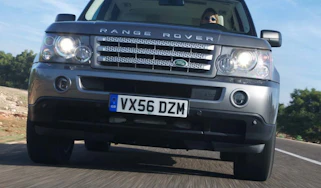
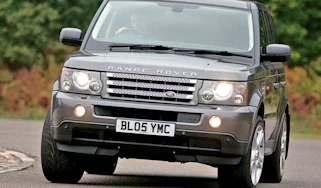
Range Rover Sport review
The Range Rover Sport is hard to beat, because it offers strong performance, superb comfort and an engaging drive

Our opinion on the Range Rover Sport
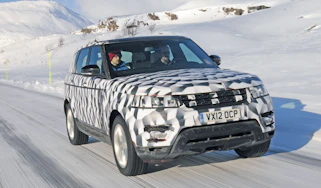
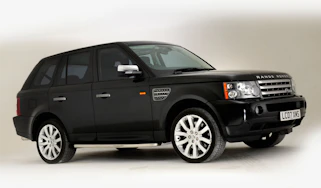
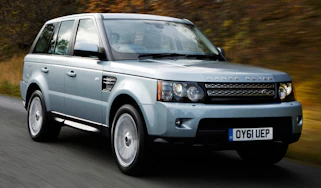
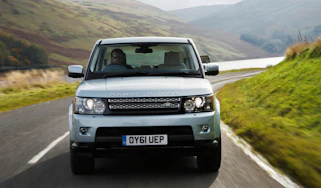
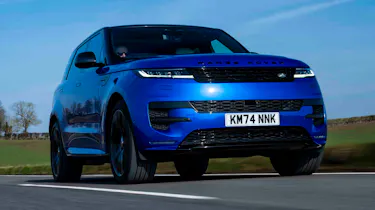
The third-generation Range Rover Sport delivers exactly what luxury SUV buyers are looking for. Smarter styling, improved onboard technology, and a raft of developments in the way the Sport drives mean that it remains as sophisticated as ever, while maintaining a dynamic edge over its bigger Range Rover sibling.
A strong choice of petrol and diesel engines, plus an efficient plug-in hybrid, will please private and business users alike, as will the sumptuous levels of comfort and refinement. Yes, it’s expensive, but the Range Rover Sport is one of the best premium SUVs you can buy.
About the Range Rover Sport
With a ‘Range Rover’ badge, the Sport is never going to be cheap, but its starting price compares well with rivals. The latest model utilises the same platform as the full-sized Range Rover, and is built to accommodate fully electric, plug-in hybrid and mild-hybrid powertrains. This gives prospective buyers plenty of choice.
The Sport’s minimalist exterior styling and sumptuous cabin certainly set the right tone, while onboard infotainment is the best yet, and optional rear-wheel steering helps with this bulky SUV’s manoeuvrability in town.
We’ve tested several variants of the Range Rover Sport on UK roads, and we’ve seen this car defeat the Audi Q7 in our real-world twin test, and hold its own in a 16-car plug-in hybrid group test. We’ve also lived with a P550e in Autobiography trim as part of our long-term test fleet, and determined that life with a Sport is cossetting and refined.
Range Rover prices and latest deals
The entry-level Range Rover Sport starts from just over £77,500, which is similar to the Mercedes GLE, and a few thousand more than the BMW X5. The Sport is better equipped than the X5, though, with standard air-suspension, blind spot monitoring, lane-keeping assist and a 360-degree camera system. The plug-in hybrid starts at just under £92,000 in P460e SE form, while the high-performance SV Celestial Edition comes in at around £175,000.
Used - available now

2024 Land Rover
Range Rover Sport
9,081 milesAutomaticPetrol4.4L
Cash £112,000
2024 Land Rover
Range Rover Sport
19,962 milesAutomaticPetrol3.0L
Cash £57,249
2023 Land Rover
Range Rover Sport
30,000 milesAutomaticPetrol3.0L
Cash £55,980
2027 Land Rover
Range Rover Sport
23,377 milesAutomaticPetrol3.0L
Cash £67,061If you want to save an average of over £5,500, you can spec your perfect Range Rover Sport by using the Auto Express Buy a Car service. We also have plenty of temptingly-priced used Range Rover Sport deals., and we can also help you sell your car.
Performance & driving experience
Pros |
|
Cons |
|
At 2.3 tonnes in petrol and diesel form (or nearly 2.7 tonnes as a plug-in hybrid) the Range Rover Sport is a sizeable luxury SUV, so it’s pleasing that Land Rover has delivered a well-judged package that is really good to drive.
All versions come with four-wheel drive for better traction in slippery conditions, and an eight-speed automatic gearbox that provides seamless gear changes when you’re just pootling around town. Fitting in with its more sporting remit, the Sport does without some of the hardcore off-road hardware of its siblings, such as the Land Rover Defender. But since this is a Land Rover, you can still specify a low-range gearbox to help out in challenging off-road terrain.
Performance, 0-60mph acceleration and top speed
For a big SUV, the Range Rover Sport offers plenty of pace, with even the entry D250 model managing 0-62mph in an impressive 7.7 seconds. Upgrade to the more powerful D350 oil burner, and the 345bhp diesel engine propels the Sport to 62mph in a hot-hatch-rivalling 5.8 seconds. It may be unfashionable in an age of increasing electrification, but it’s hard to argue against the mid-range 296bhp D300 as a sweet spot in the Sport line-up, because it’ll still manage the 0-62mph sprint in 6.4 seconds. That’s fast enough for most needs while still being usefully economical, which is particularly handy if you regularly cover longer distances.
The P460e and P550e plug-in hybrid models need 5.6 seconds and 4.8 seconds, respectively, to achieve the benchmark sprint. Opting for the top-of-the-range 533bhp P540 petrol model means you’ll have a premium SUV that delivers 0-62mph in just 4.5 seconds and a top speed of 155mph.
For outright performance, the updated Celestial and Ultimate editions of the Range Rover Sport SV offer supercar-like acceleration. Both use a 633bhp twin-turbocharged V8, which will propel it from 0-60mph in a mere 3.7 seconds and on to a top speed of 180mph. It has some serious performance-enhancing goodies, such as hydraulic cross-linked dampers and carbon ceramic brakes, which all contribute towards the SV’s ability to outperform and cosmetically stand out from any other Range Rover Sport.
| Model | Power | 0-62mph | Top speed |
| Sport D250 | 247bhp | 7.7 seconds | 128mph |
| Sport P540 | 533bhp | 4.5 seconds | 155mph |
| Sport P460e | 454bhp | 5.5 seconds | 140mph |
Town driving, visibility and parking
While it is true that the Range Rover Sport is an enormous car, you can specify a rear-wheel steering system that helps with manoeuvrability. It’s the party piece that's standard on the P540 petrol and P550e Autobiography, or optional as part of the Stormer Handling Pack on P460e models. With this, it reduces this large SUV’s turning circle from 12.53 metres to 10.95 metres, a figure comparable to many superminis. So, if you find parking manoeuvres and driving around tight turns in town a bit of a torment, and you can afford the near £5,500 outlay, then it might be worth considering.
Country road driving and handling
The Sport offers excellent grip, while the steering is light but accurate, inspiring confidence when navigating twisty B-roads. If you’re prioritising the Sport’s dynamic ability, then we’d advise ticking the Stormer Handling Pack on the options list. It’s a relatively expensive extra, but beyond the four-wheel steer mentioned earlier, it offers 48-volt active anti-roll control, an electronically controlled differential with torque vectoring and configurable dynamics programmes – all of which, when grouped together, help deliver a more agile and responsive feel to how the Sport drives. Also, the Sport’s MLA-Flex architecture is 35 per cent stiffer than its predecessor, which makes for a sharper-handling SUV.
We've tested the Range Rover Sport on its largest 23-inch alloy wheels, and it can easily handle the bumps, ridges, and potholes of typical UK roads, all while maintaining an oasis of serenity in the cabin. Rivals like the Porsche Cayenne just can’t match the Sport’s excellent ride quality.
Motorway driving and long-distance comfort
Of course, it’s equally important that a premium SUV is able to transport both the driver and any passengers in complete comfort, and the Sport doesn’t disappoint in this area. Refinement is much improved over the previous generation model, with Land Rover’s expert engineers bringing in more advanced air springs and active dampers to better manage the vehicle’s hefty weight and maintain body control, while other developments include active noise cancellation technology to counteract unwanted sounds that would grate on a long trip.
“A 4.9-second 0-60mph time for something weighing more than 2.7 tonnes with little sporting intent is ludicrous – but the SV is more than a second faster, and you can really feel the difference. On a twisty road, the SV feels alive and excitable, where the PHEV is quietly elegant.” - Paul Barker, editor.
MPG & running costs
Pros |
|
Cons |
|
Land Rover offers mild-hybrid petrol and diesel versions of its Range Rover Sport, which helps to eke out a little extra efficiency from the 2.3-tonne luxury SUV (almost 2.7-tonnes in plug-in hybrid form). With the diesel models, the brand claims that you should see 39.5mpg (on the WLTP combined cycle) from the D250, while the D300 and D350 both manage 38.1mpg. Emissions range from 188g/km for the D250 to 195g/km for the D350.
The non plug-in P540 petrol model isn’t quite as economical, managing a mere 24.1mpg and flower-wilting emissions of 265g/km. That’s a minor improvement over its earlier iteration, but you’ll still be earning the ire of Greta Thunberg if you drive one.
The plug-in hybrid models offer the best fuel economy on paper, but based on our experience of plug-in hybrid cars, you’re unlikely to see numbers as high as 254.5mpg from the P460e, or the 251.9mpg from the P550e – even with regular charging. Over 10,000 miles of driving, we saw an average fuel economy figure of 38.5mpg from our long term P550e test car based on a mix of driving with electric and petrol power. During our plug-in hybrid megatest, driving purely on petrol power saw a return of 31.0mpg in a P460e.
One thing to note is that the plug-in hybrid versions of the Range Rover Sport use a smaller 70-litre fuel tank, whereas diesel models have a more generous 80-litre tank, and petrol models get a huge 90-litre tank.
| Model | MPG | CO2 | Insurance group |
| Sport D250 | 39.5mpg | 188g/km | 44 |
| Sport D350 | 38.1mpg | 195g/km | 50 |
| Sport P540 | 24.1mpg | 265g/km | 50 |
Electric range, battery life and charge time
Both the P460e and P550e use a huge (for a plug-in hybrid) 38.2kWh battery pack. To put this into context, that’s larger than the 36.6kWh usable capacity of an entry-level MINI Cooper Electric. Given that the plug-in Sport weighs around a tonne more than the Cooper Electric and isn’t as aerodynamic, you won’t see electric range numbers close to what the MINI achieves, but the over 70 miles of electric driving that’s quoted as the WLTP range is still a lot higher than most plug-in hybrids. However, it’s worth noting that Land Rover places a caveat on its website, stating that you should expect around 60 miles of electric range in real-world driving. We achieved 65 miles of pure-electric driving during our plug-in hybrid group test on a loop that included urban, countryside, and motorway driving.
It’s predicted to take around five hours to fully recharge the battery from flat to full when using a 7kW wallbox home charger, which is similar to the time it takes to top up the BMW X5 xDrive50e and Mercedes GLE 400e. The Sport does have a faster DC rapid charge function of up to 50kW if you need to charge faster than that, with a 0-80 per cent top-up time of 40 minutes.
| Model | Battery size | Range | Insurance group |
| Sport P460e | 38.2kWh | 72.1 miles | 50 |
| Sport P550e | 38.2kWh | 71.5 miles | 50 |
Insurance groups
It should come as no surprise that the Range Rover Sport is an expensive model to insure. Despite introducing a less expensive D250 S version, the Sport range goes from group 44 up to group 50 for the most powerful diesel, petrol and plug-in hybrid versions. That’s on par with rivals, with the Audi Q7 starting in group 45 and the BMW X5 in group 46.
Tax
Business users will be better served by choosing one of the plug-in hybrid versions. The P460e has CO2 emissions from just 17g/km, putting it in the six per cent Benefit-in-Kind company car tax bracket. The more powerful P550e version also falls into the six per cent BiK rate because it only has marginally worse emissions of 18g/km. In comparison, all petrol and diesel models are in the highest tax band.
This is an expensive, premium SUV, so naturally, the luxury car tax is well and truly in play here. Every Range Rover Sport surpasses the £40,000 threshold by a significant margin, so you’ll need to pay this additional fee above the annual VED road tax payment from the second time the vehicle is taxed until it is six years old.
Depreciation
The Range Rover Sport has often been a sought-after model, and that’s helped maintain healthy residual values over a typical three-year or 36,000-mile ownership period. The third-generation Sport is predicted to maintain between 51 and 60 per cent of its value. This is a better performance than the ageing Audi Q7, which is only expected to retain 40 to 52 per cent after the same period, or the Porsche Cayenne, which retains between 40 and 52 per cent.
To get an accurate valuation for a specific model, check out our free car valuation tool...
Interior, design & technology
Pros |
|
Cons |
|
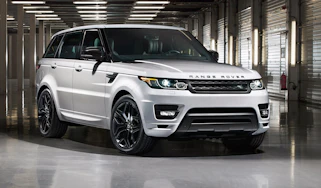
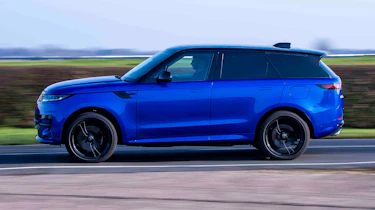
With its flush-fitting door handles and smoother body styling, the third-generation Range Rover Sport has a cool, minimalist look. Land Rover describes the Sport as having an evolutionary design, which, while hardly radical, will no doubt keep potential buyers looking to upgrade from their older models happy.
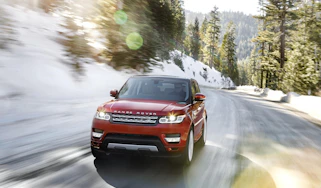
There is a wide variety of metallic and matte paint finishes available for the Sport, although a number of the more interesting shades come with a hefty price tag. There’s one free shade (Fuji White), followed by six reasonably priced metallic colours for around £900, with Giola Green and Firenze Red being the most photogenic choices. Then there are the 12 bolder SV Ultra Metallic paint finishes that certainly help the Sport to stand out, but come in at around £8,000 each. If you fancy going for a matte colour scheme, better set aside an additional £10,000 for one of the nine satin finish colours, or close to £12,000 for the Icy White SV Metallic in a satin finish.
Interior and dashboard design
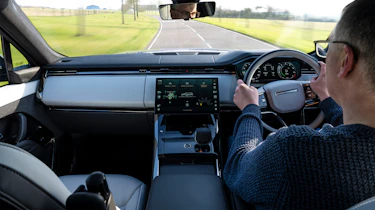
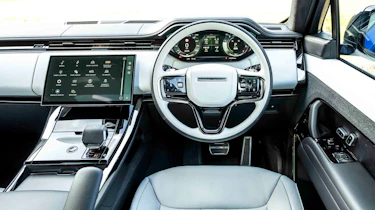
Despite offering lots of onboard technology, the cabin doesn’t feel overburdened with buttons and switches. A 13.1-inch touchscreen takes centre stage and is a huge improvement over the previous model’s infotainment system, boasting sharper graphics and quicker responses to inputs.
One small gripe we found during our time with the car, however, was that the steering column didn’t provide enough reach adjustment – a design point which may impact the overall driving experience for some. We do like that you get a handy button on the steering wheel that allows you to select one of three settings for the driver assistance system. You can have all the systems active, or select a saved pre-set selection if you want to quickly turn off the audible speed limit warning or lane keep assist system.
We’re not so fond of the fact that the innovative second screen of earlier versions that sat below the main central touchscreen has been removed. This means that the easy-to-use pair of climate control and heated seat dials we used to praise the Sport for has also gone, which is a blow in terms of usability because all of the climate functions are now relegated to the touchscreen, making simple tasks such as adjusting the temperature a far more distracting process than before. Even Land Rover’s famed Terrain Response system has been shorn of its separate dial that was near the starter button. You can argue that rivals like the Audi Q7 have also gone to touchscreen-only controls, but it seems a shame the Sport has fallen into the same trap, given that ease of use was an area where earlier versions stood out against the competition.
Materials and build quality
The attention to detail inside the Sport’s cabin underlines the luxury theme, with plenty of leather and soft materials used for the areas you regularly see and touch. Yes, you will find some more rigid plastics on show in less frequent touchpoints, but everything feels solid and well-built.
Infotainment, sat-nav and stereo
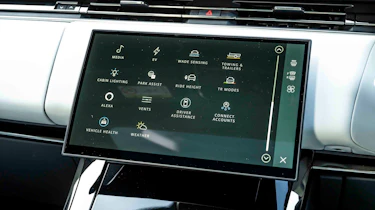
The Range Rover Sport uses a vast 13.1-inch display with fantastic resolution to back it up. However, due to the removal of the second screen, there are now more functions shown on the central screen, so it isn’t quite as uncluttered as before.
There are shortcuts running down either side of the screen to bring up temperature and heated seat controls, and these are large enough to be relatively straightforward to use. But if you want to do anything beyond that, it becomes a more involved process of diving into submenus, which we find more distracting. The rest of the screen is split into three vertical sections, and you sweep between different menus, but we don’t find this very intuitive, especially when on the move.
The sat-nav system isn’t the swiftest system around, and as a result, it can be a little bit behind your actual location, which could cause confusion at unfamiliar junctions. Still, both Android Auto and Apple CarPlay fill out the screen when they’re connected, so it’s no hardship to make the most of your smartphone’s tech instead.
A 400-watt, 15-speaker Meridian sound system comes as standard with the S trim, with a more powerful 800-watt, 19-speaker system fitted to the Autobiography specification. Wireless phone charging is provided throughout the Sport range.
“The big touchscreen does display one of the clearest camera views I’ve ever used. The perspective is sometimes a little off when it comes to people or other cars, but the top-down view is especially handy when making sure you’ve managed to nestle what is a very big car within the white lines of a parking bay.” - Paul Barker, editor.
Boot space & practicality
Pros |
|
Cons |
|
While the Range Rover’s cabin is suitably appointed with luxurious materials, 12-way electrically-adjustable seats add to the ambience by ensuring the front passengers are able to easily find a comfortable position.
Dimensions and size
Although the Range Rover Sport is positioned as the more agile, dynamic model compared to its Range Rover sibling, it’s still a giant of an SUV. The Sport measures 4,970mm long, which is 86mm shy of the standard wheelbase Range Rover. There is a 46mm difference in height, though; 1,822mm for the Sport vs 1,868mm for the Range Rover.
| Dimensions comparison | |||
| Model | Range Rover Sport | Audi Q7 | BMW X5 |
| Length | 4,970mm | 5,072mm | 4,935mm |
| Width | 2,047mm | 1,970mm | 2,004mm |
| Height | 1,822mm | 1,690mm | 1,765mm |
| Wheelbase | 3,000mm | 3,000mm | 2,980mm |
| Boot space | 647 - 1,491 litres | 563 - 2,050 litres | 500 - 1,870 litres |
Seats & passenger space
Given its vast exterior dimensions, the Range Rover Sport is, thankfully, still very spacious for those in the front. Both driver and passenger seats get standard electric adjustment with memory settings to make finding and saving an ideal position easy.
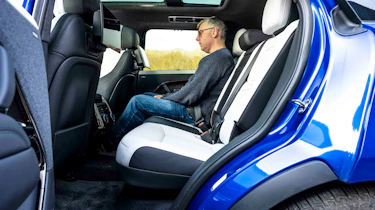
Even those six feet and above will find plenty of head and legroom, while shoulder room is equally generous. Given the car’s not inconsiderable width, some people may find the centre console too much of a stretch to rest their elbow on, but just like the regular Range Rover, you get some adjustable armrests on the sides of the front seats that are closer to hand.
While there’s plenty of space in the front of the Sport, we’d expect there to be a little more room in the rear. Rivals such as the Audi Q7 provide better head and knee room for rear passengers, although the Sport should offer enough space for most.
For anyone looking to install a child’s car seat, there are Isofix mounting points on the outer positions of the second row.
Boot space
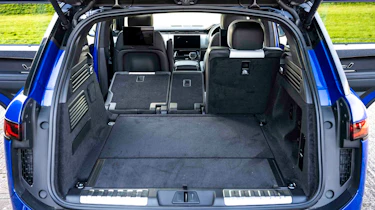
A 647-litre boot should be able to swallow most luggage, while folding the rear seats opens up a sizeable 1,491 litres of load space. A boot space divider is available to help stop smaller items from rolling all the way to the back if you don’t have enough to fill the whole boot up, and thanks to some clever packaging, the Sport also has room for a spare wheel below the boot floor.
It’s also impressive that the plug-in hybrid version doesn’t lose any boot capacity (or the ability to carry a spare wheel) over the regular petrol and diesel models, unlike in rivals such as the Audi Q7, BMW X5, and Mercedes GLE.
Towing
It’s good news for buyers who want to use their Range Rover Sport for towing duties. All models are capable of pulling up to 3,500kg braked, with the exception of the P460e and P550e plug-in hybrids, which have a 3,000kg towing capacity. For comparison, the plug-in hybrid BMW X5 xDrive60e and M60i manage up to 2,700kg.
"One thing I’m sure about is that the Sport’s interior will have plenty of space for device charging leads, snacks, drinks and other bits and pieces. Mainly more snacks. Up front is a decent-sized refrigerated compartment and a pair of cup-holders that slide back to reveal a deeper hidden recess. Plus two gloveboxes." - Paul Barker, editor.
Reliability & safety
Pros |
|
Cons |
|
This generation of Range Rover Sport has yet to feature in our Driver Power customer satisfaction survey. However, the Land Rover brand bagged an admirable fifth place finish out of 31 brands in the best manufacturer rankings. This could be a sign of efforts being made to improve the brand’s rather poor reputation for troublesome reliability.
Industry safety body Euro NCAP awarded the Range Rover Sport a top five-star rating with both adult and child occupant protection, achieving an 85 per cent score. On-board safety systems also performed well, with the Driver Assist category earning an 82 per cent mark.
Land Rover certainly hasn’t scrimped on safety tech for the Sport, with all models including lane keep assist and blind spot assist functions, adaptive cruise control with steering assist, a rear traffic monitor, traffic sign recognition and autonomous emergency braking. A number of those features are only part of the Driving Assistant Professional Pack with the BMW X5.
Front and rear parking sensors and a 3D surround-view camera are also offered as standard, which will help make parking manoeuvres a little easier, while the automatic park assist system is available if you trade up to an Autobiography model.
| Euro NCAP safety ratings | |
| Euro NCAP safety rating | Five stars (2022) |
| Adult occupant protection | 85% |
| Child occupant protection | 85% |
| Vulnerable road user protection | 69% |
| Safety assist | 82% |
Buying and owning
Best buy: Range Rover Sport Dynamic SE D350
If you’re in the market for a Range Rover Sport, odds are you can afford to treat yourself. If so, we recommend opting for the Dynamic trim along with the D350 engine. This provides the best of both in terms of additional kit and power, but without going absolutely crazy price-wise. If you’re a particularly fortunate company car driver, we’ll steer you towards the PHEVs instead due to the tax savings.
Range Rover Sport alternatives
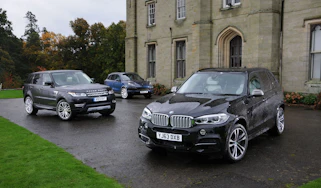
The Range Rover Sport sits in the Land Rover range above the Range Rover Velar, and below the Range Rover as a more sporty version of the brand’s most luxurious SUV. Up against the Sport are rivals such as the Audi Q7, BMW X5, Mercedes GLE and Porsche Cayenne.
Buyers considering a seven-seater will need to look towards either the Audi Q7 or BMW X5, because the latest Sport has lost the option of two fold-out chairs in the boot, leaving you to dig deeper into your savings and upgrade to the long-wheelbase version of the pricier Range Rover.
The Cayenne is perhaps a little sharper to drive, but you pay the price in terms of ride quality compared with the more supple Sport, and the Porsche can’t match the Range Rover’s imposing driving position. The Cayenne doesn’t hold its value nearly as well as the Sport, which is important to consider when totting up running costs.
In terms of plug-in hybrids, the extra capacity of the Sport’s 38.4kWh battery over the 29.7kWh X5 xDrive50e means it can go further on electric power alone, but the more efficient GLE can travel a similar distance as the Sport on battery power, despite having a smaller 25kWh battery. As long as you can tolerate the much smaller boot of the GLE due to the battery pack taking up valuable space, the Mercedes might be the one to go for if running costs are important to you.
Long-term test: Range Rover Sport P550e Autobiography
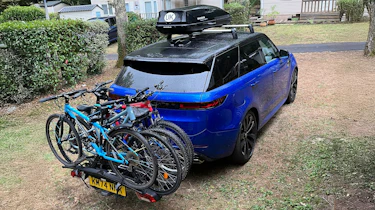
Our editor, Paul Barker, ran a top-of-the-range P550e in Autobiography trim for over 10,000 miles and enjoyed the car's comfort, its very clear 360-degree camera system, and its electric-only range. His children weren't big fans of the expensive rear seat entertainment screens, which didn't work for gaming and were a bit laggy. Read more about our long term test here...
Range Rover Sport - pictures
Key updates of the Range Rover Sport review
27 April 2026: General review update and inclusion of real-world plug-in hybrid electric range and efficiency figures from our long-term and plug-in hybrid group test
Deals on the Range Rover Sport and alternatives
Frequently Asked Questions
Land Rover offers a three-year/unlimited mileage warranty for the Range Rover. The cover includes 36 months of roadside assistance, while you can also extend the warranty for up to ten years/100,000 miles at extra cost. The plug-in hybrid model has a separate warranty for the battery pack, although the six-year/60,000-mile warranty period seems a little stingy compared with rivals that generally offer eight years or 100,000 miles of cover.